



















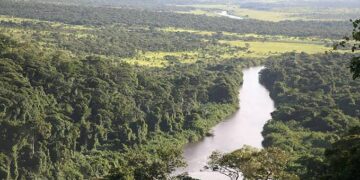
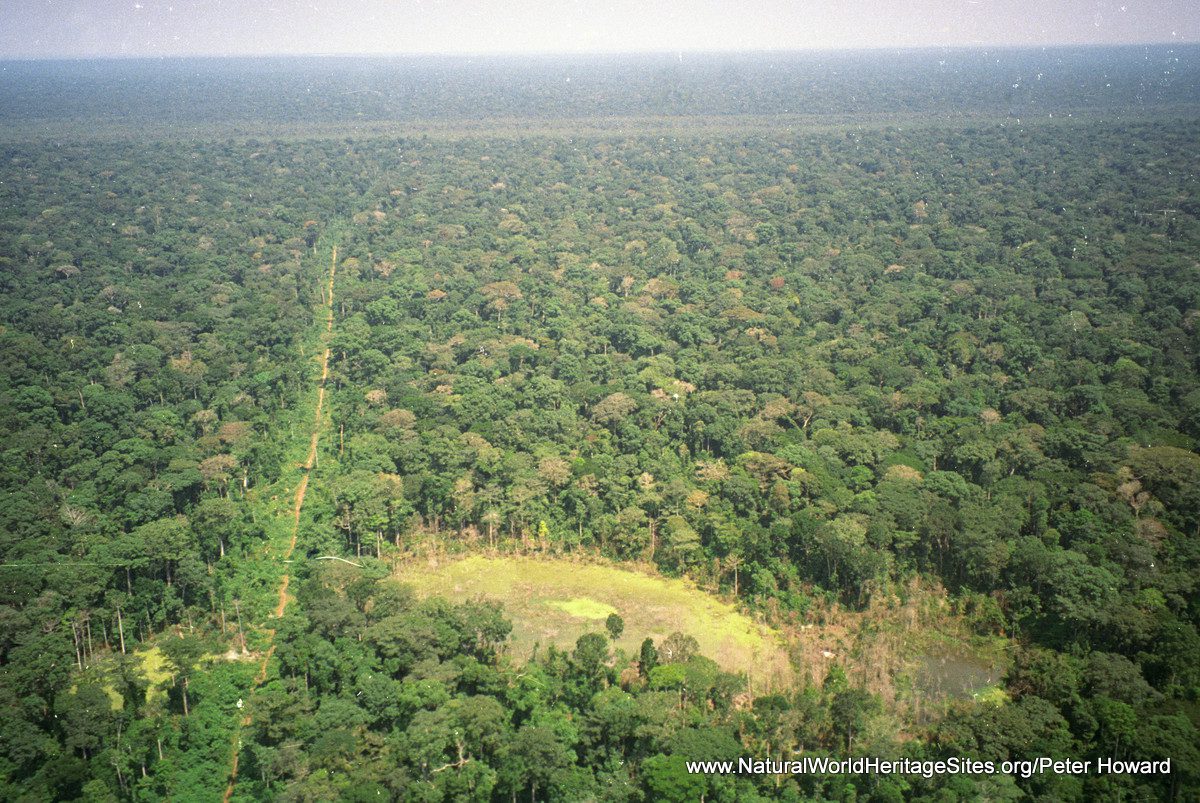
The Sangha Trinational, located in the northwestern basin of the Congo River, is one of the prominent examples of transboundary environmental protection in equatorial Africa. Spanning the borders of three major countries—Cameroon, the Central African Republic, and the Republic of the Congo—it encompasses an estimated 750,000 hectares (7,500 square kilometres) of contiguous tropical rainforest, in addition to a vast buffer zone surrounding the core reserves.
In 2012, the United Nations Educational, Scientific and Cultural Organization (UNESCO) inscribed the Sangha Trinational on the World Heritage List, based on criteria relating to ongoing biological and environmental processes, as well as the site’s exceptional importance for the conservation of global biodiversity.
The Sangha Trinational comprises three contiguous, politically defined national parks, linked by a water network and an ecosystem that transcends political boundaries.
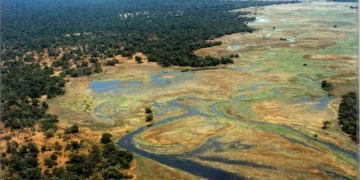
Lubeké National Park (Cameroon), located in southeastern Cameroon, is characterised by its complex hydrological network and dense tree cover. Dzanga-Ndoki National Park (Central African Republic), located in the far south and southwest of the country, its northern and southern sections are separated by a strip of forest designated for sustainable use. Also, Nouabalé-Ndoki National Park (Republic of the Congo) is located in the north of the country; it is one of the most isolated and least directly human-impacted forest areas on the African continent.
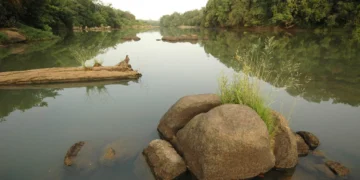
These reserves are connected by the Sangha River, a major tributary of the Congo River, which provides a vital waterway that facilitates the natural movement of wildlife and defines the hydrological pathways of the entire region.
The Sangha’s triangular natural environment consists of a network of evergreen tropical forests, semi-deciduous forests, and riparian swamps. However, the most distinctive morphological and ecological feature of this region is the prevalence of what is locally known as “bai.”
“Bai” is a natural forest opening characterised by wetlands or clay soils rich in minerals and mineral salts (such as sodium, calcium, and iron). These openings are vital outlets for many large mammals living in the deepest parts of closed forests, where animals regularly access the mineral-rich soil for foraging and social interaction.
One of the most famous bais is Dzanga Bai in the Central African Republic, which witnesses daily gatherings of large herds of wildlife, making it a prime field laboratory for studying tropical animal behaviour.
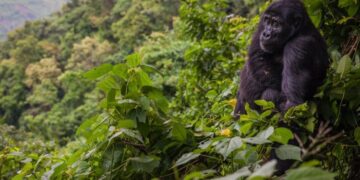
The region is home to key populations of globally threatened species, most notably the African Forest Elephant (Loxodonta cyclotis); the area represents one of the last remaining safe havens for this species, which differs morphologically and genetically from the savanna elephant and is characterised by its smaller size and straight tusks. Also, the Sanga Forest supports high densities of Western Coastal Gorillas (Gorilla gorilla gorilla); these animals and the dense environment provide necessary protection for their family groups.
The central chimpanzee (Pan troglodytes troglodytes) is found throughout the site; this species relies on the diversity of fruits and forest plants. The region includes balanced populations of the bongo (Tragelaphus eurycerus), known for its white lateral stripes, the forest buffalo, and several duiker antelope species. The area also encompasses hundreds of species of river fish in the Sangha River basin, as well as a rich diversity of tropical birds (such as the African Grey Parrot), insects, and endemic flowers.
The Sangha Trinational Complex represents an early experiment in the concept of transboundary protected areas. To organise joint action, the three countries (Cameroon, Central African Republic, and Congo) signed a Tripartite Cooperation Agreement in 2000 in Yaoundé. The site’s on-the-ground management relies on a multilateral structure that brings together the relevant governmental authorities of the three countries and international non-governmental organisations specialising in nature conservation, such as the World Wide Fund for Nature (WWF) and the Wildlife Conservation Society (WCS).
Joint patrols are conducted by reserve rangers across national borders to curb infiltration and illegal hunting. The Sangha Trinational Trust (Fond Trinational de la Sangha – FTNS) was established to ensure sustainable and independent financing for conservation and field operations, thereby reducing complete dependence on fluctuating government budgets.
Despite the region’s World Heritage status and the availability of funding mechanisms, the Sangha Trinational faces increasing pressures stemming from both human and structural factors:
Poaching poses the most immediate threat to forest elephants. Forest elephant tusks are in high demand on the illicit ivory market due to their density and resistance to cracking compared to savanna ivory. Dense forest trails and weak security coverage in parts of the borders facilitate the movement of international smuggling networks.
The core reserves are surrounded by areas designated for commercial logging concessions. While some of these companies adhere to sustainable management standards, the construction of roads and trails within the forests creates new access points for poachers and fragments the natural habitat of wildlife.
The management of tropical reserves is affected by the political stability of surrounding countries. For example, historical periods of political instability in the Central African Republic have led to security and logistical challenges that have threatened the safety of field personnel and the protection of biodiversity in the Dzanga-Ndoki sector.
The area is the historical homeland of indigenous groups, primarily the BaAka people, along with local Bantu groups whose livelihoods depend on traditional hunting, gathering, and small-scale farming.
Recent decades have seen debates about the effectiveness and equity of involving local communities in the management of protected areas. The imposition of strict grazing laws in core areas has reduced the traditional areas used by the BaAka for cross-border hunting and gathering food and medicine.
Management authorities are currently working on programmes that involve indigenous communities as environmental guides and incorporate their traditional forest knowledge into animal tracking, while also directing a portion of ecotourism revenue towards local education and health services.
The Sangha Tri-Forest forms a pivotal part of the Congo Basin, the world’s second-largest contiguous tropical forest mass after the Amazon. This forest plays a vital role in regulating the global climate, through the dense trees and tropical soils acting as massive carbon dioxide absorbers, reducing greenhouse gas concentrations in the atmosphere. The transpiration and evaporation processes from the vast forest mass contribute to local and regional rainfall across Central and Southern Africa.
In conclusion, the Sanga Tri-Forest remains a prime example of the delicate balance between protecting unique ecosystems and the pressures of development, security, and social challenges in tropical Africa.