

















By Ahmadulbadawy Abdul Raheem
The Second Ivorian Civil War (2010–2011) marked the culmination of a decade of political and social fragmentation that destabilised one of West Africa’s most prosperous and stable post-independence nations. The armed confrontation that erupted following the second round of the presidential election in November 2010 due to a dispute over ballot results between the incumbent president, Laurent Gbagbo, and his challenger, Alassane Ouattara, was the manifestation of deep-seated tensions surrounding questions of citizenship, national identity, and the legacy of a geographic divide between the north and the south.
While regional and international institutions had hoped that these repeatedly delayed elections would serve as a gateway to reconciliation—effectively closing the chapter on the first civil war that had divided the country since 2002—the electoral process itself became the spark that reignited armed violence on the streets of Abidjan and throughout the western and interior regions.
From Economic “Miracle” to the Fragmentation of “Ivoirité”
To understand the fragility of the Ivorian landscape on the eve of the 2010 elections, one must look back to the period following the death of the founding president, Félix Houphouët-Boigny, in 1993—a moment that coincided with a decline in revenues from cocoa and coffee exports, as well as mounting economic pressures on both the local population and migrants arriving from neighbouring countries. In this crisis-ridden environment, the discourse of “Ivoirité” (Ivorian-ness) emerged during the presidency of Henri Konan Bédié as a political tool to narrowly define national identity, creating a distinction between “indigenous” citizens in the south and those from the north or of immigrant descent.
This identity-based approach led to the exclusion of Alassane Ouattara from previous presidential races—ostensibly due to questions regarding his parents’ nationality—which fostered a deep sense of marginalisation among large segments of the predominantly Muslim northern population.
These tensions escalated following a 1999 coup and the controversial 2000 elections that brought Laurent Gbagbo to power. In September 2002, an armed rebellion erupted, led by the “New Forces” (Forces Nouvelles) under Guillaume Soro, effectively splitting the country into a government-controlled south and a rebel-held north. Although the 2007 Ouagadougou Peace Agreement—which called for power-sharing, free elections, the unification of the administration, and the disarmament of militias—was signed, the process of disarmament and reintegration remained incomplete.
Furthermore, the identification of voters and the issuance of national identity cards continued to be a source of intense contention, leaving the country perched atop a political and security powder keg.
November 2010 Elections: Rival Institutions and Conflicting Legitimacies
When Ivorians headed to the polls for the first round on October 31, 2010, a sense of cautious optimism prevailed; the process unfolded with relative calm and a high voter turnout, reflecting the citizens’ deep desire for stability. However, the second round on November 28, 2010—contested by Gbagbo and Ouattara—quickly exposed the fragility of the institutional consensus.
On December 2, the Independent Electoral Commission announced that Alassane Ouattara had won with 54.1% of the vote, compared to 45.9% for Laurent Gbagbo—a result endorsed by Choi Young-jin, the Special Representative of the UN Secretary-General, in accordance with the mandate granted to the international organisation under previous peace agreements. Yet, the following day, the Constitutional Council—chaired by Paul Yao N’Dré, a close ally of Gbagbo—intervened to invalidate hundreds of thousands of votes from the northern provinces, citing fraud and intimidation, and declared Gbagbo the winner with 51.45% of the vote.
The conflict in December 2010 evolved into a dual power structure, in which each camp possessed its own president, government, coercive apparatus, and moral justifications. This institutional conflict led to a political situation where both men took the oath of office as president on December 4, 2010.
Gbagbo entrenched himself in the presidential palace, backed by the Republican Guard, the regular army, and the “Young Patriots” networks led by Charles Blé Goudé. Meanwhile, Ouattara established his administration at the Golf Hotel in Abidjan, under the protection of United Nations peacekeeping forces (UNOCI) and fighters from the “Forces Nouvelles”. Regional and international organisations—including the Economic Community of West African States (ECOWAS), the African Union, the United Nations, and the European Union—aligned themselves with the results announced by the Independent Electoral Commission, which recognised Ouattara’s victory, and called on Gbagbo to step down. Gbagbo’s camp, however, held firm, invoking the rhetoric of national sovereignty and opposition to foreign interference—specifically French influence.
Military Escalation and Humanitarian Collapse in Abidjan and the West
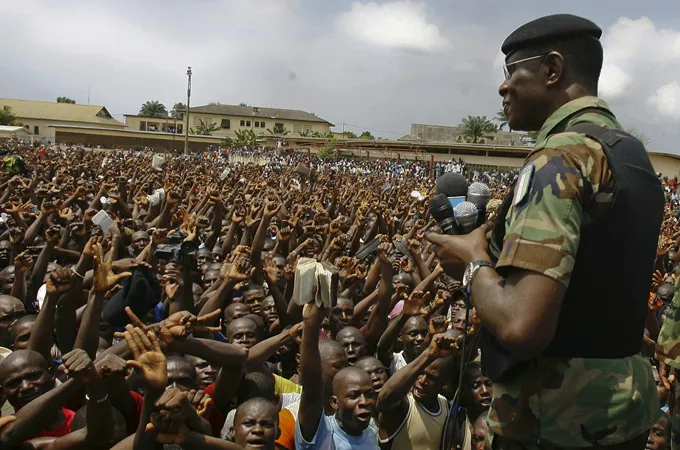
As African mediation initiatives faltered and financial and diplomatic sanctions against the Gbagbo regime intensified, the country gradually slid from a war of political and economic attrition into an all-out military confrontation in early 2011. Throughout late February and March 2011, densely populated neighbourhoods in Abidjan—such as Abobo, Yopougon, Cocody, and Treichville—became daily battlegrounds between forces loyal to Gbagbo and irregular fighters known as the “Invisible Commandos”, led by Ibrahim Coulibaly. This was followed by a large-scale southward offensive launched by the “Republican Forces of Côte d’Ivoire” (FRCI), which supported Ouattara.
Civilians paid the heaviest price for this breakdown in security. Human rights organisations and United Nations bodies documented grave abuses committed by all sides, fuelled by political, ethnic, and regional divisions. In the west of the country—most notably in the town of Duékoué in late March 2011—massacres claimed the lives of hundreds of civilians. These atrocities occurred against the backdrop of complex local conflicts over land and political allegiance, pitting groups traditionally loyal to Gbagbo against residents who had migrated from the north or from neighbouring countries.
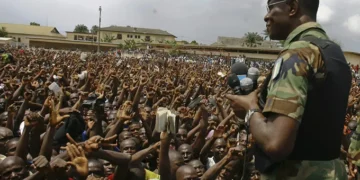
In Abidjan, hundreds of thousands of residents were trapped in their homes, facing water and electricity outages, as well as shortages of food and medicine. Meanwhile, peaceful demonstrations—such as the women’s march in Abobo on March 3, 2011—were met with live ammunition; an incident that left a profound psychological scar on the collective memory of the Ivorian people.
International Intervention and Decisive Battle in April 2011
By late March 2011, forces loyal to Ouattara advanced rapidly toward the administrative capital, Yamoussoukro, and subsequently toward the economic hub, Abidjan. They benefited from the disintegration of regular army units and the defection of several commanders, all while the financial resources available to fund the war effort dwindled. As the fighting reached the heart of Abidjan—with forces loyal to Gbagbo deploying heavy weaponry in residential areas against civilians and United Nations mission facilities—the UN Security Council adopted Resolution 1975 on March 30, 2011. The resolution condemned the violence, affirmed the legitimacy of Ouattara, and authorised the UN mission to take all necessary measures to protect civilians and prevent the use of heavy weapons.
Acting under this mandate, United Nations mission helicopters—supported by the French “Licorne” force—carried out airstrikes in early April 2011, targeting heavy-weapon depots and military positions held by Gbagbo in Abidjan. This military intervention sparked widespread debate: some viewed it as a necessary step to halt the bloodshed and resolve a protracted political stalemate, while others saw it as a departure from the neutrality required in peacekeeping operations—a direct intervention that tipped the conflict in favour of one side.
On April 11, 2011, following days of intense fighting around the presidential residence in the Cocody district, Laurent Gbagbo and his wife, Simone Gbagbo, were captured inside the presidential bunker. This marked the end of the deadliest phase of the crisis—a period that claimed approximately 3,000 lives and displaced more than a million people, both within the country and abroad.
Post-War: Transitional Justice and Dilemma of National Reconciliation
Following April 2011, the administration of Alassane Ouattara inherited a nation that was economically exhausted and socially fractured. Restoring security and reactivating state institutions proved insufficient to heal the deep wounds left by the war. Although a “Dialogue, Truth, and Reconciliation Commission” was established—modelled on transitional justice initiatives elsewhere in Africa—the reconciliation process faced accusations of an imbalance in judicial accountability.
Initially, criminal prosecutions focused on figures from Gbagbo’s camp—including the transfer of Laurent Gbagbo and Charles Blé Goudé to the International Criminal Court (ICC) in The Hague—while the prosecution of military commanders aligned with Ouattara’s camp for abuses committed during the offensive in the west and in Abidjan lagged behind.
In subsequent years, the 2019 acquittal of Laurent Gbagbo and Blé Goudé by the ICC—upheld on appeal in 2021—followed by Gbagbo’s return to Côte d’Ivoire, introduced a new dimension to the debate surrounding war narratives and both political and criminal responsibility.
While Côte d’Ivoire achieved a notable economic recovery in the decade following the war, the lessons of the 2010–2011 crisis remain a testament to the fact that democracy requires institutions that command the trust of all segments of society, as well as a social contract that guarantees equal citizenship and prevents political competition from devolving into an existential struggle—a conflict for which ordinary citizens pay the heaviest price.
ـــــــــــــــــــــــــــ
References
-
Akindès, F. (2004). The roots of the military-political crises in Côte d’Ivoire. Nordiska Afrikainstitutet.
-
Amnesty International. (2011). “They looked at his identity card and shot him dead”: Six months of post-electoral violence in Côte d’Ivoire. Amnesty International Publications.
-
Bah, A. B. (2010). Democracy and civil war: Citizenship and peacemaking in Côte d’Ivoire. African Affairs, 109(437), 597–615. https://doi.org/10.1093/afraf/adq046
-
Bassett, T. J. (2011). Winning coalition, sore loser: Côte d’Ivoire’s 2010 presidential elections. African Affairs, 110(440), 469–479.
-
Bellamy, A. J., & Williams, P. D. (2011). The new politics of protection? Côte d’Ivoire, Libya and the responsibility to protect. International Affairs, 87(4), 825–850. https://doi.org/10.1111/j.1468-2346.2011.01006.x
-
Bovcon, M. (2009). French repatriates from Côte d’Ivoire and the resilience of Françafrique. Modern & Contemporary France, 17(3), 283–299. https://doi.org/10.1080/09639480903037129
-
Charbonneau, B. (2012). War and peace in Côte d’Ivoire: Violence, agency, and the local/international line. International Peacekeeping, 19(4), 508–524. https://doi.org/10.1080/13533312.2012.709776
-
Human Rights Watch. (2011). “They killed them like it was nothing”: The need for justice for Côte d’Ivoire’s post-election crimes. Human Rights Watch.
-
Human Rights Watch. (2015). Making justice count: Lessons from the ICC’s work in Côte d’Ivoire. Human Rights Watch.
-
International Criminal Court. (2021). Judgment on the appeal of the Prosecutor against the decision of Trial Chamber I of 15 January 2019 acquitting Laurent Gbagbo and Charles Blé Goudé (Case No. ICC-02/11-01/15 A).
-
Marshall-Fratani, R. (2006). The war of “who is who”: Autochthony, nationalism, and citizenship in the Ivoirian crisis. African Studies Review, 49(2), 9–43.
-
McGovern, M. (2011). Making war in Côte d’Ivoire. University of Chicago Press.
-
Mitchell, M. I. (2012). Power-sharing and peace in Côte d’Ivoire: Past examples and future prospects. Conflict, Security & Development, 12(2), 171–191. https://doi.org/10.1080/14678802.2012.688294
-
Piccolino, G. (2012). David against Goliath in Côte d’Ivoire? Laurent Gbagbo’s war against global governance. African Affairs, 111(442), 1–23. https://doi.org/10.1093/afraf/adr064
-
Piccolino, G. (2018). Peacebuilding and statebuilding in post-2011 Côte d’Ivoire: A victor’s peace? African Affairs, 117(468), 485–508. https://doi.org/10.1093/afraf/ady020
-
Strauss, S. (2011). “It’s sheer horror here”: Patterns of violence during the first four months of Côte d’Ivoire’s post-electoral crisis. African Affairs, 110(440), 481–489.
-
United Nations Human Rights Council. (2011). Report of the independent, international commission of inquiry on Côte d’Ivoire (A/HRC/17/48). United Nations.
-
United Nations Security Council. (2011). Resolution 1975 (2011) (S/RES/1975). United Nations.
-
Vorrath, J. (2011). Post-electoral crisis in Côte d’Ivoire: Lessons for future elections in Africa (SWP Comments 2011/C 15). Stiftung Wissenschaft und Politik.