













Qiraat Africa
عربي  |  Fr
Advertisement
  • News
    • All
    • Climate Change
    • Economy
    • Education
    • Energy
    • Health
    • Migration
    • Mining
    • Politics
    • Security
    • Society
    • Sport
    Ex-opposition leader to stand as independent in Burundi’s presidential poll

    Ex-opposition leader to stand as independent in Burundi’s presidential poll

    Ethiopia says Ghebreyesus, WHO chief has links to rebellious Tigrayan forces

    WHO chief says fighting near Congo Ebola outbreak area disrupts response efforts

    Zambian opposition leader Mundubile charged with treason, lawyer says

    Zambia opposition leader charged with attempting to overthrow government

    Around 700,000 displaced by volatile conflict in southern Ethiopia

    Around 700,000 displaced by volatile conflict in southern Ethiopia

    Uganda discharges last Ebola patient, starts countdown to be virus-free

    Scientists are learning more about the rare Ebola virus in Congo outbreak

    South African minister and MPs cleared of corruption

    South Africa’s first female deputy president and UN official dies

    Somalia launches Centennial Vision 2060 roadmap for ‘peace, prospertity and progress’

    Somalia orders UAE ambassador to leave, citing ‘invasion’

    Nigeria’s president Tinubu says economy is recovering, calls for end to protests against hardship

    Nigeria’s Tinubu asks parliament to decriminalise attempted suicide

    South Africans vote as anger over failing services threatens ANC

    South Africa’s ANC and partners near coalition deal to sideline poll-topping DA in Johannesburg

  • Analysis
    • All
    • Climate Change
    • Digital & Tech
    • Economy
    • Energy & Power
    • Health
    • Politics
    • Security
    • Society
    The Future of Regional Integration in West Africa: Coexistence, Rivalry, or Re-engagement?

    The Future of Regional Integration in West Africa: Coexistence, Rivalry, or Re-engagement?

    Niger, Mali military leaders meet in Bamako, pledge stronger Sahel confederation

    Niger’s 2026 Diplomacy: A Selective Shift in Regional Engagement with Neighbouring States

    Free trade across Africa? Why policy must catch up with small-scale cross-border traders

    Free trade across Africa? Why policy must catch up with small-scale cross-border traders

    Hormuz block affected Africa in four places: what the continent must do to avoid future shocks

    Hormuz block affected Africa in four places: what the continent must do to avoid future shocks

    What is standing in the way of science’s ability to eradicate malaria? 3 areas where action can have an influence

    What is standing in the way of science’s ability to eradicate malaria? 3 areas where action can have an influence

    African Union summit clouded by Saudi-UAE rivalry in Horn of Africa

    Opportunities and Challenges of the AU’s Education in Emergencies Initiative

    Abiy Ahmed Tested: How the Tigray Alliance Is Reshaping Ethiopia’s Security—And What Comes Next

    Abiy Ahmed Tested: How the Tigray Alliance Is Reshaping Ethiopia’s Security—And What Comes Next

    UN report says Africa’s share of global trade stands at 3 percent

    AfCFTA: The Trade Rules Poised to Weave Africa’s Fragmented Textile Markets into One

    The global panel on inequality needs African evidence: here’s how it could work

    The global panel on inequality needs African evidence: here’s how it could work

  • Studies
    China could drive Africa’s renewable energy revolution, report says

    A study shows wind and solar projects in Kenya and South Africa don’t always benefit the communities that host them

    Angola’s lengthy war shaped the way farmers utilised fire—why it matters

    Angola’s lengthy war shaped the way farmers utilised fire—why it matters

    Schooling is the most severely affected by conflict when children are the target – Study

    Schooling is the most severely affected by conflict when children are the target – Study

    Pensions for Botswana’s elderly are expanding, but care services are lacking—study follows 20 years

    Pensions for Botswana’s elderly are expanding, but care services are lacking—study follows 20 years

    60 new cosmic structures have been discovered by South Africa’s MeerKAT telescope, which is mapping previously unseen gaps between galaxies

    60 new cosmic structures have been discovered by South Africa’s MeerKAT telescope, which is mapping previously unseen gaps between galaxies

    Benin government says armed forces foil coup attempt

    Coup contagion? A rash of African power grabs suggests copycats are taking note of others’ success

    One in three South Africans have never heard of AI: what this means for policy

    One in three South Africans have never heard of AI: what this means for policy

    Social Media as a Catalyst for the Spread of Dangerous Wealth Ritual Myths

    Social Media as a Catalyst for the Spread of Dangerous Wealth Ritual Myths

    Overcoming Education Barriers for Young Mothers in Sub-Saharan Africa

    Overcoming Education Barriers for Young Mothers in Sub-Saharan Africa

  • Infographics
  • Figures
    Sedick Isaacs (1940-2012): From a Robben Island prison cell to pioneering medical informatics

    Sedick Isaacs (1940-2012): From a Robben Island prison cell to pioneering medical informatics

    Prince Louis Rwagasore (1932-1961) and the Dream of Independence in Burundi

    Prince Louis Rwagasore (1932-1961) and the Dream of Independence in Burundi

    Josina Muthemba Machel (1945–1971): Reshaping of Women’s Role in the Mozambican Revolution

    Josina Muthemba Machel (1945–1971): Reshaping of Women’s Role in the Mozambican Revolution

    Yaa Asantewaa (1840-1921): Defending the Golden Stool and Asante Sovereignty in the Face of Colonialism

    Yaa Asantewaa (1840-1921): Defending the Golden Stool and Asante Sovereignty in the Face of Colonialism

    Usman Dan Fodio (1754-1817): Teacher, philosopher, and revolutionary reformer

    Usman Dan Fodio (1754-1817): Teacher, philosopher, and revolutionary reformer

    Sokhna Magat Diop (1917–2003): Senegalese cleric

    Sokhna Magat Diop (1917–2003): Senegalese cleric

    Ahmad Baba al-Timbukti (1556-1627): Writer and scholar

    Ahmad Baba al-Timbukti (1556-1627): Writer and scholar

    Namibia: Anger over Dubai COP28 trip by president Geingob’s children

    Hage Geingob (1941–2024): Former President of Namibia

    Cape Verde president says governments must discuss colonial reparations

    José Maria Neves: President of Cape Verde

  • History
    Mozambican Civil War (1977-1992): Societal Shock and the Path to Peace

    Mozambican Civil War (1977-1992): Societal Shock and the Path to Peace

    Second Ivorian Civil War (2010-2011): How struggle over legitimacy and identity lead to brink of abyss

    Second Ivorian Civil War (2010-2011): How struggle over legitimacy and identity lead to brink of abyss

    Malê Rebellion in Brazil (1835): Memory of Resistance and Identity

    Malê Rebellion in Brazil (1835): Memory of Resistance and Identity

    The Anglo-Zanzibar War (1896): A story of the shortest war in history

    The Anglo-Zanzibar War (1896): A story of the shortest war in history

    Kwanza Corridor-Cultural Landscape, Angola

    Kwanza Corridor-Cultural Landscape, Angola

    Gasumo, the southernmost source of the Nile, Burundi

    Gasumo, the southernmost source of the Nile, Burundi

    Loango ancient slavery harbour, the Republic of the Congo

    Loango ancient slavery harbour, the Republic of the Congo

    Archaeological site of Tchitundu-Hulu, Angola

    Archaeological site of Tchitundu-Hulu, Angola

    Manovo-Gounda St. Floris National Park, Central African Republic

    Manovo-Gounda St. Floris National Park, Central African Republic

  • Others
    • Culture / Literature
    • Interview
    • Opinion
  • Countries
    • Country profiles
    • Regions
      • Central Africa
      • East Africa
      • Southern Africa
      • West Africa
No Result
View All Result
Qiraat Africa
عربي  |  Fr
No Result
View All Result
Home Featured

The Future of Regional Integration in West Africa: Coexistence, Rivalry, or Re-engagement?

Oyebamiji Usman Adesoji by Oyebamiji Usman Adesoji
November 23, 2026
The Future of Regional Integration in West Africa: Coexistence, Rivalry, or Re-engagement?

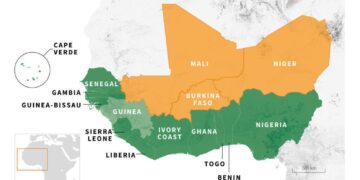
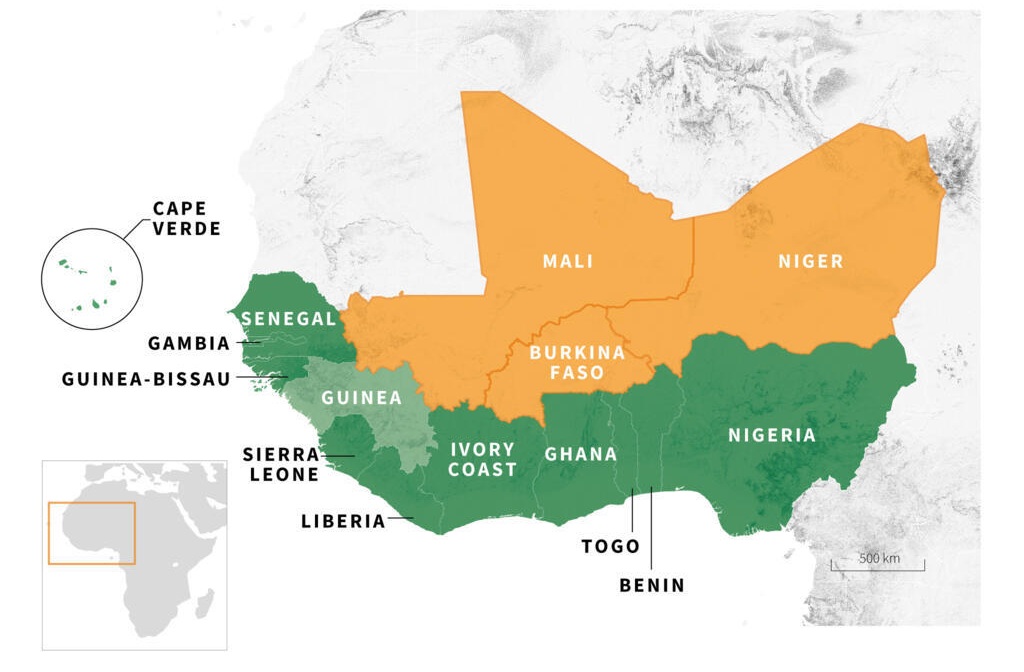
Map showing the members of Ecowas on 29 January, after the exit of Mali, Niger and Burkina Faso, the three member states of the Alliance of Sahel States. AFP - SYLVIE HUSSON,JULIE PEREIRA

Share on FacebookShare on Twitter

The West African region is approaching a critical phase in the development of its regional integration project. For close to five decades, the Economic Community of West African States (ECOWAS) has provided the institutional framework for economic cooperation, free movement, regional diplomacy and collective security. Nevertheless, military coups, disagreements over constitutional governance, deteriorating relationships among military-led regimes and regional institutions, and rival geopolitical partnerships have exposed profound divisions over the future of regional cooperation.

With the formation of the Alliance of Sahel States (AES), which includes Burkina Faso, Mali, and Niger, these differences have become an organised competition. On 29 January 2025, their withdrawal from ECOWAS became operational, thereby forming a new political reality for a region in which landlocked Sahelian states rely deeply on coastal neighbours for maritime access, trade, fuel supplies and transit infrastructure. In the interim, ECOWAS must preserve its formation ideologies without undermining the economic and security interests of people whose source of living hangs on cross-border integration.

Meanwhile, the new joint working-group discussions and efforts to maintain communication between the two blocs are consequently important. This development raises a fundamental question: can West Africa create a practical framework for cooperation in spite of their political differences, or will institutional rivalry gradually deteriorate regional integration?

Therefore, the most beneficial analytical approach is to differentiate political integration, economic interdependence, and security cooperation. However, these procedures do not necessarily move together. For the reason that regimes may disagree over democratic changes while continuing to rely on the same transport corridors, markets, and counterterrorism networks. In the end, the future of West African integration will depend on whether political disagreements can be checked without pulling apart these efficient relations.

Why Mali, Niger, and Burkina Faso Split from ECOWAS

On 28 May 1975, ECOWAS was formed through the Treaty of Lagos, mainly to encourage economic cooperation and decrease barriers to trade between West African countries. Gradually, organisation emerged as a key diplomatic mechanism, especially through its involvements in Liberia and Sierra Leone, and its efforts to respond to unconstitutional changes of government.

Yet, the ECOWAS integration structure has constantly been confronted by implementation gaps. Also, member states agreed on conventions on free movement, residence, and institution; nonetheless, travellers and traders are still encountering border delays, illegal settlement, varying customs processes, and bureaucratic bottlenecks. Therefore, regional integration progressed institutionally faster than it changed everyday economic activity.

Since 2020, countries in West Africa, especially in the Sahel region, have experienced a notable resurgence of military coups, which have marked a setback to the democratic gains that have been made over the years. Meanwhile, this trend of coups has been more noticeable in Mali and Burkina Faso, with each state going through several military overthrows. The takeover in Mali in August 2020 and May 2021 ousted civilian governments. In August 2020, the military ousted President Ibrahim Boubacar Keita, which led to an era of political instability, and there was a successful coup in May 2021, which later made the state of the nation’s governance difficult.

On the other hand, in 2022 alone Burkina Faso witnessed two coups which were led by officers quoting the disappointment of civilian leadership to solve growing threats from armed groups. These events reflect a broader trend of military intervention justified by the apparent inefficiencies of democratic systems in providing solutions to the region’s excavating crises. Burkina Faso experienced its own turmoil with coups in January and September 2022, which were commanded by Lieutenant Colonel Paul-Henri Sandaogo Damiba and later Captain Ibrahim Traore, which was driven by spiralling terrorists’ violence and governance failures. This wave extends outside these two nations, with the Niger Republic experiencing its own coup in 2023, which further climaxes a regional pattern that has often been dubbed the “Coup Belt.”

It has been argued by scholars that while ECOWAS has established a political drive in intervening in crises, its dependence on sanctions and diplomatic pressure has demonstrated insufficiency in dealing with the structural conditions backing democratic setbacks. These conditions include persistent insecurity, weak state institutions, public distrust in elected governments, and deteriorating economic disparity, all of which make suitable ground for military interferences.

Additionally, the Alliance of Sahel States (AES) was formed in the year 2023 by Mali, Burkina Faso, and Niger, and consequently this highlights this regional fragmentation. Consequently, after the AES turned down the ECOWAS framework, it has indicated a pivot toward autonomous security cooperation. Similarly, this new alliance indicates not just a break in the ECOWAS integration model but also a profound political shift away from the regional norm of democratic accountability.

On 29 January 2025, their pullout from ECOWAS became effective. Therefore, the split was both institutional and geopolitical because the governments did not accept ECOWAS’s political options while strengthening their own security and diplomatic arrangements. The important historical message is that the crisis is not simply a disparity between civilian and military rule; however, it echoes a wider contention over sovereignty, the legitimacy of regional intervention, the pace of political change, and the sharing of the costs of integration.

The October 2026 joint working-group talks: a turning point?

The most recent and subsequent development is the first ministerial meeting on ECOWAS–AES cooperation that took place in Senegal’s capital city of Dakar on 17 October 2026. After preliminary consultations, the two delegations decided to launch joint thematic working groups to create a framework pact. Their deliberations emphasised mutual admiration, good-neighbourliness, sovereignty, and the wellbeing of West African populace.

Following their consultations on 22nd May 2025 in Bamako, Republic of Mali, and succeeding diplomatic relations, such as the ECOWAS nomination of ex-Guinea prime minister Lansana Kouyaté as chief negotiator in March 2026, the Parties exchanged views on areas of common interest around which the ensuing discussions may be structured. In addition to that, the African Union and the United Nations have expressed backing for the negotiation.

Correspondingly, the parties affirm their willingness to achieve a cooperation framework that is balanced and realistic and preserves the interests of their peoples. In addition, the parties express their intention to establish joint thematic working groups to undertake technical consultations with the aim of developing a Cooperation Framework Agreement between ECOWAS and the Confederation of the AES. The outcomes of their work shall be submitted to the Ministers for their consideration before their next session.

Put simply, the working-group initiative is important for the reason that it moves the engagements from diplomatic signalling in the direction of technical dialogues. Rather than necessitating either body to leave its political identity, the development makes space for applied pacts on trade, security management, movement and other communal interests. Nevertheless, the formation of working groups is not similar to an agreement on the standings of cooperation. The framework is still under negotiation, and its ultimate effectiveness will rest on the dictate of each group, the commitments governments agree to take and the execution mechanisms recognised.

From my analysis, ECOWAS has an interest in averting the withdrawal, which is turning out to be a permanent breakup of the West African economic space. Also, the AES regimes need dependable access to regional markets, transport routes, and coastal infrastructure. While both sides are challenged with cross-border security pressures that cannot be checked via institutional separation alone. Hence, the meetings propose a modification in the direction of rational coexistence, but they do not establish that either side aims to reverse its political position.

Economic interdependence: why separation carries costs

In this region, the economic situation for cooperation is particularly robust. As West Africa’s markets, agricultural supply chains, livestock corridors, transport arrangements, and consumer networks are established across national borders long before the contemporary institutional row.

The regional food trade surpasses US$10 billion every year, which is around six times the value recorded in official trade information; these facts are noted in the 2025 study by the OECD and the Sahel and West Africa Club, Intra-regional Food Trade in West Africa. Similarly, according to the research, it was indicated that approximately 38% of West African food trade is not meant for regional markets but does not include cocoa and cashew exports. However, these conclusions also demonstrate why official customs records alone can undervalue the costs of disrupted integration.

Geographical settings have necessitated a particularly solid reason to preserve access to coastal markets for the AES states. Due to the fact that Mali, Burkina Faso, and Niger are landlocked countries, their trade hangs on routes linking them to ports in neighbouring coastal nations. Consequently, disruptions can increase transportation costs, delay imports and export activities, and also decrease the competitiveness of producers within the region.

The Sahel region is a significant market for fuel, manufactured goods, food, and transport services of coastal economies such as Ghana, Côte d’Ivoire, Benin, and Togo. Thus, it is a mutual relationship because the landlocked states need access to the coast in the same vein coastal businesses need customers and steady transportation activities.

Moreover, the economic modelling underpins this point, even though it needs careful understanding. Recently, a study by the African Development Review on the economic consequences of AES withdrawal via a multiregional computable general equilibrium model. The study found that reinstating customs duties on trade with non-West African Economic and Monetary Union ECOWAS allies may perhaps redirect trade towards WAEMU members and the international markets. In this model, the total household consumption, income, and investment maintained generally stability, according to the study. Nevertheless, the sectoral outcomes were diverse, with some transport, livestock, and service activities decreasing.

This is an important qualification because separation does not certainly yield immediate economy-wide failure. For the fact that businesses can change their suppliers and routes. Yet, adaptation can still restructure costs in the direction of particular sectors, traders, and consumers, particularly those with limited access to other markets. Hence, the practical precedence for the joint working groups should be to protect transit rights, streamline customs processes, sustain foreseeable tariff treatment, and create dispute-resolution mechanisms.

Security rivalry and the limits of institutional separation in West Africa

The second most important test of regional integration is security. For instance, the Sahel is currently experiencing overlapping insurgencies, organised criminal networks, arms trafficking, kidnappings and displacement. Today, armed groups operate across national boundaries, exploit gaps in state authority and move over territories where national security arrangements are fragmented.

The AES through its mutual-assistance obligations and joint security measures has sought to reinforce collective defence. Meanwhile, ECOWAS maintains its regional mechanisms for conflict prevention and keeps working with its member states on intelligence, early warnings, and transnational threats. So far, the institutional breakups generate the risk that information-sharing, border management, and joint operational arrangements will become less predictable.

With previous experiences so far, the issue is geographical because insurgencies in the central Sahel can affect northern Benin, Togo, Ghana, and Côte d’Ivoire, while insecurity in the Lake Chad basin involves Nigeria, Niger, Chad, and Cameroon. Hence, a security framework that ignores any major country along these connected corridors risks creating operational blind spots.

Although the premeditated choice is not necessarily to establish a single military command. For the fact that the political differences make it more feasible, it would begin with an organised cooperation on intelligence exchange, missing-person investigations, arms trafficking, border incident reporting, humanitarian access, and deconfliction between security agencies.

In the case of Niger and Nigeria, for instance, it shows how the diplomatic relationship between these two neighbours’ political disagreements can coexist with common strategic dependence. Meanwhile, in terms of trade, their common boundary links commercial markets and communities, while insecurity in the wider Sahel generates overlapping security issues. The political pressures after Niger’s 2023 coup proved in what way sanctions and border restrictions can disrupt relations outside government establishments. However, without doubt the new technical meeting could protect cross-border communities without requiring either government to abandon its place in regional governance.

To this end, the wider implication is that security partnerships should be assessed based on measurable outcomes rather than summit statements. Meanwhile, the relevant indicators consist of the frequency of cross-border intelligence sharing, joint investigations, response times to border incidents, and the continuity of humanitarian supply channels. However, without such evidence, the assertions of enhanced regional security remain problematic to validate.

Conclusion

As indicated previously, the West Africa regional integration future will be determined less by the existence of two bodies than by their capability to be able to manage the interdependence between them. Despite the fact that ECOWAS and the AES have diverse political priorities and contending institutional claims, they function within the same geographical, economic, and security setting.

Notably, the ministerial session in Dakar that was held on the 17th of October, 2026, has indicated how important the diplomatic development was due to the fact that it creates room for an official proceeding for talks on cooperation without the need for an urgent resolution of the key political crises. Still, the formation of the joint working groups is only a starting point. For the fact that a framework agreement must still be negotiated, approved, and implemented.

Read also

Ex-opposition leader to stand as independent in Burundi’s presidential poll

WHO chief says fighting near Congo Ebola outbreak area disrupts response efforts

Zambia opposition leader charged with attempting to overthrow government

In the meantime, the economic indication makes the risks clear. For instance, an annual intra-regional food trade worth over US$10 billion, wide cross-border supply chains and the dependence of landlocked states on coastal transport corridors validate that regional economic integration is not only a diplomatic goal. By reason of the fact that it is part of the structure behind food security, employment and livelihoods. Similarly, persistent insecurity means that fragmented cooperation could generate further problems for countries that have been facing cross-border threats.

Consequently, the fundamental policy test for both parties is to separate differences over political legitimacy from the real-world measures needed to protect citizens and economies. Furthermore, ECOWAS must protect its institutional ideologies while making sure that regional rules bring quantifiable benefits. Likewise, the AES must prove that greater political sovereignty can exist with steady partnership in the area of both economy and security in the West Africa subregion.

To be clear, the most important conclusion of the contemporary talks may be the development of a theory of regional integration that is not subject to a total political uniformity. So, if the two sides can come to an agreement on predictable trade rules, mutual mobility measures, security management, and credible dispute resolution, coexistence could gradually make the environments for wider re-engagement. However, if they cannot, the region risks sustaining robust informal economic connections while weakening the formal organisations that are supposed to administer them.

Conclusively, the immediate choice of the West Africa region is not basically between unity and division, but it is between handling its differences through negotiated guidelines and letting those differences erode the practical fundamentals of regional cooperation.

Source: Qiraat Africa
Tags: Alliance of Sahel States (AES)Economic Community of West African States (ECOWAS)
Oyebamiji Usman Adesoji

Oyebamiji Usman Adesoji

Writer and researcher on business, entrepreneurship and geopolitical affairs.

Related Posts

Niger, Mali military leaders meet in Bamako, pledge stronger Sahel confederation
Featured

Niger’s 2026 Diplomacy: A Selective Shift in Regional Engagement with Neighbouring States

November 23, 2026
Around 700,000 displaced by volatile conflict in southern Ethiopia
East Africa

Around 700,000 displaced by volatile conflict in southern Ethiopia

November 22, 2026
Uganda discharges last Ebola patient, starts countdown to be virus-free
Central Africa

Scientists are learning more about the rare Ebola virus in Congo outbreak

November 22, 2026
South African minister and MPs cleared of corruption
Featured

South Africa’s first female deputy president and UN official dies

November 22, 2026
Somalia launches Centennial Vision 2060 roadmap for ‘peace, prospertity and progress’
East Africa

Somalia orders UAE ambassador to leave, citing ‘invasion’

November 19, 2026
Nigeria’s president Tinubu says economy is recovering, calls for end to protests against hardship
Featured

Nigeria’s Tinubu asks parliament to decriminalise attempted suicide

November 19, 2026

Search Qiraat Africa

No Result
View All Result

Follow on Twitter

Follow @africanqiraat

Trending

Africa’s 10 Strongest Currencies in June 2026

Africa’s 10 Strongest Currencies in June 2026

July 8, 2026
Kumbi Saleh, the capital of the ancient Ghana Empire

Kumbi Saleh, the capital of the ancient Ghana Empire

October 13, 2025
DR Congo’s President Tshisekedi calls for sanctions against Rwanda

DR Congo president orders probe into copper and cobalt export revenues, document shows

April 28, 2026
Zaghawa people of northeastern Chad and western Sudan

Zaghawa people of northeastern Chad and western Sudan

March 3, 2026
The Tonga of Malawi

The Tonga of Malawi

April 16, 2026
The Bamiléké of western Cameroon

The Bamiléké of western Cameroon

September 18, 2024

Facebook

Sections

  • About Us
  • Privacy Policy
  • Opinion
  • Infographics
  • News
  • Analysis
  • Figures
  • Culture & Literature
  • Follow Ups
  • Historical Readings
  • Interview
  • Studies


© Copyright Qiraat Africa. Developed by Bunnaj Media .

No Result
View All Result
  • News
  • Analysis & Report
  • Studies
  • Opinion
  • Interview
  • Culture & Literature
  • Figures
  • Historical Readings
  • Regions

© 2021 Copyright Qiraat Africa.