










Qiraat Africa
عربي  |  Fr
Advertisement
  • News
    • All
    • Climate Change
    • Economy
    • Education
    • Energy
    • Health
    • Migration
    • Mining
    • Politics
    • Security
    • Society
    • Sport
    Somalia launches Centennial Vision 2060 roadmap for ‘peace, prospertity and progress’

    Somalia orders UAE ambassador to leave, citing ‘invasion’

    Nigeria’s president Tinubu says economy is recovering, calls for end to protests against hardship

    Nigeria’s Tinubu asks parliament to decriminalise attempted suicide

    South Africans vote as anger over failing services threatens ANC

    South Africa’s ANC and partners near coalition deal to sideline poll-topping DA in Johannesburg

    Mozambique: Opposition leader Mondlane announces break in election protests

    Mozambique’s main opposition leader goes on trial over post-election unrest

    Eritrea wary of ‘war-mongering’ Ethiopia

    Ethiopia and Eritrea amass forces along border, heightening war fears, sources say

    Nigeria’s state-owned NNPC records $4.2 billion after-tax profit in 2025

    Nigeria’s central bank, NNPC sign deal to support forex inflows, energy funding

    South Africa arrests four men suspected of planning to fight for Russia

    South Africa police searches for motive behind deadly shootings

    Guinea plans regional gold refining hub as West African race intensifies

    Guinea’s miners stockpile gold after refinery rules halted exports, sources say

    Nigerian lawmakers mediate rift with Africa’s richest man

    Dangote Refinery to expand IPO by up to 30% to $2.1 billion, sources say

  • Analysis
    • All
    • Climate Change
    • Digital & Tech
    • Economy
    • Energy & Power
    • Health
    • Politics
    • Security
    • Society
    Free trade across Africa? Why policy must catch up with small-scale cross-border traders

    Free trade across Africa? Why policy must catch up with small-scale cross-border traders

    Hormuz block affected Africa in four places: what the continent must do to avoid future shocks

    Hormuz block affected Africa in four places: what the continent must do to avoid future shocks

    What is standing in the way of science’s ability to eradicate malaria? 3 areas where action can have an influence

    What is standing in the way of science’s ability to eradicate malaria? 3 areas where action can have an influence

    African Union summit clouded by Saudi-UAE rivalry in Horn of Africa

    Opportunities and Challenges of the AU’s Education in Emergencies Initiative

    Abiy Ahmed Tested: How the Tigray Alliance Is Reshaping Ethiopia’s Security—And What Comes Next

    Abiy Ahmed Tested: How the Tigray Alliance Is Reshaping Ethiopia’s Security—And What Comes Next

    UN report says Africa’s share of global trade stands at 3 percent

    AfCFTA: The Trade Rules Poised to Weave Africa’s Fragmented Textile Markets into One

    The global panel on inequality needs African evidence: here’s how it could work

    The global panel on inequality needs African evidence: here’s how it could work

    Why Africa needs a new credit agency

    Why Africa needs a new credit agency

    Japan signs deal with Namibia to explore for rare earth minerals

    Africa’s mineral strength is wasted if countries don’t work together – new report

  • Studies
    China could drive Africa’s renewable energy revolution, report says

    A study shows wind and solar projects in Kenya and South Africa don’t always benefit the communities that host them

    Angola’s lengthy war shaped the way farmers utilised fire—why it matters

    Angola’s lengthy war shaped the way farmers utilised fire—why it matters

    Schooling is the most severely affected by conflict when children are the target – Study

    Schooling is the most severely affected by conflict when children are the target – Study

    Pensions for Botswana’s elderly are expanding, but care services are lacking—study follows 20 years

    Pensions for Botswana’s elderly are expanding, but care services are lacking—study follows 20 years

    60 new cosmic structures have been discovered by South Africa’s MeerKAT telescope, which is mapping previously unseen gaps between galaxies

    60 new cosmic structures have been discovered by South Africa’s MeerKAT telescope, which is mapping previously unseen gaps between galaxies

    Benin government says armed forces foil coup attempt

    Coup contagion? A rash of African power grabs suggests copycats are taking note of others’ success

    One in three South Africans have never heard of AI: what this means for policy

    One in three South Africans have never heard of AI: what this means for policy

    Social Media as a Catalyst for the Spread of Dangerous Wealth Ritual Myths

    Social Media as a Catalyst for the Spread of Dangerous Wealth Ritual Myths

    Overcoming Education Barriers for Young Mothers in Sub-Saharan Africa

    Overcoming Education Barriers for Young Mothers in Sub-Saharan Africa

  • Infographics
  • Figures
    Sedick Isaacs (1940-2012): From a Robben Island prison cell to pioneering medical informatics

    Sedick Isaacs (1940-2012): From a Robben Island prison cell to pioneering medical informatics

    Prince Louis Rwagasore (1932-1961) and the Dream of Independence in Burundi

    Prince Louis Rwagasore (1932-1961) and the Dream of Independence in Burundi

    Josina Muthemba Machel (1945–1971): Reshaping of Women’s Role in the Mozambican Revolution

    Josina Muthemba Machel (1945–1971): Reshaping of Women’s Role in the Mozambican Revolution

    Yaa Asantewaa (1840-1921): Defending the Golden Stool and Asante Sovereignty in the Face of Colonialism

    Yaa Asantewaa (1840-1921): Defending the Golden Stool and Asante Sovereignty in the Face of Colonialism

    Usman Dan Fodio (1754-1817): Teacher, philosopher, and revolutionary reformer

    Usman Dan Fodio (1754-1817): Teacher, philosopher, and revolutionary reformer

    Sokhna Magat Diop (1917–2003): Senegalese cleric

    Sokhna Magat Diop (1917–2003): Senegalese cleric

    Ahmad Baba al-Timbukti (1556-1627): Writer and scholar

    Ahmad Baba al-Timbukti (1556-1627): Writer and scholar

    Namibia: Anger over Dubai COP28 trip by president Geingob’s children

    Hage Geingob (1941–2024): Former President of Namibia

    Cape Verde president says governments must discuss colonial reparations

    José Maria Neves: President of Cape Verde

  • History
    Kwanza Corridor-Cultural Landscape, Angola

    Kwanza Corridor-Cultural Landscape, Angola

    Gasumo, the southernmost source of the Nile, Burundi

    Gasumo, the southernmost source of the Nile, Burundi

    Loango ancient slavery harbour, the Republic of the Congo

    Loango ancient slavery harbour, the Republic of the Congo

    Archaeological site of Tchitundu-Hulu, Angola

    Archaeological site of Tchitundu-Hulu, Angola

    Manovo-Gounda St. Floris National Park, Central African Republic

    Manovo-Gounda St. Floris National Park, Central African Republic

    Lake Malawi (Lake Nyasa) National Park, Malawi

    Lake Malawi (Lake Nyasa) National Park, Malawi

    Fasil Ghebbi, Gondar Region, Ethiopia

    Fasil Ghebbi, Gondar Region, Ethiopia

    Bwindi Impenetrable National Park, Uganda

    Bwindi Impenetrable National Park, Uganda

    Fort Jesus, Mombasa, Kenya

    Fort Jesus, Mombasa, Kenya

  • Others
    • Culture / Literature
    • Interview
    • Opinion
  • Countries
    • Country profiles
    • Regions
      • Central Africa
      • East Africa
      • Southern Africa
      • West Africa
No Result
View All Result
Qiraat Africa
عربي  |  Fr
No Result
View All Result
Home Featured

Yaa Asantewaa (1840-1921): Defending the Golden Stool and Asante Sovereignty in the Face of Colonialism

November 10, 2026
Yaa Asantewaa (1840-1921): Defending the Golden Stool and Asante Sovereignty in the Face of Colonialism

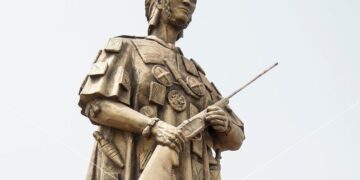
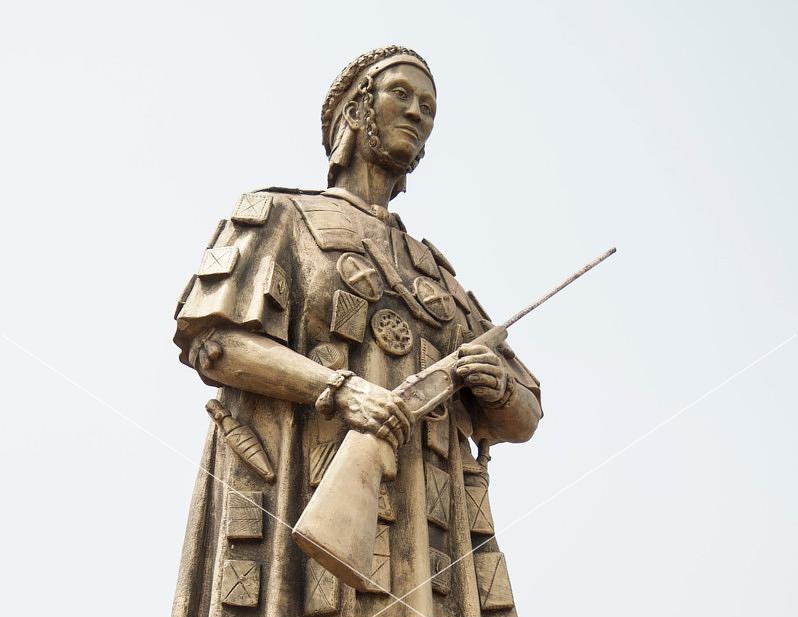
Yaa Asantewaa Statue, Ejisu, Ghana

Share on FacebookShare on Twitter

By Adam Abdurraheem*


Yaa Asantewaa was born around 1840 in the town of Besease, in what is now central Ghana, into a prominent family belonging to the Asona royal clan within the Ashanti Empire. Her father was Kwaku Ampoma, and her mother was Ata Po. She grew up alongside her brother, Afrane Panin, who later became the ruler—or “Ejisuhene”—of Ejisu, one of the key constituent chiefdoms of the Ashanti Confederacy.

In her early life, she worked in agriculture on lands near Besease. She married a man from Kumasi named OOwusu Kwabena, with whom she had one daughter, Ama Serwaa (also spelt Ama Sewaa Boankra or Ama Sewaa Brakatu). Her upbringing could be understood with the fact that the matrilineal social structure of the Akan people granted women significant standing, including the direct right to oversee and influence political authority through the institution of the “Queen Mother”.

When her older brother, Akwasi Afrane Okpase, passed away in 1894, Yaa Asantewaa exercised her constitutional prerogative as the Queen Mother of Ejisu by appointing her grandson, Kofi Tene, to the position of ruler. In Ashanti tradition, this role served as a fundamental pillar in the internal balance of governance. The Queen Mother acted as the ruler’s primary advisor and the guardian of the royal lineage, holding the decisive voice in the nomination of leaders—as well as in their removal should they fail to fulfil their obligations to the community. From this position, Yaa Asantewaa found herself at the heart of a political and military storm in the Asante Kingdom during the final decade of the nineteenth century.

The Colonial Context and the Erosion of Asante Sovereignty

The 1890s saw a sharp intensification of British pressure aimed at subjugating the Asante Empire and incorporating it into the Gold Coast protectorate—a move driven by Britain’s desire to control trade routes and gold mines and to prevent rival European powers from expanding into the interior. In January 1896, British authorities arrested the Asantehene (King of the Ashanti Empire), Prempeh I, and exiled him—along with several of his senior leaders and members of the royal family, including Yaa Asantewaa’s grandson, Kofi—first to Sierra Leone and subsequently to the Seychelles. This mass exile created a severe leadership vacuum in Kumasi and Ejisu, compelling Yaa Asantewaa to assume the role of de facto regent of the Ejisu chiefdom in the absence of her exiled grandson.

The colonial administration also imposed heavy taxes and systems of forced labour, which burdened the population and weakened the local economy. Tensions reached a breaking point on March 28, 1900, when the British Governor of the Gold Coast, Frederick Mitchell Hodgson, arrived in Kumasi and convened a meeting with the remaining Asante leaders. At that meeting, Hodgson delivered a speech in which he demanded the surrender of the “Golden Stool” (Sika Dwa Kofi)—the most sacred spiritual and political symbol of the Ashanti nation’s unity and sovereignty—claiming that, as the representative of Queen Victoria, he had the right to sit upon it.

The Kumasi Speech and the Assumption of Military Command

The British governor’s demand came as a profound shock to the Ashanti leaders. In the collective belief of the Ashante, the Golden Stool is never sat upon; it is carried on a special cushion, revered as the vessel for the nation’s soul. While hesitation and division spread among the male chiefs—who feared an unequal military confrontation against British forces equipped with cannons and machine guns—the stance taken by Yaa Asantewaa emerged as the decisive turning point.

Historical accounts recount that she stood before the assembly of chiefs and delivered a scathing rebuke for their failure to defend the Golden Stool, declaring that if the men would not take up arms, she would lead the women into battle.

The Ashanti war council appointed her as commander-in-chief of the resistance forces (“Sahene”)—a position rarely held by a woman in the region’s military history. Yaa Asantewaa worked to forge alliances among the various chiefdoms, secured supplies of food and ammunition, and devised a strategic plan to besiege the British fort in Kumasi, where Hodgson and his military garrison had taken refuge, an attempt to impose a new reality on the ground—one that would compel the British to negotiate, facilitate the return of the exiled king, and preserve the Ashanti political entity from total dissolution.

The War of the Golden Stool (1900) and the Shifting Balance of Power

Armed hostilities erupted in late March and early April 1900, in what has come to be known historically as the “War of the Golden Stool”, or the Yaa Asantewaa War. Ashante fighters laid a suffocating siege to the fort at Kumasi, severing telegraph lines and blocking routes to the coast; this led to dwindling supplies and the spread of disease among the besieged British troops. In June of that same year, Hodgson—accompanied by a portion of his forces—managed to break the siege and escape toward the coast with great difficulty, enduring a relentless barrage of attacks and leaving behind only a small garrison within the fort.

However, the British Empire’s technical and logistical advantages gradually altered the dynamics of the conflict. London brought in massive military reinforcements from Nigeria, Sierra Leone, and other parts of West Africa, under the command of Colonel James Willcocks. These forces employed heavy artillery and machine guns to destroy the wooden fortifications erected by the Ashanti fighters, while also implementing a “scorched earth” policy—burning villages and crops to undermine the popular base that sustained the resistance.
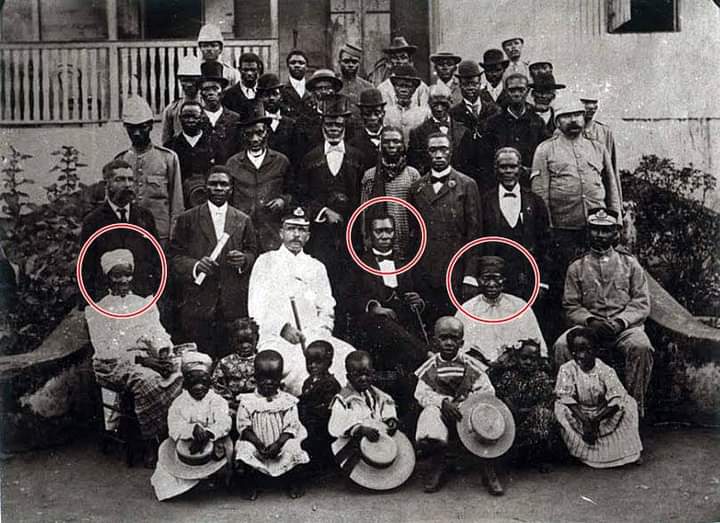
Yaa Asantewaa, circled to the right of King Prempeh I and Queen Yaa Akyaa to his left, taken in Seychelles

Despite the heavy losses suffered by both sides—with approximately one thousand soldiers from the British and allied forces killed and about two thousand Ashanti fighters—the resistance, led by Yaa Asantewaa, continued until November 1900, when colonial forces managed to suppress the final pockets of organised combat.

Capture and Exile to the Seychelles

Following the collapse of the primary defensive lines, Yaa Asantewaa—accompanied by a group of her aides—sought refuge in the forests surrounding the Ejisu chiefdom to continue organising her forces. The British eventually located and captured her in early 1901. She, along with fifteen other key resistance leaders, was transported to the coast and subsequently exiled in March 1901 to the Seychelles, in the Indian Ocean. There, she joined King Prempeh I and other members of the exiled Asante political elite.

During her twenty years of exile on the island of Mahé in the Seychelles, Yaa Asantewaa lived far from her homeland, her farmlands, and her former social standing. Colonial administrative records from the Seychelles indicate that she maintained her dignity and refused to be psychologically broken, despite her advancing age and declining health in her final years. The community of exiles made persistent efforts to preserve their language and traditions, while the British authorities—fearing a resurgence of political activity in the Gold Coast—closely monitored their correspondence and movements.

Yaa Asantewaa passed away in exile on October 17, 1921, at the age of approximately eighty-one—just three years before the British authorities permitted King Prempeh I to return to Kumasi in 1924.

The significance of Yaa Asantewaa’s life story extends well beyond her role as a military leader who confronted a colonial army possessing superior weaponry. She represents a concentrated example of the intersection between traditional social structures and the challenges of colonial modernity. On one hand, her experience reveals the institutional resilience of pre-colonial West African societies, where power was not the exclusive domain of men; the institution of the Queen Mother provided a constitutional mechanism that allowed women to intervene decisively during moments of existential crisis. On the other hand, her stance in protecting the Golden Stool highlights a profound political awareness regarding the importance of cultural symbols in preserving collective identity—for she understood that surrendering the Stool would mean not merely the loss of an artefact, but the dismantling of the spiritual and political bond that united the Ashante tribes.

Read also

Somalia orders UAE ambassador to leave, citing ‘invasion’

Nigeria’s Tinubu asks parliament to decriminalise attempted suicide

South Africa’s ANC and partners near coalition deal to sideline poll-topping DA in Johannesburg

On a human level, her journey—from a farmer and queen mother in Ejisu to a war leader and eventually an exiled captive on a remote island—reflects the heavy price paid by local and traditional leaders to maintain the independence of their decision-making. Even following her military defeat, the symbolic objective for which she fought was achieved: the British were unable to locate or seize the Golden Stool throughout the war, and it remained hidden by the Ashante custodians until it resurfaced publicly in the 1920s.

In this sense, Yaa Asantewaa remains a landmark in Ghanaian and African historical memory, symbolising institutional and cultural resilience in the face of external hegemony—a legacy that transcends the kind of mythologising reductionism that might otherwise obscure the complexities of her political and social context.

ــــــــــــــــــــــــــــــــــــــ

* Nigerian writer with interests in history, culture and African affairs.

References

  • Aidoo, A. A. (1977). Asante queen mothers in government and politics in the nineteenth century. Journal of the Historical Society of Nigeria, 9(1), 1–13.
  • Boahen, A. A. (2003). Yaa Asantewaa and the Asante-British war of 1900–1. Sub-Saharan Publishers.
  • Britannica, T. Editors of Encyclopaedia. (2026). Yaa Asantewaa. Encyclopædia Britannica. https://www.britannica.com/biography/Yaa-Asantewaa
  • Edgerton, R. B. (1995). The fall of the Asante Empire: The hundred-year war for Africa’s Gold Coast. Free Press.
  • McCaskie, T. C. (2007). The life and afterlife of Yaa Asantewaa. Africa, 77(2), 151–179. https://doi.org/10.3366/afr.2007.77.2.151
  • Edward Asare (2021). THE TRUE FACE OF YAA ASANTEWAA. https://edwardasare.com/the-true-face-of-yaa-asantewaa/
  • Brempong, A. (2000). The role of Nana Yaa Asantewaa in the 1900 Asante war of resistance. Ghana Studies, 3(1), 97-110.
  • McCaskie, T. C. (2007). The life and afterlife of Yaa Asantewaa. Africa, 77(2), 151-179.
  • Kuba, A. (2018). Women nationalists in nineteenth and twentieth century Ghana and Zimbabwe: Case studies of charwe nehanda nyakasikana and Yaa asentewaa. Journal of International Women’s Studies, 19(2), 159-171.
Tags: Asante EmpireAshantiYaa Asantewaa

Related Posts

Sedick Isaacs (1940-2012): From a Robben Island prison cell to pioneering medical informatics
Featured

Sedick Isaacs (1940-2012): From a Robben Island prison cell to pioneering medical informatics

November 19, 2026
Mozambique: Opposition leader Mondlane announces break in election protests
East Africa

Mozambique’s main opposition leader goes on trial over post-election unrest

November 18, 2026
Eritrea wary of ‘war-mongering’ Ethiopia
East Africa

Ethiopia and Eritrea amass forces along border, heightening war fears, sources say

November 18, 2026
Nigeria’s state-owned NNPC records $4.2 billion after-tax profit in 2025
Economy

Nigeria’s central bank, NNPC sign deal to support forex inflows, energy funding

November 18, 2026
Free trade across Africa? Why policy must catch up with small-scale cross-border traders
African Union

Free trade across Africa? Why policy must catch up with small-scale cross-border traders

November 17, 2026
Hormuz block affected Africa in four places: what the continent must do to avoid future shocks
Central Africa

Hormuz block affected Africa in four places: what the continent must do to avoid future shocks

November 17, 2026

Search Qiraat Africa

No Result
View All Result

Follow on Twitter

Follow @africanqiraat

Trending

Africa’s 10 Strongest Currencies in June 2026

Africa’s 10 Strongest Currencies in June 2026

July 8, 2026
Kumbi Saleh, the capital of the ancient Ghana Empire

Kumbi Saleh, the capital of the ancient Ghana Empire

October 13, 2025
DR Congo’s President Tshisekedi calls for sanctions against Rwanda

DR Congo president orders probe into copper and cobalt export revenues, document shows

April 28, 2026
Zaghawa people of northeastern Chad and western Sudan

Zaghawa people of northeastern Chad and western Sudan

March 3, 2026
Tunka Manin (c. 1010–1078), the last ruler of the Ghana Empire

Tunka Manin (c. 1010–1078), the last ruler of the Ghana Empire

December 12, 2025
The Bamiléké of western Cameroon

The Bamiléké of western Cameroon

September 18, 2024

Facebook

Sections

  • About Us
  • Privacy Policy
  • Opinion
  • Infographics
  • News
  • Analysis
  • Figures
  • Culture & Literature
  • Follow Ups
  • Historical Readings
  • Interview
  • Studies


© Copyright Qiraat Africa. Developed by Bunnaj Media .

No Result
View All Result
  • News
  • Analysis & Report
  • Studies
  • Opinion
  • Interview
  • Culture & Literature
  • Figures
  • Historical Readings
  • Regions

© 2021 Copyright Qiraat Africa.