















Qiraat Africa
عربي  |  Fr
Advertisement
  • News
    • All
    • Climate Change
    • Economy
    • Education
    • Energy
    • Health
    • Migration
    • Mining
    • Politics
    • Security
    • Society
    • Sport
    Around 700,000 displaced by volatile conflict in southern Ethiopia

    Around 700,000 displaced by volatile conflict in southern Ethiopia

    Uganda discharges last Ebola patient, starts countdown to be virus-free

    Scientists are learning more about the rare Ebola virus in Congo outbreak

    South African minister and MPs cleared of corruption

    South Africa’s first female deputy president and UN official dies

    Somalia launches Centennial Vision 2060 roadmap for ‘peace, prospertity and progress’

    Somalia orders UAE ambassador to leave, citing ‘invasion’

    Nigeria’s president Tinubu says economy is recovering, calls for end to protests against hardship

    Nigeria’s Tinubu asks parliament to decriminalise attempted suicide

    South Africans vote as anger over failing services threatens ANC

    South Africa’s ANC and partners near coalition deal to sideline poll-topping DA in Johannesburg

    Mozambique: Opposition leader Mondlane announces break in election protests

    Mozambique’s main opposition leader goes on trial over post-election unrest

    Eritrea wary of ‘war-mongering’ Ethiopia

    Ethiopia and Eritrea amass forces along border, heightening war fears, sources say

    Nigeria’s state-owned NNPC records $4.2 billion after-tax profit in 2025

    Nigeria’s central bank, NNPC sign deal to support forex inflows, energy funding

  • Analysis
    • All
    • Climate Change
    • Digital & Tech
    • Economy
    • Energy & Power
    • Health
    • Politics
    • Security
    • Society
    Free trade across Africa? Why policy must catch up with small-scale cross-border traders

    Free trade across Africa? Why policy must catch up with small-scale cross-border traders

    Hormuz block affected Africa in four places: what the continent must do to avoid future shocks

    Hormuz block affected Africa in four places: what the continent must do to avoid future shocks

    What is standing in the way of science’s ability to eradicate malaria? 3 areas where action can have an influence

    What is standing in the way of science’s ability to eradicate malaria? 3 areas where action can have an influence

    African Union summit clouded by Saudi-UAE rivalry in Horn of Africa

    Opportunities and Challenges of the AU’s Education in Emergencies Initiative

    Abiy Ahmed Tested: How the Tigray Alliance Is Reshaping Ethiopia’s Security—And What Comes Next

    Abiy Ahmed Tested: How the Tigray Alliance Is Reshaping Ethiopia’s Security—And What Comes Next

    UN report says Africa’s share of global trade stands at 3 percent

    AfCFTA: The Trade Rules Poised to Weave Africa’s Fragmented Textile Markets into One

    The global panel on inequality needs African evidence: here’s how it could work

    The global panel on inequality needs African evidence: here’s how it could work

    Why Africa needs a new credit agency

    Why Africa needs a new credit agency

    Japan signs deal with Namibia to explore for rare earth minerals

    Africa’s mineral strength is wasted if countries don’t work together – new report

  • Studies
    China could drive Africa’s renewable energy revolution, report says

    A study shows wind and solar projects in Kenya and South Africa don’t always benefit the communities that host them

    Angola’s lengthy war shaped the way farmers utilised fire—why it matters

    Angola’s lengthy war shaped the way farmers utilised fire—why it matters

    Schooling is the most severely affected by conflict when children are the target – Study

    Schooling is the most severely affected by conflict when children are the target – Study

    Pensions for Botswana’s elderly are expanding, but care services are lacking—study follows 20 years

    Pensions for Botswana’s elderly are expanding, but care services are lacking—study follows 20 years

    60 new cosmic structures have been discovered by South Africa’s MeerKAT telescope, which is mapping previously unseen gaps between galaxies

    60 new cosmic structures have been discovered by South Africa’s MeerKAT telescope, which is mapping previously unseen gaps between galaxies

    Benin government says armed forces foil coup attempt

    Coup contagion? A rash of African power grabs suggests copycats are taking note of others’ success

    One in three South Africans have never heard of AI: what this means for policy

    One in three South Africans have never heard of AI: what this means for policy

    Social Media as a Catalyst for the Spread of Dangerous Wealth Ritual Myths

    Social Media as a Catalyst for the Spread of Dangerous Wealth Ritual Myths

    Overcoming Education Barriers for Young Mothers in Sub-Saharan Africa

    Overcoming Education Barriers for Young Mothers in Sub-Saharan Africa

  • Infographics
  • Figures
    Sedick Isaacs (1940-2012): From a Robben Island prison cell to pioneering medical informatics

    Sedick Isaacs (1940-2012): From a Robben Island prison cell to pioneering medical informatics

    Prince Louis Rwagasore (1932-1961) and the Dream of Independence in Burundi

    Prince Louis Rwagasore (1932-1961) and the Dream of Independence in Burundi

    Josina Muthemba Machel (1945–1971): Reshaping of Women’s Role in the Mozambican Revolution

    Josina Muthemba Machel (1945–1971): Reshaping of Women’s Role in the Mozambican Revolution

    Yaa Asantewaa (1840-1921): Defending the Golden Stool and Asante Sovereignty in the Face of Colonialism

    Yaa Asantewaa (1840-1921): Defending the Golden Stool and Asante Sovereignty in the Face of Colonialism

    Usman Dan Fodio (1754-1817): Teacher, philosopher, and revolutionary reformer

    Usman Dan Fodio (1754-1817): Teacher, philosopher, and revolutionary reformer

    Sokhna Magat Diop (1917–2003): Senegalese cleric

    Sokhna Magat Diop (1917–2003): Senegalese cleric

    Ahmad Baba al-Timbukti (1556-1627): Writer and scholar

    Ahmad Baba al-Timbukti (1556-1627): Writer and scholar

    Namibia: Anger over Dubai COP28 trip by president Geingob’s children

    Hage Geingob (1941–2024): Former President of Namibia

    Cape Verde president says governments must discuss colonial reparations

    José Maria Neves: President of Cape Verde

  • History
    Second Ivorian Civil War (2010-2011): How struggle over legitimacy and identity lead to brink of abyss

    Second Ivorian Civil War (2010-2011): How struggle over legitimacy and identity lead to brink of abyss

    Malê Rebellion in Brazil (1835): Memory of Resistance and Identity

    Malê Rebellion in Brazil (1835): Memory of Resistance and Identity

    The Anglo-Zanzibar War (1896): A story of the shortest war in history

    The Anglo-Zanzibar War (1896): A story of the shortest war in history

    Kwanza Corridor-Cultural Landscape, Angola

    Kwanza Corridor-Cultural Landscape, Angola

    Gasumo, the southernmost source of the Nile, Burundi

    Gasumo, the southernmost source of the Nile, Burundi

    Loango ancient slavery harbour, the Republic of the Congo

    Loango ancient slavery harbour, the Republic of the Congo

    Archaeological site of Tchitundu-Hulu, Angola

    Archaeological site of Tchitundu-Hulu, Angola

    Manovo-Gounda St. Floris National Park, Central African Republic

    Manovo-Gounda St. Floris National Park, Central African Republic

    Lake Malawi (Lake Nyasa) National Park, Malawi

    Lake Malawi (Lake Nyasa) National Park, Malawi

  • Others
    • Culture / Literature
    • Interview
    • Opinion
  • Countries
    • Country profiles
    • Regions
      • Central Africa
      • East Africa
      • Southern Africa
      • West Africa
No Result
View All Result
Qiraat Africa
عربي  |  Fr
No Result
View All Result
Home Regions East Africa

The Anglo-Zanzibar War (1896): A story of the shortest war in history

November 10, 2026
The Anglo-Zanzibar War (1896): A story of the shortest war in history

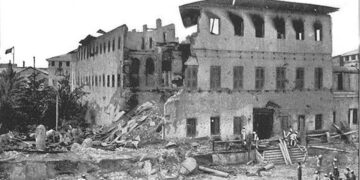
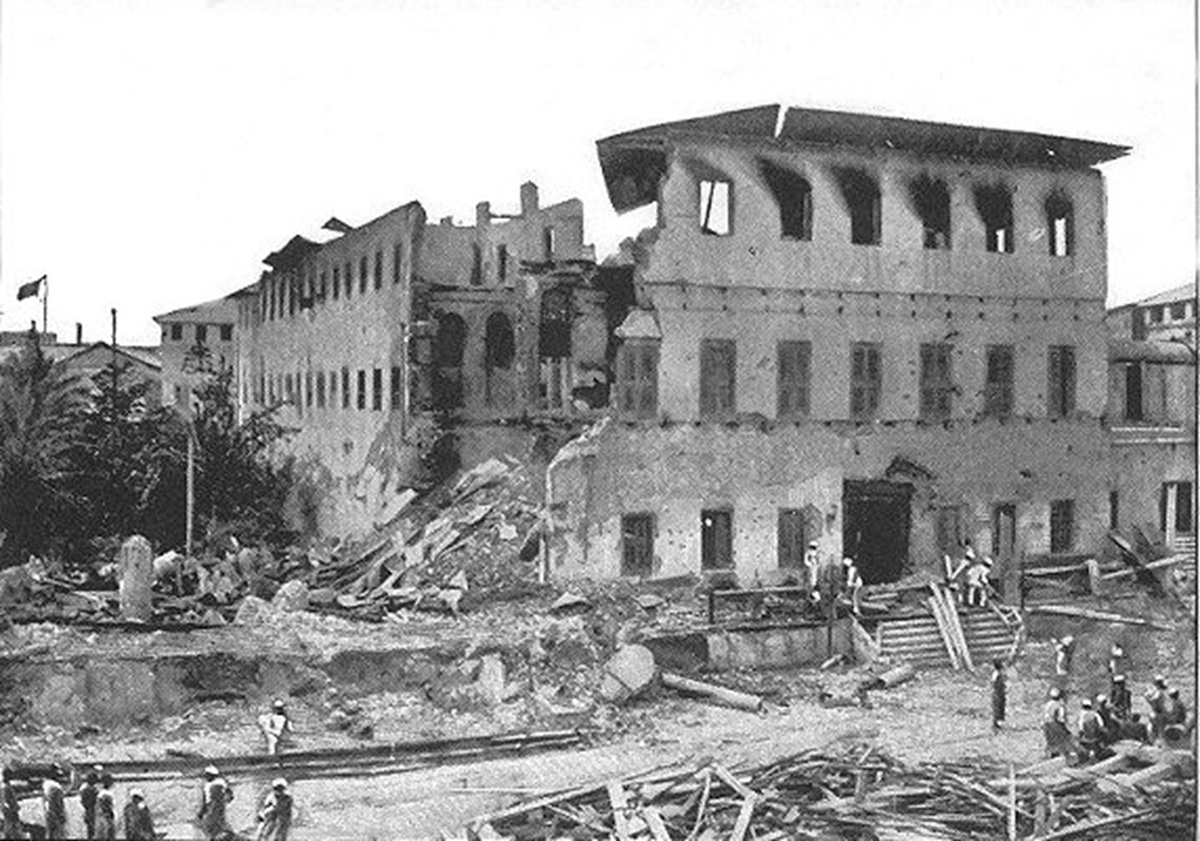
The Sultan's palace after the bombardment. Copyright: Richard Mohun

Share on FacebookShare on Twitter

By Ahmadulbadawy Abdul Raheem


The armed conflict that took place in the coastal city of Zanzibar on the morning of August 27, 1896, is frequently cited as the shortest war in modern history; the naval bombardment lasted between 38 and 45 minutes, according to varying accounts in ship logs and British consular records. Yet, focusing solely on the duration reduces a human and political tragedy to a mere statistical curiosity—masking a radical imbalance of power between a fully equipped imperial naval force and a local authority trapped within an archipelago that offered little room for military manoeuvring.

While the British Royal Navy fired approximately 500 artillery shells and thousands of rounds from machine guns and rifles at the palace and harbour-front facilities, British casualties were limited to a single sailor who sustained an accidental injury. In contrast, the Zanzibari defenders and civilians suffered around 500 casualties—killed or wounded. This stark disparity reveals the true nature of colonial warfare in the late 19th century, where heavy naval artillery confronted local resistance that lacked both parity in weaponry and the capacity to withstand sustained bombardment from the sea.

Imperial Roots and Succession Crisis in Zanzibar Archipelago

To understand the events of August 1896, one must examine the geopolitical entanglements that transformed Zanzibar into a vital point in the western Indian Ocean and East Africa during the era of the “Scramble for Africa”.

Ever since the Al Busaidi dynasty established its maritime and commercial influence in the region—linking the Sultanate to the East African coast—Zanzibar evolved into a hub for trade, navigation, and diplomatic power, eventually becoming a focal point of rivalry among major European nations. Following the imperial settlements that redrew spheres of influence in East Africa—specifically the arrangements that constrained the sultans’ freedom of action and made the legitimacy of succession contingent upon the approval of the British Consul under the 1886 agreement—the throne of Zanzibar became a testing ground for actual sovereignty over the island, a struggle over who held the authority to appoint a successor and who would safeguard London’s commercial and maritime interests at the port.

The crisis escalated abruptly on August 25, 1896, following the sudden death of Sultan Hamad bin Thuwaini—a ruler viewed by British circles as cooperative—amidst suspicions that he might have been poisoned. Within hours, his cousin, Khalid bin Barghash, moved swiftly to seize the palace and proclaim himself Sultan, without awaiting the “blessing” of the British Consulate or adhering to the protocols imposed by London.

For Basil Cave, the acting British Consul General—standing in for the absent Consul General, Arthur Hardinge—this move was a direct challenge to British influence and a threat to the position of London’s preferred candidate, Hamud bin Muhammad. Thus, the political vacuum that emerged upon the Sultan’s death transformed into a clash of wills, leaving no room for a quiet diplomatic resolution.

Naval Buildup and Final Ultimatum Before Dawn

The British administration did not content itself with diplomatic protest; instead, it moved swiftly to assemble a naval and land force at the port of Zanzibar, prepared to impose its will by force should Khalid bin Barghash fail to heed an ultimatum.

Royal Navy warships—including the cruisers HMS “St George” and HMS “Philomel”, alongside gunboats such as HMS “Raccoon”, HMS “Thrush” and HMS “Sparrow”—took up positions in the harbour under the command of Rear Admiral Harry Rawson. Meanwhile, Brigadier Lloyd Mathews assumed command of the local forces loyal to the British-backed authority.

In response, Khalid mobilised his palace guard, gathering approximately 2,800 fighters, volunteers, and servants—equipped with antiquated rifles, a limited number of artillery pieces, and machine guns—under the supervision of the guard commander, Saleh. Also at his disposal were the armed royal yacht, “Glasgow”, and two smaller vessels.

The British ultimatum gave Khalid bin Barghash until 9:00 a.m. on August 27 to vacate the palace, surrender his weapons, and disperse his forces. As the deadline approached without a full response from within the palace, the city seemed to hold its breath, awaiting the outcome of this overt display of military posturing. Khalid had banked on the symbolic significance of the palace—betting that the British, fearing chaos or swayed by political considerations, might either back down or prolong negotiations—while, in contrast, British military commanders had prepared a focused bombardment plan designed to swiftly and decisively cripple the centres of resistance near the waterfront.

Minutes of Bombardment and Collapse of Resistance at the Harbour

As the 9:00 a.m. deadline passed and warships opened fire—around 9:02 a.m.—the city’s waterfront became a scene of smoke and shrapnel. Explosive shells struck the palace and the coastal defensive batteries. Meanwhile, the ship “HMS Glasgow” came under fire and sank in the harbour shortly after the engagement began, depriving Khalid’s forces of their most significant naval asset. As fires consumed buildings and defensive cannons were destroyed, the fragile balance the defenders had sought to maintain collapsed under the weight of intense, precision-guided naval fire.

Although the battle was brief, its impact on those present was severe and immediate; many defenders and civilians near the palace and the waterfront found no safe refuge amidst the relentless bombardment and raging fires.

Historical accounts describe scenes that highlight the vast disparity between the two sides—such as defenders using bicycles to navigate the chaos. By approximately 9:40 or 9:45 a.m., the firing ceased, following the fall of the flag and the partial collapse of the palace.

Political Asylum and Accession of Hamud bin Muhammad

As the bombardment ceased, Khalid bin Barghash sought to avoid falling into British hands; he headed to the German consulate to request political asylum—a move that stirred diplomatic sensitivities among the European powers present in the city. He was later transported to German East Africa, where he spent many years in exile. On that same day, the British administration installed Hamud bin Muhammad as Sultan of Zanzibar with his authority significantly curtailed and placed under British oversight.

This even restructured the governance of the Sultanate in a way that cemented British hegemony, effectively turning the local authority into an administrative instrument subordinate to the requirements of imperial protection and control. Whereas Zanzibar had previously exercised a degree of formal, negotiable autonomy amidst international rivalries, it became—following August 27, 1896—far more tethered to direct British decision-making. This shift subsequently shaped the island’s administrative, security, and social policies, leading to tighter surveillance and the narrowing of any scope for armed rebellion for decades to come.

The 1896 war between Britain and Zanzibar remains a notable feature of public memory. It illustrates how an internal succession crisis can, overnight, transform into a pretext for asserting colonial supremacy and crushing any attempt to deviate from the framework and interests established by a colonial power.

Read also

Around 700,000 displaced by volatile conflict in southern Ethiopia

Scientists are learning more about the rare Ebola virus in Congo outbreak

Somalia orders UAE ambassador to leave, citing ‘invasion’

ـــــــــــــــــــــــــــــ

References

  • South African History Online. (2016, May 4). The Anglo-Zanzibar War of 1896. South African History Online. https://sahistory.org.za/ref/A-0120832
  • Hudson, M. (2026, September 2). Anglo-Zanzibar War. Encyclopedia Britannica. https://www.britannica.com/event/Anglo-Zanzibar-War
  • Bhacker, R. M. (1992). Trade and empire in Muscat and Zanzibar: The roots of British domination. Routledge, https://api.pageplace.de/preview/DT0400.9781134895557_A24932374/preview-9781134895557_A24932374.pdf

  • Brazil, N. (2023). The shortest war in history. British Modern Military History Society, https://bmmhs.org/the-shortest-war-in-history/

  • Owens, G.R. (2007). Exploring the Articulation of Governmentality and Sovereignty: The Chwaka Road and the Bombardment of Zanzibar, 1895-1896. Journal of Colonialism and Colonial History, 8, – .
  • Lofchie, M. F. (1965). Zanzibar: Background to revolution. Princeton University Press.

  • Sheriff, A. (2020). History of Zanzibar to 1890. In Oxford research encyclopedia of African history. Oxford University Press. https://doi.org/10.1093/acrefore/9780190277734.013.669

  • Staples, E., & Al Salimi, A. (Eds.). (2016). Oman: A Maritime History. Georg Olms Verlag.

  • Nicolini, B. (2024). The 1896 War against Zanzibar: new reflections about imperial military power. Africana: rivista di studi extraeuropei: XXX, 2024, 207-238.

Related Posts

Mozambique: Opposition leader Mondlane announces break in election protests
East Africa

Mozambique’s main opposition leader goes on trial over post-election unrest

November 18, 2026
Eritrea wary of ‘war-mongering’ Ethiopia
East Africa

Ethiopia and Eritrea amass forces along border, heightening war fears, sources say

November 18, 2026
Free trade across Africa? Why policy must catch up with small-scale cross-border traders
African Union

Free trade across Africa? Why policy must catch up with small-scale cross-border traders

November 17, 2026
Hormuz block affected Africa in four places: what the continent must do to avoid future shocks
Central Africa

Hormuz block affected Africa in four places: what the continent must do to avoid future shocks

November 17, 2026
Rwanda
East Africa

Five EU countries starting talks with Rwanda on deportation hub, Austria says

November 16, 2026
AU grants $10.4m for Mpox emergency response
Central Africa

Africa CDC says Ebola outbreak still out of control six months since it was declared

November 16, 2026

Search Qiraat Africa

No Result
View All Result

Follow on Twitter

Follow @africanqiraat

Trending

Africa’s 10 Strongest Currencies in June 2026

Africa’s 10 Strongest Currencies in June 2026

July 8, 2026
Kumbi Saleh, the capital of the ancient Ghana Empire

Kumbi Saleh, the capital of the ancient Ghana Empire

October 13, 2025
DR Congo’s President Tshisekedi calls for sanctions against Rwanda

DR Congo president orders probe into copper and cobalt export revenues, document shows

April 28, 2026
Zaghawa people of northeastern Chad and western Sudan

Zaghawa people of northeastern Chad and western Sudan

March 3, 2026
The Bamiléké of western Cameroon

The Bamiléké of western Cameroon

September 18, 2024
The Kabye People of West Africa

The Kabye People of West Africa

May 24, 2025

Facebook

Sections

  • About Us
  • Privacy Policy
  • Opinion
  • Infographics
  • News
  • Analysis
  • Figures
  • Culture & Literature
  • Follow Ups
  • Historical Readings
  • Interview
  • Studies


© Copyright Qiraat Africa. Developed by Bunnaj Media .

No Result
View All Result
  • News
  • Analysis & Report
  • Studies
  • Opinion
  • Interview
  • Culture & Literature
  • Figures
  • Historical Readings
  • Regions

© 2021 Copyright Qiraat Africa.