






Qiraat Africa
عربي  |  Fr
Advertisement
  • News
    • All
    • Climate Change
    • Economy
    • Education
    • Energy
    • Health
    • Migration
    • Mining
    • Politics
    • Security
    • Society
    • Sport
    Senegal’s top opposition leader Sonko vows to help win March 24 election

    Senegal president sacks PM Sonko, dissolves government after months of friction

    Morocco’s King pardons Senegal fans convicted on hooliganism charges

    Benin’s President Talon thanks army leaders for “remaining loyal” in face of attempted coup

    Benin’s Talon bids farewell ahead of Wadagni inauguration, Sunday

    Nigeria busts meth cartel in largest seizure, arrests kingpin

    Nigeria busts meth cartel in largest seizure, arrests kingpin

    Sierra Leone receives first group of West African deportees from US

    Sierra Leone receives first group of West African deportees from US

    WHO declares Ebola outbreak in Congo, Uganda an emergency of international concern

    India, Africa Union postpone New Delhi summit amid Ebola outbreak

    Rwanda says DR Congo shelling injured its citizens

    Rwanda tightens border controls over deadly Ebola outbreak in DR Congo

    Nigeria arrests ex-power minister Mamman after 75-year graft sentence

    Nigeria arrests ex-power minister Mamman after 75-year graft sentence

    Ethiopia says Ghebreyesus, WHO chief has links to rebellious Tigrayan forces

    WHO says 139 suspected Ebola deaths in Congo outbreak, numbers expected to rise

  • Analysis
    • All
    • Climate Change
    • Digital & Tech
    • Economy
    • Energy & Power
    • Health
    • Politics
    • Security
    • Society
    Five Years After the Coup in Mali: Are Stability and Growth Within Reach?

    The Political Economy of Insecurity in Mali: Armed Groups, Resources, and State Fragility

    Ghana to evacuate 300 citizens from South Africa after xenophobic attacks

    Xenophobic Violence and Human Security in South Africa: Causes and Consequences

    Inside an African lab that helped crack the hantavirus outbreak

    Inside an African lab that helped crack the hantavirus outbreak

    Nigeria’s Agricultural sector: Problems and challenges

    Agriculture in Africa: science and research cannot have an impact without investments and good policies

    Mali’s junta creates a new ministerial-level post to oversee the mining sector

    African Mineral Resources: The Controversial Link to US Health Deals

    Ghana curbs offshore investments to protect cedi, boost stability

    Ghana’s mining law attempts to eradicate speculation, but leaves communities in limbo: insights from a lithium case study

    East African Community’s expansion has triggered financial difficulties: why solutions come with risks

    East African Community’s expansion has triggered financial difficulties: why solutions come with risks

    Nigeria’s new election laws leaves gaps: Here are 5 reforms for free, fair, and credible elections

    Nigeria’s new election laws leaves gaps: Here are 5 reforms for free, fair, and credible elections

    Impact of Kenya’s long-overdue new infrastructure fund may be limited by design problems

    Impact of Kenya’s long-overdue new infrastructure fund may be limited by design problems

  • Studies
    Pensions for Botswana’s elderly are expanding, but care services are lacking—study follows 20 years

    Pensions for Botswana’s elderly are expanding, but care services are lacking—study follows 20 years

    60 new cosmic structures have been discovered by South Africa’s MeerKAT telescope, which is mapping previously unseen gaps between galaxies

    60 new cosmic structures have been discovered by South Africa’s MeerKAT telescope, which is mapping previously unseen gaps between galaxies

    Benin government says armed forces foil coup attempt

    Coup contagion? A rash of African power grabs suggests copycats are taking note of others’ success

    One in three South Africans have never heard of AI: what this means for policy

    One in three South Africans have never heard of AI: what this means for policy

    Social Media as a Catalyst for the Spread of Dangerous Wealth Ritual Myths

    Social Media as a Catalyst for the Spread of Dangerous Wealth Ritual Myths

    Overcoming Education Barriers for Young Mothers in Sub-Saharan Africa

    Overcoming Education Barriers for Young Mothers in Sub-Saharan Africa

    Youth Empowerment Through Vocational Training in Rural Sub-Saharan Africa

    Youth Empowerment Through Vocational Training in Rural Sub-Saharan Africa

    Manufacturers in Ghana and Nigeria claim that although corruption damages businesses, digital technologies provide a chance to combat it

    Manufacturers in Ghana and Nigeria claim that although corruption damages businesses, digital technologies provide a chance to combat it

    Environmental Threats and Conservation Efforts in Namibia

    Environmental Threats and Conservation Efforts in Namibia

  • Infographics
  • Figures
    Eduardo Mondlane (1920-1969): Mozambican Revolutionary and Anthropologist

    Eduardo Mondlane (1920-1969): Mozambican Revolutionary and Anthropologist

    William Tubman (1895-1971): Liberian politician and longest-serving president in the country’s history

    William Tubman (1895-1971): Liberian politician and longest-serving president in the country’s history

    Abebe Bikila (1932-1973): Ethiopian marathoner and first black African to win an Olympic medal

    Abebe Bikila (1932-1973): Ethiopian marathoner and first black African to win an Olympic medal

    W. E. B. Du Bois (1868-1963): Sociologist, historian, and Pan-Africanist civil rights activist

    W. E. B. Du Bois (1868-1963): Sociologist, historian, and Pan-Africanist civil rights activist

    Frantz Fanon (1925-1961): Psychiatrist and political philosopher

    Frantz Fanon (1925-1961): Psychiatrist and political philosopher

    Percy Lavon Julian (1899-1975): African American researcher and chemist

    Percy Lavon Julian (1899-1975): African American researcher and chemist

    Harriet Tubman (Araminta Ross, 1822-1913): American abolitionist and social activist

    Harriet Tubman (Araminta Ross, 1822-1913): American abolitionist and social activist

    Dorothy Vaughan (1910-2008): African American mathematician and human computer

    Dorothy Vaughan (1910-2008): African American mathematician and human computer

    George Washington Carver (1864-1943): African American agricultural scientist and inventor

    George Washington Carver (1864-1943): African American agricultural scientist and inventor

  • History
    Laas Geel, Somalia

    Laas Geel, Somalia

    Lakes Of Ounianga, Chad

    Lakes Of Ounianga, Chad

    Nok Caves, Togo

    Nok Caves, Togo

    The Land of Punt (modern Somalia, Eritrea, Ethiopia, or eastern Sudan)

    The Land of Punt (modern Somalia, Eritrea, Ethiopia, or eastern Sudan)

    Avenue of the Baobabs, Madagascar

    Avenue of the Baobabs, Madagascar

    Lopé-Okanda (Gabon)

    Lopé-Okanda (Gabon)

    The Sudd wetland

    The Sudd wetland

    Khami Ruins (Zimbabwe), the capital of the Torwa state

    Khami Ruins (Zimbabwe), the capital of the Torwa state

    Royal Palace, Porto-Novo, Republic of Benin

    Royal Palace, Porto-Novo, Republic of Benin

  • Others
    • Culture / Literature
    • Interview
    • Opinion
  • Countries
    • Country profiles
    • Regions
      • Central Africa
      • East Africa
      • Southern Africa
      • West Africa
No Result
View All Result
  • News
    • All
    • Climate Change
    • Economy
    • Education
    • Energy
    • Health
    • Migration
    • Mining
    • Politics
    • Security
    • Society
    • Sport
    Senegal’s top opposition leader Sonko vows to help win March 24 election

    Senegal president sacks PM Sonko, dissolves government after months of friction

    Morocco’s King pardons Senegal fans convicted on hooliganism charges

    Benin’s President Talon thanks army leaders for “remaining loyal” in face of attempted coup

    Benin’s Talon bids farewell ahead of Wadagni inauguration, Sunday

    Nigeria busts meth cartel in largest seizure, arrests kingpin

    Nigeria busts meth cartel in largest seizure, arrests kingpin

    Sierra Leone receives first group of West African deportees from US

    Sierra Leone receives first group of West African deportees from US

    WHO declares Ebola outbreak in Congo, Uganda an emergency of international concern

    India, Africa Union postpone New Delhi summit amid Ebola outbreak

    Rwanda says DR Congo shelling injured its citizens

    Rwanda tightens border controls over deadly Ebola outbreak in DR Congo

    Nigeria arrests ex-power minister Mamman after 75-year graft sentence

    Nigeria arrests ex-power minister Mamman after 75-year graft sentence

    Ethiopia says Ghebreyesus, WHO chief has links to rebellious Tigrayan forces

    WHO says 139 suspected Ebola deaths in Congo outbreak, numbers expected to rise

  • Analysis
    • All
    • Climate Change
    • Digital & Tech
    • Economy
    • Energy & Power
    • Health
    • Politics
    • Security
    • Society
    Five Years After the Coup in Mali: Are Stability and Growth Within Reach?

    The Political Economy of Insecurity in Mali: Armed Groups, Resources, and State Fragility

    Ghana to evacuate 300 citizens from South Africa after xenophobic attacks

    Xenophobic Violence and Human Security in South Africa: Causes and Consequences

    Inside an African lab that helped crack the hantavirus outbreak

    Inside an African lab that helped crack the hantavirus outbreak

    Nigeria’s Agricultural sector: Problems and challenges

    Agriculture in Africa: science and research cannot have an impact without investments and good policies

    Mali’s junta creates a new ministerial-level post to oversee the mining sector

    African Mineral Resources: The Controversial Link to US Health Deals

    Ghana curbs offshore investments to protect cedi, boost stability

    Ghana’s mining law attempts to eradicate speculation, but leaves communities in limbo: insights from a lithium case study

    East African Community’s expansion has triggered financial difficulties: why solutions come with risks

    East African Community’s expansion has triggered financial difficulties: why solutions come with risks

    Nigeria’s new election laws leaves gaps: Here are 5 reforms for free, fair, and credible elections

    Nigeria’s new election laws leaves gaps: Here are 5 reforms for free, fair, and credible elections

    Impact of Kenya’s long-overdue new infrastructure fund may be limited by design problems

    Impact of Kenya’s long-overdue new infrastructure fund may be limited by design problems

  • Studies
    Pensions for Botswana’s elderly are expanding, but care services are lacking—study follows 20 years

    Pensions for Botswana’s elderly are expanding, but care services are lacking—study follows 20 years

    60 new cosmic structures have been discovered by South Africa’s MeerKAT telescope, which is mapping previously unseen gaps between galaxies

    60 new cosmic structures have been discovered by South Africa’s MeerKAT telescope, which is mapping previously unseen gaps between galaxies

    Benin government says armed forces foil coup attempt

    Coup contagion? A rash of African power grabs suggests copycats are taking note of others’ success

    One in three South Africans have never heard of AI: what this means for policy

    One in three South Africans have never heard of AI: what this means for policy

    Social Media as a Catalyst for the Spread of Dangerous Wealth Ritual Myths

    Social Media as a Catalyst for the Spread of Dangerous Wealth Ritual Myths

    Overcoming Education Barriers for Young Mothers in Sub-Saharan Africa

    Overcoming Education Barriers for Young Mothers in Sub-Saharan Africa

    Youth Empowerment Through Vocational Training in Rural Sub-Saharan Africa

    Youth Empowerment Through Vocational Training in Rural Sub-Saharan Africa

    Manufacturers in Ghana and Nigeria claim that although corruption damages businesses, digital technologies provide a chance to combat it

    Manufacturers in Ghana and Nigeria claim that although corruption damages businesses, digital technologies provide a chance to combat it

    Environmental Threats and Conservation Efforts in Namibia

    Environmental Threats and Conservation Efforts in Namibia

  • Infographics
  • Figures
    Eduardo Mondlane (1920-1969): Mozambican Revolutionary and Anthropologist

    Eduardo Mondlane (1920-1969): Mozambican Revolutionary and Anthropologist

    William Tubman (1895-1971): Liberian politician and longest-serving president in the country’s history

    William Tubman (1895-1971): Liberian politician and longest-serving president in the country’s history

    Abebe Bikila (1932-1973): Ethiopian marathoner and first black African to win an Olympic medal

    Abebe Bikila (1932-1973): Ethiopian marathoner and first black African to win an Olympic medal

    W. E. B. Du Bois (1868-1963): Sociologist, historian, and Pan-Africanist civil rights activist

    W. E. B. Du Bois (1868-1963): Sociologist, historian, and Pan-Africanist civil rights activist

    Frantz Fanon (1925-1961): Psychiatrist and political philosopher

    Frantz Fanon (1925-1961): Psychiatrist and political philosopher

    Percy Lavon Julian (1899-1975): African American researcher and chemist

    Percy Lavon Julian (1899-1975): African American researcher and chemist

    Harriet Tubman (Araminta Ross, 1822-1913): American abolitionist and social activist

    Harriet Tubman (Araminta Ross, 1822-1913): American abolitionist and social activist

    Dorothy Vaughan (1910-2008): African American mathematician and human computer

    Dorothy Vaughan (1910-2008): African American mathematician and human computer

    George Washington Carver (1864-1943): African American agricultural scientist and inventor

    George Washington Carver (1864-1943): African American agricultural scientist and inventor

  • History
    Laas Geel, Somalia

    Laas Geel, Somalia

    Lakes Of Ounianga, Chad

    Lakes Of Ounianga, Chad

    Nok Caves, Togo

    Nok Caves, Togo

    The Land of Punt (modern Somalia, Eritrea, Ethiopia, or eastern Sudan)

    The Land of Punt (modern Somalia, Eritrea, Ethiopia, or eastern Sudan)

    Avenue of the Baobabs, Madagascar

    Avenue of the Baobabs, Madagascar

    Lopé-Okanda (Gabon)

    Lopé-Okanda (Gabon)

    The Sudd wetland

    The Sudd wetland

    Khami Ruins (Zimbabwe), the capital of the Torwa state

    Khami Ruins (Zimbabwe), the capital of the Torwa state

    Royal Palace, Porto-Novo, Republic of Benin

    Royal Palace, Porto-Novo, Republic of Benin

  • Others
    • Culture / Literature
    • Interview
    • Opinion
  • Countries
    • Country profiles
    • Regions
      • Central Africa
      • East Africa
      • Southern Africa
      • West Africa
No Result
View All Result
Qiraat Africa
عربي  |  Fr
No Result
View All Result
Home Regions East Africa

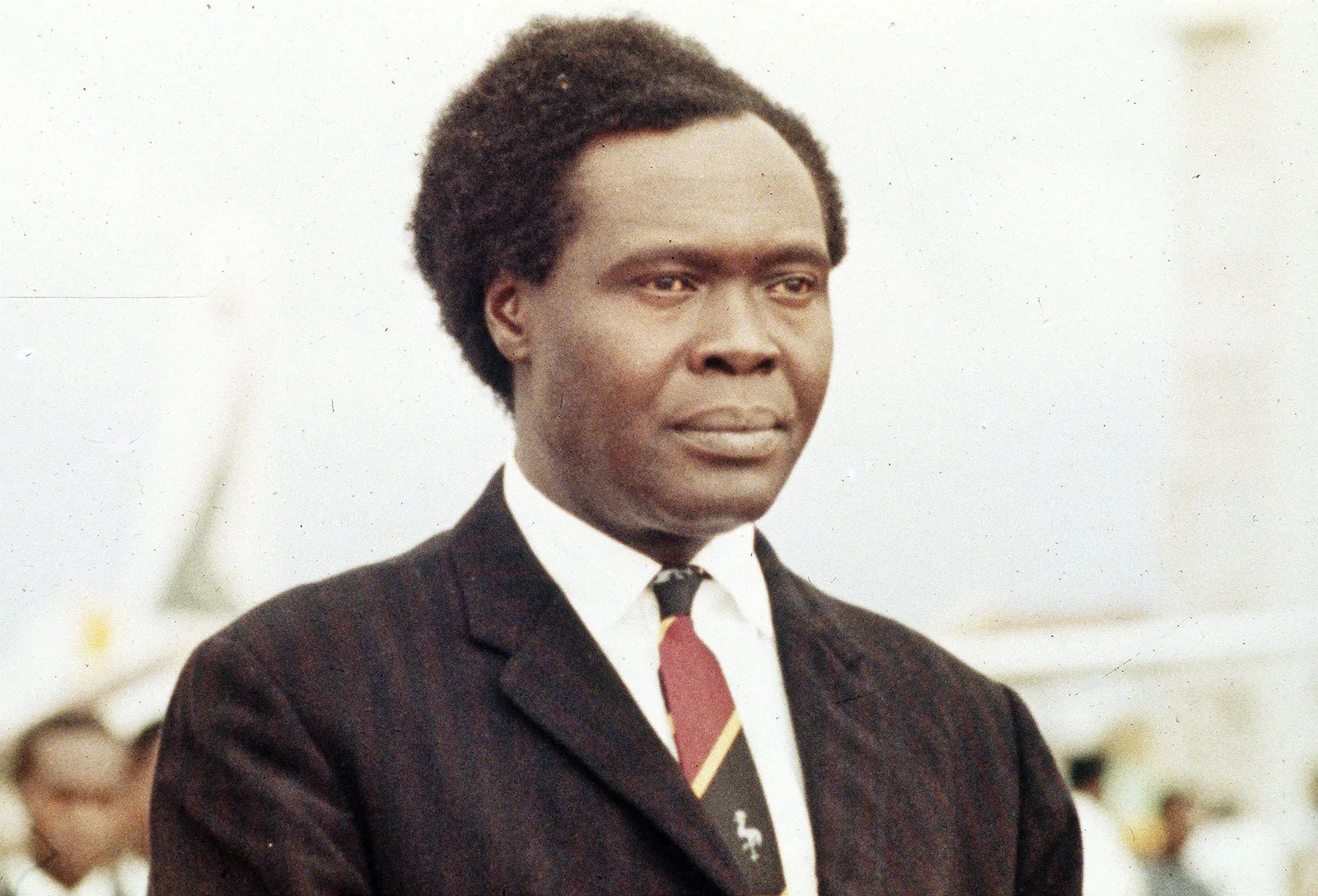
Apollo Milton Obote (1925-2005): Former President of Uganda

September 9, 2025
Apollo Milton Obote (1925-2005): Former President of Uganda
Share on FacebookShare on Twitter

Apollo Milton Obote was a pivotal and controversial figure in Uganda’s post-independence history. As the country’s first prime minister and then president for two separate terms, his political career witnessed radical transformations that shaped the course of the Ugandan state, from leading the national liberation movement to establishing a one-party system to periods of internal conflict and exile.

Milton Obote, a Lango (one of Uganda’s ethnic groups), was born around 1925 in the village of Akokoro in Apac District, Uganda Protectorate. His father was a local chief, affording him a good education compared to his peers. He enrolled at Busoga College and Makerere University, then the most prominent institution of higher learning in East Africa, to study arts. However, his academic career was cut short, as he left the college before graduating under circumstances that differ. Some sources indicate he was expelled due to his political activism, while others claim he left in protest against the administration’s policies.

After leaving Makerere, Obote worked in neighboring Kenya for several years, where he became involved in trade union work and the anti-colonial political movement. Influenced by the nationalist ideas spreading across the continent, upon his return to Uganda in 1956, he joined the Uganda National Congress (UNC). He quickly emerged as a capable organizer and orator, and in 1957, he was elected to the colony’s legislative council.

As divisions within the UNC grew, Obote broke away and, with others, founded the Uganda People’s Congress (UPC) in 1959. The party drew its support primarily from the northern and western regions, while Buganda, the largest and most powerful of the country’s traditional kingdoms, enjoyed considerable autonomy and feared the dominance of a strong central government.

To achieve independence and bridge the deep political divide between the Buganda kingdom and the rest of the country, Obote formed an unlikely political alliance with the Kabaka Yekka (KY) party, which represented the interests of the Buganda kingdom. This alliance, known as the “unholy alliance” due to the deep ideological differences between the two parties, enabled them to win the elections that preceded independence.

On October 9, 1962, Uganda gained independence from Britain. Milton Obote became the first prime minister, while Sir Edward Mutesa II, the Kabaka (king) of Buganda, assumed the ceremonial role of head of state. This arrangement was a compromise aimed at preserving a semblance of national unity, but it was fragile from the outset.

Late tensions between Obote and the Kabaka soon emerged. Obote sought to build a strong, centralized state, which directly conflicted with Buganda’s ambitions to maintain its autonomy and special status. The crisis reached its peak in 1966. Following accusations of corruption and gold and ivory smuggling involving Obote and his deputy army commander, Idi Amin, the Buganda parliament demanded that the central government remove its “capital” from Buganda territory. Obote’s response was decisive: he suspended the constitution, declared himself executive president, and ordered the army, led by Idi Amin, to storm the Kabaka’s palace. Kabaka Mutesa fled into exile in London, where he later died, and Obote abolished all traditional kingdoms in Uganda.

In 1967, Obote imposed a new constitution that abolished the federal system and established a strong presidential republic, declaring Uganda a unitary state. This move, known as the “Begone Revolution,” greatly consolidated his power but deepened the animosity between his government and the Baganda people, who felt humiliated and marginalized.

In the late 1960s, Obote began adopting a socialist approach he called “Move to the Left.” He issued the “Common Man’s Charter,” a political document calling for a more equitable distribution of wealth. This was followed by decisions to nationalize major corporations and foreign banks in 1970. These policies alarmed foreign investors and the local business class and led to an economic slowdown. At the same time, he increasingly relied on the state security apparatus to suppress dissent, leading to growing popular discontent.

Read also

Infographic: Top 10 African Nations With The Lowest Diesel Prices In March 2026

Rwanda tightens border controls over deadly Ebola outbreak in DR Congo

Ugandan government sets up border controls amid DRC Ebola outbreak

While Obote was attending a Commonwealth summit in Singapore on January 25, 1971, his army commander, Major General Idi Amin, took advantage of his absence and staged a military coup, seizing power. The coup was initially welcomed by large segments of the population, particularly in Buganda, as well as by some Western powers concerned about Obote’s socialist leanings.

Obote sought refuge in neighboring Tanzania, where President Julius Nyerere, a friend and ally, granted him political asylum. For the next eight years, Obote attempted to organize an armed opposition to Amin’s regime, which soon revealed its brutal nature, causing the deaths of hundreds of thousands of Ugandans and devastating the country’s economy. In 1972, an invasion attempt by Obote-aligned forces from Tanzania failed.

Amin’s regime came to an end in 1979, after he invaded Tanzania. This prompted a counteroffensive by the Tanzanian army, aided by groups of armed Ugandan exiles, that led to Amin’s overthrow and his flight from the country.

After Amin’s fall, and amid the ensuing power vacuum, Obote returned to Uganda in May 1980. In December of the same year, general elections were held, won by his party, the Uganda People’s Congress, amid widespread accusations of fraud and vote-rigging by his opponents, particularly the Democratic Party. This controversial election led to Obote’s return to the presidency.

His second term was difficult from the start. Obote inherited an economically devastated and socially divided country with an undisciplined army. He faced fierce armed opposition, most notably the National Resistance Army (NRA) led by Yoweri Museveni, which resorted to guerrilla warfare in the Luwero Triangle region of central Uganda.

Obote’s government responded to the rebellion with a brutal military campaign. The Uganda National Liberation Army (UNLA), largely composed of soldiers from the northern Acholi and Lango ethnic groups, was accused of committing widespread human rights violations in the Luwero Triangle and other areas that supported the rebels. These violations included mass killings, torture, and forced displacement, with civilian casualties estimated at tens of thousands, if not hundreds of thousands.

Economically, Obote abandoned his previous socialist policies and adopted economic reform programs supported by the International Monetary Fund and the World Bank. These policies succeeded in achieving some economic stability and reducing inflation, but their positive effects did not reach most of the population, who continued to suffer.

By mid-1985, Obote’s government had lost control of large parts of the country. Ethnic divisions within the army itself worsened, particularly between Acholi officers (led by General Tito Okello) and Lango officers (loyal to Obote). On July 27, 1985, Acholi officers staged a military coup that ousted Obote for a second time.

Obote fled again, this time settling in Zambia. He remained in exile for the remainder of his life, never returning to Uganda. He died on October 10, 2005, in Johannesburg, South Africa, where he was receiving medical treatment. His body was repatriated to Uganda, where he received a state funeral by the government of President Yoweri Museveni, his former political rival.

Tags: Apollo Milton OboteEdward Mutesa IIIdi AminKabaka of BugandaUgandaYoweri Museveni

Related Posts

Dangote raises planned investment in Ethiopia fertiliser project to over $4 billion
East Africa

Dangote raises planned investment in Ethiopia fertiliser project to over $4 billion

May 18, 2026
Uganda’s 81-year-old President Yoweri Museveni sworn in to seventh term
East Africa

Uganda’s president signs contentious law meant to curb foreign influence

May 18, 2026
Protests erupt over Kenya fuel price hikes, strike strands commuters
East Africa

Protests erupt over Kenya fuel price hikes, strike strands commuters

May 18, 2026
Night curfew imposed in Comoros after protests over president’s re-election
East Africa

Comoros suspends fuel price hikes after deadly protests

May 17, 2026
Rwandan genocide suspect Kabuga, 93, dies in custody
East Africa

Rwandan genocide suspect Kabuga, 93, dies in custody

May 17, 2026
WHO declares Ebola outbreak in Congo, Uganda an emergency of international concern
East Africa

WHO declares Ebola outbreak in Congo, Uganda an emergency of international concern

May 17, 2026

Search Qiraat Africa

No Result
View All Result

Follow on Twitter

Follow @africanqiraat

Trending

Zimbabwe’s banking sector faces 75% job decrease Since 2000

China writes off unspecified amount of Zimbabwe interest-free loan

April 18, 2024
Kumbi Saleh, the capital of the ancient Ghana Empire

Kumbi Saleh, the capital of the ancient Ghana Empire

October 13, 2025
Africa’s Richest Billionaires, Mid-2025

Africa’s Richest Billionaires, Mid-2025

July 17, 2025
Kagame and the Rwandan Economic Miracle: Autocracy at its finest?

Kagame and the Rwandan Economic Miracle: Autocracy at its finest?

May 19, 2022
The Balanta of Guinea-Bissau, Senegal and The Gambia

The Balanta of Guinea-Bissau, Senegal and The Gambia

January 20, 2026
Kalenjin people of East Africa

Kalenjin people of East Africa

August 15, 2025

Facebook

Sections

  • About Us
  • Privacy Policy
  • Opinion
  • Infographics
  • News
  • Analysis
  • Figures
  • Culture & Literature
  • Follow Ups
  • Historical Readings
  • Interview
  • Studies


© Copyright Qiraat Africa. Developed by Bunnaj Media .

No Result
View All Result
  • News
  • Analysis & Report
  • Studies
  • Opinion
  • Interview
  • Culture & Literature
  • Figures
  • Historical Readings
  • Regions

© 2021 Copyright Qiraat Africa.