













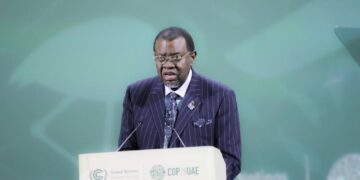









Netumbo Nandi-Ndaitwah is one of the prominent political figures in Namibia’s modern history. She made history as the country’s first female president following her victory in the November 2024 presidential election and her swearing-in on March 21, 2025. Her ascent to power marks a pivotal moment in Namibia’s political trajectory, bridging the ideological legacy of the national liberation movement with the need to adapt to democratic transitions and contemporary economic demands.
Netumbo Nandi-Ndaitwah was born on October 29, 1952, in the village of Onamutai in the Oshana region of northern Namibia, during the era of the apartheid regime imposed by South Africa. She grew up in a religious family; her father was an Anglican priest. She joined the South West Africa People’s Organisation (SWAPO) in 1966 at the age of fourteen, becoming involved in the anti-colonial movement at an early age.
Between 1972 and 1974, she led the SWAPO Youth League in the northern region. Due to her political activism and the protests she helped organise against apartheid policies, she faced arrest and persecution by the authorities in 1973. This pressure compelled her to leave the country and go into exile in 1974 to continue the struggle from abroad.
During her years of exile—spanning approximately a decade and a half—she undertook prominent diplomatic and political roles on behalf of SWAPO. She became a member of the party’s Central Committee in 1976 and served as the organisation’s chief representative for Central Africa (based in Lusaka, Zambia) between 1978 and 1980, followed by a tenure as chief representative for East Africa and the Organisation of African Unity’s Liberation Committee (based in Dar es Salaam, Tanzania) from 1980 to 1986.
Her time in exile was not limited to political work; she also used the period to further her higher education. She obtained a diploma in fieldwork from the Komsomol schools in Moscow, then moved to the United Kingdom, where she earned a postgraduate diploma in public administration from Glasgow College of Technology in 1987, followed by a master’s degree in diplomatic studies from Keele University in 1989.
With the onset of the transition period and Namibia’s attainment of independence in 1990, Nandi-Ndaitwah returned to the country and was elected to the National Assembly (Parliament). Since then, she has held a series of ministerial portfolios and leadership positions over the course of three decades. As a deputy minister of foreign affairs (1990–1996), she participated in establishing the foundational principles of modern Namibia’s foreign policy. As Director General of Women’s Affairs (1996–2000) and then Minister of Women’s Affairs and Child Welfare (2000–2005), during this period, she spearheaded significant legislative efforts to protect women’s rights, most notably the Married Persons Equality Act (1996) and the Combating of Domestic Violence Act (2003).
She also served as the general rapporteur for the Fourth World Conference on Women in Beijing in 1995, and as the minister of information and broadcasting (2005–2010), she oversaw government media and communication policies. She managed as minister of environment and tourism (2010–2012): the wildlife conservation and natural resource management sectors. Also, as minister of international relations and cooperation (2012–2024), she led Namibian diplomacy for many years.
Netumbo Nandi-Ndaitwah was appointed Deputy Prime Minister (2015–2024) alongside her ministerial duties during the tenure of the late President Hage Geingob, and following his death in February 2024 and Nangolo Mbumba’s assumption of the interim presidency, she was appointed Vice President of the Republic until the end of the electoral term (2024–2025).
In 2017, Nandi-Ndaitwah was elected vice president of the SWAPO party and was subsequently re-elected at the party’s 2022 congress. Under party bylaws—and given that President Geingob had exhausted his two constitutional terms—she became the ruling party’s official candidate for the 2024 presidential election.
She contested the presidential election on November 27, 2024, amidst a highly competitive political landscape and a decline in SWAPO’s historical level of support compared to the early decades of independence. Despite logistical challenges during the electoral process and the extension of voting hours in certain constituencies, Nandi-Ndaitwah secured victory with approximately 57% of the vote, outpacing her main rival, Panduleni Itula of the Independent Patriots for Change (IPC) party.
She officially assumed office on March 21, 2025, becoming the fifth president of the Republic of Namibia.
During her presidency, Netumbo Nandi-Ndaitwah faces complex issues that require balancing SWAPO’s political legacy with new economic and social demands. High youth unemployment and economic inequality are among the most pressing domestic issues, placing pressure on her administration to create jobs and attract investment. With offshore oil and gas discoveries and the potential for green hydrogen production, the government faces the challenge of regulating these sectors to maximise national revenue while upholding transparency standards and environmental safeguards.
Also, maintaining public trust requires strengthening governance principles and addressing the practices that have sparked public criticism of certain government institutions in recent years. She adopts an approach based on continuity in maintaining balanced diplomatic relations, with a focus on enhancing African cooperation and multilateral international partnerships.