






Qiraat Africa
عربي  |  Fr
Advertisement
  • News
    • All
    • Climate Change
    • Economy
    • Education
    • Energy
    • Health
    • Migration
    • Mining
    • Politics
    • Security
    • Society
    • Sport
    AfDB approves $8.6 million grant to boost non-oil revenue mobilisation in South Sudan

    South Sudan and UN failed to heed massacre warnings-Amnesty International

    DRC opposition vows to resist constitutional changes under Tshisekedi

    DRC opposition vows to resist constitutional changes under Tshisekedi

    Ghana unveils new cedi banknotes celebrating national heritage

    Ghana unveils new cedi banknotes celebrating national heritage

    South Sudan’s presidency announces postponement of long-delayed election by two years

    South Sudan vote: UN warns political transition must hold beyond polling day

    Ethiopian coffee exports earn more than $500 million in just two months

    Ethiopia’s coffee exports fetch more than $870 million

    Ghana discovers hydrocarbons in new type of offshore reservoir

    Ghana discovers hydrocarbons in new type of offshore reservoir

    Nigeria’s state-owned NNPC records $4.2 billion after-tax profit in 2025

    Nigeria approves 145 new oil wells so far this year, regulator says

    Uganda to impose 21-day quarantine on returning citizens with Congo travel history

    Congo’s Ebola cases surpass 11,000, government data show

    Senegal vows action on smugglers after latest migrant boat tragedy

    Senegal vows action on smugglers after latest migrant boat tragedy

  • Analysis
    • All
    • Climate Change
    • Digital & Tech
    • Economy
    • Energy & Power
    • Health
    • Politics
    • Security
    • Society
    What is standing in the way of science’s ability to eradicate malaria? 3 areas where action can have an influence

    What is standing in the way of science’s ability to eradicate malaria? 3 areas where action can have an influence

    African Union summit clouded by Saudi-UAE rivalry in Horn of Africa

    Opportunities and Challenges of the AU’s Education in Emergencies Initiative

    Abiy Ahmed Tested: How the Tigray Alliance Is Reshaping Ethiopia’s Security—And What Comes Next

    Abiy Ahmed Tested: How the Tigray Alliance Is Reshaping Ethiopia’s Security—And What Comes Next

    UN report says Africa’s share of global trade stands at 3 percent

    AfCFTA: The Trade Rules Poised to Weave Africa’s Fragmented Textile Markets into One

    The global panel on inequality needs African evidence: here’s how it could work

    The global panel on inequality needs African evidence: here’s how it could work

    Why Africa needs a new credit agency

    Why Africa needs a new credit agency

    Japan signs deal with Namibia to explore for rare earth minerals

    Africa’s mineral strength is wasted if countries don’t work together – new report

    Ethiopia: at least 40 army allies killed in drone strike

    Ethiopia’s peace deal is unravelling – what went wrong with the Tigray agreement

    DRC on a mission to financing the world’s largest hydropower dam

    DR Congo: The INGA Dam Paradox

  • Studies
    China could drive Africa’s renewable energy revolution, report says

    A study shows wind and solar projects in Kenya and South Africa don’t always benefit the communities that host them

    Angola’s lengthy war shaped the way farmers utilised fire—why it matters

    Angola’s lengthy war shaped the way farmers utilised fire—why it matters

    Schooling is the most severely affected by conflict when children are the target – Study

    Schooling is the most severely affected by conflict when children are the target – Study

    Pensions for Botswana’s elderly are expanding, but care services are lacking—study follows 20 years

    Pensions for Botswana’s elderly are expanding, but care services are lacking—study follows 20 years

    60 new cosmic structures have been discovered by South Africa’s MeerKAT telescope, which is mapping previously unseen gaps between galaxies

    60 new cosmic structures have been discovered by South Africa’s MeerKAT telescope, which is mapping previously unseen gaps between galaxies

    Benin government says armed forces foil coup attempt

    Coup contagion? A rash of African power grabs suggests copycats are taking note of others’ success

    One in three South Africans have never heard of AI: what this means for policy

    One in three South Africans have never heard of AI: what this means for policy

    Social Media as a Catalyst for the Spread of Dangerous Wealth Ritual Myths

    Social Media as a Catalyst for the Spread of Dangerous Wealth Ritual Myths

    Overcoming Education Barriers for Young Mothers in Sub-Saharan Africa

    Overcoming Education Barriers for Young Mothers in Sub-Saharan Africa

  • Infographics
  • Figures
    South Sudan’s presidency announces postponement of long-delayed election by two years

    South Sudan vote: UN warns political transition must hold beyond polling day

    Usman Dan Fodio (1754-1817): Teacher, philosopher, and revolutionary reformer

    Usman Dan Fodio (1754-1817): Teacher, philosopher, and revolutionary reformer

    Sokhna Magat Diop (1917–2003): Senegalese cleric

    Sokhna Magat Diop (1917–2003): Senegalese cleric

    Ahmad Baba al-Timbukti (1556-1627): Writer and scholar

    Ahmad Baba al-Timbukti (1556-1627): Writer and scholar

    Namibia: Anger over Dubai COP28 trip by president Geingob’s children

    Hage Geingob (1941–2024): Former President of Namibia

    Cape Verde president says governments must discuss colonial reparations

    José Maria Neves: President of Cape Verde

    Jorge Bom Jesus: Linguist and former Prime Minister of São Tomé and Príncipe

    Jorge Bom Jesus: Linguist and former Prime Minister of São Tomé and Príncipe

    Joseph Leabua Jonathan (1914-1987): Former Prime Minister of Lesotho

    Joseph Leabua Jonathan (1914-1987): Former Prime Minister of Lesotho

    Gambia’s president Barrow faces backlash over ‘death wish’ on archrival

    Adama Barrow: President of the Republic of The Gambia

  • History
    Kwanza Corridor-Cultural Landscape, Angola

    Kwanza Corridor-Cultural Landscape, Angola

    Gasumo, the southernmost source of the Nile, Burundi

    Gasumo, the southernmost source of the Nile, Burundi

    Loango ancient slavery harbour, the Republic of the Congo

    Loango ancient slavery harbour, the Republic of the Congo

    Archaeological site of Tchitundu-Hulu, Angola

    Archaeological site of Tchitundu-Hulu, Angola

    Manovo-Gounda St. Floris National Park, Central African Republic

    Manovo-Gounda St. Floris National Park, Central African Republic

    Lake Malawi (Lake Nyasa) National Park, Malawi

    Lake Malawi (Lake Nyasa) National Park, Malawi

    Fasil Ghebbi, Gondar Region, Ethiopia

    Fasil Ghebbi, Gondar Region, Ethiopia

    Bwindi Impenetrable National Park, Uganda

    Bwindi Impenetrable National Park, Uganda

    Fort Jesus, Mombasa, Kenya

    Fort Jesus, Mombasa, Kenya

  • Others
    • Culture / Literature
    • Interview
    • Opinion
  • Countries
    • Country profiles
    • Regions
      • Central Africa
      • East Africa
      • Southern Africa
      • West Africa
No Result
View All Result
Qiraat Africa
عربي  |  Fr
No Result
View All Result
Home Featured

Zambia’s chaotic but decisive election: government demonstrates strength, democracy shows weakness

August 22, 2026
Zambia’s chaotic but decisive election: government demonstrates strength, democracy shows weakness

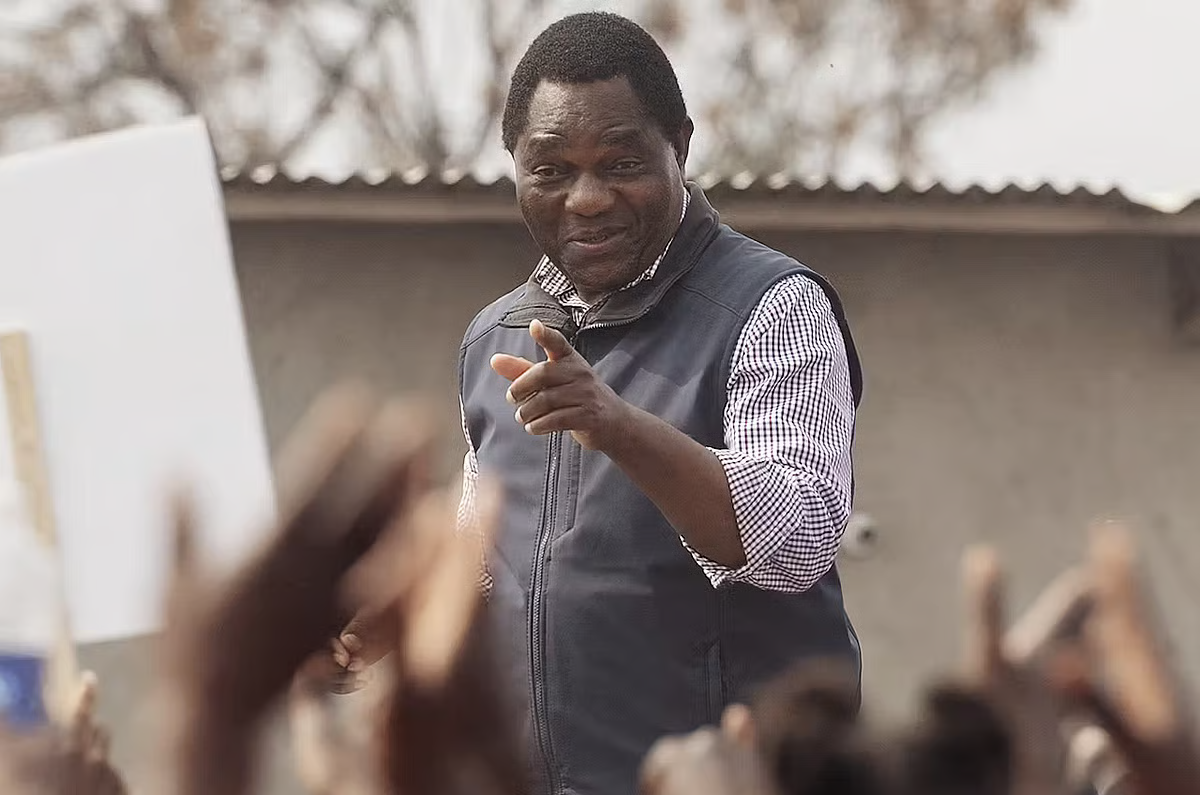
Zambian president Hakainde Hichilema on the campaign trail ahead of elections. Gianluigi Guercia/AFP/Getty Images

Share on FacebookShare on Twitter

By Michael Wahman* & Lindsay Favero*


Across southern Africa, sitting presidents have faced a wave of turnovers and electoral setbacks in the past few years.

Malawi and Botswana saw opposition victories. In Namibia and South Africa, incumbents were re-elected, but with significantly smaller majorities.

In Zambia, the Patriotic Front suffered a humiliating defeat in 2021 as voters reacted to poor economic performance. This resulted in a new government led by Hakainde Hichilema and his United Party for National Development.

Hichilema’s government has ruled in a time of extreme global economic anxieties. Conflict, supply chain interruptions and aid withdrawal have piled pressure on governments, not least in Africa. In southern Africa, erratic weather conditions have brought droughts, food insecurity and energy shortages, adding to economic woes. In this environment, how did Zambia’s incumbent party secure such a decisive re-election in 2026?

In an impressive showing, Hichilema secured an increased 61% of the vote compared to 38% for the main opposition challenger, Brian Mundubile. However, accusations of fraud and manipulation have tainted the election.

We are politics scholars who focus on democracy and elections in the region. We’ve been following developments in Zambia as the vote turned increasingly controversial.

In our view, however, it would be a mistake to understand the party’s victory as purely a reflection of manipulation. Other important factors contributed, including voter approval of the government’s handling of the economic crisis as well as education, healthcare and food security.

Was it fraud?

While many of us political scholars had anticipated a decisive victory for the United Party for National Development, academics Nic Cheeseman and Nicole Beardsworth published a remarkable article days after the election analysing voting patterns. The numbers were not adding up.

Election results announced by the Electoral Commission of Zambia showed improbably high voter turnout in many government-party strongholds. Even more suspicious were large and illogical differences in votes cast in parliamentary and presidential elections in some constituencies.

This was compounded by a highly unusual country-wide suspension of vote counting imposed by the electoral commission the day after the election, amid reports of violence. The European Union Election Observation Mission noted that the “overall conduct of tabulation (vote counting) deteriorated significantly” after the lifting of the suspension.

If fraud was indeed perpetrated inside ruling party strongholds, the critical question is whether it is decisive. Focusing only on 16 particularly suspicious constituencies, analysis found a difference of 170,000 votes between the number of presidential and parliamentary votes, but the nationwide vote difference was more than 1.1 million between the president and the opposition challenger.

Much more clarity came after the respected domestic election observer network, the Christian Churches Monitoring Group (CCMG), published their regular Parallel Voting Tabulation survey. Indeed, the parallel results did not match the official results. It appears United Party for National Development votes were inflated.

Importantly, however, the monitoring group still had the party as the runaway winner in the presidential election. According to their survey, Hichilema received 56% of the vote (give or take 1.7 percentage points), compared to Mundubile’s 42%. In other words, manipulation does not seem to be enough to explain Hichilema’s decisive victory.

His party’s re-election was a reflection of both opposition weakness and government strength.

Opposition weakness

Throughout most of the presidential term, voters expected a re-match between Hichilema and former president Edgar Lungu. However, Lungu unexpectedly died just over a year before the election and the opposition was left without a leader.

Internal succession struggles within the Patriotic Front tore the party into factions. And the Registrar of Societies, which regulates political parties, frustrated attempts to register new political challengers. Polling voters after Lungu’s death, we did not find any opposition party with more than 12% declared support.

After dramatic nominations, Mundubile emerged as the main opposition candidate. He ran under the banner of a previously obscure opposition party, National Reconciliation Party for Unity and Prosperity. Mundubile’s strategy was to revitalise the former Patriotic Front coalition. In campaigns, he proudly declared that as president he would “rule like Lungu”.

This strategy may have been sound for uniting the opposition. However, to win national elections, emulating a coalition that voters soundly removed from office five years ago was not enough.

The final performance was nonetheless impressive for a party that was virtually nonexistent three months earlier. It won more votes than the government in most areas where the Patriotic Front dominated in 2021. It also made inroads among urban voters, a notoriously volatile voter group in Zambia.

However, the 2026 election reaffirms an old truth about Zambian politics: elections are won by mobilising the base and winning regional strongholds with big margins.

Given the apparently inflated votes in many of these strongholds, we need to treat official vote counts with a grain of salt. Nevertheless, some patterns are so clear that we can still draw some conclusions.

Mundubile’s party simply lacked the ground organisation needed to win. And the government was winning respectable shares of the vote in areas that were supposedly opposition strongholds.

Government strength

While we will probably never know the real voter turnout, independent estimates put it at around 54% of registered voters. In the last election, it was 71%.

In 2021, voters were highly motivated to vote and oust a highly unpopular government. This wasn’t the case in 2026.

Key to the government’s popularity is its strong handling of the economy. The government successfully restructured debt, kept inflation under control, and delivered steady growth. Voters credited government with stepping up drought initiatives to ease the suffering of rural Zambians.

Our poll showed strong approval of the government’s performance on education, healthcare and food security. Hichilema’s approval rating was measured at an unusually high 79%. His party’s campaign posters touted slogans such as “continuity”, a globally rare campaign message in days of anti-incumbent sentiment.

A weakening of democracy

A decisive victory leaves Hichilema with a strong mandate and a weakened opposition.

His party is now looking to gain a comfortable majority in parliament. This dominance was certainly helped by controversial constitutional changes instituted just ahead of the election. A new bill created new constituencies, expanded presidentially nominated seats, and introduced new seats for women, youth, and persons with disabilities. This aided the party.

It has also asserted stronger party discipline. The debate over the bill ignited infighting, but the election seemed to settle the contest. Hichilema took a hard line against MPs who voted against it. He now leads an increasingly unified and loyal party.

However, the election is not settled and leaves many questions unanswered. The opposition intends challenging the results in the Constitutional Court. Crucially, they will have to show that manipulation changed the outcome. While it will be hard to argue it did, it looks like it may have affected the proportional distribution of parliamentary seats.

Read also

South Sudan and UN failed to heed massacre warnings-Amnesty International

DRC opposition vows to resist constitutional changes under Tshisekedi

Ghana unveils new cedi banknotes celebrating national heritage

Generally, the election has weakened Zambia’s democratic credentials in an environment where western pressure to protect democratic institutions is weaker than it has been in decades.

Not only did the election itself raise questions, but also a mysterious security operation the day after. This targeted opposition officials, including Mundubile. It left one person dead and several more detained. It raises serious human rights concerns.

This will be Hichilema’s last term, and the battle over who succeeds him is likely to begin soon. How his party uses its new dominance, whether to manage succession or to change the rules to consolidate its position further, will shape Zambian politics in the years to come.

ـــــــــــــــــــــــ
* Professor, Public Affairs, The University of Texas at Austin

* PhD Student, Michigan State University

Source: The Conversation
Tags: Zambia

Related Posts

Ethiopian coffee exports earn more than $500 million in just two months
East Africa

Ethiopia’s coffee exports fetch more than $870 million

November 11, 2026
Ghana discovers hydrocarbons in new type of offshore reservoir
Energy

Ghana discovers hydrocarbons in new type of offshore reservoir

November 11, 2026
Nigeria’s state-owned NNPC records $4.2 billion after-tax profit in 2025
Energy

Nigeria approves 145 new oil wells so far this year, regulator says

November 11, 2026
Uganda to impose 21-day quarantine on returning citizens with Congo travel history
Central Africa

Congo’s Ebola cases surpass 11,000, government data show

November 11, 2026
What is standing in the way of science’s ability to eradicate malaria? 3 areas where action can have an influence
Featured

What is standing in the way of science’s ability to eradicate malaria? 3 areas where action can have an influence

November 10, 2026
Senegal vows action on smugglers after latest migrant boat tragedy
Featured

Senegal vows action on smugglers after latest migrant boat tragedy

November 10, 2026

Search Qiraat Africa

No Result
View All Result

Follow on Twitter

Follow @africanqiraat

Trending

Africa’s 10 Strongest Currencies in June 2026

Africa’s 10 Strongest Currencies in June 2026

July 8, 2026
Tunka Manin (c. 1010–1078), the last ruler of the Ghana Empire

Tunka Manin (c. 1010–1078), the last ruler of the Ghana Empire

December 12, 2025
Kumbi Saleh, the capital of the ancient Ghana Empire

Kumbi Saleh, the capital of the ancient Ghana Empire

October 13, 2025
Brief History and Culture of the City of Lagos, Nigeria

Brief History and Culture of the City of Lagos, Nigeria

July 24, 2024
The Great Mosque of Djenne, Mali

The Great Mosque of Djenne, Mali

March 25, 2025
Garre/Garee/Gurrehb, Somali pastoralist clan

Garre/Garee/Gurrehb, Somali pastoralist clan

August 17, 2026

Facebook

Sections

  • About Us
  • Privacy Policy
  • Opinion
  • Infographics
  • News
  • Analysis
  • Figures
  • Culture & Literature
  • Follow Ups
  • Historical Readings
  • Interview
  • Studies


© Copyright Qiraat Africa. Developed by Bunnaj Media .

No Result
View All Result
  • News
  • Analysis & Report
  • Studies
  • Opinion
  • Interview
  • Culture & Literature
  • Figures
  • Historical Readings
  • Regions

© 2021 Copyright Qiraat Africa.