






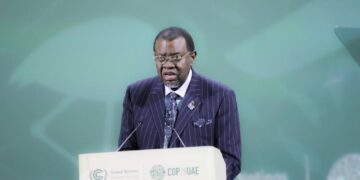
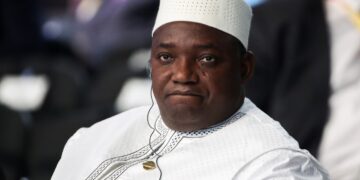





The experience of Adama Barrow, the third president of the Republic of The Gambia, stands as an exceptional example of sudden political transformation in West Africa. He transitioned from a private-sector businessman—with no prior history in government or executive office—to the helm of a nation that had endured 22 years of authoritarian rule under the grip of Yahya Jammeh.
Adama Barrow was born on February 15, 1965, in the village of Mankamang Kunda—near Basse Santa Su in the Upper River Region of The Gambia—just days before the country gained independence from the United Kingdom. He grew up in a modest rural environment rooted in traditional social structures. After completing his primary education locally, he moved to the capital, Banjul, to pursue secondary education at Crab Island School and later the Muslim High School, attending both on scholarships earned through academic excellence.
He began his professional career working in fuel sales for a local company. At the turn of the millennium, he travelled to the United Kingdom to pursue higher studies in real estate management. To cover his living and educational expenses, he worked as a security guard at a well-known store in London—a period he later credited with shaping his character and instilling in him discipline and patience. Barrow returned to The Gambia in 2006 to pursue a career in the private sector, founding and managing his own real estate and consultancy firm, Majum Real Estate, until late 2016. This experience enabled him to build an extensive network within Banjul’s bustling business community while remaining aloof from partisan conflicts and direct confrontations with the ruling regime.
Barrow’s political engagement began with his affiliation with the United Democratic Party (UDP)—the country’s main opposition party—where he rose through the ranks to become treasurer. In 2016, political repression by Yahya Jammeh’s regime intensified, leading to the imprisonment of dozens of opposition leaders, most notably UDP leader Ousainou Darboe.
Faced with this leadership vacuum, seven opposition parties and civil society representatives agreed to form a broad coalition known as “Coalition 2016”. Barrow was selected as the coalition’s independent candidate, having formally resigned from his party to ensure organisational neutrality. His election campaign centred on straightforward pledges, including: ending the dictatorship and releasing political prisoners; Reforming judicial and security institutions and committing to a transitional period of only three years, after which he would hand over power. The elections took place on December 1, 2016, and Barrow achieved a historic upset by winning 43.3% of the vote, compared to 39.6% for the incumbent, Jammeh. Although Jammeh initially conceded defeat, he later retracted his concession, citing procedural irregularities, thereby plunging the country into a severe constitutional and security crisis.
Security threats forced Barrow to temporarily leave for Senegal, where he was sworn in as President of The Gambia at his country’s embassy in Dakar on January 19, 2017. Backed by resolutions from the Economic Community of West African States (ECOWAS) and the UN Security Council, regional forces threatened military intervention to uphold the will of the Gambian people; this ultimately compelled Jammeh to relinquish power and depart for exile in Equatorial Guinea. Barrow returned to Banjul on January 27, 2017, to officially assume the reins of government.
Barrow’s administration inherited a state suffering from international isolation, economic decline, and political institutions that had been hollowed out. Short-term political priorities focused on rebuilding the rule of law.
Key initiatives and transformations include lifting restrictions on independent media, releasing political prisoners, and facilitating the return of dozens of exiles. He created the Truth, Reconciliation, and Reparations Commission (TRRC), which was established to investigate abuses and violations committed during the Jammeh era (1994–2017). It submitted its final report, which included recommendations to hold those responsible for human rights violations accountable.
Barrow brought The Gambia back into the Commonwealth and sought to strengthen ties with the International Criminal Court (ICC) after his predecessor had withdrawn the country from it. Relations with neighbouring Senegal also improved significantly, a shift underscored by the completion of the strategic Senegambia Bridge.
Despite these institutional achievements, Barrow faced sharp criticism due to his political shifts. He reneged on the pledge he made as part of the “2016 Coalition” to resign after three years, opting instead to adhere to the constitutional provision setting the presidential term at five years. This sparked a grassroots movement and widespread protests under the slogan “Three Years Jotna” (Three Years Are Enough), which were met with a harsh security crackdown by the authorities.
The inter-party agreements that had supported him collapsed, and Barrow parted ways with Ousainou Darboe and the United Democratic Party (UDP). In 2019, Barrow founded his new party, the National People’s Party (NPP), to consolidate his own grassroots support base.
To regain power, Barrow’s party formed an alliance with the majority faction of the Alliance for Patriotic Reorientation and Construction (APRC)—Jammeh’s former ruling party—a move viewed by the human rights community as a compromise on transitional justice.
In December 2021, Adama Barrow contested the presidential election as the leader of the NPP, winning 53% of the vote and defeating his main rival, Ousainou Darboe, amidst international praise for the integrity and transparency of the electoral process.
Barrow’s second term focused on infrastructure projects, economic stability, and strengthening service sectors. Hundreds of kilometres of roads connecting remote regions to major cities (such as the Basse-Fatoto-Koina road) were constructed to facilitate trade and logistics. Electricity and water networks were expanded in cooperation with the World Bank and regional partners to increase coverage in rural areas that had long suffered from marginalisation.
The Gambian economy faced external pressures stemming from supply chain crises and global inflation, which impacted the prices of essential goods and compelled the government to adopt prudent measures to reduce the budget deficit.