



































The old towns—often referred to as “walled cities” or “medinas”—in the Comoros archipelago represent a distinctive architectural and cultural legacy of the trade and political networks that linked the East African coast with the Arabian Peninsula and the Indian Ocean region during the Middle Ages and the early modern period. The significance of these historic urban settlements lies in their status as tangible embodiments of the era of the “Comorian Sultanates”—independent political entities that governed the archipelago’s four islands (Ngazidja/Grande Comore, Nzwani/Anjouan, Mwali/Mohéli, and Mayotte/Maore) prior to French colonisation in the late 19th century.
The emergence of these old towns in the Comoros was a gradual transformation linked to waves of migration and maritime trade networks across the Indian Ocean. Beginning in the 10th century CE, Shirazi and Arab groups arrived in the archipelago, intermingling with the local Bantu-descended population. This cultural and ethnic fusion gave rise to the “Comorian Swahili” language and heritage, subsequently leading to the establishment of micro-states known as sultanates.
The political structure of these sultanates varied by island:
- Grande Comore (Ngazidja): Characterised by political fragmentation and constant rivalry among several sultanates (such as the Sultanates of Bambao, Itsandra, and Mbadjini). The supreme ruler was sometimes known as the “Mniy Mkou” or the “Great Sultan”; however, he did not possess absolute centralised authority but was instead subject to the balance of power among notables and dignitaries (“al-akabir).
- Anjouan (Nzwani) Island: Characterised by a more centralised and stable political system centred on the towns of Mutsamudu and Domoni, where power was concentrated in ruling dynasties capable of collecting taxes and conducting large-scale foreign trade.
- Mohéli (Mwali) Island: Subject to the influence of the sultanates of Anjouan and Grande Comore, it later experienced the influence of the ruling dynasty of Madagascar (the Malagasy) during the 19th century.
Rivalries between these sultanates—along with external threats such as raids by Malagasy pirates during the 18th and 19th centuries—served as a primary impetus for fortifying towns and constructing walls and coastal defences. - Historic Comorian towns—foremost among them Moroni, Itsandra, and Iconi (on Grande Comore), as well as Mutsamudu and Domoni (on Anjouan)—are distinguished by a unique architectural style known as “Swahili stone architecture”. This style is adapted to the tropical climate and meets the security and religious requirements regarding the “harem” and conservative social norms.
Traditional Comorian architecture relied on locally available materials. Coral stone and volcanic ash rubble were used to construct thick walls that provide thermal insulation for the buildings. Lime mortar was prepared by burning coral and mixing it with ash and water; this gives buildings a white finish and a coating resistant to salinity and humidity. Mangrove and local timber were used to construct roofs, beams, doors, and windows, which are often carved with geometric and floral patterns influenced by Islamic and Arab art.

Streets within the old cities are characterised by their narrowness and sharp curves; these pedestrian-only pathways are known as “saqifas” or “aziqqas” (alleys). This labyrinthine layout serves as security, to break the momentum of invading strangers and disorient them should they breach the city walls; and climactic, to create continuous shade and minimise direct exposure to sunlight, while also channelling air currents to mitigate summer heat.
Large residential buildings are known as “maisons à cour” (courtyard houses). The traditional Comorian house consists of a high outer wall enclosing an internal courtyard, around which the rooms are arranged. Exterior windows are small and few in number to preserve family privacy, whereas doors and main rooms open onto the internal courtyard.
These buildings include reception areas for men—known as the “saqifa”—located near the main entrance to prevent strangers from entering the inner parts of the house.
Key landmarks in historic cities include the following:
- Congregational and Historic Mosques: Mosques form the heart of the urban fabric in every old city. Their function extends beyond worship to serve as centres for justice and education, as well as hubs for social activity.
- The Friday Mosque in Moroni (Badjanani Mosque): A prominent landmark, distinguished by its multi-columned prayer hall and a minaret that bears witness to architectural transformations over the decades.
- The Mosques of Mutsamudu and Domoni are distinguished by “mihrabs” (prayer niches) intricately carved from coral stone, often featuring inscriptions and Quranic verses in Kufic or regional Naskh scripts.
- Fortifications, Walls, and Citadels: Due to frequent attacks from the sea, sultanates surrounded their cities with thick walls featuring main gates that were closed at night.
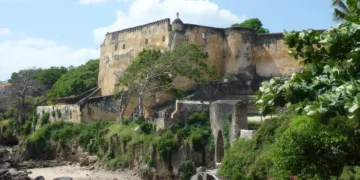
- The Citadel of Mutsamudu (“Citadelle de Mutsamudu”): The archipelago’s most prominent defensive landmark, built in the late 18th century by order of the Sultan to deter Malagasy raids. Situated on high ground overlooking the city and the sea, the citadel is equipped with embrasures for cannons imported from European traders.
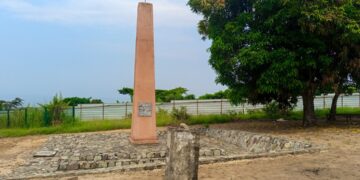
- Walls and Towers of Iconi and Moroni: Remnants of defensive walls and semi-circular towers—formerly used for surveillance and defence—are still visible.
The historical architecture of the Comoros cannot be separated from prevailing social systems, particularly the “Grand Mariage” (“Anda”) tradition on Grande Comore and the matrilineal system of property ownership.
- Ownership and Usufruct Rights (Matrilineal System): Under traditional Comorian custom, ownership of the stone house (“Moni”) belongs to the woman. The historic building is the mother’s property and is inherited by her daughters. This system ensures economic security for women; the husband moves into his wife’s home, and immovable property remains in female hands within the extended lineage.
- The “Grand Mariage” and Urban Development: The “Grand Mariage” is a social, political, and economic institution that defines an individual’s status within society and the city. Requirements for this marriage include building or renovating a stone house for the bride within the city’s historic fabric, as well as organising wealth-distributing banquets and holding celebrations in public squares. This practice has driven continuous construction and restoration work in historic cities for centuries, as coral-stone construction served as a symbol of transition into the class of “notables” (“Wabeni”).
The condition of these old cities today depends on the efficiency of heritage management in the Union of the Comoros, as well as on economic and demographic factors. Most historic buildings and walls suffer from deterioration caused by environmental factors—such as high humidity, heavy rainfall, and cyclones—compounded by the absence of organised maintenance plans. Modern materials—such as cement and metal roofing—have damaged the original urban fabric, as some residents have replaced sections of coral-stone buildings with concrete that is incompatible with the heritage environment.
Population growth and internal migration from rural areas to cities (particularly Moroni and Mutsamudu) have led to overcrowding within the historic urban fabric. This has been accompanied by alterations to room layouts and the enclosure of open courtyard spaces to accommodate larger populations, resulting in damage to traditional drainage and water infrastructure.
Although the Comoros submitted the “Historic Towns and Sultanates of the Comoros” dossier to the UNESCO World Heritage Tentative List, achieving comprehensive protection standards and sustainable heritage management continues to face financial and technical obstacles. Heritage authorities and national antiquities institutions lack the budgets necessary to implement large-scale restoration projects utilizing traditional lime-based techniques.
The Medinas of the historic towns of the Comoros constitute an architectural and material record of an exceptional era in Indian Ocean history; their identities were forged through a blend of African, Arab, and Shirazi elements. These towns are not merely ancient residential clusters but reflect a complex political and social system driven by sultanates that competed commercially and militarily, shaping their built environments in accordance with unique social norms and protective regulations. Preserving this distinguished heritage hinges on the ability to strike a balance between contemporary urban development and the implementation of scientific conservation policies that safeguard the “Moon City’s” historic coral fabric and its political and social symbolism.