







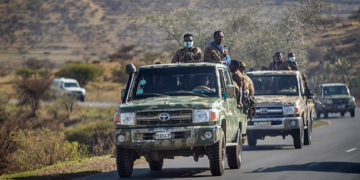





















Forces from the northern Ethiopian region of Tigray launched a major offensive against the federal government on Wednesday, a senior Ethiopian official said, shattering a four-year-old peace deal and threatening a wider regional conflict.
Tigray’s leaders said in a statement they had entered a “defensive” war to counter aggression by the federal government.
A civil war that began in 2020 between the Tigray People’s Liberation Front (TPLF) and federal forces resulted in hundreds of thousands of deaths before the Pretoria Agreement was signed in November 2022.
The new hostilities follow months of growing animosity between the two sides, capped by Sunday’s announcement that the TPLF had formed an alliance with six other armed groups from across Ethiopia aimed at overthrowing Prime Minister Abiy Ahmed’s government.
The TPLF-led regional administration said there had been an “intensification of the invasion conducted through various methods” by Abiy’s government against the people of Tigray.
“The Tigray Forces have been instructed to counter the attack and have entered a defensive war,” it said in a statement.
Getachew Reda, an adviser to Abiy and a former TPLF official, wrote on X that the TPLF had seized control of federally controlled airports in Tigray and launched an “all-out offensive” against government positions in the neighbouring regions of Afar and Amhara.
“The TPLF politico-military leadership has obviously taken irresponsibility to new heights,” he said.
Ethiopian Airlines suspended flights to the region.
FEARS OF A WIDER WAR
Spokespeople for Abiy, the federal government and the TPLF did not respond to requests for comment on Wednesday.
Regional diplomats and analysts have warned for months that a resumption of the conflict in Tigray could quickly escalate into a wider war, overlapping with fighting in neighbouring Sudan and further roiling the volatile Red Sea region.
A civil war that broke out in 2023 in Sudan has drawn in powerful states from outside the Horn of Africa and created what the UN describes as the world’s largest humanitarian crisis.
In the 2020-2022 Tigray war, Ethiopia’s neighbour and historical adversary Eritrea backed the government militarily against the TPLF.
But relations between the two countries have soured since then. Abiy’s spokesperson, Billene Seyoum, told Reuters on Monday that members of the newly announced alliance had been collaborating for a while with Eritrea’s financial backing.
Eritrea has repeatedly denied accusations it supports Ethiopian armed groups. Its information minister declined to comment on Wednesday about the latest developments.
ARMED GROUPS SIDE WITH TPLF
In Afar, Tigrayan forces were fighting alongside a local armed group, and in Amhara, they were fighting alongside the Fano militia, according to a senior Ethiopian government official, a diplomatic source, a humanitarian source and another source with links to the TPLF and Fano.
Fano sided with the federal government during the 2020-2022 war, but rose up against it in 2023 in an ongoing insurgency that has resulted in thousands of deaths. It is a member of the new alliance with the TPLF.
In a statement on Wednesday, the regional government in Afar accused the TPLF of launching an invasion and said Afari forces would defend themselves in coordination with their allies.
In Amhara, federal forces were firing heavy weapons from a camp in the town of Lalibela, which is famed for its rock-hewn churches dating back to the 12th and 13th centuries, two residents told Reuters.
The firing targeted Fano forces some 50 km (30 miles) outside the town who were advancing as part of the new offensive, the residents said.
The wider scale and intensity of the fighting were not clear. Jawar Mohammed, a political analyst and formerly a close ally of Abiy, said the federal government was limiting its engagement to try to prove to the international community that the TPLF was the instigator.
The federal government is in a tactically stronger position than in 2020 due to its large stocks of drones and divisions within the TPLF, said Edward Bach, Senior Africa Analyst at risk intelligence company Verisk Maplecroft.
DRONE STRIKES
The TPLF dominated Ethiopian politics for nearly three decades before Abiy’s appointment as prime minister in 2018.
Tigray is yet to recover from the devastating humanitarian toll of the 2020-2022 war, which pushed hundreds of thousands into famine conditions. Around 750,000 Tigrayans were still internally displaced as of February, according to the UN refugee agency, and the region is currently facing drought linked to El Nino.
The Ethiopian military has carried out several drone strikes against Tigrayan forces in recent months, according to data from the Armed Conflict Location & Event Data project.
On Tuesday, the US government said it condemned a recent drone strike on a Catholic Relief Services humanitarian assistance convoy in Tigray and called for an investigation, without saying who was responsible for the attack.
According to a statement by the Catholic Eparchy of Adigrat in northern Tigray, the drone strike on Sunday destroyed a truck carrying food aid destined for internally displaced people.
The federal government has not commented on any of the reported strikes in Tigray.