

































South Africa is a nation of multiple ethnicities, languages and nationalities. From the Zulu and Xhosa to the Dutch and the British. Somali and Tutsi to Indian Tamil and Gujarati, Chinese and Zimbabwean. However, divided, unequal, and structurally flawed, South Africa is home to a very diverse population of people. A country with deep pockets, it remains attractive as a home for migrants, some of them seeking greener economic pastures, others seeking safety and security. The economy relies heavily on migrants, be it to make up for a massive skills shortage or as cheap labour in farms and mines.
Research has revealed that xenophobic violence is a long-standing feature of democratic South Africa. Violent incidents were recorded since 1994, riddled throughout all of South Africa’s nine provinces. Gauteng, Western Cape, KwaZulu-Natal and the Eastern Cape are the worst affected. The violence occurs mostly in locations (informal settlements and townships), considered hotspots, in the periphery of the country’s major cities or metropolitan municipalities of Johannesburg, Cape Town, eThekwini, Tshwane, Ekurhuleni, and Nelson Mandela Bay. This is not surprising, since for economic reasons these low-income locations are commonly the destination of most domestic and international migrants in the country.
Of late, the provinces with the highest growth in anti-immigrant sentiment – Mpumalanga, Gauteng, Limpopo and KwaZulu-Natal – are ones through which most immigrants travel and often settle. The situation has become particularly delicate in KwaZulu-Natal. The share of adults in the province who said that they would welcome no immigrants grew from 23% in 2021 to 45% in 2023 and then again to 60% in 2025. The upsurge in hostility in KwaZulu-Natal could be linked to growing popular anger against the current economic and political status quo. A staggering 88% of provincial residents are unhappy with present economic conditions, and an equal proportion expects conditions to worsen over the next five years.
Despite the violence meted out to foreign nationals, tens of thousands continue to seek asylum there, as many as 60,000 to 80,000 per year. According to the UNHCR, there were almost 310,000 refugees and asylum seekers in the country as of July 2014. By the end of 2015, this number is expected to top 330,000. South Africa’s immigrant population has seen a steady rise over the past few decades, increasing from 2% of the total population in 1996 to 4% in 2022, according to a report from the national statistics agency Stats SA. Most of them are from the Southern African Development Community region, it said.
It could be argued that the poor have become more likely to scapegoat foreigners for the failures and inequalities of the post-pandemic economic recovery. Poor people have been badly affected by a cost of living crisis and persistent deindustrialisation. They need someone to blame, and foreigners have long provided a handy scapegoat. The South African economy has struggled in the last few years, dealing with doggedly high unemployment. The country also has notoriously high crime rates. Such problems, as experts have argued again and again, cannot be directly laid at the feet of immigrants living in the country. But it would appear that they are getting blamed anyway.
This analysis studies the causes, consequences, and intervention strategies related to xenophobic violence in South Africa from a human security perception. It contends that xenophobia is not just a creation of hatred toward foreigners but is profoundly linked to structural inequality, unemployment, political rhetoric, weak governance, and socio-economic frustrations inherited from apartheid. The article supplementary indicates that sustainable solutions necessitate multidimensional interventions including the state, civil society, regional organisations, and local communities.
History of Xenophobia in South Africa
The concept of human security gained prominence after the 1994 United Nations Development Programme (UNDP) Human Development Report. Unlike traditional security methods that prioritise territorial defence and military threats, human security focuses on the protection of persons and communities from threats such as poverty, hunger, disease, violence, and political subjugation. Meanwhile, human security includes economic security, food security, health security, environmental security, personal security, community security and political security.
Xenophobic violence directly threatens personal and community security for the reason that migrants become vulnerable to attacks, displacement, looting, and social exclusion. It also impedes economic security since migrants are unable to find livelihoods and investments during violent outbreaks. However, xenophobia refers to fear, hatred, or hostility toward foreigners. In the South African situation, intellectuals often differentiate between general xenophobia and “Afrophobia”, since most attacks explicitly target African migrants rather than Europeans or Asians. This discriminatory hostility mirrors deeper racial, economic, and political dynamics within South African society.
The history of xenophobia in South Africa dates back to the pre-1994 period where many political and economic refugees who had flocked into the country from other Southern African countries and beyond for jobs and other economic opportunities were subjected to different forms of violence, hostilities, and discrimination by locals. However, the post-1994 era witnessed several episodes of intensified and more brutal xenophobia against immigrants in South Africa as immigrants continued to be blamed by locals for crime, unemployment and spreading diseases.
In May 2008, 62 people were killed in a wave of xenophobic attacks across townships. Foreign nationals, mostly migrants from Somalia and Ethiopia, were dragged through the streets of Alexandra, barely a few kilometres from Johannesburg’s plush Sandton suburb, and “necklaced” – a throwback to the summary execution tactic used in the Apartheid days.
A rubber tyre, filled with petrol, is forced around a victim’s chest and arms and set alight. In an instant, the story of South Africa’s much-touted rainbow nation of Black, white, and brown people happily living together fizzled away in an outburst of vengeance. Tens of thousands of people were displaced, forced to seek refuge in churches, mosques, and even police stations. In the end, it took military intervention to quell the violence.
Another major wave of violence broke out in 2015, mainly in the cities of Durban and Johannesburg. Countless foreign-owned shops were looted and burnt. According to Human Rights Watch, at least seven people were killed and thousands displaced during this wave of attacks. Several African countries organised evacuations for those wanting to leave South Africa during these turbulent times: Neighbouring Zimbabwe sent buses to bring its nationals home, while Malawi and Mozambique also assisted returnees with logistics.
In September 2019, violence swept through parts of Johannesburg and Pretoria again. According to South African police figures cited by Reuters, at least 12 people were killed, and hundreds of businesses were looted or destroyed. Nigeria evacuated more than 500 of its citizens from South Africa. The attacks triggered a diplomatic crisis across Africa, with Nigeria even temporarily boycotting the World Economic Forum on Africa hosted in Cape Town.
The anti-migrant group Operation Dudula emerged in the township of Soweto in 2021 and quickly garnered national attention for its ambitions. The group organised marches against undocumented migrants, conducted raids on businesses and accused foreigners of taking jobs from South Africans while overburdening public services. Human rights organisations accused Operation Dudala of fuelling vigilantism and xenophobia, as well as blocking foreign nationals from accessing healthcare, schools, and informal trading spaces.
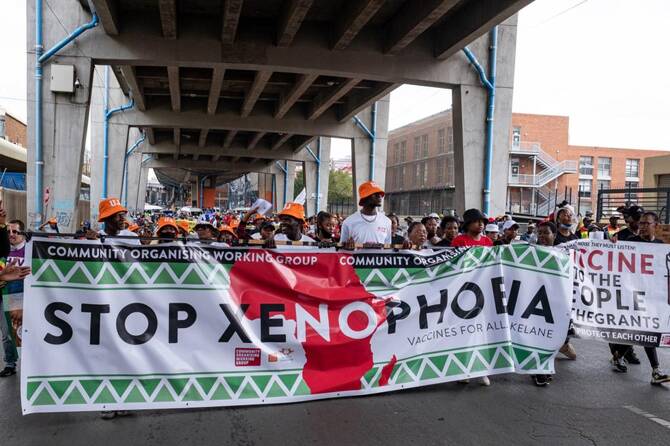
Current events show that xenophobia remains rooted inside local political discourse and socio-economic strains. Anti-immigrant groups all the time frame migration as a threat to jobs, housing, healthcare, and public services. In April 2026, protesters held rallies in Pretoria and Johannesburg, demanding tougher action against illegal immigration, saying undocumented foreign nationals were putting pressure on jobs, security and public services. Migrant-rights groups say foreigners are often scapegoated for South Africa’s economic problems.
Xenophobia and negative attitudes towards outsiders
In all research areas, residents and the local institutions of authority generally harbour strongly negative views towards outsiders, and particularly foreign nationals, whom they perceive to be the cause of most problems in their respective locations or communities. They blame foreign nationals for most of the socio-economic ills and perceive their presence to be a threat to their lives and livelihoods.
Xenophobia in South Africa is not new. Some, like Michael Neocosmos, Director of Global Movements Research at the University of South Africa (UNISA), recall anti-migrant sentiment in the early nineties, when the new government was in the midst of planning new economic policies and politicians of all stripes began drumming up anti-immigrant sentiment. “It is important to recognise that xenophobia can exist without violence. And it’s not sufficient to simply recognise it when people start killing each other,” he said.
A survey in 1997 showed that just six percent of South Africans were tolerant of immigration. In another survey cited by Danso and McDonald in 2001, 75 per cent of South Africans held negative perceptions about Black African foreigners.
There is no evidence that international migrants are a major cause of unemployment in South Africa. An analysis of labour migration done by the World Bank in 2018 showed that for every employed migrant in South Africa, two jobs were created for South Africans. A report published in 2019 by Stats SA showed that international migrants are more likely to be employed than internal migrants and non-movers. However, the work that foreigners generally do does not conform to the Decent Work Framework of the International Labour Organisation. In 11 of the sub-domains in this framework, the score for international migrants was worst in eight of them. It would seem that many foreigners are working in indecent conditions.
Causes of Xenophobic Violence in South Africa
Xenophobic Discrimination in South Africa: An Overview of Trends, Effects, and Responses (2022–2024) is a report that provides an analysis of xenophobic discrimination incidents in South Africa between 2022 and 2024 (hereinafter the reporting period), based on data collected through the Xenowatch platform. Xenowatch is a project of the African Centre for Migration & Society (ACMS) at the University of the Witwatersrand, hosted by the Mobility Governance Lab—a joint initiative between ACMS and the University of Oxford that explores mobility and governance across the Global South. The following, according to the study, are the causes of xenophobic violence in South Africa:
i. Governance deficit and violence entrepreneurship
The underlying conditions discussed above are evidently common and shared by many communities in the country, and while important, cannot help to explain why violence occurs in some locations and not in others. A report identifies local governance as the most significant distinguishing factor explaining the occurrence or absence of xenophobic violence in communities or locations with similar socio-economic conditions.
Research evidence indicates that local governance plays a defining role in the occurrence of xenophobic violence in South Africa by providing a favourable political opportunity structure and through its use of social and political controls to facilitate violence rather than prevent it. These are clear symptoms of a governance deficit. In other words, governance deficit facilitates xenophobic violence, while effective governance prevents it, despite the presence of other violence determinants.
ii. Violent service delivery, community protests
Also, studies show that violent service delivery and community protests are a regular occurrence in the case study communities. Respondents indicated that residents and their leaders often mobilise and use violent public protests as a political tool or an effective mechanism to attract (local or national) government’s attention and responses to their otherwise neglected socio-economic grievances (Freedom House, 2017).
Protesters believe that attacking foreigners, in addition to the usual violent service delivery protests, is an effective mechanism to attract government attention. Attacks on and looting of foreign-owned businesses are also an effective protest strategy used by protest leaders to attract crowds of participants because looting offers immediate material reward.
iii. Violence entrepreneurship: Leadership vacuums and the rise of violence entrepreneurs
Correspondingly, another proximate cause of xenophobic violence is violence entrepreneurship. As research finds out that official leadership vacuums created by absent or weak institutional governance led to the emergence of violent alternative governance in the form of powerful informal community leadership structures that take over the authority of the state in their respective locations. These include civic associations, concerned residents’ forums, local business associations, local development forums, etc.
iv. Mobilisation as a trigger of xenophobic violence
The study also identifies mobilisation as an immediate trigger of xenophobic violence, which is often a collective violent action, as discussed earlier. By looking for answers to the question “What triggers xenophobic violence?”, a study identifies an often-missed empirical factor and key element in the xenophobic violence causal chain: mobilisation.
Furthermore, the study shows that while macro- and micro-level socio-economic and political circumstances are important elements in heightening tensions and creating collective discontent, anger and resentment towards foreign nationals, it is the mobilisation of this discontent – and not the discontent itself – that triggers collective violent attacks on South Africa’s foreign residents. Mobilisation constitutes the vital connective tissue between discontent and collective violence. As a trigger, mobilisation helps to explain the pathways from collective discontent and/or instrumental motives to collective violent action. Collective discontent requires mobilisation to trigger a collective violence incident in the same way that dry grass only needs a spark to ignite fire.
Instigators of xenophobic violence in South Africa use various mobilisation techniques and processes, including ‘haranguing’ their target; inciting crowds during mass community meetings; posting social media messages; spreading purposely engineered rumours; appealing to the community’s sense of solidarity and right to self-defence; setting examples and asking community members to join; and hiring unemployed youths to carry out the attacks.
The Consequences of Xenophobic Violence
Xenophobic violence in South Africa is generally a collective action (i.e., a type of collective violence) carried out by groups (large or small) of ordinary members of the public, often mobilised by local leaders (formal or informal) and influential groups or individuals to further their own political and economic interests. It is a constant and increasing threat to the lives and livelihoods of foreign nationals and others deemed ‘outsiders’.
Target groups and individuals are regularly killed, assaulted, injured, and displaced, and their property and livelihood assets looted, destroyed, or appropriated. However, as noted, this violence has consequences and implications that extend far beyond the targeted groups. By undermining the country’s socio-economic prosperity, nation-building, security, and rule of law, xenophobic violence has negative socio-economic, political, and security implications for all country residents, foreigners, and citizens.
At least 62 people were killed, more than 670 injured, and over 100,000 displaced during the attacks, according to the UN refugee agency UNHCR. In May 2026, Nigeria condemned the violence against its citizens in South Africa, including the deaths of two Nigerians allegedly assaulted by security officials. It had also summoned South Africa’s High Commissioner in Abuja over the situation, and its diplomatic missions in South Africa are working with local authorities to reduce risks to Nigerians. As of May 12, 2026, Ghana is planning to evacuate 300 citizens from South Africa following a wave of xenophobic attacks targeting migrants from other sub-Saharan African countries, according to a post by the foreign minister on X.
After the 2008 crisis for migrant organisations, one of the most significant political opportunity structures of the crisis related to changes in their potential and actual migrant constituent base. The need for emergency material support and protection for individuals directly affected by violence and the fear of victimisation of others brought many previously isolated individuals into contact with existing migrant organisations.
In addition, South Africa is a signatory to the Global Compact for Safe, Orderly and Regular Migration as well as the Global Compact for Refugees in 2018. The non-binding agreements provide a blueprint for migration and refugee governance. Both seek to protect the rights of migrants and set out how countries can do this. It is the country’s obligation to aspire to the objectives of these agreements and to manage the opportunities that migration presents from an evidence-based perspective.
What is the SA government doing to stop xenophobia?
In April 2026, South Africa promised to crack down on anyone carrying out xenophobic attacks after Ghana and other African countries reported that their nationals had faced violence and discrimination.
Although the government of South Africa, in partnership with various stakeholders, has been implementing different peace-building activities that have been aimed at preventing the recurrence, escalation and continuation of xenophobic attacks. In March 2019, the government launched the National Action Plan (NAP) to Combat Racism, Racial Discrimination, Xenophobia and Related Intolerance in addition to the already existing National Strategy for Developing an Inclusive and a Cohesive South African Society.
Experts say, clearly, whether because of a lack of resources or government coordination, the plan has not succeeded. The country needs to reinvigorate it and its associated processes. What’s needed is political, civic and community leaders to address legitimate socio-economic grievances without allowing immigrants to become scapegoats for deeper structural failures in society. Efforts to strengthen social cohesion, improve economic inclusion, enhance public trust in governance and promote responsible political leadership are also crucial. Well-provisioned and effective anti-xenophobia strategies are urgently required to address the worsening situation. The alternative is to allow hatred to flourish.
Conclusion
Xenophobic violence in South Africa embodies a profound human security catastrophe engrained in structural inequality, unemployment, political rhetoric, weak governance, and socio-economic frustrations inherited from apartheid. The occurrences echo wide-ranging obstructions inside post-apartheid society rather than simple hatred of foreigners alone.
The consequences spread past migrant communities, affecting regional diplomacy, economic stability, social cohesion, and South Africa’s international reputation. A purely security-based response is unsatisfactory for the reason that xenophobia is primarily tied to structural socio-economic challenges.
Solving the problem entails all-inclusive policies involving economic reform, migration governance, law enforcement, education, community dialogue, and regional cooperation. In due course, sustainable peace and security in South Africa rest on building an inclusive society where both citizens and migrants enjoy dignity, protection, and equal prospects.