























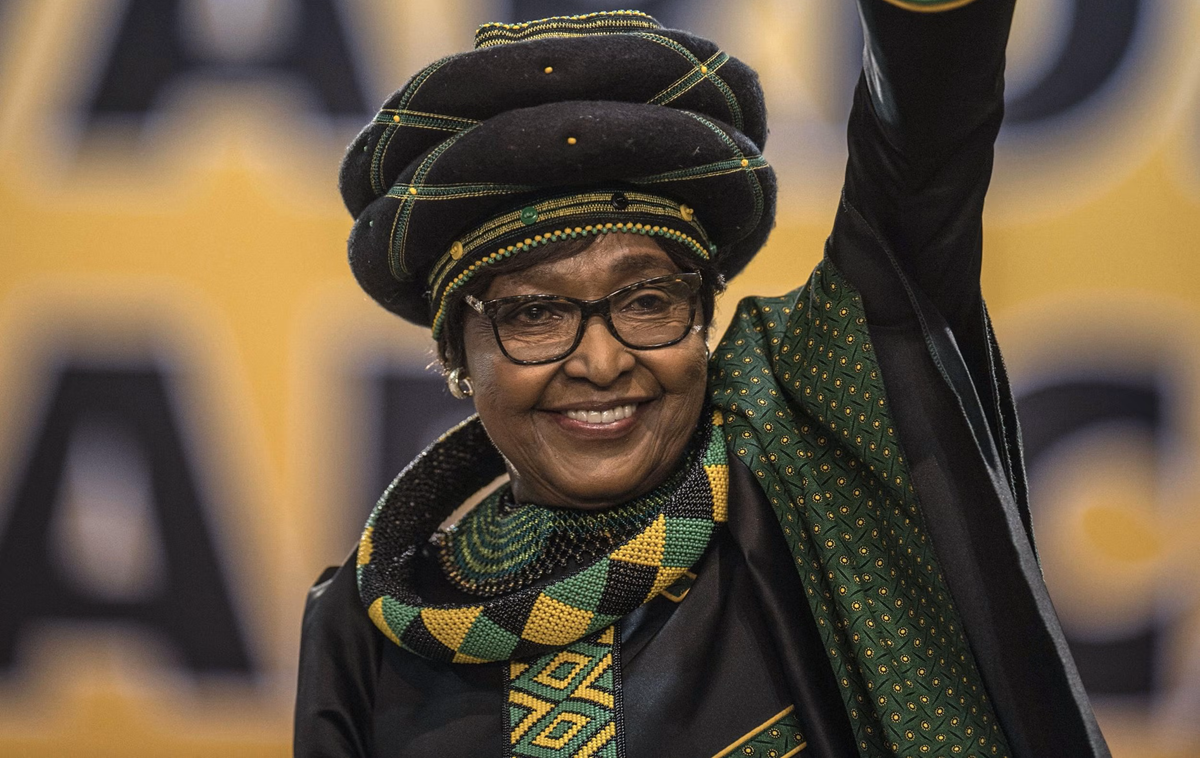
Winnie Madikizela-Madanela (1936–2018) is one of the most controversial figures in contemporary South African political history. For decades, her name was synonymous with the Black struggle against apartheid, and at the height of her activism, she was known as the “Mother of the Nation”.
Winnie Nomzamo Madikizela was born on September 26, 1936, in the village of Bizana in the Pondoland region (now part of the Eastern Cape province). She grew up in a rural environment with parents who were educators, which afforded her a relatively good education compared to most of her peers at the time. She later moved to Johannesburg to study at the Jan H. Hofmeyr School of Social Work, from which she graduated successfully. In the mid-1950s, she became the first Black social worker at Baragwanath Hospital in Soweto.
During her early career, Madikizela witnessed firsthand the tragic reality of systemic discrimination and extreme poverty endured by the Black population. This field experience helped shape her early political awareness, as she realised that the social problems she encountered daily were not merely isolated incidents but rather a direct result of a legal and political structure based on segregation and racial discrimination.
1957 marked a pivotal turning point in her life when she met Nelson Mandela, a lawyer and leading political activist in the African National Congress (ANC). The couple married in June 1958, and Winnie immediately entered the heart of the complex political arena. Family stability was short-lived, however, as Nelson was regularly pursued and targeted by the security services.
With Nelson Mandela’s arrest in 1962 and his infamous Rivonia Trial (1963-1964), which resulted in a life sentence, Winnie transformed from the wife of an imprisoned leader into a living symbol of internal resistance. At a time when most of the party’s male leadership were forced into exile or faced imprisonment, she became the last remaining public face of the movement within the country and the essential link between the masses and the leadership behind bars on Robben Island.
In the decades following her husband’s imprisonment, Winnie Madnela was subjected to an intense campaign of security harassment by the white minority government. This included repeated administrative detention, travel bans, and house arrest. In 1969, she was arrested under the Suppression of Communism Act and spent 491 days in solitary confinement, a period she later described in her memoirs as a systematic attempt to break her psychologically.
The confrontation did not abate. Following the Soweto student uprising of 1976, the security authorities considered her a key instigator of the unrest. As a result, she was exiled in 1977 to the remote township of Brandfort in Free State province. The aim of the exile was to isolate her from her popular base in Soweto, but she transformed her place of exile into a media and political focal point, where she continued to receive diplomats and foreign journalists, consistently highlighting the practices of the ruling regime.
The mid-1980s saw a shift in Winnie Mandela’s political discourse toward violent radicalism, coinciding with escalating government repression and renewed fighting in the Black suburbs. In 1986, she delivered a widely criticised speech in which she openly advocated for “necklacing”—a form of summary execution in which a burning tyre was placed around the victim’s neck—to punish suspected collaborators.
During this same period, she founded a group known as the United Mandela Football Club (MUFC), a local militia and gang that exerted significant influence in Soweto. Its members quickly became accused of acts of violence, kidnapping, and attacks against local residents. These accusations culminated in late 1988 with the abduction of four young men from a church mission house, including 14-year-old Stombi Moeketsi.
Winnie’s groups were accused of torturing young men suspected of being police informants, and Moeketsi’s body was later found with his throat slit. This incident led to widespread condemnation of Winnie by leaders of the Collective Democratic Movement and within the African National Congress (ANC) itself and was considered a major political and moral failing that tarnished her image as a liberation icon.
With the beginning of the 1990s, the release of Nelson Mandela, and the lifting of the ban on the ANC, a complex transitional phase began in Winnie’s life. In 1991, she was tried for her involvement in the abduction and assault of the young men in the Moeketsi case. She was initially convicted and sentenced to six years in prison, but the Court of Appeal later reduced the sentence to a fine and a suspended sentence for abduction only, acquitting her of the direct assault charge.
On a personal level, these events and fundamental political disagreements strained her relationship with Nelson Mandela, leading to their formal separation in 1992 and their final divorce in 1996. Despite her diminished standing with the ruling party elite, Winnie maintained immense popularity among the poorest and most marginalised communities in the suburbs, who saw her as a voice for their frustration with the slow pace of economic change.
Elected president of the ANC Women’s League in 1993, she became deputy minister of arts, culture, science, and technology in the first democratically elected government in 1994. However, Nelson Mandela dismissed her from her government post after only eleven months due to allegations of financial corruption and poor administrative discipline.
In 1997, Winnie Madikizela-Mandela appeared before the Truth and Reconciliation Commission (TRC), chaired by Archbishop Desmond Tutu. The commission held lengthy public hearings to examine the abuses committed by the United Mandela Football Club. The commission’s final report concluded that Winnie was politically and morally responsible for the gross human rights violations perpetrated by her guards, stating that she aided and abetted the creation of a climate of terror in Soweto in the late 1980s.
Legal persecution continued to haunt her into the 21st century. In 2003, she was convicted on multiple counts of bank fraud and embezzlement related to fictitious loan applications for members of the Women’s League. Her initial prison sentence was later reduced on appeal to a suspended sentence.
Despite these successive legal and political convictions, Winnie Mandela remained a member of parliament and a member of the ANC’s National Executive Committee until her death. She continued to present herself as a critic of the neoliberal policies of successive governments, arguing that the 1994 political settlement had failed to deliver the economic justice needed by the majority of the Black population.
Winnie Madikizela-Mandela died on April 2, 2018, in Johannesburg after a long illness, at the age of 81. The government declared a period of national mourning, and a state funeral was held, reflecting the weight of her historical presence.