











Qiraat Africa
عربي  |  Fr
Advertisement
  • News
    • All
    • Climate Change
    • Economy
    • Education
    • Energy
    • Health
    • Migration
    • Mining
    • Politics
    • Security
    • Society
    • Sport
    Sao Tome and Principe President Vila Nova wins second term, preliminary results show

    Sao Tome and Principe President Vila Nova wins second term, preliminary results show

    Al Qaeda affiliate says it killed 70 soldiers in Benin, SITE reports

    Mali insurgents ambush army convoy, source says more than 50 killed

    West Africa’s ECOWAS bloc signs agreement backing Nigeria-Morocco atlantic gas pipeline, statement reports

    West Africa’s ECOWAS bloc signs agreement backing Nigeria-Morocco atlantic gas pipeline, statement reports

    US to block citizens in Congo from immediate travel home, citing Ebola

    Canada to temporarily bar entry for foreigners who have recently been to Congo, against UN advice

    Kenyan officials banned from non-essential travel

    Kenya investigating cybersecurity incident affecting president’s website

    Sao Tome and Principe’s President fires Prime Minister and government

    Sao Tome and Principe votes for president, Vila Nova seeks new term

    Burkina Faso declares UN coordinator persona non grata

    UN sanctions armed groups’ leaders in eastern Congo

    DR Congo’s South Kivu governor lifts mining suspension in province

    DRC: Uvira’s displaced lose hope as US ultimatum on Rwanda troops expires

    DR Congo and Uganda report 263 confirmed Ebola cases with 43 deaths, Africa CDC says

    Aid group says seven Americans quarantining at Kenya Ebola facility after US travel ban

  • Analysis
    • All
    • Climate Change
    • Digital & Tech
    • Economy
    • Energy & Power
    • Health
    • Politics
    • Security
    • Society
    African entrepreneurs work in challenging environments, and others may benefit from the skills they have developed

    African entrepreneurs work in challenging environments, and others may benefit from the skills they have developed

    Title: Ethiopia’s 2026 General Election: Progress, Challenges, and Implications

    Title: Ethiopia’s 2026 General Election: Progress, Challenges, and Implications

    Senegal’s top opposition leader Sonko vows to help win March 24 election

    Senegal at a Political Crossroads: The Faye–Sonko Rivalry and the Future of Democratic Governance

    Ulysses in isiZulu: Why an African translation of the classic Irish novel is important in today’s world

    Ulysses in isiZulu: Why an African translation of the classic Irish novel is important in today’s world

    The promise and risks of Kenya’s ambitious new strategy to close refugee camps

    The promise and risks of Kenya’s ambitious new strategy to close refugee camps

    Al Qaeda-linked militants curb their brutality in seized Malian territory

    Al Qaeda-linked militants curb their brutality in seized Malian territory

    Five Years After the Coup in Mali: Are Stability and Growth Within Reach?

    The Political Economy of Insecurity in Mali: Armed Groups, Resources, and State Fragility

    Ghana to evacuate 300 citizens from South Africa after xenophobic attacks

    Xenophobic Violence and Human Security in South Africa: Causes and Consequences

    Inside an African lab that helped crack the hantavirus outbreak

    Inside an African lab that helped crack the hantavirus outbreak

  • Studies
    Angola’s lengthy war shaped the way farmers utilised fire—why it matters

    Angola’s lengthy war shaped the way farmers utilised fire—why it matters

    Schooling is the most severely affected by conflict when children are the target – Study

    Schooling is the most severely affected by conflict when children are the target – Study

    Pensions for Botswana’s elderly are expanding, but care services are lacking—study follows 20 years

    Pensions for Botswana’s elderly are expanding, but care services are lacking—study follows 20 years

    60 new cosmic structures have been discovered by South Africa’s MeerKAT telescope, which is mapping previously unseen gaps between galaxies

    60 new cosmic structures have been discovered by South Africa’s MeerKAT telescope, which is mapping previously unseen gaps between galaxies

    Benin government says armed forces foil coup attempt

    Coup contagion? A rash of African power grabs suggests copycats are taking note of others’ success

    One in three South Africans have never heard of AI: what this means for policy

    One in three South Africans have never heard of AI: what this means for policy

    Social Media as a Catalyst for the Spread of Dangerous Wealth Ritual Myths

    Social Media as a Catalyst for the Spread of Dangerous Wealth Ritual Myths

    Overcoming Education Barriers for Young Mothers in Sub-Saharan Africa

    Overcoming Education Barriers for Young Mothers in Sub-Saharan Africa

    Youth Empowerment Through Vocational Training in Rural Sub-Saharan Africa

    Youth Empowerment Through Vocational Training in Rural Sub-Saharan Africa

  • Infographics
  • Figures
    Marcus Garvey (1887-1940): Activist, Black nationalist, and Pan-Africanist

    Marcus Garvey (1887-1940): Activist, Black nationalist, and Pan-Africanist

    John B. Russwurm (1799–1851): Jamaican-born American abolitionist, publisher, and colonial governor

    John B. Russwurm (1799–1851): Jamaican-born American abolitionist, publisher, and colonial governor

    Winnie Mandela (1936-2018): South African politician and anti-apartheid activist

    Winnie Mandela (1936-2018): South African politician and anti-apartheid activist

    Abdias do Nascimento (1914-2011): Prominent African Brazilian scholar, artist, and politician

    Abdias do Nascimento (1914-2011): Prominent African Brazilian scholar, artist, and politician

    Edward Wilmot Blyden (1832-1912): Educator and former Secretary of State of Liberia

    Edward Wilmot Blyden (1832-1912): Educator and former Secretary of State of Liberia

    Eduardo Mondlane (1920-1969): Mozambican Revolutionary and Anthropologist

    Eduardo Mondlane (1920-1969): Mozambican Revolutionary and Anthropologist

    William Tubman (1895-1971): Liberian politician and longest-serving president in the country’s history

    William Tubman (1895-1971): Liberian politician and longest-serving president in the country’s history

    Abebe Bikila (1932-1973): Ethiopian marathoner and first black African to win an Olympic medal

    Abebe Bikila (1932-1973): Ethiopian marathoner and first black African to win an Olympic medal

    W. E. B. Du Bois (1868-1963): Sociologist, historian, and Pan-Africanist civil rights activist

    W. E. B. Du Bois (1868-1963): Sociologist, historian, and Pan-Africanist civil rights activist

  • History
    Laas Geel, Somalia

    Laas Geel, Somalia

    Lakes Of Ounianga, Chad

    Lakes Of Ounianga, Chad

    Nok Caves, Togo

    Nok Caves, Togo

    The Land of Punt (modern Somalia, Eritrea, Ethiopia, or eastern Sudan)

    The Land of Punt (modern Somalia, Eritrea, Ethiopia, or eastern Sudan)

    Avenue of the Baobabs, Madagascar

    Avenue of the Baobabs, Madagascar

    Lopé-Okanda (Gabon)

    Lopé-Okanda (Gabon)

    The Sudd wetland

    The Sudd wetland

    Khami Ruins (Zimbabwe), the capital of the Torwa state

    Khami Ruins (Zimbabwe), the capital of the Torwa state

    Royal Palace, Porto-Novo, Republic of Benin

    Royal Palace, Porto-Novo, Republic of Benin

  • Others
    • Culture / Literature
    • Interview
    • Opinion
  • Countries
    • Country profiles
    • Regions
      • Central Africa
      • East Africa
      • Southern Africa
      • West Africa
No Result
View All Result
  • News
    • All
    • Climate Change
    • Economy
    • Education
    • Energy
    • Health
    • Migration
    • Mining
    • Politics
    • Security
    • Society
    • Sport
    Sao Tome and Principe President Vila Nova wins second term, preliminary results show

    Sao Tome and Principe President Vila Nova wins second term, preliminary results show

    Al Qaeda affiliate says it killed 70 soldiers in Benin, SITE reports

    Mali insurgents ambush army convoy, source says more than 50 killed

    West Africa’s ECOWAS bloc signs agreement backing Nigeria-Morocco atlantic gas pipeline, statement reports

    West Africa’s ECOWAS bloc signs agreement backing Nigeria-Morocco atlantic gas pipeline, statement reports

    US to block citizens in Congo from immediate travel home, citing Ebola

    Canada to temporarily bar entry for foreigners who have recently been to Congo, against UN advice

    Kenyan officials banned from non-essential travel

    Kenya investigating cybersecurity incident affecting president’s website

    Sao Tome and Principe’s President fires Prime Minister and government

    Sao Tome and Principe votes for president, Vila Nova seeks new term

    Burkina Faso declares UN coordinator persona non grata

    UN sanctions armed groups’ leaders in eastern Congo

    DR Congo’s South Kivu governor lifts mining suspension in province

    DRC: Uvira’s displaced lose hope as US ultimatum on Rwanda troops expires

    DR Congo and Uganda report 263 confirmed Ebola cases with 43 deaths, Africa CDC says

    Aid group says seven Americans quarantining at Kenya Ebola facility after US travel ban

  • Analysis
    • All
    • Climate Change
    • Digital & Tech
    • Economy
    • Energy & Power
    • Health
    • Politics
    • Security
    • Society
    African entrepreneurs work in challenging environments, and others may benefit from the skills they have developed

    African entrepreneurs work in challenging environments, and others may benefit from the skills they have developed

    Title: Ethiopia’s 2026 General Election: Progress, Challenges, and Implications

    Title: Ethiopia’s 2026 General Election: Progress, Challenges, and Implications

    Senegal’s top opposition leader Sonko vows to help win March 24 election

    Senegal at a Political Crossroads: The Faye–Sonko Rivalry and the Future of Democratic Governance

    Ulysses in isiZulu: Why an African translation of the classic Irish novel is important in today’s world

    Ulysses in isiZulu: Why an African translation of the classic Irish novel is important in today’s world

    The promise and risks of Kenya’s ambitious new strategy to close refugee camps

    The promise and risks of Kenya’s ambitious new strategy to close refugee camps

    Al Qaeda-linked militants curb their brutality in seized Malian territory

    Al Qaeda-linked militants curb their brutality in seized Malian territory

    Five Years After the Coup in Mali: Are Stability and Growth Within Reach?

    The Political Economy of Insecurity in Mali: Armed Groups, Resources, and State Fragility

    Ghana to evacuate 300 citizens from South Africa after xenophobic attacks

    Xenophobic Violence and Human Security in South Africa: Causes and Consequences

    Inside an African lab that helped crack the hantavirus outbreak

    Inside an African lab that helped crack the hantavirus outbreak

  • Studies
    Angola’s lengthy war shaped the way farmers utilised fire—why it matters

    Angola’s lengthy war shaped the way farmers utilised fire—why it matters

    Schooling is the most severely affected by conflict when children are the target – Study

    Schooling is the most severely affected by conflict when children are the target – Study

    Pensions for Botswana’s elderly are expanding, but care services are lacking—study follows 20 years

    Pensions for Botswana’s elderly are expanding, but care services are lacking—study follows 20 years

    60 new cosmic structures have been discovered by South Africa’s MeerKAT telescope, which is mapping previously unseen gaps between galaxies

    60 new cosmic structures have been discovered by South Africa’s MeerKAT telescope, which is mapping previously unseen gaps between galaxies

    Benin government says armed forces foil coup attempt

    Coup contagion? A rash of African power grabs suggests copycats are taking note of others’ success

    One in three South Africans have never heard of AI: what this means for policy

    One in three South Africans have never heard of AI: what this means for policy

    Social Media as a Catalyst for the Spread of Dangerous Wealth Ritual Myths

    Social Media as a Catalyst for the Spread of Dangerous Wealth Ritual Myths

    Overcoming Education Barriers for Young Mothers in Sub-Saharan Africa

    Overcoming Education Barriers for Young Mothers in Sub-Saharan Africa

    Youth Empowerment Through Vocational Training in Rural Sub-Saharan Africa

    Youth Empowerment Through Vocational Training in Rural Sub-Saharan Africa

  • Infographics
  • Figures
    Marcus Garvey (1887-1940): Activist, Black nationalist, and Pan-Africanist

    Marcus Garvey (1887-1940): Activist, Black nationalist, and Pan-Africanist

    John B. Russwurm (1799–1851): Jamaican-born American abolitionist, publisher, and colonial governor

    John B. Russwurm (1799–1851): Jamaican-born American abolitionist, publisher, and colonial governor

    Winnie Mandela (1936-2018): South African politician and anti-apartheid activist

    Winnie Mandela (1936-2018): South African politician and anti-apartheid activist

    Abdias do Nascimento (1914-2011): Prominent African Brazilian scholar, artist, and politician

    Abdias do Nascimento (1914-2011): Prominent African Brazilian scholar, artist, and politician

    Edward Wilmot Blyden (1832-1912): Educator and former Secretary of State of Liberia

    Edward Wilmot Blyden (1832-1912): Educator and former Secretary of State of Liberia

    Eduardo Mondlane (1920-1969): Mozambican Revolutionary and Anthropologist

    Eduardo Mondlane (1920-1969): Mozambican Revolutionary and Anthropologist

    William Tubman (1895-1971): Liberian politician and longest-serving president in the country’s history

    William Tubman (1895-1971): Liberian politician and longest-serving president in the country’s history

    Abebe Bikila (1932-1973): Ethiopian marathoner and first black African to win an Olympic medal

    Abebe Bikila (1932-1973): Ethiopian marathoner and first black African to win an Olympic medal

    W. E. B. Du Bois (1868-1963): Sociologist, historian, and Pan-Africanist civil rights activist

    W. E. B. Du Bois (1868-1963): Sociologist, historian, and Pan-Africanist civil rights activist

  • History
    Laas Geel, Somalia

    Laas Geel, Somalia

    Lakes Of Ounianga, Chad

    Lakes Of Ounianga, Chad

    Nok Caves, Togo

    Nok Caves, Togo

    The Land of Punt (modern Somalia, Eritrea, Ethiopia, or eastern Sudan)

    The Land of Punt (modern Somalia, Eritrea, Ethiopia, or eastern Sudan)

    Avenue of the Baobabs, Madagascar

    Avenue of the Baobabs, Madagascar

    Lopé-Okanda (Gabon)

    Lopé-Okanda (Gabon)

    The Sudd wetland

    The Sudd wetland

    Khami Ruins (Zimbabwe), the capital of the Torwa state

    Khami Ruins (Zimbabwe), the capital of the Torwa state

    Royal Palace, Porto-Novo, Republic of Benin

    Royal Palace, Porto-Novo, Republic of Benin

  • Others
    • Culture / Literature
    • Interview
    • Opinion
  • Countries
    • Country profiles
    • Regions
      • Central Africa
      • East Africa
      • Southern Africa
      • West Africa
No Result
View All Result
Qiraat Africa
عربي  |  Fr
No Result
View All Result
Home Regions East Africa

Title: Ethiopia’s 2026 General Election: Progress, Challenges, and Implications

Oyebamiji Usman Adesoji by Oyebamiji Usman Adesoji
July 20, 2026
Title: Ethiopia’s 2026 General Election: Progress, Challenges, and Implications

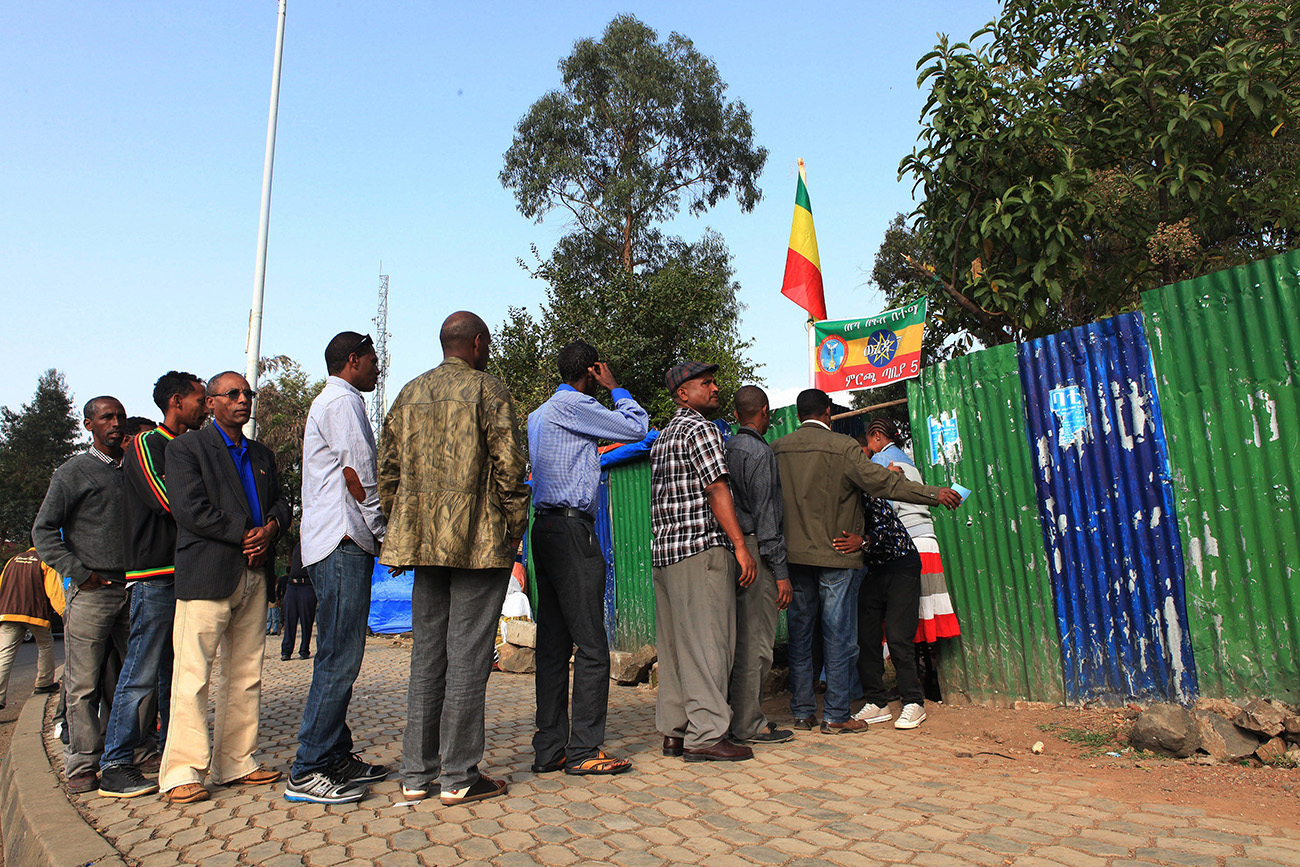
24 May 2015, Addis Ababa, Ethiopia --- epa04765092 Male residents queue for the Ethiopian presidential elections at the Bole Subcity polling station in the capital, Addis Ababa, Ethiopia, 24 May2015. The elections are the first since since the death of Prime Minister Meles Zenawi and it is expected that his successor, Hailemariam Desalegn, is certain to stay in office. An estimated 37 million people are thought to vote today. EPA/Solan Kolli --- Image by © Solan Kolli/epa/Corbis

Share on FacebookShare on Twitter

Support for democracy is falling in Africa amid a string of military coups and dissatisfaction with corruption and mismanagement, according to a report by Afrobarometer. However, Africans still have a stronger preference for democratic governance than many parts of the world. Two-thirds of people in 30 African countries prefer democracy, surveys conducted in 2021 or 2023 found, down seven percentage points from a decade earlier. Zambia topped the table in its preference for democracy. Ethiopia was in second place, followed by Senegal (The Guardian, 2024).

Ethiopian powers that be presented the election as an indication of democratic progress; critics raised apprehensions regarding political inclusiveness, security situations, and the competitiveness of the electoral procedure. Reports said Ethiopia’s electoral body suspended or cancelled voting in dozens of constituencies due to what it described as “unfavourable conditions” and violent disruptions. Voting did not take place at all in the northern region of Tigray, Ethiopia, which was at the centre of a devastating civil war from 2020 to 2022. The region now faces mass internal displacement and renewed fighting in recent months between the federal government and the Tigray People’s Liberation Front (TPLF).

However, official outcomes declared by the National Election Board of Ethiopia (NEBE) showed that Prime Minister Abiy Ahmed’s Prosperity Party won 438 seats out of 501 in the House of Representatives, the National Election Board of Ethiopia said.

The new parliament is expected to convene in October to re-elect Abiy for another five-year term. Turnout was 94%. More than 50 million people, out of Ethiopia’s estimated population of 130 million, were registered to vote, the board said. At the last elections in 2021 the Prosperity Party won a similar ​percentage of the available seats. Furthermore, the result ensured the extension of Abiy’s leadership and provided his government with a renewed mandate. Nevertheless, questions remain regarding whether electoral success translates into long-term political legitimacy and national stability.

This article studies the progress, challenges, and geopolitical implications of Ethiopia’s 2026 election through addressing main questions regarding democratic progress, ethno-federal tensions, national reconciliation, regional stability, and global engagement.

Ethiopia’s Political Situation Before the 2026 Election

In order to know the significance of the 2026 election, it is required to examine Ethiopia’s recent political development. Abiy Ahmed Ali took up the post of Prime Minister of Ethiopia in April 2018. The country was ravaged by a protracted conflict with its neighbour, Eritrea, over a disputed border area. An international arbitration commission ruled in favour of Eritrea in 2002, but the Ethiopian government refused to accept the ruling. After 16 years of “no war, no peace” between the two countries, Abiy Ahmed broke the deadlock and accepted the decision.

The Prosperity Party replaced an often-unwieldy multi-party coalition that governed ​Ethiopia for more than a quarter-century and has helped Abiy, 49, to consolidate his grip on national politics even as he has faced violent opposition in some of the country’s largest regions.

The government also faces insurgencies in the country’s two biggest regions, connected to grievances among different ethnic groups about alleged marginalisation within Ethiopia’s federal system.

For instance, the Tigray region, where hundreds of thousands of people had died in the war between the federal forces and regional groups, was again excluded from the election, denying it a voice in parliament and further pushing it to the margins. The region has not had federal representation for six years.

Tigray’s main political party reasserted control over the ‌northern ⁠Ethiopian region’s political administration in May, following through on a threat to violate a key provision of the deal that ended a civil war with the ​federal government. The conflict in Tigray, which drew in forces from neighbouring Eritrea, was one of the ⁠century’s ​deadliest, killing hundreds of thousands ​of people through direct violence, the collapse of healthcare and famine, according ​to researchers.

Additionally, tensions within the movement have produced rival factions. In early May, Tigray People’s Liberation Front chairman Debretsion Gebremichael assumed full control of the region, pushing out Addis Ababa-backed Tadesse Werede. These developments raised tensions with the federal government.

In Abiy’s native Oromiya in the south, fighting between government forces and the Oromo Liberation Army separatist group has killed ​hundreds of people in the ​past few years. In neighbouring Amhara, ⁠a militia known as Fano has captured swathes of the countryside since 2023. As a result, voting did not take place in at least eight of Amhara’s 138 constituencies.

Though a ​2022 Pretoria Peace Agreement ended the civil war in Tigray, which researchers say caused hundreds ​of thousands of ⁠deaths, a move last month by the main political party there to reassert control over the region’s political administration led Ethiopian officials and analysts to warn of the risk of fresh unrest.

Civic and political space has also narrowed in recent years. Journalists, activists and opposition figures have faced arrests, harassment, travel restrictions and pressure from security forces, particularly under emergency measures introduced during the conflicts in Amhara and Oromia.

The 2026 election consequently embodied not purely a routine democratic exercise but a serious test of Ethiopia’s state resilience and political future.

Democratic Progress and Institutional Development

Since 1995, Ethiopia has held elections every five years, except for the 2021 election, delayed by COVID-19. The incumbent party has consistently secured over 95% of national parliament seats, except for 2005, when the opposition won about 32%. In 2021, the ruling Prosperity Party won 96.8% of the seats.

Meanwhile, Prime Minister Abiy Ahmed’s Prosperity Party remains by far the strongest political force nationally. The party controls most federal and regional state institutions. The incumbent faced more than 45 opposition parties that contested the election. These include the Ethiopian Citizens for Social Justice, the National Movement of Amhara, the Enat Party, the Freedom and Equality Party and the Promo Federalist Congress.

  1. Electoral Administration: The National Election Board of Ethiopia (NEBE) Chairperson Melatwork Hailu noted that it organised 19 debate forums in five languages, which were broadcast through various media outlets. She added that political parties were provided with free campaign airtime, including 782.5 hours of radio coverage, 520 hours of television airtime, and 576 newspaper columns.

Similarly, for the successful conduct of the election, more than 220,000 party representatives, 64 media institutions, and 1,814 journalists have been granted accreditation and reporting permits. In addition, licences were issued to 169 civil society organisations engaged in voter education, while 114 of them received financial support from the board. Observer licences were also granted to 55 civil society organisations.

Read also

African entrepreneurs work in challenging environments, and others may benefit from the skills they have developed

Sao Tome and Principe President Vila Nova wins second term, preliminary results show

Mali insurgents ambush army convoy, source says more than 50 killed

Among the 47 participating political parties, the ruling Prosperity Party (PP) fielded candidates in all constituencies. Several regional and national opposition parties also registered candidates, though some prominent opposition coalitions expressed reservations about the fairness of the electoral environment. NEBE announced that all submitted nominations underwent a screening process to verify that candidates met the constitutional and legal requirements for candidacy, including age, citizenship, and freedom from legal disqualification.

Also, women’s participation among registered candidates reached approximately 30%, the highest proportion recorded in any Ethiopian general election to date, a result NEBE attributed to targeted outreach and gender parity incentives introduced in the updated electoral framework.

2. Positive Assessments by Regional Observers: The presence of observers from regional organisations such as the African Union and the Intergovernmental Authority on Development, who were confined mostly to Addis Ababa, helped provide the election with international legitimacy. The missions were criticised for not deploying more personnel across the country.

However, the African Union and IGAD Election Observation Missions to the 2026 Ethiopian election have commended the significant milestone in the country’s democratic and electoral evolution. Presenting the preliminary statement of the mission, AUEOM Head and former Kenyan President Uhuru Kenyatta said the election was conducted within a legal and institutional framework that broadly supports democratic governance.

In addition, the Chairperson of the African Union Commission, Mahmoud Ali Youssouf, also acknowledged Ethiopia for the fruitful conduct of the election and commended the professionalism of the electoral establishments. These assessments propose that Ethiopia has made measurable progress in building electoral institutions related to previous decades categorised by more centralised and less competitive political systems.

Persistent Democratic Deficits

More than ​50 million people were registered to vote, but there was no election in the northern Tigray region, where organisers had cited “unfavourable conditions” ‌in the ⁠aftermath of a two-year civil war and amid continuing political turmoil. Subsequently, while the election reinforced procedural features of democracy, questions persist regarding functional democratic pluralism.

Opposition parties accuse the federal government of undermining them by arresting ⁠their leaders ​and imposing legal roadblocks to their political activities, charges denied by the ​government. Also, the election faced criticism, with most of the ruling party’s opponents prevented from participating, while its most prominent critics were imprisoned, in exile, or had disappeared. Similarly, those who chose to run in the election complained that it was neither free nor fair and that the political environment was rife with fear and intimidation.

Yitayal Assefa, who ran under the opposition banner of the All Ethiopia Unity Party and lost, told The Associated Press recently that he felt the government had an overwhelming advantage while opposition members were harassed and did not stand a chance. “My participation was not about winning but about fighting for my voice and political ideals within the political spectrum against a government that is assured of a win, win or lose,” he said.

While Merara Gudina, a professor at Addis Ababa University and an opposition leader who refused to participate in the election, told the AP that the vote was a “sham” and that the ruling party’s win was no surprise. He said the result will “negatively affect the already deteriorating stability of the country”.

The Centrality of Ethnic Politics

Ethiopia’s multi-ethnic federal system was introduced in 1991. It was designed to accommodate diversity and grant significant autonomy to regional states. But in practice it has also sharpened struggles over territory, autonomy and access to political power.

Today those unresolved tensions are visible in the insurgency in Amhara, the conflict in Oromia and the fragile post-war order in Tigray. If voting cannot take place across those three major regions and ethnic groups, then the elections lose legitimacy.

Rather than resolving competing claims, the federal system has in many cases institutionalised them by linking territory, political representation and state power to ethnic identity. For some the system has failed, as power was highly centralised. For others it contributed to the development of ethno-nationalism at the expense of a common national identity and nationhood.

The result is that identity has been turned into a central axis of political competition.

In his research work, Bizuneh Yimenu, Lecturer in Comparative Politics, Queen’s University Belfast, says that in an ethnically diverse federal state like Ethiopia, an electoral system that promotes broad representation is essential for stability and inclusive governance.

Furthermore, Bizuneh suggests three steps. First, moving towards a proportional representation system would help balance the political competition. Proportional representation means that if a party gets 20% of the vote, it receives 20% of the seats. About 130 countries, including South Africa, Namibia and Sierra Leone, use this system. Multi-party representation has led to more stable and inclusive governance. Fewer than 55 countries use first-past-the-post. Second, the government must guarantee that opposition parties can operate freely in all regions, not just in areas where they pose little threat. All parties should have an equal chance to compete.

Third, independent electoral bodies and international observers need greater access to ensure fair play. Strengthening Ethiopia’s electoral board and making sure it’s impartial will foster public trust in elections. He added that Ethiopia’s democracy is at a tipping point. If the country continues with its current system, it risks further political alienation and instability. By embracing electoral reform, Ethiopia could move towards a more peaceful, inclusive, democratic and representative future.

Regional Implications: Ethiopia and the Horn of Africa

Ethiopia is one of the world’s oldest countries, its territorial extent having varied over the millennia of its existence. In ancient times it remained centred on Aksum, an imperial capital located in the northern part of the modern state, about 100 miles (160 km) from the Red Sea coast. The landlocked country on the Horn of Africa’s capital is Addis Ababa (“New Flower”), located almost at the centre of the country. Ethiopia is the largest and most populated country in the Horn of Africa. With the 1993 secession of Eritrea, its former province along the Red Sea, Ethiopia became landlocked.

The Horn of Africa is a region marked by both historical complexity and contemporary strategic importance. Comprising Ethiopia, Somalia, Kenya, Sudan, Eritrea, and Djibouti, the Horn sits at the crossroads of critical global trade routes, linking the Middle East to Sub-Saharan Africa. The geopolitics of the Horn of Africa is shaped by both regional dynamics and external interventions.

Meanwhile, China and the United States have increasingly sought to secure economic and strategic footholds in the region, with China’s Belt and Road Initiative further embedding it as a key player in the region’s infrastructure development. The role of international organisations, such as the African Union (AU) and the United Nations, has also been crucial in peacekeeping and conflict resolution, though their effectiveness has often been limited by geopolitical rivalries and inadequate resources.

Indeed, Ethiopia’s involvement in the wider Sudan conflict is another source of tension. An escalation with Eritrea or further spillover from Sudan could intensify nationalist rhetoric and divert political attention away from domestic reform.

In September 2018, he and Eritrean President Isaias Afwerki signed a historic peace agreement. Mr Abiy’s peace deal with Eritrea ended a 20-year military stalemate following their 1998-2000 border war. He was named as the winner of the 100th Nobel Peace Prize in Oslo, where he will receive the award in 2019. Analyst says the two countries then fought alongside each other against the TPLF during the Tigray war, but tensions have since spiked over Abiy’s push for access to the Red Sea and Eritrea’s refusal to withdraw its troops from border regions in western Tigray. (Ethiopia lost maritime access when Eritrea gained independence from it in 1993.)

Experts believe that the Horn of Africa’s geopolitical challenges are deeply intertwined with internal conflicts, external interventions, and regional rivalries. While external actors have brought investment and support for peacekeeping, their involvement often complicates efforts to resolve conflicts. Regional organisations like the African Union and IGAD play a critical role but face significant hurdles in maintaining unity and effectiveness. Ultimately, the path to stability in the Horn of Africa will require greater regional cooperation, the strengthening of local governance, and a more balanced approach to external engagement, where foreign powers prioritise the long-term peace and development of the region rather than their own strategic interests.

In conclusion, Abiy’s re-election paves the way for advancement of his Red Sea ambitions, which he describes as an “existential” imperative for Ethiopia. His push has already triggered an alliance among Eritrea, Somalia, and Egypt, which has its own grievances with Addis Ababa over the Grand Ethiopian Renaissance Dam, risking a broader regional conflict.

Source: Qiraat Africa
Tags: Ethiopia
Oyebamiji Usman Adesoji

Oyebamiji Usman Adesoji

Writer and researcher on business, entrepreneurship and geopolitical affairs.

Related Posts

US to block citizens in Congo from immediate travel home, citing Ebola
East Africa

Canada to temporarily bar entry for foreigners who have recently been to Congo, against UN advice

July 20, 2026
Kenyan officials banned from non-essential travel
East Africa

Kenya investigating cybersecurity incident affecting president’s website

July 19, 2026
Sao Tome and Principe’s President fires Prime Minister and government
Featured

Sao Tome and Principe votes for president, Vila Nova seeks new term

July 19, 2026
Burkina Faso declares UN coordinator persona non grata
East Africa

UN sanctions armed groups’ leaders in eastern Congo

July 19, 2026
DR Congo’s South Kivu governor lifts mining suspension in province
East Africa

DRC: Uvira’s displaced lose hope as US ultimatum on Rwanda troops expires

July 17, 2026
DR Congo and Uganda report 263 confirmed Ebola cases with 43 deaths, Africa CDC says
East Africa

Aid group says seven Americans quarantining at Kenya Ebola facility after US travel ban

July 17, 2026

Search Qiraat Africa

No Result
View All Result

Follow on Twitter

Follow @africanqiraat

Trending

No Content Available

Facebook

Sections

  • About Us
  • Privacy Policy
  • Opinion
  • Infographics
  • News
  • Analysis
  • Figures
  • Culture & Literature
  • Follow Ups
  • Historical Readings
  • Interview
  • Studies


© Copyright Qiraat Africa. Developed by Bunnaj Media .

No Result
View All Result
  • News
  • Analysis & Report
  • Studies
  • Opinion
  • Interview
  • Culture & Literature
  • Figures
  • Historical Readings
  • Regions

© 2021 Copyright Qiraat Africa.