




Qiraat Africa
عربي  |  Fr
Advertisement
  • News
    • All
    • Climate Change
    • Economy
    • Education
    • Energy
    • Health
    • Migration
    • Mining
    • Politics
    • Security
    • Society
    • Sport
    In Democratic Republic of Congo, Ebola At Its Brim

    Second Ebola treatment centre opens in North Kivu

    Tanzania’s president dismisses foreign, information ministers

    Tanzania on edge ahead of planned protests

    Cape Verde’s World Cup team returns home to a hero’s welcome

    Cape Verde’s World Cup team returns home to a hero’s welcome

    Production starts at Senegal’s first offshore oil project

    Senegal’s Sangomar oil project has produced about 18 million barrels so far this year, document says

    Nigeria says two nationals killed in anti-migrant violence in South Africa

    Nigeria says two nationals killed in anti-migrant violence in South Africa

    What the AU’s new mission means for Somalia?

    Somalia peacekeeping mission at risk as US blocks UN support, sources say

    Insurgents stage coordinated attacks on army positions across Mali

    Insurgents stage coordinated attacks on army positions across Mali

    Tanzania’s president dismisses foreign, information ministers

    US to give Tanzania $1.3 billion under five-year health pact

    Kenyan activists launch new court case against luxury lodges in Maasai Mara reserve

    Kenyan activists launch new court case against luxury lodges in Maasai Mara reserve

  • Analysis
    • All
    • Climate Change
    • Digital & Tech
    • Economy
    • Energy & Power
    • Health
    • Politics
    • Security
    • Society
    Senegal’s top opposition leader Sonko vows to help win March 24 election

    Senegal at a Political Crossroads: The Faye–Sonko Rivalry and the Future of Democratic Governance

    Ulysses in isiZulu: Why an African translation of the classic Irish novel is important in today’s world

    Ulysses in isiZulu: Why an African translation of the classic Irish novel is important in today’s world

    The promise and risks of Kenya’s ambitious new strategy to close refugee camps

    The promise and risks of Kenya’s ambitious new strategy to close refugee camps

    Al Qaeda-linked militants curb their brutality in seized Malian territory

    Al Qaeda-linked militants curb their brutality in seized Malian territory

    Five Years After the Coup in Mali: Are Stability and Growth Within Reach?

    The Political Economy of Insecurity in Mali: Armed Groups, Resources, and State Fragility

    Ghana to evacuate 300 citizens from South Africa after xenophobic attacks

    Xenophobic Violence and Human Security in South Africa: Causes and Consequences

    Inside an African lab that helped crack the hantavirus outbreak

    Inside an African lab that helped crack the hantavirus outbreak

    Nigeria’s Agricultural sector: Problems and challenges

    Agriculture in Africa: science and research cannot have an impact without investments and good policies

    Mali’s junta creates a new ministerial-level post to oversee the mining sector

    African Mineral Resources: The Controversial Link to US Health Deals

  • Studies
    Angola’s lengthy war shaped the way farmers utilised fire—why it matters

    Angola’s lengthy war shaped the way farmers utilised fire—why it matters

    Schooling is the most severely affected by conflict when children are the target – Study

    Schooling is the most severely affected by conflict when children are the target – Study

    Pensions for Botswana’s elderly are expanding, but care services are lacking—study follows 20 years

    Pensions for Botswana’s elderly are expanding, but care services are lacking—study follows 20 years

    60 new cosmic structures have been discovered by South Africa’s MeerKAT telescope, which is mapping previously unseen gaps between galaxies

    60 new cosmic structures have been discovered by South Africa’s MeerKAT telescope, which is mapping previously unseen gaps between galaxies

    Benin government says armed forces foil coup attempt

    Coup contagion? A rash of African power grabs suggests copycats are taking note of others’ success

    One in three South Africans have never heard of AI: what this means for policy

    One in three South Africans have never heard of AI: what this means for policy

    Social Media as a Catalyst for the Spread of Dangerous Wealth Ritual Myths

    Social Media as a Catalyst for the Spread of Dangerous Wealth Ritual Myths

    Overcoming Education Barriers for Young Mothers in Sub-Saharan Africa

    Overcoming Education Barriers for Young Mothers in Sub-Saharan Africa

    Youth Empowerment Through Vocational Training in Rural Sub-Saharan Africa

    Youth Empowerment Through Vocational Training in Rural Sub-Saharan Africa

  • Infographics
  • Figures
    Marcus Garvey (1887-1940): Activist, Black nationalist, and Pan-Africanist

    Marcus Garvey (1887-1940): Activist, Black nationalist, and Pan-Africanist

    John B. Russwurm (1799–1851): Jamaican-born American abolitionist, publisher, and colonial governor

    John B. Russwurm (1799–1851): Jamaican-born American abolitionist, publisher, and colonial governor

    Winnie Mandela (1936-2018): South African politician and anti-apartheid activist

    Winnie Mandela (1936-2018): South African politician and anti-apartheid activist

    Abdias do Nascimento (1914-2011): Prominent African Brazilian scholar, artist, and politician

    Abdias do Nascimento (1914-2011): Prominent African Brazilian scholar, artist, and politician

    Edward Wilmot Blyden (1832-1912): Educator and former Secretary of State of Liberia

    Edward Wilmot Blyden (1832-1912): Educator and former Secretary of State of Liberia

    Eduardo Mondlane (1920-1969): Mozambican Revolutionary and Anthropologist

    Eduardo Mondlane (1920-1969): Mozambican Revolutionary and Anthropologist

    William Tubman (1895-1971): Liberian politician and longest-serving president in the country’s history

    William Tubman (1895-1971): Liberian politician and longest-serving president in the country’s history

    Abebe Bikila (1932-1973): Ethiopian marathoner and first black African to win an Olympic medal

    Abebe Bikila (1932-1973): Ethiopian marathoner and first black African to win an Olympic medal

    W. E. B. Du Bois (1868-1963): Sociologist, historian, and Pan-Africanist civil rights activist

    W. E. B. Du Bois (1868-1963): Sociologist, historian, and Pan-Africanist civil rights activist

  • History
    Laas Geel, Somalia

    Laas Geel, Somalia

    Lakes Of Ounianga, Chad

    Lakes Of Ounianga, Chad

    Nok Caves, Togo

    Nok Caves, Togo

    The Land of Punt (modern Somalia, Eritrea, Ethiopia, or eastern Sudan)

    The Land of Punt (modern Somalia, Eritrea, Ethiopia, or eastern Sudan)

    Avenue of the Baobabs, Madagascar

    Avenue of the Baobabs, Madagascar

    Lopé-Okanda (Gabon)

    Lopé-Okanda (Gabon)

    The Sudd wetland

    The Sudd wetland

    Khami Ruins (Zimbabwe), the capital of the Torwa state

    Khami Ruins (Zimbabwe), the capital of the Torwa state

    Royal Palace, Porto-Novo, Republic of Benin

    Royal Palace, Porto-Novo, Republic of Benin

  • Others
    • Culture / Literature
    • Interview
    • Opinion
  • Countries
    • Country profiles
    • Regions
      • Central Africa
      • East Africa
      • Southern Africa
      • West Africa
No Result
View All Result
  • News
    • All
    • Climate Change
    • Economy
    • Education
    • Energy
    • Health
    • Migration
    • Mining
    • Politics
    • Security
    • Society
    • Sport
    In Democratic Republic of Congo, Ebola At Its Brim

    Second Ebola treatment centre opens in North Kivu

    Tanzania’s president dismisses foreign, information ministers

    Tanzania on edge ahead of planned protests

    Cape Verde’s World Cup team returns home to a hero’s welcome

    Cape Verde’s World Cup team returns home to a hero’s welcome

    Production starts at Senegal’s first offshore oil project

    Senegal’s Sangomar oil project has produced about 18 million barrels so far this year, document says

    Nigeria says two nationals killed in anti-migrant violence in South Africa

    Nigeria says two nationals killed in anti-migrant violence in South Africa

    What the AU’s new mission means for Somalia?

    Somalia peacekeeping mission at risk as US blocks UN support, sources say

    Insurgents stage coordinated attacks on army positions across Mali

    Insurgents stage coordinated attacks on army positions across Mali

    Tanzania’s president dismisses foreign, information ministers

    US to give Tanzania $1.3 billion under five-year health pact

    Kenyan activists launch new court case against luxury lodges in Maasai Mara reserve

    Kenyan activists launch new court case against luxury lodges in Maasai Mara reserve

  • Analysis
    • All
    • Climate Change
    • Digital & Tech
    • Economy
    • Energy & Power
    • Health
    • Politics
    • Security
    • Society
    Senegal’s top opposition leader Sonko vows to help win March 24 election

    Senegal at a Political Crossroads: The Faye–Sonko Rivalry and the Future of Democratic Governance

    Ulysses in isiZulu: Why an African translation of the classic Irish novel is important in today’s world

    Ulysses in isiZulu: Why an African translation of the classic Irish novel is important in today’s world

    The promise and risks of Kenya’s ambitious new strategy to close refugee camps

    The promise and risks of Kenya’s ambitious new strategy to close refugee camps

    Al Qaeda-linked militants curb their brutality in seized Malian territory

    Al Qaeda-linked militants curb their brutality in seized Malian territory

    Five Years After the Coup in Mali: Are Stability and Growth Within Reach?

    The Political Economy of Insecurity in Mali: Armed Groups, Resources, and State Fragility

    Ghana to evacuate 300 citizens from South Africa after xenophobic attacks

    Xenophobic Violence and Human Security in South Africa: Causes and Consequences

    Inside an African lab that helped crack the hantavirus outbreak

    Inside an African lab that helped crack the hantavirus outbreak

    Nigeria’s Agricultural sector: Problems and challenges

    Agriculture in Africa: science and research cannot have an impact without investments and good policies

    Mali’s junta creates a new ministerial-level post to oversee the mining sector

    African Mineral Resources: The Controversial Link to US Health Deals

  • Studies
    Angola’s lengthy war shaped the way farmers utilised fire—why it matters

    Angola’s lengthy war shaped the way farmers utilised fire—why it matters

    Schooling is the most severely affected by conflict when children are the target – Study

    Schooling is the most severely affected by conflict when children are the target – Study

    Pensions for Botswana’s elderly are expanding, but care services are lacking—study follows 20 years

    Pensions for Botswana’s elderly are expanding, but care services are lacking—study follows 20 years

    60 new cosmic structures have been discovered by South Africa’s MeerKAT telescope, which is mapping previously unseen gaps between galaxies

    60 new cosmic structures have been discovered by South Africa’s MeerKAT telescope, which is mapping previously unseen gaps between galaxies

    Benin government says armed forces foil coup attempt

    Coup contagion? A rash of African power grabs suggests copycats are taking note of others’ success

    One in three South Africans have never heard of AI: what this means for policy

    One in three South Africans have never heard of AI: what this means for policy

    Social Media as a Catalyst for the Spread of Dangerous Wealth Ritual Myths

    Social Media as a Catalyst for the Spread of Dangerous Wealth Ritual Myths

    Overcoming Education Barriers for Young Mothers in Sub-Saharan Africa

    Overcoming Education Barriers for Young Mothers in Sub-Saharan Africa

    Youth Empowerment Through Vocational Training in Rural Sub-Saharan Africa

    Youth Empowerment Through Vocational Training in Rural Sub-Saharan Africa

  • Infographics
  • Figures
    Marcus Garvey (1887-1940): Activist, Black nationalist, and Pan-Africanist

    Marcus Garvey (1887-1940): Activist, Black nationalist, and Pan-Africanist

    John B. Russwurm (1799–1851): Jamaican-born American abolitionist, publisher, and colonial governor

    John B. Russwurm (1799–1851): Jamaican-born American abolitionist, publisher, and colonial governor

    Winnie Mandela (1936-2018): South African politician and anti-apartheid activist

    Winnie Mandela (1936-2018): South African politician and anti-apartheid activist

    Abdias do Nascimento (1914-2011): Prominent African Brazilian scholar, artist, and politician

    Abdias do Nascimento (1914-2011): Prominent African Brazilian scholar, artist, and politician

    Edward Wilmot Blyden (1832-1912): Educator and former Secretary of State of Liberia

    Edward Wilmot Blyden (1832-1912): Educator and former Secretary of State of Liberia

    Eduardo Mondlane (1920-1969): Mozambican Revolutionary and Anthropologist

    Eduardo Mondlane (1920-1969): Mozambican Revolutionary and Anthropologist

    William Tubman (1895-1971): Liberian politician and longest-serving president in the country’s history

    William Tubman (1895-1971): Liberian politician and longest-serving president in the country’s history

    Abebe Bikila (1932-1973): Ethiopian marathoner and first black African to win an Olympic medal

    Abebe Bikila (1932-1973): Ethiopian marathoner and first black African to win an Olympic medal

    W. E. B. Du Bois (1868-1963): Sociologist, historian, and Pan-Africanist civil rights activist

    W. E. B. Du Bois (1868-1963): Sociologist, historian, and Pan-Africanist civil rights activist

  • History
    Laas Geel, Somalia

    Laas Geel, Somalia

    Lakes Of Ounianga, Chad

    Lakes Of Ounianga, Chad

    Nok Caves, Togo

    Nok Caves, Togo

    The Land of Punt (modern Somalia, Eritrea, Ethiopia, or eastern Sudan)

    The Land of Punt (modern Somalia, Eritrea, Ethiopia, or eastern Sudan)

    Avenue of the Baobabs, Madagascar

    Avenue of the Baobabs, Madagascar

    Lopé-Okanda (Gabon)

    Lopé-Okanda (Gabon)

    The Sudd wetland

    The Sudd wetland

    Khami Ruins (Zimbabwe), the capital of the Torwa state

    Khami Ruins (Zimbabwe), the capital of the Torwa state

    Royal Palace, Porto-Novo, Republic of Benin

    Royal Palace, Porto-Novo, Republic of Benin

  • Others
    • Culture / Literature
    • Interview
    • Opinion
  • Countries
    • Country profiles
    • Regions
      • Central Africa
      • East Africa
      • Southern Africa
      • West Africa
No Result
View All Result
Qiraat Africa
عربي  |  Fr
No Result
View All Result
Home Culture & Literature

The Antaifasy people of Madagascar

January 23, 2026
The Antaifasy people of Madagascar
Share on FacebookShare on Twitter

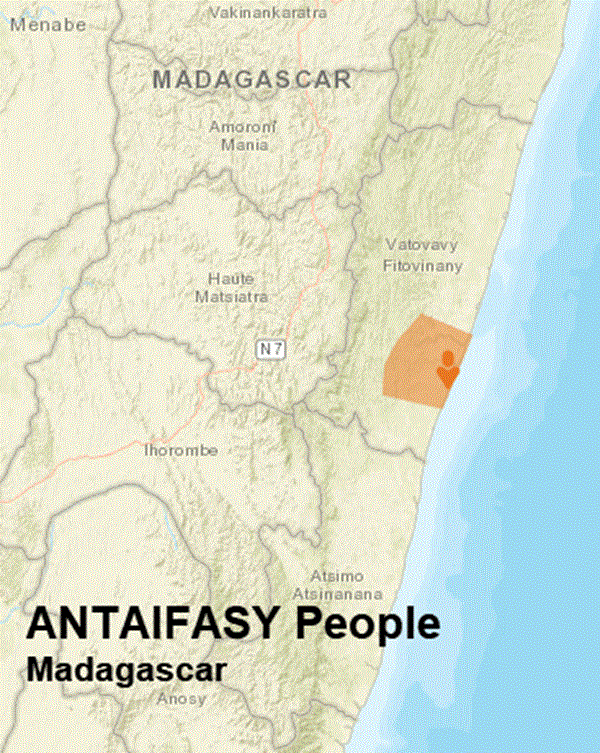
Madagascar, an island in the Indian Ocean off the east coast of Africa, is home to a complex human tapestry comprised of eighteen officially recognised ethnic groups. Among these, the Antaifasy people stand out as a significant cultural and social component of the island’s southeastern region. The word “Antaifasy” literally means “those who live in the sand” or “sand dwellers”, a name reflecting the geography of the coastal area they historically inhabited around the city of Farafangana.

Like most ethnic groups in Madagascar, the Antaifasy trace their origins to a mix of migrations from Southeast Asia (Indonesia) and the African coast, with later Arab trade influences. However, their oral traditions suggest that they began to crystallise as a distinct political and social entity in the 17th century.

Some historical studies link the emergence of the Antaifasy to the Maroserana dynasty, which ruled large parts of southern Madagascar. It is believed that a group of warriors and nobles migrated from the Sakalava region in the west and settled in the southeast, where they integrated with the local population and formed the Antaifasy identity. During the 18th century, this group established itself in the area around the Manampatrana River, founding urban and trading centres that made them a significant regional power.

Historically, the Antaifasy society has been characterised by a strict hierarchical structure, common in many Malagasy cultures, but with its own distinct form. Society is traditionally divided into three main classes or major clans.

  • The Noble Class: Descendants of founders and military leaders, they enjoy high social standing and have the right to make major political decisions and manage spiritual affairs.
  • The Middle Class (Commoners): Comprising farmers, artisans, and fishermen, they form the backbone of the local economy.
  • The Slave Class (Historically): Like most royal societies on the island, there was a class of servants and slaves who were later integrated into society after the abolition of slavery during the French colonial era.

What distinguishes the social organisation of the Antaifasy is the clan system based on absolute loyalty to the local chieftain and the distribution of land based on clan affiliation. Customary agreements or pacts play a crucial role in regulating relations between different clans to ensure social peace and prevent conflicts over natural resources.

Read also

Second Ebola treatment centre opens in North Kivu

Tanzania on edge ahead of planned protests

Somalia peacekeeping mission at risk as US blocks UN support, sources say

Due to their coastal location and the availability of fertile land around rivers, the Antaifasy have adopted a dual economic pattern combining agriculture and fishing.

Rice is the strategic and essential crop for the Antaifasy. They have developed techniques for cultivating rice in low-lying and floodplain areas, and owning rice fields is a measure of wealth and social status within the clan. As people of the sands and coast, fishing is a vital activity. They fish in the Indian Ocean and in the freshwater lakes near Varavanganja, using traditional boats and inherited techniques.

In more recent times, during and after the colonial period, the Antaifasy have cultivated coffee, vanilla, and cloves, export crops that have contributed to the introduction of a cash economy to their region. Although not as important as rice, raising Zebu cattle plays an important role in social and funeral rituals and is used as a tool for ploughing fields and a measure of financial power.

The Antaifasy adhere to a strict system of taboos, or “fady”. These taboos may relate to certain types of food, specific days on which work is prohibited, or certain behaviours toward nature. These rules aim to maintain social order and balance with spiritual and natural forces.

The history of the Antaifasy is marked by long conflicts with their neighbours, particularly the Zafisoro group. These conflicts have primarily centred on control of fertile farmland and political influence in the Farafangana region. This historical rivalry has persisted for centuries and has often led to the intervention of central powers in Madagascar or the colonial administration to resolve the disputes.

In the 19th century, the Antaifasy faced the expansion of the Merina kingdom from the high plateaus, led by King Radama I and later Queen Ranavalona I. The Antaifasy fiercely resisted attempts to assimilate them into the central kingdom, taking advantage of their rugged terrain and dense forests. However, the superior military power of the Merina, later bolstered by European technology, led to the partial subjugation of the region, resulting in changes to the traditional Antifasi administrative and tax systems.

With the arrival of French colonialism in Madagascar in 1896, the Antaifasy entered a new phase of resistance. The French administration imposed a system of forced labour and high taxes, which fuelled resentment among the local population. The Antaifasy participated in national resistance movements, particularly the major uprising of 1947 against French rule, which saw fierce fighting in the southeastern region.

After Madagascar gained independence in 1960, the Antaifasy sought to preserve their identity within the modern nation-state. Despite integration into the political and educational systems, loyalty to clans and traditional leaders remained strong in rural areas, where customary law is still applied to resolve local disputes, sometimes outside the formal court system.

Today, the Antaifasy people face significant challenges that hinder their economic and social development. The Farafangana region is subject to frequent and devastating tropical cyclones, which destroy rice crops and erode soil, exacerbating the food security crisis.

The Antaifasy-inhabited areas suffer from poor infrastructure, a lack of paved roads, and limited access to major markets, keeping many farmers trapped in subsistence poverty. The historical legacy of conflicts with the Zafisoro continues to resurface, requiring ongoing efforts from the state and civil society organisations to achieve lasting reconciliation. Also, a silent struggle exists between younger generations seeking modern education and migrating to cities and older generations who fear the loss of their traditions, language, and funeral rites.

Tags: Antaifasy peopleMadagascar

Related Posts

Tanzania’s president dismisses foreign, information ministers
East Africa

US to give Tanzania $1.3 billion under five-year health pact

July 2, 2026
Kenyan activists launch new court case against luxury lodges in Maasai Mara reserve
East Africa

Kenyan activists launch new court case against luxury lodges in Maasai Mara reserve

July 2, 2026
Ethiopia says Ghebreyesus, WHO chief has links to rebellious Tigrayan forces
East Africa

Trial for Bundibugyo Ebola treatment starts in DRC, WHO says

July 2, 2026
AU grants $10.4m for Mpox emergency response
East Africa

Africa CDC: Uganda health ministry confirms isolated Marburg case

July 1, 2026
Protesters throw rocks at Kenyan police as a three-day tax protest begins
East Africa

Kenyan police open fire at protest against reported abductions, witnesses say

June 30, 2026
Media group shut by Ugandan military says talks are underway to reopen outlets
East Africa

Media group shut by Ugandan military says talks are underway to reopen outlets

June 30, 2026

Search Qiraat Africa

No Result
View All Result

Follow on Twitter

Follow @africanqiraat

Trending

Kumbi Saleh, the capital of the ancient Ghana Empire

Kumbi Saleh, the capital of the ancient Ghana Empire

October 13, 2025
Meja Mwangi: The Literary Genius with a Mighty pen

Meja Mwangi: The Literary Genius with a Mighty pen

May 24, 2025
Mbunda people of Angola and Zambia

Mbunda people of Angola and Zambia

January 18, 2026
Tuareg: The Blue People of the Sahara

Tuareg: The Blue People of the Sahara

May 23, 2025
New date set for return of Patrice Lumumba’s tooth

Patrice Lumumba (1925-1961), Congolese politician and independence leader

March 4, 2025
Zaghawa people of northeastern Chad and western Sudan

Zaghawa people of northeastern Chad and western Sudan

March 3, 2026

Facebook

Sections

  • About Us
  • Privacy Policy
  • Opinion
  • Infographics
  • News
  • Analysis
  • Figures
  • Culture & Literature
  • Follow Ups
  • Historical Readings
  • Interview
  • Studies


© Copyright Qiraat Africa. Developed by Bunnaj Media .

No Result
View All Result
  • News
  • Analysis & Report
  • Studies
  • Opinion
  • Interview
  • Culture & Literature
  • Figures
  • Historical Readings
  • Regions

© 2021 Copyright Qiraat Africa.