







































Ahmad Baba al-Timbukti (أحمد باب الصنهاجي التُّنْبُكْتي)—historically known as Ahmad ibn Ahmad ibn Ahmad ibn Umar ibn Muhammad Aqit al-Timbukti al-Sanhaji—stands as one of the most prominent figures in the fields of Islamic thought, Hadith, and Maliki jurisprudence in West Africa during the mediaeval and early modern Islamic periods. He was born on October 26, 1556 AD, corresponding to the month of Dhu al-Qa’dah in the year 963 AH. Historians differ regarding his exact birthplace; some sources suggest he was born in the oasis of Araouane, located northwest of Timbuktu, while others argue he was born within the city of Timbuktu itself—a city that, for centuries, served as a vital commercial and cultural hub, acting as a crossroads for caravans traversing the Sahara Desert.
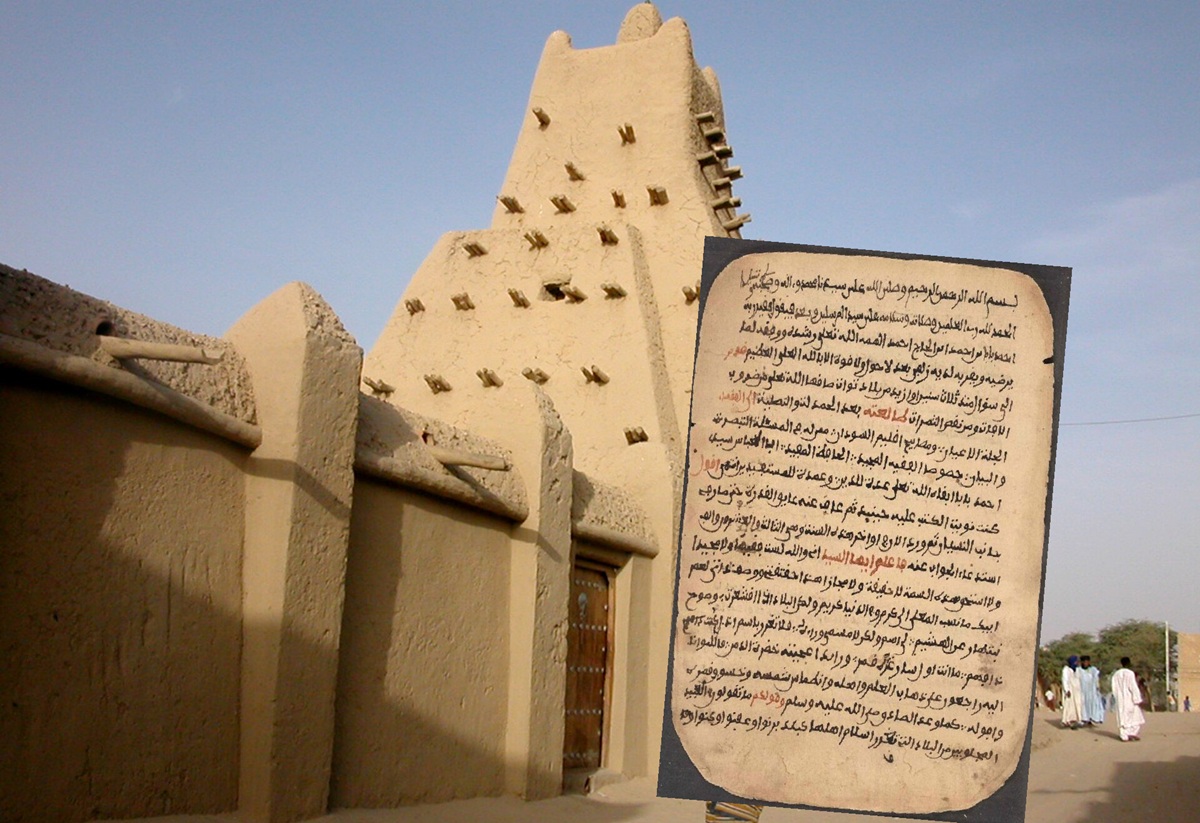
Ahmad Baba belonged to the “Aqit” (أقيت) family, a lineage renowned for its deep-rooted scholarly and religious traditions, tracing its origins back to the Sanhaja Berber tribes. He grew up in an environment that nurtured learning and knowledge; he received his early education from his father, Ahmad ibn al-Hajj, and later pursued advanced studies under the leading scholars of his time in Timbuktu—most notably the scholar and jurist Muhammad Baghayogo. Gifted with a sharp intellect and an intense thirst for knowledge, he was able, at a young age, to master foundational texts in Maliki jurisprudence, Arabic grammar, Quranic exegesis (tafsir), and theology (usul al-din). He benefited greatly from the vibrant intellectual climate of Timbuktu, which boasted major educational institutions—such as the Sankore and Sankaré universities—as well as its renowned mosques.
Ahmad Baba left behind a vast and diverse intellectual legacy, comprising dozens of works that spanned a wide range of academic disciplines. Historical estimates, derived from his own writings and the accounts of his contemporaries, suggest that he authored dozens of books and treatises. He also possessed an extensive personal library—comprising some 1,500 to 1,600 volumes covering a wide array of human and religious disciplines—which was subsequently scattered and lost in the wake of the political upheavals that struck the region.
His works span several key fields, most notably the study of biographies and the lives of notable figures. His encyclopedic work, “Nayl al-Ibtihaj bi-Tatriz al-Dibaj” (نيل الابتهاج بتطريز الديباج), stands as a primary source for the study of prominent figures within the Maliki school of jurisprudence and scholars from West Africa. He also produced an abridgement of this work, titled “Kifayat al-Muhtaj li-Ma’rifat Man Laysa fi al-Dibaj” (كفاية المحتاج لمعرفة من ليس في الديباج).
In the realm of Maliki jurisprudence (“fiqh”) and its foundational principles (“usul”), he authored numerous treatises and legal opinions (“fatawa”) addressing the specific jurisprudential challenges faced by West African society at the time. In these, he rejected intellectual stagnation, relying instead on rigorous methods of “ijtihad” (independent legal reasoning) and an approach rooted in the “maqasid” (the higher objectives of Islamic law). Furthermore, he made significant contributions to the Arabic language, including grammar and rhetoric.
Ahmad Baba’s life took a turn that altered his path for many years, following the military intervention by the Saadi Sultanate of Morocco—led by Sultan Ahmad al-Mansur al-Dhahabi—into the Songhai Empire, which resulted in the fall of its capital and major cities, such as Timbuktu and Gao, in 1591 AD. Due to his significant social and symbolic standing—and as a member of the local scholarly and religious elite who refused to submit unconditionally to the new military occupation or who openly opposed the invasion—Ahmad Baba, along with several other prominent Timbuktu scholars, was arrested in late 1593. He was taken in chains, accompanied by his family and a group of other scholars, across the Sahara Desert toward the Moroccan capital, Marrakesh—an arduous journey that historical accounts describe as marked by tragedy and severe hardships.
Ahmad Baba lived under house arrest in Morocco for approximately fourteen years, spending much of this time in the cities of Marrakesh and Fez. Despite the harshness of his exile and the loss of his personal library—the very foundation of his intellectual life—he dedicated himself to teaching, engaging in academic debates, and writing. Moroccan students and scholars, impressed by the breadth of his knowledge and his profound expertise in Islamic jurisprudence (“fiqh”) and the “hadith”, gathered around him; his teaching sessions eventually drew the attention of the elite within the Saadian royal court.
This forced exile only came to an end following the death of Sultan Ahmad al-Mansur and the accession of his successor, Sultan Zaydan al-Nasir, who issued a decree releasing the exiles and permitting them to return to their homelands.
Ahmad Baba returned to his home city of Timbuktu in April 1608.
The jurisprudential and social stance adopted by Ahmad Baba regarding the issue of slavery and human trafficking represents a significant milestone in his reformist and theoretical thought. Amidst the widespread commercial practices involving the enslavement of African peoples—and the intensifying jurisprudential debate surrounding them—he authored his renowned treatise, titled “معراج الصعود إلى نيل حكم مجلب السود” (“The Ascent to Attaining the Ruling on Imported Black Africans”).
This text was distinguished by an approach that was both bold and progressive for its historical context. Ahmad Baba sharply criticised the common conflation of skin colour with slavery, and he refuted the flimsy narratives and theories—such as the myth concerning the “curse of Ham”, found in certain “Isra’iliyyat” (Judeo-Christian traditions)—that were exploited to justify the enslavement of Black people. Employing a rigorous jurisprudential methodology, al-Timbukti argued that the default state of all human beings is freedom. He maintained that the enslavement of a human being is religiously impermissible except under the precise conditions and strict criteria established by Islamic law (“Shari‘a”). Furthermore, he asserted that the established Muslim peoples and societies of West Africa—such as those in Borno and Kano—could not be enslaved or trafficked, given their adherence to Islam and their valid faith, regardless of their skin colour.
Although this “fatwa” did not call for the total abolition of slavery—an economic and social institution deeply entrenched in the ancient and mediaeval worlds—it nonetheless constituted a significant reformist effort. It sought to protect Muslims from forced enslavement and established a legal and ethical foundation that rejects racism, affirming the equality of all Muslims regardless of their race or ethnicity. Following his return to Timbuktu, Ahmed Baba spent the final two decades of his life teaching, issuing legal opinions (fatwas), and reconstructing the city’s scholarly infrastructure—a task facilitated by his immense stature as a leading authority, which led many to regard him as the intellectual renewer of his century. Ahmed Baba al-Timbukti passed away in Timbuktu in 1627 AD (1036 AH), leaving an indelible mark on the historical and cultural memory of West Africa and the Islamic world.
To honour his memory and enduring contributions, his name was given to the foremost national institute for Islamic research, studies, and the preservation of manuscripts in Timbuktu—the Ahmed Baba Institute of Higher Learning and Islamic Research—which houses thousands of rare manuscripts documenting the region’s Islamic and cultural golden age. He remains a pillar of African cultural identity—an identity that defies oblivion—and stands as a living testament to the depth and antiquity of Islamic civilisation within the Sahara Desert.