













A team of leading Ebola scientists will travel to Nigeria to help investigate how the country’s first patient in more than a decade got infected, Africa CDC Director-General Jean Kaseya said.
Their task will involve trying to work out how the female patient, the Ugandan-born wife of a Swiss diplomat based in Abuja, caught the Bundibugyo species of Ebola. Her travel documents show she had not visited the outbreak epicentre in Democratic Republic of Congo, Kaseya said in an interview with Reuters in London.
Finding out how she became ill matters to ensure that the deadly Bundibugyo outbreak, already the second-largest Ebola epidemic on record, is not spreading silently in as-yet undiscovered locations, and to help trace and isolate all contacts.
‘MANY UNKNOWNS’
“We have so many unknowns,” said Kaseya. “I’m bringing a group of scientists in Abuja because… we need to be led by science.”
One of the theories the scientists will investigate is a potential link between the patient in Nigeria and the first case in Kenya, reported earlier this month in a man who had travelled from Congo. On Friday, genomic sequencing showed that the viruses that infected the two patients were closely related.
The patient in Nigeria had been on holiday in Uganda and travelled through Entebbe Airport on October 3. The patient in Kenya, who has since died, was likely in the airport at the same time, as their flights were around 40 minutes apart, although they did not depart from the same gate and it is not clear whether they had any contact, Kaseya said.
Kaseya said while genomic sequencing had shown that the viruses were similar, it did not mean that one of the patients had directly infected the other and the patient in Abuja, whose condition is improving, has said she does not remember meeting the Kenya patient.
However, he said they were not excluding any options, including that there may have been indirect contact through another person, for example. Ebola spreads through close contact with the infected bodily fluids of a person with symptoms, according to the World Health Organization.
INVESTIGATION ONGOING
Kaseya said all countries involved were now willing to collaborate in the investigation, after what he described as tension last week when Uganda’s government insisted the patient in Abuja had been to Congo, while Nigerian authorities suggested she had not and was infected in Uganda, which has been Ebola-free since August.
Kaseya said the team, which will be led by the co-discoverer of Ebola, Congolese expert Jean-Jacques Muyembe, would also look at more sequencing data to work out where the Kenyan patient was infected.
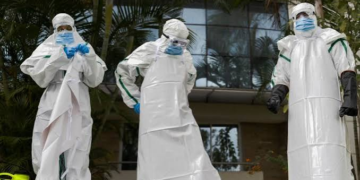
The Ebola Bundibugyo outbreak in Congo has now caused almost 10,000 cases and more than 4,600 deaths in Congo, and spread to three other countries in Africa – Kenya, Nigeria and Uganda. The disease can cause fever, vomiting, diarrhoea and, in severe cases, internal and external bleeding. There is currently no approved vaccine or treatment for Ebola Bundibugyo.