





Qiraat Africa
عربي  |  Fr
Advertisement
  • News
    • All
    • Climate Change
    • Economy
    • Education
    • Energy
    • Health
    • Migration
    • Mining
    • Politics
    • Security
    • Society
    • Sport
    Is Ethiopia’s Tigray barreling towards another war?

    Ethiopian Airlines cancels flights to Tigray region after clashes

    African governments look to Islamic finance after Benin sukuk success

    African governments look to Islamic finance after Benin sukuk success

    Ukraine says Niger’s move to cut relations is ‘regrettable’

    Gunfire, blasts rock Niger airport overnight before calm restored

    DR Congo Military Court Issues Arrest Warrant for Corneille Nangaa

    Rebel leader denounces US-DRC minerals deal one year after Goma’s fall

    Zambia groups say freedom of expression under threat

    Zambia is hopeful of agreement on debt restructuring terms with Afreximbank

    Rwanda’s presidential election set for July 15, 2024

    Rwanda says UK owes $130 million over scrapped asylum scheme

    Giant Dangote oil refinery to begin production in third quarter

    Shipping data shows Indian diesel exports to West Africa at record high

    Ex-Nigerian minister, Alison-Madueke faces bribery charges in London court

    Nigeria lowers entry barriers to attract investors for latest oil round

    Uganda’s constitutional court to hear challenges against anti-homosexuality law

    Uganda court releases prominent rights activist on bail

  • Analysis
    • All
    • Climate Change
    • Digital & Tech
    • Economy
    • Energy & Power
    • Health
    • Politics
    • Security
    • Society
    BRICS Plus and the Shifting Global Power Balance: Implications of South Africa’s Role

    BRICS Plus and the Shifting Global Power Balance: Implications of South Africa’s Role

    African Union suspends Niger over coup, prepares sanctions; France denies report it asked Algeria to use airspace for a Niger operation

    Leaders in Africa’s human rights institutions are being elected. Why it matters

    Sahel Alliance leaders meet in Bamako to deepen break with ECOWAS

    The AES and the Reconfiguration of Regional Security Architecture: A Look at the 2025 Bamako Summit

    US airstrikes in northern Nigeria: potential windfalls and dangers

    US airstrikes in northern Nigeria: potential windfalls and dangers

    Why France’s Focus is Shifting to Anglophone Africa

    Why France’s Focus is Shifting to Anglophone Africa

    UN believes hundreds were killed in Tanzania election protests

    Cameroon and Tanzania’s rulers clung to power in 2025—but look more vulnerable than ever

    General sworn in as Guinea-Bissau leader in swift coup after disputed vote

    Military and Politics in Guinea-Bissau

    Global power shifts are playing out in the Red Sea region: why this is where the rules are changing

    Global power shifts are playing out in the Red Sea region: why this is where the rules are changing

    Understanding Trump’s Christian Genocide Claim and Military Threat: What It Means for Nigeria-U.S. Relations

    Understanding Trump’s Christian Genocide Claim and Military Threat: What It Means for Nigeria-U.S. Relations

  • Studies
    Benin government says armed forces foil coup attempt

    Coup contagion? A rash of African power grabs suggests copycats are taking note of others’ success

    One in three South Africans have never heard of AI: what this means for policy

    One in three South Africans have never heard of AI: what this means for policy

    Social Media as a Catalyst for the Spread of Dangerous Wealth Ritual Myths

    Social Media as a Catalyst for the Spread of Dangerous Wealth Ritual Myths

    Overcoming Education Barriers for Young Mothers in Sub-Saharan Africa

    Overcoming Education Barriers for Young Mothers in Sub-Saharan Africa

    Youth Empowerment Through Vocational Training in Rural Sub-Saharan Africa

    Youth Empowerment Through Vocational Training in Rural Sub-Saharan Africa

    Manufacturers in Ghana and Nigeria claim that although corruption damages businesses, digital technologies provide a chance to combat it

    Manufacturers in Ghana and Nigeria claim that although corruption damages businesses, digital technologies provide a chance to combat it

    Environmental Threats and Conservation Efforts in Namibia

    Environmental Threats and Conservation Efforts in Namibia

    Your teachers’ level of knowledge affects how well you perform in class: perspectives from 14 French-speaking African nations

    Your teachers’ level of knowledge affects how well you perform in class: perspectives from 14 French-speaking African nations

    Islamic Finance in Nigeria: Between Islamization and Shariah Non-Compliance Polemics

    Islamic Finance in Nigeria: Between Islamization and Shariah Non-Compliance Polemics

  • Infographics
  • Figures
    Samori Touré (1830-1900): Military leader and founder of Wassoulou Empire

    Samori Touré (1830-1900): Military leader and founder of Wassoulou Empire

    Mohammed Abdulle Hassan (1856-1920): Somali religious and nationalist leader

    Mohammed Abdulle Hassan (1856-1920): Somali religious and nationalist leader

    Imam Abdullah Haron (1924-1969): South African Muslim cleric and anti-apartheid activist

    Imam Abdullah Haron (1924-1969): South African Muslim cleric and anti-apartheid activist

    Joyce Banda, educator and former president of Malawi

    Joyce Banda, educator and former president of Malawi

    Jomo Kenyatta (1894-1978): First prime minister and first president of Kenya

    Jomo Kenyatta (1894-1978): First prime minister and first president of Kenya

    What does a diary entry reveal about the West African origins of Apongo, a rebel leader in Jamaica?

    What does a diary entry reveal about the West African origins of Apongo, a rebel leader in Jamaica?

    Obafemi Awolowo (1909 – 1987): Nigerian statesman and influential advocate of independence

    Obafemi Awolowo (1909 – 1987): Nigerian statesman and influential advocate of independence

    Tunka Manin (c. 1010–1078), the last ruler of the Ghana Empire

    Tunka Manin (c. 1010–1078), the last ruler of the Ghana Empire

    Samuel Ajayi Crowther (1809-1891): First African Anglican Bishop

    Samuel Ajayi Crowther (1809-1891): First African Anglican Bishop

  • History
    W-Arly-Pendjari Complex, the West African wildlife sanctuary

    W-Arly-Pendjari Complex, the West African wildlife sanctuary

    Royal Court of Tiébélé, Burkina Faso

    Royal Court of Tiébélé, Burkina Faso

    Lake Tanganyika, the world’s longest freshwater lake

    Lake Tanganyika, the world’s longest freshwater lake

    The Bafut Chiefdom, Cameroon

    The Bafut Chiefdom, Cameroon

    The battles of Isandlwana and Rorke’s Drift

    The battles of Isandlwana and Rorke’s Drift

    Kimberley’s Big Hole, Northern Cape, South Africa

    Kimberley’s Big Hole, Northern Cape, South Africa

    Ogbunike Caves, Southeastern Nigeria

    Ogbunike Caves, Southeastern Nigeria

    Historic Town of Grand-Bassam

    Historic Town of Grand-Bassam

    Mandara Mountains, Northern Cameroon and Nigeria

    Mandara Mountains, Northern Cameroon and Nigeria

  • Others
    • Culture / Literature
    • Follow-ups
    • Interview
    • Opinion
  • Countries
    • Country profiles
    • Regions
      • Central Africa
      • East Africa
      • Southern Africa
      • West Africa
No Result
View All Result
  • News
    • All
    • Climate Change
    • Economy
    • Education
    • Energy
    • Health
    • Migration
    • Mining
    • Politics
    • Security
    • Society
    • Sport
    Is Ethiopia’s Tigray barreling towards another war?

    Ethiopian Airlines cancels flights to Tigray region after clashes

    African governments look to Islamic finance after Benin sukuk success

    African governments look to Islamic finance after Benin sukuk success

    Ukraine says Niger’s move to cut relations is ‘regrettable’

    Gunfire, blasts rock Niger airport overnight before calm restored

    DR Congo Military Court Issues Arrest Warrant for Corneille Nangaa

    Rebel leader denounces US-DRC minerals deal one year after Goma’s fall

    Zambia groups say freedom of expression under threat

    Zambia is hopeful of agreement on debt restructuring terms with Afreximbank

    Rwanda’s presidential election set for July 15, 2024

    Rwanda says UK owes $130 million over scrapped asylum scheme

    Giant Dangote oil refinery to begin production in third quarter

    Shipping data shows Indian diesel exports to West Africa at record high

    Ex-Nigerian minister, Alison-Madueke faces bribery charges in London court

    Nigeria lowers entry barriers to attract investors for latest oil round

    Uganda’s constitutional court to hear challenges against anti-homosexuality law

    Uganda court releases prominent rights activist on bail

  • Analysis
    • All
    • Climate Change
    • Digital & Tech
    • Economy
    • Energy & Power
    • Health
    • Politics
    • Security
    • Society
    BRICS Plus and the Shifting Global Power Balance: Implications of South Africa’s Role

    BRICS Plus and the Shifting Global Power Balance: Implications of South Africa’s Role

    African Union suspends Niger over coup, prepares sanctions; France denies report it asked Algeria to use airspace for a Niger operation

    Leaders in Africa’s human rights institutions are being elected. Why it matters

    Sahel Alliance leaders meet in Bamako to deepen break with ECOWAS

    The AES and the Reconfiguration of Regional Security Architecture: A Look at the 2025 Bamako Summit

    US airstrikes in northern Nigeria: potential windfalls and dangers

    US airstrikes in northern Nigeria: potential windfalls and dangers

    Why France’s Focus is Shifting to Anglophone Africa

    Why France’s Focus is Shifting to Anglophone Africa

    UN believes hundreds were killed in Tanzania election protests

    Cameroon and Tanzania’s rulers clung to power in 2025—but look more vulnerable than ever

    General sworn in as Guinea-Bissau leader in swift coup after disputed vote

    Military and Politics in Guinea-Bissau

    Global power shifts are playing out in the Red Sea region: why this is where the rules are changing

    Global power shifts are playing out in the Red Sea region: why this is where the rules are changing

    Understanding Trump’s Christian Genocide Claim and Military Threat: What It Means for Nigeria-U.S. Relations

    Understanding Trump’s Christian Genocide Claim and Military Threat: What It Means for Nigeria-U.S. Relations

  • Studies
    Benin government says armed forces foil coup attempt

    Coup contagion? A rash of African power grabs suggests copycats are taking note of others’ success

    One in three South Africans have never heard of AI: what this means for policy

    One in three South Africans have never heard of AI: what this means for policy

    Social Media as a Catalyst for the Spread of Dangerous Wealth Ritual Myths

    Social Media as a Catalyst for the Spread of Dangerous Wealth Ritual Myths

    Overcoming Education Barriers for Young Mothers in Sub-Saharan Africa

    Overcoming Education Barriers for Young Mothers in Sub-Saharan Africa

    Youth Empowerment Through Vocational Training in Rural Sub-Saharan Africa

    Youth Empowerment Through Vocational Training in Rural Sub-Saharan Africa

    Manufacturers in Ghana and Nigeria claim that although corruption damages businesses, digital technologies provide a chance to combat it

    Manufacturers in Ghana and Nigeria claim that although corruption damages businesses, digital technologies provide a chance to combat it

    Environmental Threats and Conservation Efforts in Namibia

    Environmental Threats and Conservation Efforts in Namibia

    Your teachers’ level of knowledge affects how well you perform in class: perspectives from 14 French-speaking African nations

    Your teachers’ level of knowledge affects how well you perform in class: perspectives from 14 French-speaking African nations

    Islamic Finance in Nigeria: Between Islamization and Shariah Non-Compliance Polemics

    Islamic Finance in Nigeria: Between Islamization and Shariah Non-Compliance Polemics

  • Infographics
  • Figures
    Samori Touré (1830-1900): Military leader and founder of Wassoulou Empire

    Samori Touré (1830-1900): Military leader and founder of Wassoulou Empire

    Mohammed Abdulle Hassan (1856-1920): Somali religious and nationalist leader

    Mohammed Abdulle Hassan (1856-1920): Somali religious and nationalist leader

    Imam Abdullah Haron (1924-1969): South African Muslim cleric and anti-apartheid activist

    Imam Abdullah Haron (1924-1969): South African Muslim cleric and anti-apartheid activist

    Joyce Banda, educator and former president of Malawi

    Joyce Banda, educator and former president of Malawi

    Jomo Kenyatta (1894-1978): First prime minister and first president of Kenya

    Jomo Kenyatta (1894-1978): First prime minister and first president of Kenya

    What does a diary entry reveal about the West African origins of Apongo, a rebel leader in Jamaica?

    What does a diary entry reveal about the West African origins of Apongo, a rebel leader in Jamaica?

    Obafemi Awolowo (1909 – 1987): Nigerian statesman and influential advocate of independence

    Obafemi Awolowo (1909 – 1987): Nigerian statesman and influential advocate of independence

    Tunka Manin (c. 1010–1078), the last ruler of the Ghana Empire

    Tunka Manin (c. 1010–1078), the last ruler of the Ghana Empire

    Samuel Ajayi Crowther (1809-1891): First African Anglican Bishop

    Samuel Ajayi Crowther (1809-1891): First African Anglican Bishop

  • History
    W-Arly-Pendjari Complex, the West African wildlife sanctuary

    W-Arly-Pendjari Complex, the West African wildlife sanctuary

    Royal Court of Tiébélé, Burkina Faso

    Royal Court of Tiébélé, Burkina Faso

    Lake Tanganyika, the world’s longest freshwater lake

    Lake Tanganyika, the world’s longest freshwater lake

    The Bafut Chiefdom, Cameroon

    The Bafut Chiefdom, Cameroon

    The battles of Isandlwana and Rorke’s Drift

    The battles of Isandlwana and Rorke’s Drift

    Kimberley’s Big Hole, Northern Cape, South Africa

    Kimberley’s Big Hole, Northern Cape, South Africa

    Ogbunike Caves, Southeastern Nigeria

    Ogbunike Caves, Southeastern Nigeria

    Historic Town of Grand-Bassam

    Historic Town of Grand-Bassam

    Mandara Mountains, Northern Cameroon and Nigeria

    Mandara Mountains, Northern Cameroon and Nigeria

  • Others
    • Culture / Literature
    • Follow-ups
    • Interview
    • Opinion
  • Countries
    • Country profiles
    • Regions
      • Central Africa
      • East Africa
      • Southern Africa
      • West Africa
No Result
View All Result
Qiraat Africa
عربي  |  Fr
No Result
View All Result
Home Regions East Africa

Jomo Kenyatta (1894-1978): First prime minister and first president of Kenya

January 6, 2026
Jomo Kenyatta (1894-1978): First prime minister and first president of Kenya

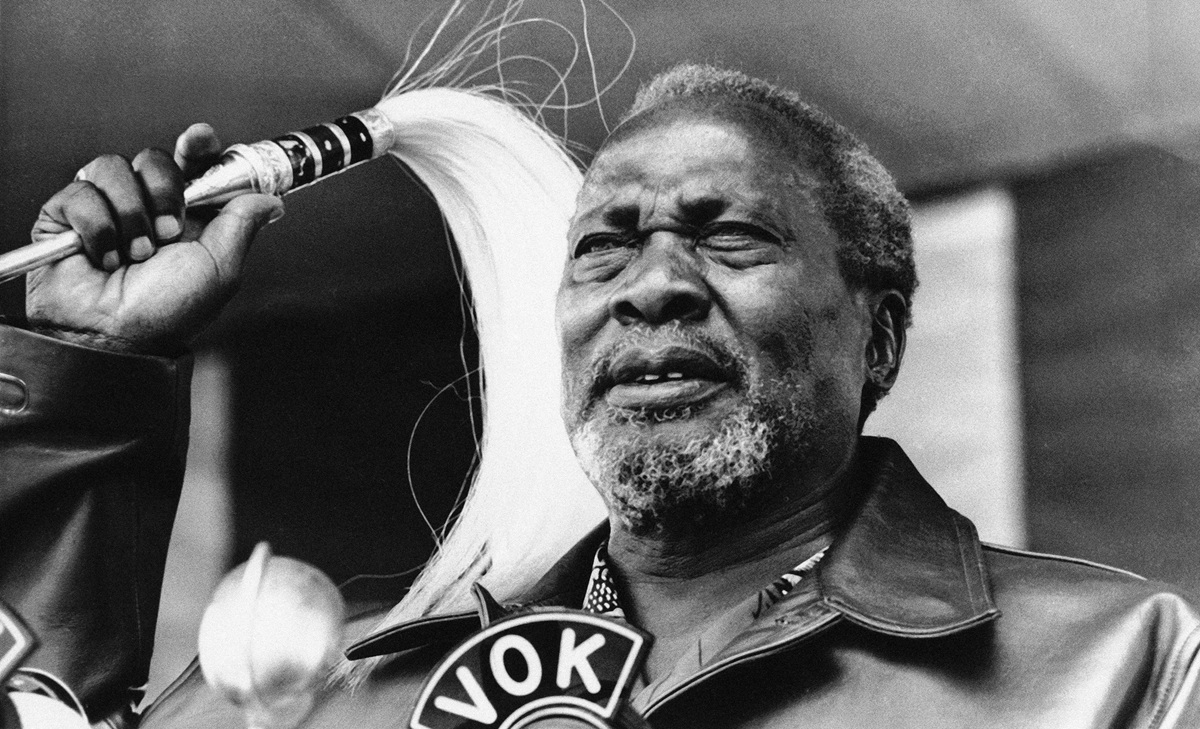
Jomo Kenyatta, President of Kenya holds the inevitable flywhisk as he addresses a huge rally to mark Kenyatta in Nairobi, Kenya, Oct. 20, 1966. (AP Photo)

Share on FacebookShare on Twitter

Jomo Kenyatta is an important figure in modern Kenyan history as the man whose name is synonymous with the transition from British colonial rule to sovereign independence. In his homeland, he is affectionately known as “Mzee,” a Swahili word meaning “wise elder” or “father,” reflecting his status as the founder of the Kenyan nation and its first president.

Jomo Kenyatta was born in the 1890s (likely 1893 or 1894) in a small village in central Kenya, to a Kikuyu family, the country’s largest ethnic group. His birth name was Kamau wa Ngengi. He enrolled in a Scottish missionary school, where he received his early education and was baptized in the church as Johnstone Kamau.

In his youth, he moved to Nairobi, where he worked for the city’s water department. During this time, his political awareness began to develop as a result of racial discrimination and the British appropriation of African tribal lands for the benefit of white settlers. He later changed his name to Jomo Kenyatta, the first name derived from a word meaning “flaming spear” and the second from a traditional belt he wore.

In 1929, Kenyatta traveled to London to represent the Kikuyu Central Association (KCA), a political organization that sought to reclaim stolen lands and improve the lives of Africans. This trip marked the beginning of a nearly 15-year period of exile that shaped his political and global outlook.

While in Europe, Kenyatta studied at the London School of Economics (LSE) under the renowned anthropologist Bronisław Malinowski. This study culminated in his seminal work, “Facing Mount Kenya,” published in 1938, in which he presented a scholarly and compelling defense of Kikuyu culture and social order, challenging the colonial view that African societies were “primitive.”

In 1945, Kenyatta helped organize the Fifth Pan-African Conference in Manchester, alongside historical figures such as Kwame Nkrumah and W.E.B. Du Bois. This conference served as a resounding call for the end of colonialism in Africa, with attendees demanding complete independence and the right of peoples to self-determination.

Kenyatta returned to his homeland in 1946 to find a country seething with discontent. He assumed the presidency of the Kenya African Union (KAU) and began traveling the country, calling for political reforms. As the colonial authorities became increasingly intransigent, the Mau Mau armed insurgency erupted in the 1950s. This clandestine movement launched attacks against white settlers and their collaborators.

Although Kenyatta publicly advocated for constitutional and peaceful change, the British administration accused him of organizing and leading the Mau Mau. In 1952, he was arrested as part of a group known as the Kapenguria Six. He was sentenced to seven years of hard labor, followed by exile to a remote area in northern Kenya. During his years in prison, Kenyatta became a symbol of resistance, and the demand for his release became a unifying national cry.

Under increasing international and domestic pressure, Kenyatta was released in 1961. He led his party, the Kenya African National Union (KANU), in the Lancaster House negotiations in London to draft the new constitution. On December 12, 1963, Kenya gained its independence, and Kenyatta became its first prime minister, then president the following year.

From the moment he took office, Kenyatta embraced a message of reconciliation. In a famous symbolic gesture, he invited white settlers to stay and contribute to building the new nation, emphasizing the need to “forget the past” and work for the future. His national motto was “Harambee,” a Swahili word meaning “let’s all work together,” which became an official philosophy for building schools and hospitals through community-based efforts.

Kenyatta opted for a moderately capitalist economic model. He encouraged foreign investment and maintained strong ties with the West, resulting in high rates of economic growth during the first decade of his rule, a period known as “Kenya Stability.”

However, his domestic policies faced significant criticism.  Over time, Kenya effectively became a one-party state, and Kenyatta severely restricted political opposition. He was accused of favoring members of his Kikuyu tribe in government positions and land distribution, sowing the seeds of the ethnic tensions that Kenya later experienced. And, while land reform was successful in some respects, vast tracts of land ended up in the hands of a political elite close to the political palace, creating stark class disparities.

His rule was marked by dramatic events that shook his image. The assassination of the charismatic politician Tom Mboya in 1969 was a dark turning point; Mboya was seen as a potential successor and a representative of the modern, cross-tribal voice. This assassination sparked widespread protests and deepened the divide between the Kikuyu and Luo tribes.

His later years were characterized by health and political isolation, with a group of close associates known as the “Kiambu clique” controlling key decision-making positions, raising concerns about the transfer of power after his death.

Read also

Ethiopian Airlines cancels flights to Tigray region after clashes

Rwanda says UK owes $130 million over scrapped asylum scheme

Uganda court releases prominent rights activist on bail

On the international stage, Kenyatta was a prominent figure in the Organization of African Unity, but he also maintained close ties with Britain and the United States during the Cold War, which provided Kenya with military and economic stability, despite criticism from leaders on the continent who considered him an appeaser of neocolonialism.

Jomo Kenyatta died on August 22, 1978, in Mombasa, leaving behind a country that was relatively stable politically and economically compared to its neighbors but burdened with structural challenges.

Kenyatta’s legacy can be summarized in two overlapping aspects. His success in preventing state collapse after independence, building a national identity under the Harambe banner, and achieving significant economic prosperity in the 1970s. However, the establishment of a strong presidential system lacking democratic institutions and the legitimization of ethnic favoritism in the distribution of state resources—problems that Kenya struggled to address for decades afterward.
Tags: Jomo KenyattaKenya

Related Posts

Uganda’s president appoints son as military chief
East Africa

Uganda army chief denies allegation of assault on opposition leader’s wife

January 27, 2026
Can the recent bilateral relationship between China and Angola lead to genuine economic and social progress this time?
Central Africa

African nations now send more money to China than they receive in new loans

January 27, 2026
Rwanda launches trial for Marburg virus as death toll climbs to 12
East Africa

Ethiopia declares end of Marburg outbreak that killed nine

January 26, 2026
Heavy fighting as Somali forces battle al-Shabab attack
East Africa

Al Shabaab kills local chief and teacher in northeast Kenya, police say

January 26, 2026
More than 640,000 people affected by catastrophic Mozambique floods
Climate Change

More than 640,000 people affected by catastrophic Mozambique floods

January 25, 2026
Uganda public prosecutor withdraws case against Bobi Wine
East Africa

Uganda opposition leader says wife hospitalised after being choked by soldiers

January 25, 2026

Search Qiraat Africa

No Result
View All Result

Follow on Twitter

Follow @africanqiraat

Trending

At least six killed in border clashes between South Sudan and Uganda

South Sudan government says rebel advance poses ‘serious threat to peace’

January 27, 2026
Brief History and Culture of the City of Lagos, Nigeria

Brief History and Culture of the City of Lagos, Nigeria

July 24, 2024
Republic of Congo to pass new gas code soon as it seeks to lure investment

Norway police file charges over suspected oil bribery in Congo Republic

January 26, 2026
Osei Tutu (c. 1660—c. 1717) , founder of the Asante nation

Osei Tutu (c. 1660—c. 1717) , founder of the Asante nation

December 6, 2025
Kumbi Saleh, the capital of the ancient Ghana Empire

Kumbi Saleh, the capital of the ancient Ghana Empire

October 13, 2025
The NYSC SCHEME in Nigeria: Impacts, Challenges, and the Path Forward

The NYSC SCHEME in Nigeria: Impacts, Challenges, and the Path Forward

June 19, 2025

Facebook

Sections

  • About Us
  • Privacy Policy
  • Opinion
  • Infographics
  • News
  • Analysis
  • Figures
  • Culture & Literature
  • Follow Ups
  • Historical Readings
  • Interview
  • Studies


© Copyright Qiraat Africa. Developed by Bunnaj Media .

No Result
View All Result
  • News
  • Analysis & Report
  • Studies
  • Opinion
  • Interview
  • Culture & Literature
  • Figures
  • Follow-ups
  • Historical Readings
  • Regions

© 2021 Copyright Qiraat Africa.