



Qiraat Africa
عربي  |  Fr
Advertisement
  • News
    • All
    • Climate Change
    • Economy
    • Education
    • Energy
    • Health
    • Migration
    • Mining
    • Politics
    • Security
    • Society
    • Sport
    Guinea-Bissau to hold referendum on expanding presidential power

    Guinea-Bissau to hold referendum on expanding presidential power

    Nigerian First Lady tells critics her husband is not a magician

    Nigeria to investigate tech firms over news content use

    Senegal’s President Faye says ruling party, led by PM Sonko, risks ‘collapse’

    Senegal’s Faye plans to form his own political party

    In Democratic Republic of Congo, Ebola At Its Brim

    Second Ebola treatment centre opens in North Kivu

    Tanzania’s president dismisses foreign, information ministers

    Tanzania on edge ahead of planned protests

    Cape Verde’s World Cup team returns home to a hero’s welcome

    Cape Verde’s World Cup team returns home to a hero’s welcome

    Production starts at Senegal’s first offshore oil project

    Senegal’s Sangomar oil project has produced about 18 million barrels so far this year, document says

    Nigeria says two nationals killed in anti-migrant violence in South Africa

    Nigeria says two nationals killed in anti-migrant violence in South Africa

    What the AU’s new mission means for Somalia?

    Somalia peacekeeping mission at risk as US blocks UN support, sources say

  • Analysis
    • All
    • Climate Change
    • Digital & Tech
    • Economy
    • Energy & Power
    • Health
    • Politics
    • Security
    • Society
    Senegal’s top opposition leader Sonko vows to help win March 24 election

    Senegal at a Political Crossroads: The Faye–Sonko Rivalry and the Future of Democratic Governance

    Ulysses in isiZulu: Why an African translation of the classic Irish novel is important in today’s world

    Ulysses in isiZulu: Why an African translation of the classic Irish novel is important in today’s world

    The promise and risks of Kenya’s ambitious new strategy to close refugee camps

    The promise and risks of Kenya’s ambitious new strategy to close refugee camps

    Al Qaeda-linked militants curb their brutality in seized Malian territory

    Al Qaeda-linked militants curb their brutality in seized Malian territory

    Five Years After the Coup in Mali: Are Stability and Growth Within Reach?

    The Political Economy of Insecurity in Mali: Armed Groups, Resources, and State Fragility

    Ghana to evacuate 300 citizens from South Africa after xenophobic attacks

    Xenophobic Violence and Human Security in South Africa: Causes and Consequences

    Inside an African lab that helped crack the hantavirus outbreak

    Inside an African lab that helped crack the hantavirus outbreak

    Nigeria’s Agricultural sector: Problems and challenges

    Agriculture in Africa: science and research cannot have an impact without investments and good policies

    Mali’s junta creates a new ministerial-level post to oversee the mining sector

    African Mineral Resources: The Controversial Link to US Health Deals

  • Studies
    Angola’s lengthy war shaped the way farmers utilised fire—why it matters

    Angola’s lengthy war shaped the way farmers utilised fire—why it matters

    Schooling is the most severely affected by conflict when children are the target – Study

    Schooling is the most severely affected by conflict when children are the target – Study

    Pensions for Botswana’s elderly are expanding, but care services are lacking—study follows 20 years

    Pensions for Botswana’s elderly are expanding, but care services are lacking—study follows 20 years

    60 new cosmic structures have been discovered by South Africa’s MeerKAT telescope, which is mapping previously unseen gaps between galaxies

    60 new cosmic structures have been discovered by South Africa’s MeerKAT telescope, which is mapping previously unseen gaps between galaxies

    Benin government says armed forces foil coup attempt

    Coup contagion? A rash of African power grabs suggests copycats are taking note of others’ success

    One in three South Africans have never heard of AI: what this means for policy

    One in three South Africans have never heard of AI: what this means for policy

    Social Media as a Catalyst for the Spread of Dangerous Wealth Ritual Myths

    Social Media as a Catalyst for the Spread of Dangerous Wealth Ritual Myths

    Overcoming Education Barriers for Young Mothers in Sub-Saharan Africa

    Overcoming Education Barriers for Young Mothers in Sub-Saharan Africa

    Youth Empowerment Through Vocational Training in Rural Sub-Saharan Africa

    Youth Empowerment Through Vocational Training in Rural Sub-Saharan Africa

  • Infographics
  • Figures
    Marcus Garvey (1887-1940): Activist, Black nationalist, and Pan-Africanist

    Marcus Garvey (1887-1940): Activist, Black nationalist, and Pan-Africanist

    John B. Russwurm (1799–1851): Jamaican-born American abolitionist, publisher, and colonial governor

    John B. Russwurm (1799–1851): Jamaican-born American abolitionist, publisher, and colonial governor

    Winnie Mandela (1936-2018): South African politician and anti-apartheid activist

    Winnie Mandela (1936-2018): South African politician and anti-apartheid activist

    Abdias do Nascimento (1914-2011): Prominent African Brazilian scholar, artist, and politician

    Abdias do Nascimento (1914-2011): Prominent African Brazilian scholar, artist, and politician

    Edward Wilmot Blyden (1832-1912): Educator and former Secretary of State of Liberia

    Edward Wilmot Blyden (1832-1912): Educator and former Secretary of State of Liberia

    Eduardo Mondlane (1920-1969): Mozambican Revolutionary and Anthropologist

    Eduardo Mondlane (1920-1969): Mozambican Revolutionary and Anthropologist

    William Tubman (1895-1971): Liberian politician and longest-serving president in the country’s history

    William Tubman (1895-1971): Liberian politician and longest-serving president in the country’s history

    Abebe Bikila (1932-1973): Ethiopian marathoner and first black African to win an Olympic medal

    Abebe Bikila (1932-1973): Ethiopian marathoner and first black African to win an Olympic medal

    W. E. B. Du Bois (1868-1963): Sociologist, historian, and Pan-Africanist civil rights activist

    W. E. B. Du Bois (1868-1963): Sociologist, historian, and Pan-Africanist civil rights activist

  • History
    Laas Geel, Somalia

    Laas Geel, Somalia

    Lakes Of Ounianga, Chad

    Lakes Of Ounianga, Chad

    Nok Caves, Togo

    Nok Caves, Togo

    The Land of Punt (modern Somalia, Eritrea, Ethiopia, or eastern Sudan)

    The Land of Punt (modern Somalia, Eritrea, Ethiopia, or eastern Sudan)

    Avenue of the Baobabs, Madagascar

    Avenue of the Baobabs, Madagascar

    Lopé-Okanda (Gabon)

    Lopé-Okanda (Gabon)

    The Sudd wetland

    The Sudd wetland

    Khami Ruins (Zimbabwe), the capital of the Torwa state

    Khami Ruins (Zimbabwe), the capital of the Torwa state

    Royal Palace, Porto-Novo, Republic of Benin

    Royal Palace, Porto-Novo, Republic of Benin

  • Others
    • Culture / Literature
    • Interview
    • Opinion
  • Countries
    • Country profiles
    • Regions
      • Central Africa
      • East Africa
      • Southern Africa
      • West Africa
No Result
View All Result
  • News
    • All
    • Climate Change
    • Economy
    • Education
    • Energy
    • Health
    • Migration
    • Mining
    • Politics
    • Security
    • Society
    • Sport
    Guinea-Bissau to hold referendum on expanding presidential power

    Guinea-Bissau to hold referendum on expanding presidential power

    Nigerian First Lady tells critics her husband is not a magician

    Nigeria to investigate tech firms over news content use

    Senegal’s President Faye says ruling party, led by PM Sonko, risks ‘collapse’

    Senegal’s Faye plans to form his own political party

    In Democratic Republic of Congo, Ebola At Its Brim

    Second Ebola treatment centre opens in North Kivu

    Tanzania’s president dismisses foreign, information ministers

    Tanzania on edge ahead of planned protests

    Cape Verde’s World Cup team returns home to a hero’s welcome

    Cape Verde’s World Cup team returns home to a hero’s welcome

    Production starts at Senegal’s first offshore oil project

    Senegal’s Sangomar oil project has produced about 18 million barrels so far this year, document says

    Nigeria says two nationals killed in anti-migrant violence in South Africa

    Nigeria says two nationals killed in anti-migrant violence in South Africa

    What the AU’s new mission means for Somalia?

    Somalia peacekeeping mission at risk as US blocks UN support, sources say

  • Analysis
    • All
    • Climate Change
    • Digital & Tech
    • Economy
    • Energy & Power
    • Health
    • Politics
    • Security
    • Society
    Senegal’s top opposition leader Sonko vows to help win March 24 election

    Senegal at a Political Crossroads: The Faye–Sonko Rivalry and the Future of Democratic Governance

    Ulysses in isiZulu: Why an African translation of the classic Irish novel is important in today’s world

    Ulysses in isiZulu: Why an African translation of the classic Irish novel is important in today’s world

    The promise and risks of Kenya’s ambitious new strategy to close refugee camps

    The promise and risks of Kenya’s ambitious new strategy to close refugee camps

    Al Qaeda-linked militants curb their brutality in seized Malian territory

    Al Qaeda-linked militants curb their brutality in seized Malian territory

    Five Years After the Coup in Mali: Are Stability and Growth Within Reach?

    The Political Economy of Insecurity in Mali: Armed Groups, Resources, and State Fragility

    Ghana to evacuate 300 citizens from South Africa after xenophobic attacks

    Xenophobic Violence and Human Security in South Africa: Causes and Consequences

    Inside an African lab that helped crack the hantavirus outbreak

    Inside an African lab that helped crack the hantavirus outbreak

    Nigeria’s Agricultural sector: Problems and challenges

    Agriculture in Africa: science and research cannot have an impact without investments and good policies

    Mali’s junta creates a new ministerial-level post to oversee the mining sector

    African Mineral Resources: The Controversial Link to US Health Deals

  • Studies
    Angola’s lengthy war shaped the way farmers utilised fire—why it matters

    Angola’s lengthy war shaped the way farmers utilised fire—why it matters

    Schooling is the most severely affected by conflict when children are the target – Study

    Schooling is the most severely affected by conflict when children are the target – Study

    Pensions for Botswana’s elderly are expanding, but care services are lacking—study follows 20 years

    Pensions for Botswana’s elderly are expanding, but care services are lacking—study follows 20 years

    60 new cosmic structures have been discovered by South Africa’s MeerKAT telescope, which is mapping previously unseen gaps between galaxies

    60 new cosmic structures have been discovered by South Africa’s MeerKAT telescope, which is mapping previously unseen gaps between galaxies

    Benin government says armed forces foil coup attempt

    Coup contagion? A rash of African power grabs suggests copycats are taking note of others’ success

    One in three South Africans have never heard of AI: what this means for policy

    One in three South Africans have never heard of AI: what this means for policy

    Social Media as a Catalyst for the Spread of Dangerous Wealth Ritual Myths

    Social Media as a Catalyst for the Spread of Dangerous Wealth Ritual Myths

    Overcoming Education Barriers for Young Mothers in Sub-Saharan Africa

    Overcoming Education Barriers for Young Mothers in Sub-Saharan Africa

    Youth Empowerment Through Vocational Training in Rural Sub-Saharan Africa

    Youth Empowerment Through Vocational Training in Rural Sub-Saharan Africa

  • Infographics
  • Figures
    Marcus Garvey (1887-1940): Activist, Black nationalist, and Pan-Africanist

    Marcus Garvey (1887-1940): Activist, Black nationalist, and Pan-Africanist

    John B. Russwurm (1799–1851): Jamaican-born American abolitionist, publisher, and colonial governor

    John B. Russwurm (1799–1851): Jamaican-born American abolitionist, publisher, and colonial governor

    Winnie Mandela (1936-2018): South African politician and anti-apartheid activist

    Winnie Mandela (1936-2018): South African politician and anti-apartheid activist

    Abdias do Nascimento (1914-2011): Prominent African Brazilian scholar, artist, and politician

    Abdias do Nascimento (1914-2011): Prominent African Brazilian scholar, artist, and politician

    Edward Wilmot Blyden (1832-1912): Educator and former Secretary of State of Liberia

    Edward Wilmot Blyden (1832-1912): Educator and former Secretary of State of Liberia

    Eduardo Mondlane (1920-1969): Mozambican Revolutionary and Anthropologist

    Eduardo Mondlane (1920-1969): Mozambican Revolutionary and Anthropologist

    William Tubman (1895-1971): Liberian politician and longest-serving president in the country’s history

    William Tubman (1895-1971): Liberian politician and longest-serving president in the country’s history

    Abebe Bikila (1932-1973): Ethiopian marathoner and first black African to win an Olympic medal

    Abebe Bikila (1932-1973): Ethiopian marathoner and first black African to win an Olympic medal

    W. E. B. Du Bois (1868-1963): Sociologist, historian, and Pan-Africanist civil rights activist

    W. E. B. Du Bois (1868-1963): Sociologist, historian, and Pan-Africanist civil rights activist

  • History
    Laas Geel, Somalia

    Laas Geel, Somalia

    Lakes Of Ounianga, Chad

    Lakes Of Ounianga, Chad

    Nok Caves, Togo

    Nok Caves, Togo

    The Land of Punt (modern Somalia, Eritrea, Ethiopia, or eastern Sudan)

    The Land of Punt (modern Somalia, Eritrea, Ethiopia, or eastern Sudan)

    Avenue of the Baobabs, Madagascar

    Avenue of the Baobabs, Madagascar

    Lopé-Okanda (Gabon)

    Lopé-Okanda (Gabon)

    The Sudd wetland

    The Sudd wetland

    Khami Ruins (Zimbabwe), the capital of the Torwa state

    Khami Ruins (Zimbabwe), the capital of the Torwa state

    Royal Palace, Porto-Novo, Republic of Benin

    Royal Palace, Porto-Novo, Republic of Benin

  • Others
    • Culture / Literature
    • Interview
    • Opinion
  • Countries
    • Country profiles
    • Regions
      • Central Africa
      • East Africa
      • Southern Africa
      • West Africa
No Result
View All Result
Qiraat Africa
عربي  |  Fr
No Result
View All Result
Home Regions East Africa

Ngugi wa Thiong’o (1938-2025): A Literary Revolutionary and Voice of African Identity

June 6, 2025
Ngugi wa Thiong’o: Five things you should know about one of Africa’s greatest living writers

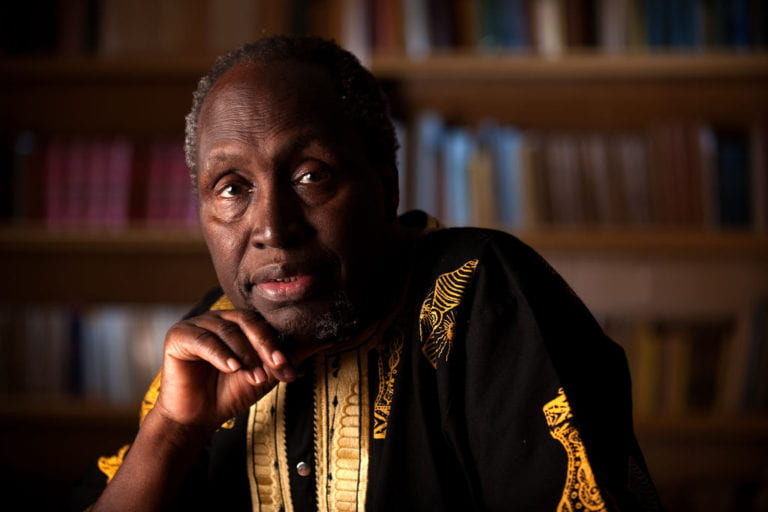
Ngugi wa Thiong’o, Distinguished Professor of comparative literature and English, has been awarded the 15th biennial Erich Maria Remarque Peace Prize for “Decolonising the Mind: The Politics of Language in African Literature.” Daniel Anderson / UCI

Share on FacebookShare on Twitter

Ngũgĩ wa Thiong’o is one of Africa’s most prominent literary and intellectual voices and a pivotal figure in the anti-colonial and post-colonial struggles. Through his prolific body of work spanning novels, plays, criticism, and essays, Ngugi has shaped an intellectual and literary movement that advocates for the reclaiming of African identity, the rejection of cultural subordination, and the defence of indigenous languages. His literary and intellectual career is a true reflection of the modern history of Kenya and Africa, and his influence continues to resonate in academic, political, and literary circles today.

According to Professor Emnet Tadesse Woldegiorgis, Ngũgĩ wa Thiong’o “redefined the purpose of African literature, insisting that it must speak to its people in their own languages, reflect their histories, and resist the epistemic violence of colonial modernity.”

Ngugi wa Thiong’o was born in 1938 in Kamirithu, Kenya, under British colonial rule. His early years were marked by violence and immense challenges, as the Mau Mau Uprising profoundly impacted his life and that of his family. This early experience planted within him the seeds of resistance and political awareness that would inform his later works. He was educated at Makerere College, University of East Africa, Uganda, where he studied English literature. He then pursued postgraduate studies at the University of Leeds in the United Kingdom. It was at this stage that his critical view of the English language as a colonial tool and its impact on African culture began to take shape.

Ngugi began his literary career by writing his first novels in English, such as Weep Not, Child (1964) and The River Between (1965), which dealt with themes of cultural conflict and the impact of colonialism on Kenyan society. However, his 1967 novel A Grain of Wheat was a turning point in his career. This novel, which depicts Kenya on the eve of independence, addresses the complexities of the struggle for freedom, betrayal, and hope. In these early works, Ngugi’s narrative style began to emerge, combining realism with deep historical narrative, focusing on characters who embody the conflict between tradition and modernity, nationalism and conflicting loyalties.

But the most significant point in Ngugi’s intellectual and literary career was his decision to switch to writing in his mother tongue, Gikuyu, in the late 1970s. This decision was not merely a personal choice; it was a profound political and cultural statement. Ngugi believed that English, as a colonial legacy, contributed to the “colonization of the mind”, alienating African intellectuals and writers from their original audiences. He called for “Decolonizing the Mind,” the title of one of his most important critical works, published in 1986. In this book, Ngugi powerfully argues that African languages ​​are the authentic vehicles for expressing African experience, heritage, and history, and that adherence to European languages ​​fosters cultural and intellectual subordination.

These bold stances led to a direct clash with the Kenyan authorities. In 1977, Ngugi wrote the play “Ngaahika Ndeenda” (I Marry Whenever I Want) in the Gikuyu language, which was performed at a community centre in Kamirithu, his hometown. The play criticised corruption and exploitation in post-independence Kenya and addressed sensitive issues of class and social class. The play was a popular success, but it angered the Kenyan government. As a result, Ngugi was arrested and imprisoned without trial for a year in a maximum-security prison. During his detention, Ngugi wrote the novel “Caitaani Mũtharaba-inĩ” (The Devil on the Cross) on toilet paper. This novel, one of his most famous works, is a powerful political and social satire that uses fictional narrative to criticise conditions in Kenya.

“Resistance is the best way of keeping alive,” he told The Guardian in 2018. “It can take even the smallest form of saying no to injustice. If you really think you’re right, you stick to your beliefs, and they help you to survive.”

After his release from prison, Ngugi was banned from teaching at the University of Nairobi and faced severe restrictions. In 1982, while visiting abroad, he learnt that he could not safely return to Kenya due to government threats. This marked the beginning of a long period of exile, most of which he spent in the United States. Despite this, he never stopped writing and campaigning. He continued to produce important literary and intellectual works in both Kikuyu and English and dedicated himself to promoting African languages ​​and cultures.

His later works include Mũrogi wa Kagogo (The Wizard of the Crow), a complex fantasy epic that is the longest novel written in the Kikuyu language and addresses issues of corruption, power, and myth.

“Rumor has it that the Ruler talked nonstop for seven nights and days, seven hours, seven minutes, and seven seconds. By then the ministers had clapped so hard, they felt numb and drowsy,” he wrote. “When they became too tired to stand, they started kneeling down before the ruler, until the whole scene looked like an assembly in prayer before the eyes of the Lord. But soon they found that even holding their bodies erect while on their knees was equally tiring, and some assumed the cross-legged posture of the Buddhist.”

Ngugi also continued to write critical essays, such as “Globalectics: Theory and the Politics of Knowing” (2012), in which he expanded the concept of “decolonising the mind” to include a global context and advocated for a multipolar view of knowledge.

Ngugi wa Thiong’o is not just a writer; he is a philosopher, thinker, and activist. His contributions extend beyond literature to encompass the fields of education, politics, and anthropology. He challenged prevailing notions of “world literature” and emphasised the need to recognise the diversity of voices and languages ​​from around the globe. He also inspired generations of African writers and thinkers to embrace their native languages ​​and express their unique experiences.

Read also

Nigeria to investigate tech firms over news content use

Senegal’s Faye plans to form his own political party

Second Ebola treatment centre opens in North Kivu

Ngugi has received numerous international awards and honours in recognition of his contributions and is often mentioned as a potential candidate for the Nobel Prize in Literature. Awards aside, his true legacy lies in his lasting impact on African and global thought and his ability to spark debates about identity, language, and power.

In recent years, Ngugi wa Thiong’o has returned to Kenya for intermittent visits, but he continues to write and engage in intellectual activism. His voice remains powerful and influential in defending African heritage, rejecting cultural appropriation, and advocating for a more just and equitable world where all languages ​​and cultures are valued. In a time of accelerating globalisation, Ngugi’s calls for a “decolonisation of the mind” become even more relevant and urgent, as he invites us to critically reflect on the sources of knowledge, the languages ​​we use to express ourselves, and how these languages ​​shape our view of the world.

Ngugi wa Thiong’o faced significant health challenges late in life. In 1995, he was diagnosed with aggressive prostate cancer, but he made a remarkable recovery. More recently, in 2019, he underwent triple bypass open-heart surgery, during which time he also began to suffer from kidney failure. He died on May 28, 2025, in Buford, Georgia, USA, at the age of 87.
Tags: Ngũgĩ wa Thiong'o

Related Posts

Tanzania’s president dismisses foreign, information ministers
East Africa

Tanzania on edge ahead of planned protests

July 6, 2026
Production starts at Senegal’s first offshore oil project
Energy

Senegal’s Sangomar oil project has produced about 18 million barrels so far this year, document says

July 6, 2026
What the AU’s new mission means for Somalia?
East Africa

Somalia peacekeeping mission at risk as US blocks UN support, sources say

July 5, 2026
Insurgents stage coordinated attacks on army positions across Mali
Featured

Insurgents stage coordinated attacks on army positions across Mali

July 5, 2026
Senegal’s top opposition leader Sonko vows to help win March 24 election
Featured

Senegal at a Political Crossroads: The Faye–Sonko Rivalry and the Future of Democratic Governance

July 3, 2026
Tanzania’s president dismisses foreign, information ministers
East Africa

US to give Tanzania $1.3 billion under five-year health pact

July 2, 2026

Search Qiraat Africa

No Result
View All Result

Follow on Twitter

Follow @africanqiraat

Trending

Kumbi Saleh, the capital of the ancient Ghana Empire

Kumbi Saleh, the capital of the ancient Ghana Empire

October 13, 2025
Meja Mwangi: The Literary Genius with a Mighty pen

Meja Mwangi: The Literary Genius with a Mighty pen

May 24, 2025
Tuareg: The Blue People of the Sahara

Tuareg: The Blue People of the Sahara

May 23, 2025
Mbunda people of Angola and Zambia

Mbunda people of Angola and Zambia

January 18, 2026
New date set for return of Patrice Lumumba’s tooth

Patrice Lumumba (1925-1961), Congolese politician and independence leader

March 4, 2025
Zaghawa people of northeastern Chad and western Sudan

Zaghawa people of northeastern Chad and western Sudan

March 3, 2026

Facebook

Sections

  • About Us
  • Privacy Policy
  • Opinion
  • Infographics
  • News
  • Analysis
  • Figures
  • Culture & Literature
  • Follow Ups
  • Historical Readings
  • Interview
  • Studies


© Copyright Qiraat Africa. Developed by Bunnaj Media .

No Result
View All Result
  • News
  • Analysis & Report
  • Studies
  • Opinion
  • Interview
  • Culture & Literature
  • Figures
  • Historical Readings
  • Regions

© 2021 Copyright Qiraat Africa.