

Qiraat Africa
عربي  |  Fr
Advertisement
  • News
    • All
    • Climate Change
    • Economy
    • Education
    • Energy
    • Health
    • Migration
    • Mining
    • Politics
    • Security
    • Society
    • Sport
    Russia and Sahel states deepen military ties as insurgent attacks persist

    Russia and Sahel states deepen military ties as insurgent attacks persist

    Mozambique refines its new energy transition plan to attract investment worth $80 billion

    Russia is ready to help Mozambique fight ‘terrorist threat’, TASS cites Lavrov

    Zambia election will put Hichilema’s economic record to the test

    Zambia election will put Hichilema’s economic record to the test

    Eleven more Trump deportees arrive in Eswatini from the United States, lawyer says

    Eleven more Trump deportees arrive in Eswatini from the United States, lawyer says

    South Africa arrests over 200 in illegal mining crackdown

    South Africa arrests over 200 in illegal mining crackdown

    Nigeria’s Dangote refinery starts production after years of delays

    Dangote to fund proposed Kenya refinery with cash, bonds and an IPO

    Zimbabwe: Mnangagwa faces internal revolt over his legitimacy

    Zimbabwe’s Mnangagwa signs law extending his presidency to 2030

    Ghana president taps retired army officer as envoy to junta-led Sahel states

    Ghana delays South Africa meetings over anti-migrant violence

    Johannesburg, other municipalities face funding freeze over high spending

    Johannesburg, other municipalities face funding freeze over high spending

  • Analysis
    • All
    • Climate Change
    • Digital & Tech
    • Economy
    • Energy & Power
    • Health
    • Politics
    • Security
    • Society
    Senegal’s top opposition leader Sonko vows to help win March 24 election

    Senegal at a Political Crossroads: The Faye–Sonko Rivalry and the Future of Democratic Governance

    Ulysses in isiZulu: Why an African translation of the classic Irish novel is important in today’s world

    Ulysses in isiZulu: Why an African translation of the classic Irish novel is important in today’s world

    The promise and risks of Kenya’s ambitious new strategy to close refugee camps

    The promise and risks of Kenya’s ambitious new strategy to close refugee camps

    Al Qaeda-linked militants curb their brutality in seized Malian territory

    Al Qaeda-linked militants curb their brutality in seized Malian territory

    Five Years After the Coup in Mali: Are Stability and Growth Within Reach?

    The Political Economy of Insecurity in Mali: Armed Groups, Resources, and State Fragility

    Ghana to evacuate 300 citizens from South Africa after xenophobic attacks

    Xenophobic Violence and Human Security in South Africa: Causes and Consequences

    Inside an African lab that helped crack the hantavirus outbreak

    Inside an African lab that helped crack the hantavirus outbreak

    Nigeria’s Agricultural sector: Problems and challenges

    Agriculture in Africa: science and research cannot have an impact without investments and good policies

    Mali’s junta creates a new ministerial-level post to oversee the mining sector

    African Mineral Resources: The Controversial Link to US Health Deals

  • Studies
    Angola’s lengthy war shaped the way farmers utilised fire—why it matters

    Angola’s lengthy war shaped the way farmers utilised fire—why it matters

    Schooling is the most severely affected by conflict when children are the target – Study

    Schooling is the most severely affected by conflict when children are the target – Study

    Pensions for Botswana’s elderly are expanding, but care services are lacking—study follows 20 years

    Pensions for Botswana’s elderly are expanding, but care services are lacking—study follows 20 years

    60 new cosmic structures have been discovered by South Africa’s MeerKAT telescope, which is mapping previously unseen gaps between galaxies

    60 new cosmic structures have been discovered by South Africa’s MeerKAT telescope, which is mapping previously unseen gaps between galaxies

    Benin government says armed forces foil coup attempt

    Coup contagion? A rash of African power grabs suggests copycats are taking note of others’ success

    One in three South Africans have never heard of AI: what this means for policy

    One in three South Africans have never heard of AI: what this means for policy

    Social Media as a Catalyst for the Spread of Dangerous Wealth Ritual Myths

    Social Media as a Catalyst for the Spread of Dangerous Wealth Ritual Myths

    Overcoming Education Barriers for Young Mothers in Sub-Saharan Africa

    Overcoming Education Barriers for Young Mothers in Sub-Saharan Africa

    Youth Empowerment Through Vocational Training in Rural Sub-Saharan Africa

    Youth Empowerment Through Vocational Training in Rural Sub-Saharan Africa

  • Infographics
  • Figures
    Marcus Garvey (1887-1940): Activist, Black nationalist, and Pan-Africanist

    Marcus Garvey (1887-1940): Activist, Black nationalist, and Pan-Africanist

    John B. Russwurm (1799–1851): Jamaican-born American abolitionist, publisher, and colonial governor

    John B. Russwurm (1799–1851): Jamaican-born American abolitionist, publisher, and colonial governor

    Winnie Mandela (1936-2018): South African politician and anti-apartheid activist

    Winnie Mandela (1936-2018): South African politician and anti-apartheid activist

    Abdias do Nascimento (1914-2011): Prominent African Brazilian scholar, artist, and politician

    Abdias do Nascimento (1914-2011): Prominent African Brazilian scholar, artist, and politician

    Edward Wilmot Blyden (1832-1912): Educator and former Secretary of State of Liberia

    Edward Wilmot Blyden (1832-1912): Educator and former Secretary of State of Liberia

    Eduardo Mondlane (1920-1969): Mozambican Revolutionary and Anthropologist

    Eduardo Mondlane (1920-1969): Mozambican Revolutionary and Anthropologist

    William Tubman (1895-1971): Liberian politician and longest-serving president in the country’s history

    William Tubman (1895-1971): Liberian politician and longest-serving president in the country’s history

    Abebe Bikila (1932-1973): Ethiopian marathoner and first black African to win an Olympic medal

    Abebe Bikila (1932-1973): Ethiopian marathoner and first black African to win an Olympic medal

    W. E. B. Du Bois (1868-1963): Sociologist, historian, and Pan-Africanist civil rights activist

    W. E. B. Du Bois (1868-1963): Sociologist, historian, and Pan-Africanist civil rights activist

  • History
    Laas Geel, Somalia

    Laas Geel, Somalia

    Lakes Of Ounianga, Chad

    Lakes Of Ounianga, Chad

    Nok Caves, Togo

    Nok Caves, Togo

    The Land of Punt (modern Somalia, Eritrea, Ethiopia, or eastern Sudan)

    The Land of Punt (modern Somalia, Eritrea, Ethiopia, or eastern Sudan)

    Avenue of the Baobabs, Madagascar

    Avenue of the Baobabs, Madagascar

    Lopé-Okanda (Gabon)

    Lopé-Okanda (Gabon)

    The Sudd wetland

    The Sudd wetland

    Khami Ruins (Zimbabwe), the capital of the Torwa state

    Khami Ruins (Zimbabwe), the capital of the Torwa state

    Royal Palace, Porto-Novo, Republic of Benin

    Royal Palace, Porto-Novo, Republic of Benin

  • Others
    • Culture / Literature
    • Interview
    • Opinion
  • Countries
    • Country profiles
    • Regions
      • Central Africa
      • East Africa
      • Southern Africa
      • West Africa
No Result
View All Result
  • News
    • All
    • Climate Change
    • Economy
    • Education
    • Energy
    • Health
    • Migration
    • Mining
    • Politics
    • Security
    • Society
    • Sport
    Russia and Sahel states deepen military ties as insurgent attacks persist

    Russia and Sahel states deepen military ties as insurgent attacks persist

    Mozambique refines its new energy transition plan to attract investment worth $80 billion

    Russia is ready to help Mozambique fight ‘terrorist threat’, TASS cites Lavrov

    Zambia election will put Hichilema’s economic record to the test

    Zambia election will put Hichilema’s economic record to the test

    Eleven more Trump deportees arrive in Eswatini from the United States, lawyer says

    Eleven more Trump deportees arrive in Eswatini from the United States, lawyer says

    South Africa arrests over 200 in illegal mining crackdown

    South Africa arrests over 200 in illegal mining crackdown

    Nigeria’s Dangote refinery starts production after years of delays

    Dangote to fund proposed Kenya refinery with cash, bonds and an IPO

    Zimbabwe: Mnangagwa faces internal revolt over his legitimacy

    Zimbabwe’s Mnangagwa signs law extending his presidency to 2030

    Ghana president taps retired army officer as envoy to junta-led Sahel states

    Ghana delays South Africa meetings over anti-migrant violence

    Johannesburg, other municipalities face funding freeze over high spending

    Johannesburg, other municipalities face funding freeze over high spending

  • Analysis
    • All
    • Climate Change
    • Digital & Tech
    • Economy
    • Energy & Power
    • Health
    • Politics
    • Security
    • Society
    Senegal’s top opposition leader Sonko vows to help win March 24 election

    Senegal at a Political Crossroads: The Faye–Sonko Rivalry and the Future of Democratic Governance

    Ulysses in isiZulu: Why an African translation of the classic Irish novel is important in today’s world

    Ulysses in isiZulu: Why an African translation of the classic Irish novel is important in today’s world

    The promise and risks of Kenya’s ambitious new strategy to close refugee camps

    The promise and risks of Kenya’s ambitious new strategy to close refugee camps

    Al Qaeda-linked militants curb their brutality in seized Malian territory

    Al Qaeda-linked militants curb their brutality in seized Malian territory

    Five Years After the Coup in Mali: Are Stability and Growth Within Reach?

    The Political Economy of Insecurity in Mali: Armed Groups, Resources, and State Fragility

    Ghana to evacuate 300 citizens from South Africa after xenophobic attacks

    Xenophobic Violence and Human Security in South Africa: Causes and Consequences

    Inside an African lab that helped crack the hantavirus outbreak

    Inside an African lab that helped crack the hantavirus outbreak

    Nigeria’s Agricultural sector: Problems and challenges

    Agriculture in Africa: science and research cannot have an impact without investments and good policies

    Mali’s junta creates a new ministerial-level post to oversee the mining sector

    African Mineral Resources: The Controversial Link to US Health Deals

  • Studies
    Angola’s lengthy war shaped the way farmers utilised fire—why it matters

    Angola’s lengthy war shaped the way farmers utilised fire—why it matters

    Schooling is the most severely affected by conflict when children are the target – Study

    Schooling is the most severely affected by conflict when children are the target – Study

    Pensions for Botswana’s elderly are expanding, but care services are lacking—study follows 20 years

    Pensions for Botswana’s elderly are expanding, but care services are lacking—study follows 20 years

    60 new cosmic structures have been discovered by South Africa’s MeerKAT telescope, which is mapping previously unseen gaps between galaxies

    60 new cosmic structures have been discovered by South Africa’s MeerKAT telescope, which is mapping previously unseen gaps between galaxies

    Benin government says armed forces foil coup attempt

    Coup contagion? A rash of African power grabs suggests copycats are taking note of others’ success

    One in three South Africans have never heard of AI: what this means for policy

    One in three South Africans have never heard of AI: what this means for policy

    Social Media as a Catalyst for the Spread of Dangerous Wealth Ritual Myths

    Social Media as a Catalyst for the Spread of Dangerous Wealth Ritual Myths

    Overcoming Education Barriers for Young Mothers in Sub-Saharan Africa

    Overcoming Education Barriers for Young Mothers in Sub-Saharan Africa

    Youth Empowerment Through Vocational Training in Rural Sub-Saharan Africa

    Youth Empowerment Through Vocational Training in Rural Sub-Saharan Africa

  • Infographics
  • Figures
    Marcus Garvey (1887-1940): Activist, Black nationalist, and Pan-Africanist

    Marcus Garvey (1887-1940): Activist, Black nationalist, and Pan-Africanist

    John B. Russwurm (1799–1851): Jamaican-born American abolitionist, publisher, and colonial governor

    John B. Russwurm (1799–1851): Jamaican-born American abolitionist, publisher, and colonial governor

    Winnie Mandela (1936-2018): South African politician and anti-apartheid activist

    Winnie Mandela (1936-2018): South African politician and anti-apartheid activist

    Abdias do Nascimento (1914-2011): Prominent African Brazilian scholar, artist, and politician

    Abdias do Nascimento (1914-2011): Prominent African Brazilian scholar, artist, and politician

    Edward Wilmot Blyden (1832-1912): Educator and former Secretary of State of Liberia

    Edward Wilmot Blyden (1832-1912): Educator and former Secretary of State of Liberia

    Eduardo Mondlane (1920-1969): Mozambican Revolutionary and Anthropologist

    Eduardo Mondlane (1920-1969): Mozambican Revolutionary and Anthropologist

    William Tubman (1895-1971): Liberian politician and longest-serving president in the country’s history

    William Tubman (1895-1971): Liberian politician and longest-serving president in the country’s history

    Abebe Bikila (1932-1973): Ethiopian marathoner and first black African to win an Olympic medal

    Abebe Bikila (1932-1973): Ethiopian marathoner and first black African to win an Olympic medal

    W. E. B. Du Bois (1868-1963): Sociologist, historian, and Pan-Africanist civil rights activist

    W. E. B. Du Bois (1868-1963): Sociologist, historian, and Pan-Africanist civil rights activist

  • History
    Laas Geel, Somalia

    Laas Geel, Somalia

    Lakes Of Ounianga, Chad

    Lakes Of Ounianga, Chad

    Nok Caves, Togo

    Nok Caves, Togo

    The Land of Punt (modern Somalia, Eritrea, Ethiopia, or eastern Sudan)

    The Land of Punt (modern Somalia, Eritrea, Ethiopia, or eastern Sudan)

    Avenue of the Baobabs, Madagascar

    Avenue of the Baobabs, Madagascar

    Lopé-Okanda (Gabon)

    Lopé-Okanda (Gabon)

    The Sudd wetland

    The Sudd wetland

    Khami Ruins (Zimbabwe), the capital of the Torwa state

    Khami Ruins (Zimbabwe), the capital of the Torwa state

    Royal Palace, Porto-Novo, Republic of Benin

    Royal Palace, Porto-Novo, Republic of Benin

  • Others
    • Culture / Literature
    • Interview
    • Opinion
  • Countries
    • Country profiles
    • Regions
      • Central Africa
      • East Africa
      • Southern Africa
      • West Africa
No Result
View All Result
Qiraat Africa
عربي  |  Fr
No Result
View All Result
Home Analysis & Report

Africa and Caribbean unite on reparations

April 4, 2024
Africa and Caribbean unite on reparations

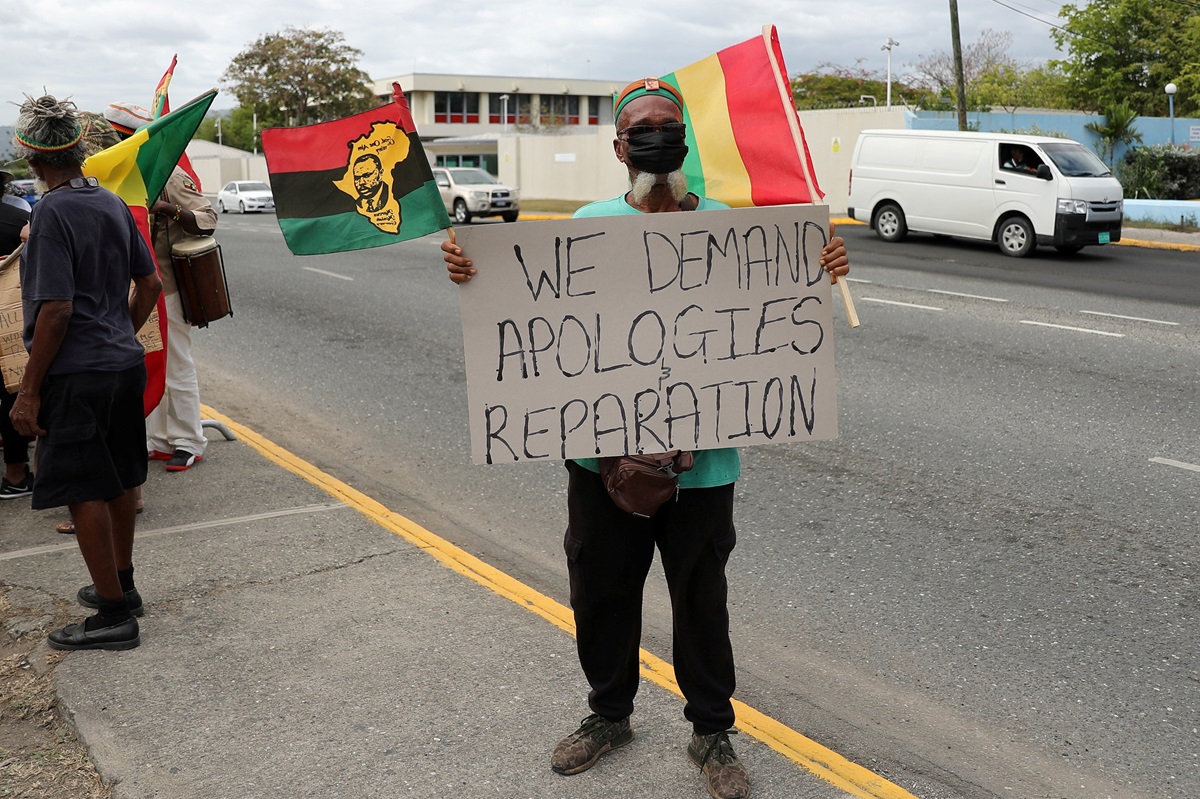
FILE PHOTO: A protester holds a sign during a rally to demand that the United Kingdom make reparations for slavery, ahead of a visit to Jamaica by the Duke and Duchess of Cambridge as part of their tour of the Caribbean, outside the British High Commission, in Kingston, Jamaica March 22, 2022. REUTERS/Gilbert Bellamy/File Photo

Share on FacebookShare on Twitter

Support is building among Africa and Caribbean nations for the creation of an international tribunal on atrocities dating to the transatlantic trade of enslaved people, with the United States backing a U.N. panel at the heart of the effort.

A tribunal, modelled on other ad-hoc courts such as the Nuremberg trials of Nazi war criminals after World War Two, was proposed last year. It has now gained traction within a broader slavery reparations movement, Reuters reporting based on interviews with a dozen people reveals.

Formally recommended in June by the U.N. Permanent Forum on People of African Descent, the idea of a special tribunal has been explored further at African and Caribbean regional bodies, said Eric Phillips, a vice-chair of the slavery reparations commission for the Caribbean Community, CARICOM, which groups 15 member states.

The scope of any tribunal has not been determined but the U.N. Forum recommended in a preliminary report that it should address reparations for enslavement, apartheid, genocide, and colonialism.

Advocates, including within CARICOM and the African Union (AU), which groups 55 nations across the continent, are working to build wider backing for the idea among U.N. members, Phillips said.

A special U.N. tribunal would help establish legal norms for complex international and historical reparations claims, its supporters say. Opponents of reparations argue, among other things, that contemporary states and institutions should not be held responsible for historical slavery.

Even its supporters recognise that establishing an international tribunal for slavery will not be easy.

There are “huge obstacles,” said Martin Okumu-Masiga, Secretary-General of the Africa Judges and Jurists Forum (AJJF), which is providing reparations-related advice to the AU.

Hurdles include obtaining the cooperation of nations that were involved in the trade of enslaved people and the legal complexities of finding responsible parties and determining remedies.

“These things happened many years ago and historical records and evidence can be challenging to access and even verify,” Okumo-Masiga said.

Unlike the Nuremberg trials, nobody directly involved in transatlantic slavery is alive.

Asked about the idea of a tribunal, a spokesperson for the British Foreign Office acknowledged the country’s role in transatlantic slavery, but said it had no plan to pay reparations. Instead, past wrongs should be tackled by learning lessons from history and tackling “today’s challenges,” the spokesperson said.

However, advocates for reparations say Western countries and institutions that continue to benefit from the wealth slavery generated should be held accountable, particularly given ongoing legacies of racial discrimination.

A tribunal would help establish an “official record of history,” said Brian Kagoro, a Zimbabwean lawyer who has been advocating for reparations for over two decades.

Racism, impoverishment and economic underdevelopment are linked to the longstanding consequences of transatlantic slavery from the United States to Europe and the African continent, according to U.N. studies.

“These legacies are alive and well,” said Clive Lewis, a British Labour MP and a descendant of people enslaved in the Caribbean nation of Grenada.

Black people “live in poorer and more polluted areas, they have worse diets, they have worse educational outcomes… because structural racism is embedded deep.”

NIGERIA IN FAVOUR

The proposal for a tribunal was discussed in November at a reparations summit in Ghana attended by African and Caribbean leaders.

The Ghana summit ended with a commitment to explore judicial routes, including “litigation options.”

Africa’s most populous nation, Nigeria, is in favour of the push for a tribunal, Foreign Minister Yusuf Tuggar told Reuters in February, saying the country would support the idea “until it becomes a reality.”

In Grenada, where hundreds of thousands were enslaved, Prime Minister Dickon Mitchell is “in full support,” a spokesperson said, describing the tribunal as a CARICOM-led initiative.

Phillips said the work to establish a tribunal would have to take place through the United Nations system and include conversations with countries, including Portugal, Britain, France, Spain, Netherlands and Denmark, that were involved in trading enslaved people to the Caribbean and other regions.

Reuters could not establish how many countries in Africa and the Caribbean were likely to support the idea.

Among the tribunal’s most vocal advocates is Justin Hansford, a Howard University law professor backed by the U.S. State Department to serve at the U.N. forum. He said the idea will be discussed at the forum’s third session, starting April 16, due to be attended by 50 or more nations.

Hansford then plans to travel to Africa to lobby for further support, with the goal of raising the proposal with stronger backing during the U.N. General Assembly in September, he told Reuters.

“A lot of my work now is to try to help make it a reality,” he said of the tribunal, saying it could take three to five years to get it off the ground. Phillips said the goal was to garner enough support by 2025.

The United States, which has financed the U.N forum, “will make a decision on the tribunal when it has been developed and established,” a U.S. State Department spokesperson said. “However, the United States strongly supports” the forum’s work, the spokesperson added.

Regarding reparations, “the complexity of the issue, legal challenges, and differing perspectives among Caribbean nations present significant challenges,” the spokesperson said.

The U.N. leadership has now come out in support for reparations, which have been used in other circumstances to offset large moral and economic debts, such as to Japanese Americans interned by the United States during World War Two and to families of Holocaust survivors.

“We call for reparatory justice frameworks, to help overcome generations of exclusion and discrimination,” U.N. General Secretary Antonio Guterres said on March 25, in his most direct public comments yet on the issue. Guterres’ office did not respond to a request for comment about a possible tribunal.

“No country with a legacy of enslavement, the trade in enslaved Africans, or colonialism has fully reckoned with the past, or comprehensively accounted for the impacts on the lives of people of African descent today,” said Liz Throssell, spokesperson for the U.N. Human Rights office, in response to a question about the tribunal.

The Netherlands apologised for its role in transatlantic slavery last year and announced a roughly $200 million fund to address that past. A spokesperson for the foreign ministry said it was not aware of the discussions around a tribunal and could not respond to questions.

The French government declined to comment. The governments of Portugal, Spain and Denmark did not respond to requests for comment.

CLAIMANTS AND DEFENDANTS

The push for a tribunal stems in part from a belief that claims need to be enshrined in a legal framework, said Okumu-Masiga, of the Africa Judges and Jurists Forum.

Several institutions, including the European Union, have concluded that transatlantic slavery was a crime against humanity.

After the 1940s Nuremberg trials, the U.N. formalised the structure of special tribunals – criminal courts set up on an ad-hoc basis to investigate serious international crimes, such as crimes against humanity.

The U.N. has since established two: one to prosecute those responsible for the 1994 Rwandan genocide and another to prosecute war crimes committed in the former Yugoslavia in the 1990s.

The Rwanda and Yugoslavia tribunals were established by the U.N. Security Council, however the International Criminal Court, another international U.N. tribunal, was founded through a General Assembly resolution, a possible route for a slavery reparations tribunal, Hansford said.

Okumu-Masiga said affected countries, descendents of enslaved people and indigenous groups could be potential claimants, while defendants could include nations and institutions with historic links to slavery or even descendants of enslavers.

An international tribunal is not the only judicial path available.

At a summit of Caribbean countries in February this year, the gathered prime ministers and presidents proposed working with the AU to request an ICJ advisory legal opinion on reparations through the U.N. General Assembly, a source familiar with the matter at CARICOM said.

Read also

Russia and Sahel states deepen military ties as insurgent attacks persist

Russia is ready to help Mozambique fight ‘terrorist threat’, TASS cites Lavrov

Zambia election will put Hichilema’s economic record to the test

Makmid Kamara, founder of the Accra-based civil society group Reforms Initiatives that works with the AU on reparatory justice, said decisions on which route to take would be made based on that advisory by the ICJ.

REPARATIONS MOVEMENT

From the 15th to the late 19th century, at least 12.5 million enslaved Africans were forcibly transported by mainly European but also U.S. and Brazilian-flagged ships and sold into slavery.

Before pushing for the abolition of slavery, Britain transported an estimated 3.2 million people, the most active European country after Portugal, which enslaved nearly 6 million.

Those who survived the brutal voyage ended up toiling on plantations under inhumane conditions in the Americas, mostly in Brazil, the Caribbean and the United States, while others profited from their labour.

Calls for reparations started with enslaved people themselves.

“They ran away, they raised their voices in songs of protests, they fought wars of resistance,” said Verene A. Sheperd, director of the centre for reparation research at the University of West Indies.

The movement later garnered support from quarters as varied as U.S. civil rights leader Martin Luther King Jr. and the Caribbean’s Rastafarians. In the past year, some of the world’s largest institutions have added their voices.

Ghana led efforts to get African support for formally pursuing reparations, with Nigeria, Senegal and South Africa also taking up the cause, said Kamara.

Most discussion has focused on transatlantic trafficking, Hansford and Phillips said, rather than the older trans-Saharan trade to the Islamic world, estimated to have transported several million enslaved Africans.

What reparations would consist of in practice is debated. Some, including in the United States, have pushed for individual payments to descendants of enslaved people. CARICOM, in a 2014 plan, called for debt cancellation and support from European nations to tackle public health and economic crises.

The AU decision to join CARICOM has given new heft to the campaign, said Jasmine Mickens, a U.S.- based strategist for social movements who specialises in reparations.

The AU is now developing Africa’s own white paper on what reparations might look like, said Okumu-Masiga.

“We have a global community behind this message,” said Mickens, who attended the Ghana event. “That’s something this movement has never seen before.”
Source: Reuters
Tags: CARICOMGhanaInternational Tribunal on AtrocitiesMartin Luther King Jr.NigeriaRastafariansSenegalSlavery tribunalSouth AfricaZimbabwe

Related Posts

Eleven more Trump deportees arrive in Eswatini from the United States, lawyer says
Featured

Eleven more Trump deportees arrive in Eswatini from the United States, lawyer says

July 9, 2026
South Africa arrests over 200 in illegal mining crackdown
Featured

South Africa arrests over 200 in illegal mining crackdown

July 8, 2026
Nigeria’s Dangote refinery starts production after years of delays
East Africa

Dangote to fund proposed Kenya refinery with cash, bonds and an IPO

July 8, 2026
Zimbabwe: Mnangagwa faces internal revolt over his legitimacy
Featured

Zimbabwe’s Mnangagwa signs law extending his presidency to 2030

July 8, 2026
Ghana president taps retired army officer as envoy to junta-led Sahel states
Economy

Ghana delays South Africa meetings over anti-migrant violence

July 8, 2026
Johannesburg, other municipalities face funding freeze over high spending
Economy

Johannesburg, other municipalities face funding freeze over high spending

July 8, 2026

Search Qiraat Africa

No Result
View All Result

Follow on Twitter

Follow @africanqiraat

Trending

Kumbi Saleh, the capital of the ancient Ghana Empire

Kumbi Saleh, the capital of the ancient Ghana Empire

October 13, 2025
Zaghawa people of northeastern Chad and western Sudan

Zaghawa people of northeastern Chad and western Sudan

March 3, 2026
Meja Mwangi: The Literary Genius with a Mighty pen

Meja Mwangi: The Literary Genius with a Mighty pen

May 24, 2025
Mbunda people of Angola and Zambia

Mbunda people of Angola and Zambia

January 18, 2026
Tuareg: The Blue People of the Sahara

Tuareg: The Blue People of the Sahara

May 23, 2025
The Khoikhoi people of southern Africa

The Khoikhoi people of southern Africa

January 19, 2026

Facebook

Sections

  • About Us
  • Privacy Policy
  • Opinion
  • Infographics
  • News
  • Analysis
  • Figures
  • Culture & Literature
  • Follow Ups
  • Historical Readings
  • Interview
  • Studies


© Copyright Qiraat Africa. Developed by Bunnaj Media .

No Result
View All Result
  • News
  • Analysis & Report
  • Studies
  • Opinion
  • Interview
  • Culture & Literature
  • Figures
  • Historical Readings
  • Regions

© 2021 Copyright Qiraat Africa.