









































By Ahmadulbadawy Abdul Raheem
The armed conflict that took place in the coastal city of Zanzibar on the morning of August 27, 1896, is frequently cited as the shortest war in modern history; the naval bombardment lasted between 38 and 45 minutes, according to varying accounts in ship logs and British consular records. Yet, focusing solely on the duration reduces a human and political tragedy to a mere statistical curiosity—masking a radical imbalance of power between a fully equipped imperial naval force and a local authority trapped within an archipelago that offered little room for military manoeuvring.
While the British Royal Navy fired approximately 500 artillery shells and thousands of rounds from machine guns and rifles at the palace and harbour-front facilities, British casualties were limited to a single sailor who sustained an accidental injury. In contrast, the Zanzibari defenders and civilians suffered around 500 casualties—killed or wounded. This stark disparity reveals the true nature of colonial warfare in the late 19th century, where heavy naval artillery confronted local resistance that lacked both parity in weaponry and the capacity to withstand sustained bombardment from the sea.
Imperial Roots and Succession Crisis in Zanzibar Archipelago
To understand the events of August 1896, one must examine the geopolitical entanglements that transformed Zanzibar into a vital point in the western Indian Ocean and East Africa during the era of the “Scramble for Africa”.
Ever since the Al Busaidi dynasty established its maritime and commercial influence in the region—linking the Sultanate to the East African coast—Zanzibar evolved into a hub for trade, navigation, and diplomatic power, eventually becoming a focal point of rivalry among major European nations. Following the imperial settlements that redrew spheres of influence in East Africa—specifically the arrangements that constrained the sultans’ freedom of action and made the legitimacy of succession contingent upon the approval of the British Consul under the 1886 agreement—the throne of Zanzibar became a testing ground for actual sovereignty over the island, a struggle over who held the authority to appoint a successor and who would safeguard London’s commercial and maritime interests at the port.
The crisis escalated abruptly on August 25, 1896, following the sudden death of Sultan Hamad bin Thuwaini—a ruler viewed by British circles as cooperative—amidst suspicions that he might have been poisoned. Within hours, his cousin, Khalid bin Barghash, moved swiftly to seize the palace and proclaim himself Sultan, without awaiting the “blessing” of the British Consulate or adhering to the protocols imposed by London.
For Basil Cave, the acting British Consul General—standing in for the absent Consul General, Arthur Hardinge—this move was a direct challenge to British influence and a threat to the position of London’s preferred candidate, Hamud bin Muhammad. Thus, the political vacuum that emerged upon the Sultan’s death transformed into a clash of wills, leaving no room for a quiet diplomatic resolution.
Naval Buildup and Final Ultimatum Before Dawn
The British administration did not content itself with diplomatic protest; instead, it moved swiftly to assemble a naval and land force at the port of Zanzibar, prepared to impose its will by force should Khalid bin Barghash fail to heed an ultimatum.
Royal Navy warships—including the cruisers HMS “St George” and HMS “Philomel”, alongside gunboats such as HMS “Raccoon”, HMS “Thrush” and HMS “Sparrow”—took up positions in the harbour under the command of Rear Admiral Harry Rawson. Meanwhile, Brigadier Lloyd Mathews assumed command of the local forces loyal to the British-backed authority.
In response, Khalid mobilised his palace guard, gathering approximately 2,800 fighters, volunteers, and servants—equipped with antiquated rifles, a limited number of artillery pieces, and machine guns—under the supervision of the guard commander, Saleh. Also at his disposal were the armed royal yacht, “Glasgow”, and two smaller vessels.
The British ultimatum gave Khalid bin Barghash until 9:00 a.m. on August 27 to vacate the palace, surrender his weapons, and disperse his forces. As the deadline approached without a full response from within the palace, the city seemed to hold its breath, awaiting the outcome of this overt display of military posturing. Khalid had banked on the symbolic significance of the palace—betting that the British, fearing chaos or swayed by political considerations, might either back down or prolong negotiations—while, in contrast, British military commanders had prepared a focused bombardment plan designed to swiftly and decisively cripple the centres of resistance near the waterfront.
Minutes of Bombardment and Collapse of Resistance at the Harbour
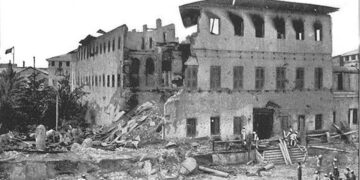
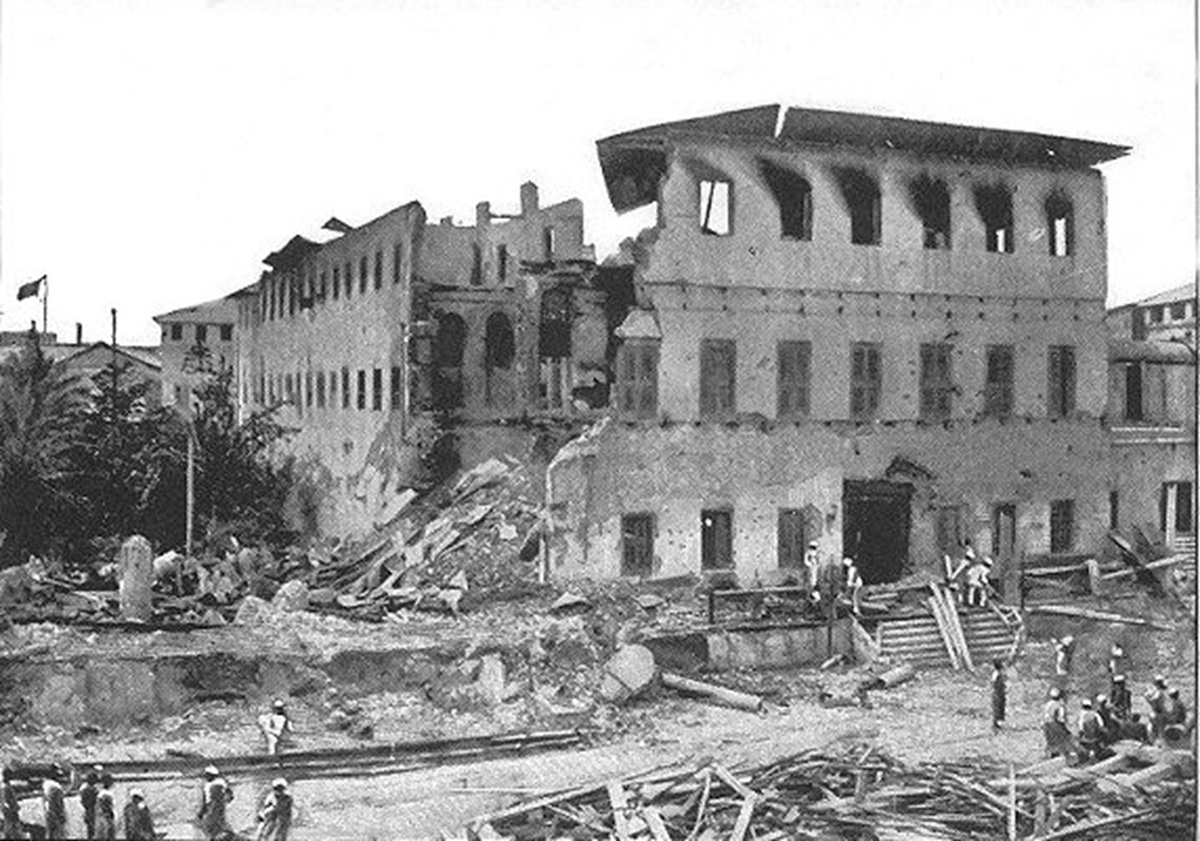
As the 9:00 a.m. deadline passed and warships opened fire—around 9:02 a.m.—the city’s waterfront became a scene of smoke and shrapnel. Explosive shells struck the palace and the coastal defensive batteries. Meanwhile, the ship “HMS Glasgow” came under fire and sank in the harbour shortly after the engagement began, depriving Khalid’s forces of their most significant naval asset. As fires consumed buildings and defensive cannons were destroyed, the fragile balance the defenders had sought to maintain collapsed under the weight of intense, precision-guided naval fire.
Although the battle was brief, its impact on those present was severe and immediate; many defenders and civilians near the palace and the waterfront found no safe refuge amidst the relentless bombardment and raging fires.
Historical accounts describe scenes that highlight the vast disparity between the two sides—such as defenders using bicycles to navigate the chaos. By approximately 9:40 or 9:45 a.m., the firing ceased, following the fall of the flag and the partial collapse of the palace.
Political Asylum and Accession of Hamud bin Muhammad
As the bombardment ceased, Khalid bin Barghash sought to avoid falling into British hands; he headed to the German consulate to request political asylum—a move that stirred diplomatic sensitivities among the European powers present in the city. He was later transported to German East Africa, where he spent many years in exile. On that same day, the British administration installed Hamud bin Muhammad as Sultan of Zanzibar with his authority significantly curtailed and placed under British oversight.
This even restructured the governance of the Sultanate in a way that cemented British hegemony, effectively turning the local authority into an administrative instrument subordinate to the requirements of imperial protection and control. Whereas Zanzibar had previously exercised a degree of formal, negotiable autonomy amidst international rivalries, it became—following August 27, 1896—far more tethered to direct British decision-making. This shift subsequently shaped the island’s administrative, security, and social policies, leading to tighter surveillance and the narrowing of any scope for armed rebellion for decades to come.
The 1896 war between Britain and Zanzibar remains a notable feature of public memory. It illustrates how an internal succession crisis can, overnight, transform into a pretext for asserting colonial supremacy and crushing any attempt to deviate from the framework and interests established by a colonial power.
ـــــــــــــــــــــــــــــ
References
- South African History Online. (2016, May 4). The Anglo-Zanzibar War of 1896. South African History Online. https://sahistory.org.za/ref/A-0120832
- Hudson, M. (2026, September 2). Anglo-Zanzibar War. Encyclopedia Britannica. https://www.britannica.com/event/Anglo-Zanzibar-War
-
Bhacker, R. M. (1992). Trade and empire in Muscat and Zanzibar: The roots of British domination. Routledge, https://api.pageplace.de/preview/DT0400.9781134895557_A24932374/preview-9781134895557_A24932374.pdf
-
Brazil, N. (2023). The shortest war in history. British Modern Military History Society, https://bmmhs.org/the-shortest-war-in-history/
- Owens, G.R. (2007). Exploring the Articulation of Governmentality and Sovereignty: The Chwaka Road and the Bombardment of Zanzibar, 1895-1896. Journal of Colonialism and Colonial History, 8, – .
-
Lofchie, M. F. (1965). Zanzibar: Background to revolution. Princeton University Press.
-
Sheriff, A. (2020). History of Zanzibar to 1890. In Oxford research encyclopedia of African history. Oxford University Press. https://doi.org/10.1093/acrefore/9780190277734.013.669
-
Staples, E., & Al Salimi, A. (Eds.). (2016). Oman: A Maritime History. Georg Olms Verlag.
- Nicolini, B. (2024). The 1896 War against Zanzibar: new reflections about imperial military power. Africana: rivista di studi extraeuropei: XXX, 2024, 207-238.