


























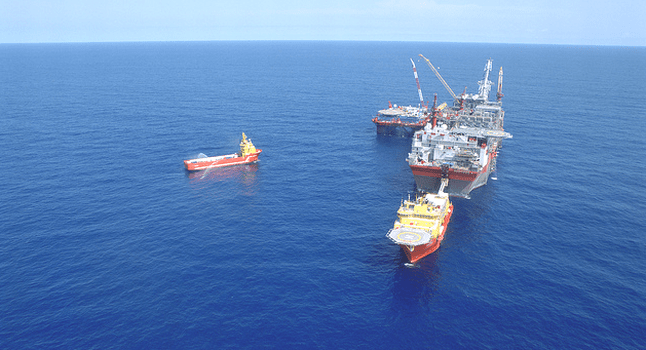
Nigerian President Bola Tinubu has approved the Bonga Southwest Aparo deepwater project, which is expected to attract about $20bn in foreign direct investment into the Nigerian oil and gas sector.
The approval, announced on Tuesday by the Nigerian National Petroleum Company Limited (NNPCL), is designed to pave the way for the long-awaited Final Investment Decision on the offshore project, which has remained stalled for nearly two decades.
The Bonga Southwest Aparo project is operated by Shell Nigeria Exploration and Production Company, a subsidiary of Shell Plc, and involves a consortium of international oil companies working alongside the national oil company.
The project represents one of Nigeria’s most significant upstream investments in recent years and could help revive deepwater exploration, which has slowed in the country amid fiscal uncertainties and global energy transition pressures.
According to the NNPCL, the presidential approval followed months of negotiations among key stakeholders, including the National Revenue Service, the Special Adviser to the President on Energy, Olu Verheijen, and the Chief Executive Officer of Shell Plc, Wael Sawan.
In a statement signed by the Chief Corporate Communications Officer of NNPCL, Andy Odeh, the company described the decision as a major step toward restoring investor confidence in Nigeria’s deepwater petroleum assets.
The fiscal framework approved by President Tinubu includes an enhanced production tax credit and the resolution of the 2021 dispute settlement agreement, measures designed to create a competitive investment environment, while safeguarding Nigeria’s long-term revenue interests.
The statement explained that the approval followed extensive technical and commercial engagements aimed at resolving long-standing fiscal and contractual issues that had delayed the project’s take-off.
It noted that the decision also fulfilled a directive issued by President Tinubu during a previous meeting with Shell’s leadership to accelerate the enabling conditions required to move the project toward Final Investment Decision.
Reacting to the development, the Group Chief Executive Officer of NNPCL, Mr. Bayo Ojulari, said that the approval marked a turning point for a project that had remained stalled for nearly 20 years.
“This approval is a testament to the President’s leadership, NNPCL’s disciplined execution, and our ability to structure complex, bankable transactions that deliver value for Nigeria. For nearly two decades, the Bonga Southwest project remained stalled. Today, under President Tinubu’s reform-driven leadership and through NNPC’s sustained advocacy, we have broken that logjam. This is what partnership, persistence, and policy clarity can achieve.”
“This milestone further affirms NNPC’s commitment, under the President’s leadership, to unlocking Nigeria’s vast energy potential through partnerships, disciplined innovation and execution excellence,” Ojulari said.
He emphasised that the development reinforces NNPCL’s commitment to unlocking Nigeria’s vast energy potential.
“This milestone further affirms NNPC’s commitment, under the President’s leadership, to unlocking Nigeria’s vast energy potential through partnerships, disciplined innovation, and execution excellence,” he added.
According to NNPCL, the Bonga Southwest Aparo project will become Nigeria’s first Final Investment Decision on a deepwater Production Sharing Contract asset since 2008, potentially signalling renewed investor interest in offshore exploration.
The project could significantly reshape Nigeria’s upstream sector by demonstrating that large-scale investments remain viable despite global shifts toward cleaner energy. Once operational, the project is expected to produce about 150,000 barrels of crude oil per day and 140 million standard cubic feet of gas daily, significantly boosting Nigeria’s hydrocarbon output.
It is also projected to generate over 5,000 direct and indirect jobs across various segments of the Nigerian oil and gas value chain. The project forms part of the Nigerian Government’s broader strategy to attract large-scale investment into Nigerian oil and gas sector.