







Qiraat Africa
عربي  |  Fr
Advertisement
  • News
    • All
    • Climate Change
    • Economy
    • Education
    • Energy
    • Health
    • Migration
    • Mining
    • Politics
    • Security
    • Society
    • Sport
    Senegal’s top opposition leader Sonko vows to help win March 24 election

    Senegal president sacks PM Sonko, dissolves government after months of friction

    Morocco’s King pardons Senegal fans convicted on hooliganism charges

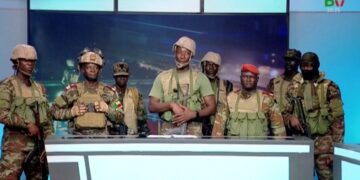
    Benin’s President Talon thanks army leaders for “remaining loyal” in face of attempted coup

    Benin’s Talon bids farewell ahead of Wadagni inauguration, Sunday

    Nigeria busts meth cartel in largest seizure, arrests kingpin

    Nigeria busts meth cartel in largest seizure, arrests kingpin

    Sierra Leone receives first group of West African deportees from US

    Sierra Leone receives first group of West African deportees from US

    WHO declares Ebola outbreak in Congo, Uganda an emergency of international concern

    India, Africa Union postpone New Delhi summit amid Ebola outbreak

    Rwanda says DR Congo shelling injured its citizens

    Rwanda tightens border controls over deadly Ebola outbreak in DR Congo

    Nigeria arrests ex-power minister Mamman after 75-year graft sentence

    Nigeria arrests ex-power minister Mamman after 75-year graft sentence

    Ethiopia says Ghebreyesus, WHO chief has links to rebellious Tigrayan forces

    WHO says 139 suspected Ebola deaths in Congo outbreak, numbers expected to rise

  • Analysis
    • All
    • Climate Change
    • Digital & Tech
    • Economy
    • Energy & Power
    • Health
    • Politics
    • Security
    • Society
    Inside an African lab that helped crack the hantavirus outbreak

    Inside an African lab that helped crack the hantavirus outbreak

    Nigeria’s Agricultural sector: Problems and challenges

    Agriculture in Africa: science and research cannot have an impact without investments and good policies

    Mali’s junta creates a new ministerial-level post to oversee the mining sector

    African Mineral Resources: The Controversial Link to US Health Deals

    Ghana curbs offshore investments to protect cedi, boost stability

    Ghana’s mining law attempts to eradicate speculation, but leaves communities in limbo: insights from a lithium case study

    East African Community’s expansion has triggered financial difficulties: why solutions come with risks

    East African Community’s expansion has triggered financial difficulties: why solutions come with risks

    Nigeria’s new election laws leaves gaps: Here are 5 reforms for free, fair, and credible elections

    Nigeria’s new election laws leaves gaps: Here are 5 reforms for free, fair, and credible elections

    Impact of Kenya’s long-overdue new infrastructure fund may be limited by design problems

    Impact of Kenya’s long-overdue new infrastructure fund may be limited by design problems

    Why Africans Are Targeted by Recruitment Networks in the Ukraine-Russia War?

    Why Africans Are Targeted by Recruitment Networks in the Ukraine-Russia War?

    From Water Security to Geopolitical Realignment: Key Takeaways and Outcomes of the 39th African Union Summit 2026

    From Water Security to Geopolitical Realignment: Key Takeaways and Outcomes of the 39th African Union Summit 2026

  • Studies
    Pensions for Botswana’s elderly are expanding, but care services are lacking—study follows 20 years

    Pensions for Botswana’s elderly are expanding, but care services are lacking—study follows 20 years

    60 new cosmic structures have been discovered by South Africa’s MeerKAT telescope, which is mapping previously unseen gaps between galaxies

    60 new cosmic structures have been discovered by South Africa’s MeerKAT telescope, which is mapping previously unseen gaps between galaxies

    Benin government says armed forces foil coup attempt

    Coup contagion? A rash of African power grabs suggests copycats are taking note of others’ success

    One in three South Africans have never heard of AI: what this means for policy

    One in three South Africans have never heard of AI: what this means for policy

    Social Media as a Catalyst for the Spread of Dangerous Wealth Ritual Myths

    Social Media as a Catalyst for the Spread of Dangerous Wealth Ritual Myths

    Overcoming Education Barriers for Young Mothers in Sub-Saharan Africa

    Overcoming Education Barriers for Young Mothers in Sub-Saharan Africa

    Youth Empowerment Through Vocational Training in Rural Sub-Saharan Africa

    Youth Empowerment Through Vocational Training in Rural Sub-Saharan Africa

    Manufacturers in Ghana and Nigeria claim that although corruption damages businesses, digital technologies provide a chance to combat it

    Manufacturers in Ghana and Nigeria claim that although corruption damages businesses, digital technologies provide a chance to combat it

    Environmental Threats and Conservation Efforts in Namibia

    Environmental Threats and Conservation Efforts in Namibia

  • Infographics
  • Figures
    Eduardo Mondlane (1920-1969): Mozambican Revolutionary and Anthropologist

    Eduardo Mondlane (1920-1969): Mozambican Revolutionary and Anthropologist

    William Tubman (1895-1971): Liberian politician and longest-serving president in the country’s history

    William Tubman (1895-1971): Liberian politician and longest-serving president in the country’s history

    Abebe Bikila (1932-1973): Ethiopian marathoner and first black African to win an Olympic medal

    Abebe Bikila (1932-1973): Ethiopian marathoner and first black African to win an Olympic medal

    W. E. B. Du Bois (1868-1963): Sociologist, historian, and Pan-Africanist civil rights activist

    W. E. B. Du Bois (1868-1963): Sociologist, historian, and Pan-Africanist civil rights activist

    Frantz Fanon (1925-1961): Psychiatrist and political philosopher

    Frantz Fanon (1925-1961): Psychiatrist and political philosopher

    Percy Lavon Julian (1899-1975): African American researcher and chemist

    Percy Lavon Julian (1899-1975): African American researcher and chemist

    Harriet Tubman (Araminta Ross, 1822-1913): American abolitionist and social activist

    Harriet Tubman (Araminta Ross, 1822-1913): American abolitionist and social activist

    Dorothy Vaughan (1910-2008): African American mathematician and human computer

    Dorothy Vaughan (1910-2008): African American mathematician and human computer

    George Washington Carver (1864-1943): African American agricultural scientist and inventor

    George Washington Carver (1864-1943): African American agricultural scientist and inventor

  • History
    Laas Geel, Somalia

    Laas Geel, Somalia

    Lakes Of Ounianga, Chad

    Lakes Of Ounianga, Chad

    Nok Caves, Togo

    Nok Caves, Togo

    The Land of Punt (modern Somalia, Eritrea, Ethiopia, or eastern Sudan)

    The Land of Punt (modern Somalia, Eritrea, Ethiopia, or eastern Sudan)

    Avenue of the Baobabs, Madagascar

    Avenue of the Baobabs, Madagascar

    Lopé-Okanda (Gabon)

    Lopé-Okanda (Gabon)

    The Sudd wetland

    The Sudd wetland

    Khami Ruins (Zimbabwe), the capital of the Torwa state

    Khami Ruins (Zimbabwe), the capital of the Torwa state

    Royal Palace, Porto-Novo, Republic of Benin

    Royal Palace, Porto-Novo, Republic of Benin

  • Others
    • Culture / Literature
    • Interview
    • Opinion
  • Countries
    • Country profiles
    • Regions
      • Central Africa
      • East Africa
      • Southern Africa
      • West Africa
No Result
View All Result
  • News
    • All
    • Climate Change
    • Economy
    • Education
    • Energy
    • Health
    • Migration
    • Mining
    • Politics
    • Security
    • Society
    • Sport
    Senegal’s top opposition leader Sonko vows to help win March 24 election

    Senegal president sacks PM Sonko, dissolves government after months of friction

    Morocco’s King pardons Senegal fans convicted on hooliganism charges

    Benin’s President Talon thanks army leaders for “remaining loyal” in face of attempted coup

    Benin’s Talon bids farewell ahead of Wadagni inauguration, Sunday

    Nigeria busts meth cartel in largest seizure, arrests kingpin

    Nigeria busts meth cartel in largest seizure, arrests kingpin

    Sierra Leone receives first group of West African deportees from US

    Sierra Leone receives first group of West African deportees from US

    WHO declares Ebola outbreak in Congo, Uganda an emergency of international concern

    India, Africa Union postpone New Delhi summit amid Ebola outbreak

    Rwanda says DR Congo shelling injured its citizens

    Rwanda tightens border controls over deadly Ebola outbreak in DR Congo

    Nigeria arrests ex-power minister Mamman after 75-year graft sentence

    Nigeria arrests ex-power minister Mamman after 75-year graft sentence

    Ethiopia says Ghebreyesus, WHO chief has links to rebellious Tigrayan forces

    WHO says 139 suspected Ebola deaths in Congo outbreak, numbers expected to rise

  • Analysis
    • All
    • Climate Change
    • Digital & Tech
    • Economy
    • Energy & Power
    • Health
    • Politics
    • Security
    • Society
    Inside an African lab that helped crack the hantavirus outbreak

    Inside an African lab that helped crack the hantavirus outbreak

    Nigeria’s Agricultural sector: Problems and challenges

    Agriculture in Africa: science and research cannot have an impact without investments and good policies

    Mali’s junta creates a new ministerial-level post to oversee the mining sector

    African Mineral Resources: The Controversial Link to US Health Deals

    Ghana curbs offshore investments to protect cedi, boost stability

    Ghana’s mining law attempts to eradicate speculation, but leaves communities in limbo: insights from a lithium case study

    East African Community’s expansion has triggered financial difficulties: why solutions come with risks

    East African Community’s expansion has triggered financial difficulties: why solutions come with risks

    Nigeria’s new election laws leaves gaps: Here are 5 reforms for free, fair, and credible elections

    Nigeria’s new election laws leaves gaps: Here are 5 reforms for free, fair, and credible elections

    Impact of Kenya’s long-overdue new infrastructure fund may be limited by design problems

    Impact of Kenya’s long-overdue new infrastructure fund may be limited by design problems

    Why Africans Are Targeted by Recruitment Networks in the Ukraine-Russia War?

    Why Africans Are Targeted by Recruitment Networks in the Ukraine-Russia War?

    From Water Security to Geopolitical Realignment: Key Takeaways and Outcomes of the 39th African Union Summit 2026

    From Water Security to Geopolitical Realignment: Key Takeaways and Outcomes of the 39th African Union Summit 2026

  • Studies
    Pensions for Botswana’s elderly are expanding, but care services are lacking—study follows 20 years

    Pensions for Botswana’s elderly are expanding, but care services are lacking—study follows 20 years

    60 new cosmic structures have been discovered by South Africa’s MeerKAT telescope, which is mapping previously unseen gaps between galaxies

    60 new cosmic structures have been discovered by South Africa’s MeerKAT telescope, which is mapping previously unseen gaps between galaxies

    Benin government says armed forces foil coup attempt

    Coup contagion? A rash of African power grabs suggests copycats are taking note of others’ success

    One in three South Africans have never heard of AI: what this means for policy

    One in three South Africans have never heard of AI: what this means for policy

    Social Media as a Catalyst for the Spread of Dangerous Wealth Ritual Myths

    Social Media as a Catalyst for the Spread of Dangerous Wealth Ritual Myths

    Overcoming Education Barriers for Young Mothers in Sub-Saharan Africa

    Overcoming Education Barriers for Young Mothers in Sub-Saharan Africa

    Youth Empowerment Through Vocational Training in Rural Sub-Saharan Africa

    Youth Empowerment Through Vocational Training in Rural Sub-Saharan Africa

    Manufacturers in Ghana and Nigeria claim that although corruption damages businesses, digital technologies provide a chance to combat it

    Manufacturers in Ghana and Nigeria claim that although corruption damages businesses, digital technologies provide a chance to combat it

    Environmental Threats and Conservation Efforts in Namibia

    Environmental Threats and Conservation Efforts in Namibia

  • Infographics
  • Figures
    Eduardo Mondlane (1920-1969): Mozambican Revolutionary and Anthropologist

    Eduardo Mondlane (1920-1969): Mozambican Revolutionary and Anthropologist

    William Tubman (1895-1971): Liberian politician and longest-serving president in the country’s history

    William Tubman (1895-1971): Liberian politician and longest-serving president in the country’s history

    Abebe Bikila (1932-1973): Ethiopian marathoner and first black African to win an Olympic medal

    Abebe Bikila (1932-1973): Ethiopian marathoner and first black African to win an Olympic medal

    W. E. B. Du Bois (1868-1963): Sociologist, historian, and Pan-Africanist civil rights activist

    W. E. B. Du Bois (1868-1963): Sociologist, historian, and Pan-Africanist civil rights activist

    Frantz Fanon (1925-1961): Psychiatrist and political philosopher

    Frantz Fanon (1925-1961): Psychiatrist and political philosopher

    Percy Lavon Julian (1899-1975): African American researcher and chemist

    Percy Lavon Julian (1899-1975): African American researcher and chemist

    Harriet Tubman (Araminta Ross, 1822-1913): American abolitionist and social activist

    Harriet Tubman (Araminta Ross, 1822-1913): American abolitionist and social activist

    Dorothy Vaughan (1910-2008): African American mathematician and human computer

    Dorothy Vaughan (1910-2008): African American mathematician and human computer

    George Washington Carver (1864-1943): African American agricultural scientist and inventor

    George Washington Carver (1864-1943): African American agricultural scientist and inventor

  • History
    Laas Geel, Somalia

    Laas Geel, Somalia

    Lakes Of Ounianga, Chad

    Lakes Of Ounianga, Chad

    Nok Caves, Togo

    Nok Caves, Togo

    The Land of Punt (modern Somalia, Eritrea, Ethiopia, or eastern Sudan)

    The Land of Punt (modern Somalia, Eritrea, Ethiopia, or eastern Sudan)

    Avenue of the Baobabs, Madagascar

    Avenue of the Baobabs, Madagascar

    Lopé-Okanda (Gabon)

    Lopé-Okanda (Gabon)

    The Sudd wetland

    The Sudd wetland

    Khami Ruins (Zimbabwe), the capital of the Torwa state

    Khami Ruins (Zimbabwe), the capital of the Torwa state

    Royal Palace, Porto-Novo, Republic of Benin

    Royal Palace, Porto-Novo, Republic of Benin

  • Others
    • Culture / Literature
    • Interview
    • Opinion
  • Countries
    • Country profiles
    • Regions
      • Central Africa
      • East Africa
      • Southern Africa
      • West Africa
No Result
View All Result
Qiraat Africa
عربي  |  Fr
No Result
View All Result
Home Regions East Africa

An conversation with scholar Mahmood Mamdani about the making and breaking of Uganda

January 15, 2026
An conversation with scholar Mahmood Mamdani about the making and breaking of Uganda

Idi Amin and Yoweri Museveni.

Share on FacebookShare on Twitter

By Mahmood Mamdani*


In his latest book, Slow Poison: Idi Amin, Yoweri Museveni, and the Making of the Ugandan State, anthropologist Mahmood Mamdani explains the factors and characters – Idi Amin and Yoweri Museveni – that shaped post-independence Uganda.

As he explains to The Conversation Africa, there are striking differences between the two men.

Museveni has been in office for almost four decades. Amin lasted eight years. What explains Museveni’s endurance?

I try to explain in the book some of the most important reasons Museveni has lasted for more than four decades. I think these reasons are both internal and external.

The internal reason is that he has tried to perfect what the British introduced as “divide and rule”, which is to undermine the basis of a unified citizenship in the country. Not just as the British did, taking existing ethnic groups and politicising them into political structures we call tribes. But more than that, taking some sub-ethnic groups and turning them into tribes. So from fewer than 20 tribes, he has created more than 100. It’s an endless process.

And then there is the external. Unlike Amin, who was the sworn enemy of big powers in the west, Museveni is the sworn protégé and the sworn friend of the big powers in the west.

Some analysts seem to suggest that it’s only now, particularly after his son has started making sort of political pronouncements, that Ugandan politics is being militarised. But a theme that comes out clearly in your book is that under both Amin and Museveni, the army has always been a substitute for political organisation in Uganda.

I think that’s a correct reading of the book. Now, within that very broad comparison, there are some important differences in the route taken by Amin.

Amin was recruited as a child soldier by the British at the age of 14 or so. He was trained in what they call the arts of counter insurgency, which is really a polite term for state terrorism. He used to publicly demonstrate, particularly to African heads of state, for example, at their meeting in Morocco, how he could suffocate with a handkerchief.

And Amin went through some kind of a transformation in the first year after he had gained power.

He gained power through the direct assistance of the British and the Israelis. The Israelis, in particular, advised Amin that he could not just overthrow Uganda’s first post-independence president Milton Obote and think that that was the end of the story. He would have to deal with his cohorts, the people he had brought to key positions, and the reckoning would be around the corner.

So the only way he could avoid the reckoning was to annihilate them. And his first year in power was brutal. I mean, he killed hundreds of people in different army barracks. These were massacres. There’s no other word to describe it.

And then, after that, he went to Israel and to Britain with sort of a list of what he wanted. He thought he had gone forward for the Israelis and the British, and now it was time for them to do him a favour. And they were amused, and he was humiliated. He looked for an alternative, and that is how he, through the then Egyptian president Anwar Sadat, met Libyan leader Muammar Gaddafi, and that is how, through Gaddafi, he met Sudanese leader Gaafar Muhammad Nimeiry. Amin, along with Ethiopian emperor Haile Selassie, played a key role in the Addis Ababa agreement of 1972 which brought the first civil war in Sudan to an end.

After the second year of his coming to power, I don’t know of any massacres. He still killed opponents, but he did not generalise the killing to either family or friends or clans or just groups that the person was identified with or associated with. His killing was much more that of a dictator who uses violence to deal with his opposition.

It’s very different in Museveni’s case. Museveni came to power with the sense that violence is critical to politics, and especially critical to liberation politics. Museveni is an avid devotee of Frantz Fanon, particularly The Wretched of the Earth. And the key lesson he takes from Fanon is the essentiality of violence in any emancipatory politics.

And so I try to trace the path whereby Museveni begins by thinking of violence as central to dismantling an oppressive state and ends up with the notion that violence is central to building a state. He arrives at exactly the opposite conclusion. And this is long before his son comes into the picture.

There’s a whole chapter I have in the book on the first few decades after 1986 when Museveni comes to power in his operations in the north and in successive massacres and killings, claiming that what he was fighting in the north was a continuation of the war on terror, which had begun after the 11 September 2001 attacks in the US.

And these claims were just accepted at face value by the international community, which is the name we give to western powers.

So would you say the war on terror was a godsend for Museveni in helping him advance his agenda?

Definitely. Ever since the structural adjustment programme of the late 1980s, he understood that if he was going to stifle opposition at home, he would need support overseas, and this support would come to him if he claimed to be central to waging the war on terror.

Museveni was smart enough to realise that American foreign policy, American military involvement, had political limitations. And those limitations were: how many Americans could be killed? And when these killings took place in Somalia, the Black Hawk Down incident, Museveni offered his services.

He took his soldiers to Somalia. You remember that slogan, African solutions for African problems. Museveni offered that African solution in South Sudan, in Rwanda, in eastern Congo. The African solution was just a fancy name for Africans massacring Africans in the service of imperial powers. And that’s what happened at the end.

You recommend a federation as the most likely to succeed in post Museveni Uganda. Is there a political base for it at the moment? Or would something need to happen for the proposed federation to succeed?

Those of us who are militant nationalists and independents understood federation as a British project. We understood that it was the right wing, it was those who were interested in creating tribal fiefdoms, who used federation as a fig leaf to describe their agenda. We understood that this was their way of undercutting any attempt to build a strong nationalist state.

But since then, with a strong state having been built, we have understood the conditions have changed and the times have changed. Local organisation, local autonomy, has come to have a very different significance.

It is a way of resisting a development of autocracy in the centre and I think people are beginning to draw lessons from this.

Now, the thing is what kind of federation, because Museveni has also promoted something resembling a federation. But he has, as in Ethiopia, promoted what you can call an ethnic federalism. So in each single unit, he has divided the majority from the minority, the majority belonging to the ethnic group living in the country, and the minority having descended from other ethnic groups, even though living in the country, even though born in that place, still deprived of rights.

This is what’s happened in Ethiopia. If you look at Ethiopia, if you look at Sudan, you will see that the British politicised ethnic groups and turned them into tribes. And then after colonialism, what we have done is to militarise these tribes. So we have created tribal militias. That’s what they have done in Ethiopia. That’s the fighting between different tribal militias. That’s what they did in Sudan. They created tribal militias, starting in Darfur and then in other places. It is the state military which led the systems in creating these tribal militias. Then it is the tribal militias which have begun to swallow the state.

So this current civil war we have going on is between the state army and the tribal militias. It’s the same process you see in Uganda. We have not gone to the point of creating tribal militias, but we have been manufacturing tribe after tribe after tribe in order to fragment the country.

Some of these trends that you describe about Uganda can be found in most African countries. What are the lessons about the way forward for the rest of the African continent?

Broadly, we can see these trends in many African countries. The British model of colonialism became the general colonial model. Even the French, known for their assimilationist preferences, adopted indirect rule when they moved from assimilation to what they called association in the 1930s. And the Portuguese followed the French.

South Africans were the last ones in – they called it apartheid. But it was the same thing, the creation of homelands, the tribalisation of local differences. So that’s one trend in much of the thinking on the continent.

The alternative to that trend has been described as centralisation, so we’ve been moving between beefing up autocratic, centralised power and then opposing with fragmented, tribal powers.

I’m proposing a third way. I’m proposing a federation which is more ethnic. I’m proposing a federation which is more based on territory, more based on where you live. So it doesn’t matter where you’re from, but just the fact that you live there means that you have cast your lot with the rest of the people there in creating a common future.

And what matters in politics, more than where you came from, is the decision to make a common future. Migration is characteristic of human society. Human society has not come into being through homelands. So homeland is a colonial fiction.

The idea that Africans did not move, that they were tied to a particular piece of territory, is absurd, because Africans moved more than anybody else. We know that humanity began in Africa and spread to the rest of the world. So where is the homeland? You can have a homeland for this generation, for the previous few generations, but all African people have a story of migration. This is, I think, central.

So the way forward: one is a federation which consolidates democracy rather than eroding it.

The second way forward is to critically think through the whole neoliberal economic model and the empowering of elites, whether they are racial or ethnic or whatever.

Read also

Senegal president sacks PM Sonko, dissolves government after months of friction

Morocco’s King pardons Senegal fans convicted on hooliganism charges

Inside an African lab that helped crack the hantavirus outbreak

I think we have to find a different economic model. But as you say, the book is not dedicated to looking for solutions. The book is dedicated to the proposition that we need to understand the problem before rushing to solutions.

And each country will have its own nuances. Different to Uganda.

ــــــــــــــــــ

* Herbert Lehman Professor of Government, Department of Anthropology, Columbia University.

Source: The Conversation Africa
Tags: Idi AminMahmood MamdaniYoweri Museveni

Related Posts

Benin’s President Talon thanks army leaders for “remaining loyal” in face of attempted coup
Featured

Benin’s Talon bids farewell ahead of Wadagni inauguration, Sunday

May 21, 2026
Sierra Leone receives first group of West African deportees from US
Featured

Sierra Leone receives first group of West African deportees from US

May 21, 2026
WHO declares Ebola outbreak in Congo, Uganda an emergency of international concern
African Union

India, Africa Union postpone New Delhi summit amid Ebola outbreak

May 21, 2026
Rwanda says DR Congo shelling injured its citizens
East Africa

Rwanda tightens border controls over deadly Ebola outbreak in DR Congo

May 20, 2026
Nigeria arrests ex-power minister Mamman after 75-year graft sentence
Featured

Nigeria arrests ex-power minister Mamman after 75-year graft sentence

May 20, 2026
Ethiopia says Ghebreyesus, WHO chief has links to rebellious Tigrayan forces
Central Africa

WHO says 139 suspected Ebola deaths in Congo outbreak, numbers expected to rise

May 20, 2026

Search Qiraat Africa

No Result
View All Result

Follow on Twitter

Follow @africanqiraat

Trending

Zimbabwe’s banking sector faces 75% job decrease Since 2000

China writes off unspecified amount of Zimbabwe interest-free loan

April 18, 2024
Kumbi Saleh, the capital of the ancient Ghana Empire

Kumbi Saleh, the capital of the ancient Ghana Empire

October 13, 2025
Brief History and Culture of the City of Lagos, Nigeria

Brief History and Culture of the City of Lagos, Nigeria

July 24, 2024
Joseph Ki-Zerbo (1922-2006): Burkinabé historian and politician

Joseph Ki-Zerbo (1922-2006): Burkinabé historian and politician

June 18, 2025
Africa’s Richest Billionaires, Mid-2025

Africa’s Richest Billionaires, Mid-2025

July 17, 2025
Equatorial Guinea

Equatorial Guinea orders crackdown on sex in government offices after videos leaked

November 6, 2024

Facebook

Sections

  • About Us
  • Privacy Policy
  • Opinion
  • Infographics
  • News
  • Analysis
  • Figures
  • Culture & Literature
  • Follow Ups
  • Historical Readings
  • Interview
  • Studies


© Copyright Qiraat Africa. Developed by Bunnaj Media .

No Result
View All Result
  • News
  • Analysis & Report
  • Studies
  • Opinion
  • Interview
  • Culture & Literature
  • Figures
  • Historical Readings
  • Regions

© 2021 Copyright Qiraat Africa.