































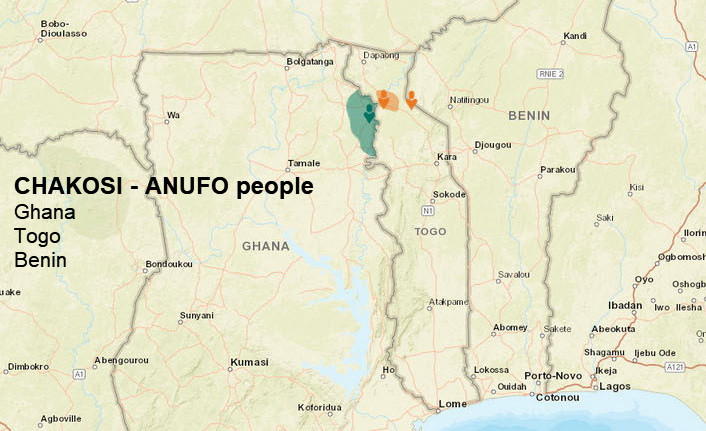
The Chakosi people—known locally and nationally as the “Anufo”—constitute a distinct ethnic group in West Africa. They are primarily distributed across the borders of three modern-day nations: Ghana, Togo, and Benin. Significant populations are concentrated in northern Togo (notably in the Mango and Dapango regions), northeastern Ghana, and northwestern Benin. In their own language, the term “Anufo” refers to the “people or inhabitants of Anu”, a reference to the “Anu” (or “Ou”) region in present-day Côte d’Ivoire, where their earliest historical roots lie. “Chakosi” (or “Tchokossi”) is the name commonly used to refer to them by neighbouring groups and surrounding tribes.
The ethnic and linguistic makeup of the Chakosi / Anufo people is the product of complex historical interactions between diverse human and cultural elements. Although their language belongs to the Kwa family—specifically the Akan branch, linking them to other Akan-related peoples such as the Baoulé and the Anyi—their social and political history reflects an early blending of various ethnic components.
Anthropological and historical studies indicate that migrations beginning in the early 18th century brought together several groups: Mande-speaking horsemen and Muslim scholars arriving from the north, Akan groups migrating from the east, and the indigenous “Ndenyi” populations already present in the region. This interaction gradually gave rise to an independent cultural and linguistic identity, distinguished by unique characteristics that set it apart from its geographical surroundings; indeed, the Chakosi/Anufo language is the only one in the region that does not belong to the “Gur” language family, which is otherwise prevalent throughout northern Togo.

The emergence of the Chakosi as an influential force in the region dates back to the mid-eighteenth century, when small groups of warriors and mercenaries departed from their original homeland in present-day Côte d’Ivoire. They had been summoned by local rulers and kingdoms—such as the Gonja and the Mamprusi, located in what is now Ghana—to provide support in military conflicts. These migrant contingents were composed of a cohesive mix: skilled Mandé cavalry, Akan infantry armed with traditional muskets, and Muslim scholars and students of Islamic jurisprudence who provided spiritual counsel, crafted protective amulets, and offered moral and psychological reinforcement.
Over time, these military groups settled along the banks of the Oti River, specifically at the site where the Togolese town of “Mango” stands today. Because they were defined primarily by their martial prowess—and did not engage in traditional agriculture during their early formative period—their subsistence economy relied on launching raids against neighbouring agrarian communities to secure food supplies, livestock, captives, and wives. This rigorous, military-orientated lifestyle gave rise to a precise and distinct stratified social structure, divided into three cohesive classes: the nobility—comprising leaders and military commanders; the commoners—consisting of ordinary warriors; and the Muslimin—a class of clerics and scholars who oversaw spiritual and judicial affairs.
As political conditions stabilised, the Chakosi gradually integrated into the local environment through intermarriage and assimilation with surrounding agrarian communities. They evolved into a settled society engaged in agriculture and civilian economic activities while retaining vestiges of their ancestral military and tribal organisation—structures that continue to define clan identities and the historical roles played in past wars and conflicts.
The historical roots of the Anufu people are clearly reflected in their contemporary social, economic, and cultural organisation. Their society is patriarchal, with lineage and inheritance traced along the paternal line. Although the historical class divisions have largely dissolved with the decline of the old feudal system, a strong sense of clan affiliation—linked to traditional martial roles—continues to shape the social fabric of their villages.
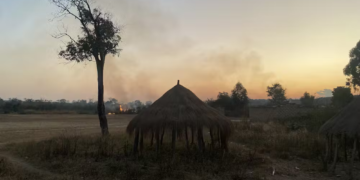
The primary economic activity of the Chakosi is subsistence farming, despite natural challenges such as poor soil quality and limited water resources in the savanna regions they inhabit across northern Ghana, Togo, and Benin. Farmers rely on collective labour and cooperation between men and women to carry out demanding agricultural tasks, such as harvesting and preparing the land. To compensate for the stagnation of local markets and to secure essential living needs, traditional markets operate on a regular, recurring schedule—often based on a six-day cycle—providing a vibrant space for social interaction and the exchange of goods between various villages.
Regarding cultural customs and traditions, the Nunu people share with other Akan groups a system for naming newborns that is primarily based on the day of the week on which they were born. Linguistically and culturally, however, the names of the days of the week and their sequence in the Nunu language differ from those found in other central Akan languages. This reflects the independent evolution of the Nunu language, which occurred following its geographic isolation and subsequent interaction with surrounding languages in Northwest Africa. For instance, children are given specific names—such as Amoin, Akisie (Agishie), Kouasi, Adjoah, Amlan (Amanna), and others—corresponding to the day of the week of their birth; these names carry deep-seated temporal and cultural significance passed down through generations.
The religious landscape of the Chokosi/Anufo people is characterised by diversity and a distinct cultural duality. Statistics and anthropological studies indicate that, historically, the vast majority of this group has practiced both “traditional” ethnic religious beliefs and Islam.
The class of Muslims and religious scholars (“malam”) who accompanied the initial military migrations played a pivotal role in establishing the presence of Islam in the region. Consequently, Islam has become a fundamental component of the Anufo’s social identity, particularly in urban and semi-urban centres such as the town of Mango. Recent decades have also seen a notable engagement with Christian missionary activities, leading to the emergence of small local church congregations among the tribe.
The Chakosi community, spread across Togo, Ghana, and Benin, faces developmental and economic challenges similar to those encountered in marginalised rural areas within the African savanna belt. Foremost among these are the degradation of agricultural soil fertility and an over-reliance on rudimentary, traditional farming methods—practices rendered increasingly vulnerable by climate change and a lack of modern irrigation systems. These factors constrain agricultural productivity, compelling large numbers of young people to seek employment opportunities in major urban centres.
Culturally and linguistically, the Chakosi/Anufo language remains relatively vibrant, sustained by its daily use across generations and its integration into certain local educational programmes, as well as academic and linguistic documentation projects—this despite the mounting pressures exerted by dominant languages and the forces of modern globalisation. The community’s capacity to adapt to contemporary political and social shifts within these three West African nations reflects a historical resilience deeply rooted in its ethnic composition. It serves as a compelling case study of how migrant groups can integrate into complex local environments without losing their distinct identity, preserving a unique cultural and linguistic character that sets them apart within Africa’s diverse ethnic landscape.