




























Southwestern Eritrea and its adjacent border regions in Ethiopia are home to a unique ethnic and linguistic diversity, shaped by a long history of migrations between the Nile Basin, the Arabian Peninsula, and the Ethiopian highlands. Within this complex geographical context, the Nara people—known historically in some ancient sources as the Baria—stand out as one of the oldest inhabitants of the region.
The term “Nara” is used to refer to both the people and their language. The term “Baria”, on the other hand, is the name given to them by their neighbours from the Semitic and Cushitic groups (such as the Tigrinya, Amhara, and Jabarti) throughout history. The term “Baria” carries complex social and historical dimensions, linked to periods of ancient invasions and border conflicts in the lowlands, where it was sometimes used to refer to captives and enslaved people. For this reason, the Nara people prefer to use their own name, “Nara”, due to the negative connotations of the old term.
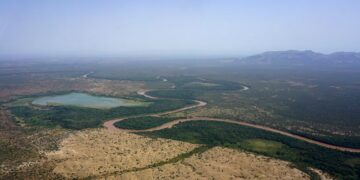
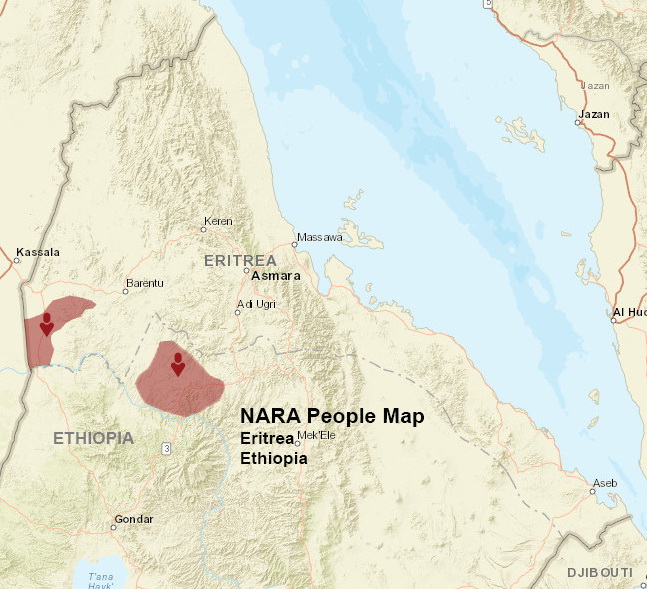
Most of the Nara people currently reside in the Gash-Barka region of southwestern Eritrea, specifically in the areas surrounding the towns of Barentu and Akurdet. This region is characterised by its varied topography, which includes semi-arid plains and seasonal valleys such as the Gash-Barka valleys.
Cultural and ethnic ties to Nilo-Saharan groups extend across the Ethiopian border, particularly in the Shimelba region and areas adjacent to the northwestern Tigray region, where administrative boundaries overlap with the historical homeland of linguistically and culturally similar groups such as the Kunama people.
The Nara language occupies an important position in African linguistics. It is classified within the Nilo-Saharan branch, but it constitutes a distinct branch within this larger language family and is not closely related to the well-known southern or eastern Nilo-speaking languages (such as Murle, Maasai, or Nuer).
The Nara language is divided into four main dialects, reflecting the tribal and geographical distribution of the group: Higir (spoken in the areas surrounding Barentu); Mogareb (spoken from Haykota to Bisha and functions as a major western/eastern variant); Saantoorta (spoken west of Barentu and aligned with a smaller regional subtribe); and Koyta (spoken northeast of Barentu and forms the final primary sub-variety).
Despite a degree of linguistic commonality among these dialects, linguistic research indicates significant phonetic and lexical differences between them. Due to geographical location and commercial and religious interactions, the Nara language has been influenced over the centuries by Arabic and Tigrinya, borrowing numerous words from them related to religious, commercial, and administrative matters.
The historical homeland of the Nara people witnessed numerous political and military transformations due to its strategic location between the Christian kingdoms of the Ethiopian Highlands, the Funj Islamic sultanate and Sudan, as well as neighbouring pastoral groups such as the Beni Amer.
Historical sources indicate that western Eritrea was a region of constant contact and confrontation for centuries, directly impacting the demographic and social structure of the indigenous population. The groups inhabiting this region are mentioned in ancient Aksumite documents, where it was considered the western border of the kingdom’s sphere of influence.
In the 19th century, the Nara regions were subjected to intense pressure from repeated invasions and a series of raids by neighbouring powers, leading to a shrinking of their geographical territory and the migration of some of their people to more geographically fortified areas. The region was under Italian rule in the late 19th century, followed by British administration, and finally annexed by Ethiopia until Eritrea’s independence in 1991. During the Eritrean War of Independence, the Nara people participated in the armed struggle alongside other Eritrean ethnic groups.
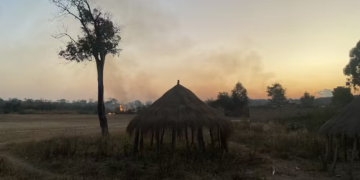
The traditional economy of the Nara people is based primarily on mixed agricultural and pastoral practices. The semi-arid environment plays a crucial role in determining the nature of crops and economic activities. Sorghum, sesame, and millet are the main crops grown depending on seasonal rainfall and in river valleys.
The Nara people own herds of cattle, goats, and sheep. Livestock is used not only as a source of food but also as a symbol of social status and as part of the dowry system and social exchange. Their traditional crafts include pottery, spinning, mat weaving, and traditional blacksmithing, which is used to make agricultural tools and traditional weapons.
Most Nara people converted to Islam during the 19th and early 20th centuries as a result of interaction with traders and neighbouring tribes such as the Beja and Tigray, as well as the political circumstances of the region. Their social structure is based on a patrilineal system, where the ethnic group is divided into main clans and extended families.
Marriage is considered a social event that unites two families or clans, not merely a contract between two individuals. Marriage ceremonies include the presentation of a dowry in the form of livestock or cash. They rely on a council of elders (known locally by different names depending on the dialect) to resolve disputes and conflicts concerning land, livestock, and family matters, based on inherited traditional customs.
The Nara people, like other communities in the Eritrean-Ethiopian border region, face a range of structural and environmental challenges. Frequent droughts and water scarcity in the Gash-Barka region impact agricultural and livestock production, threatening food security and stability.
Despite the Eritrean government’s efforts to implement a mother-tongue education policy for early childhood education, the Nara language faces challenges in documentation and a scarcity of written educational resources compared to major languages such as Tigrinya and Arabic.
Also, border disputes and political tensions between Ethiopia and Eritrea have affected population movements and traditional cross-border trade, sometimes leading to displacement and disruption of settled lifestyles.