










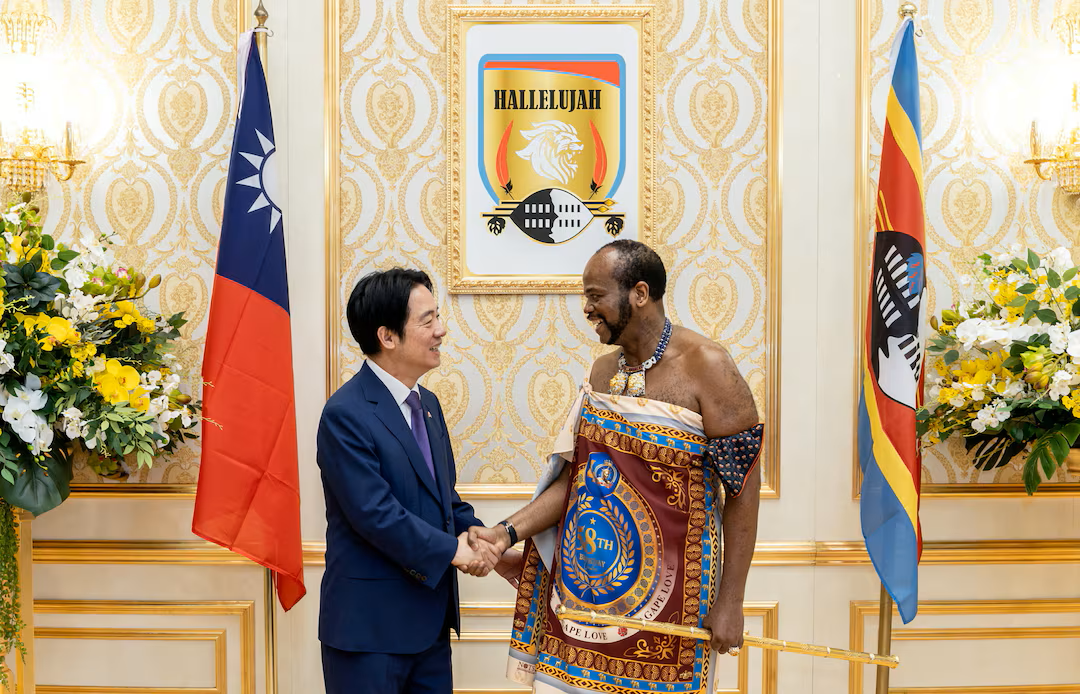
China said on Wednesday Eswatini’s leaders were being “kept and fed” by Taiwan, using unusually strong language to condemn the small southern African kingdom for hosting President Lai Ching-te.
China and Taiwan have long traded accusations of “dollar diplomacy” to win support from developing countries.
Beijing’s latest criticism came after Lai returned home on Tuesday from a surprise trip to the former Swaziland, one of just 12 countries with formal diplomatic ties to the democratically governed island claimed by China.
Beijing views Lai as a “separatist” and has demanded that other countries refuse to deal with his government or host him.
Lai’s government said China had forced three Indian Ocean nations – the Seychelles, Mauritius and Madagascar – to deny overflight permission for his aircraft when he first planned to go last month for celebrations of the 40th anniversary of the accession to the throne of King Mswati III.
Lai had “stowed away” to get to Eswatini, said Lin Jian, a spokesperson of China’s foreign ministry.
This showed that “separatist” activities were rejected by the international community and were a “scandal and a farce”, he told reporters in Beijing.
“Some politicians in Eswatini, kept and fed by Taiwan, have provided space for Taiwan independence forces — this runs counter to the tide of history, and China strongly condemns it,” Lin added, using a derogatory expression used to refer to a person being kept in servitude to another or used as a lackey.
In response, Eswatini’s acting government spokeswoman Thabile Mdluli told Reuters the remarks were “deeply unfortunate and fall short of the standards expected in respectful international discourse. It is especially concerning when statements of this nature come from a country that positions itself as a responsible global actor.”
“Eswatini must not be bullied and our sovereign decisions ought to be respected by all,” she added.
Taiwan’s government has been in celebratory mood after Lai made it to Eswatini and then returned via a circuitous route skirting airspace controlled by Mauritius and Madagascar.
Instead of travelling on a plane chartered from Taiwan’s China Airlines, as originally planned in line with usual practice, Lai flew on the king’s private A340 aircraft.
The trip further deepened the friendship between Taiwan and Eswatini, Lai, who rejects Beijing’s sovereignty claims, told a regular weekly meeting of his Democratic Progressive Party on Wednesday.
Despite China’s “blockade and suppression”, Taiwan “will surely advance steadily onto the international stage” as long as it remains unyielding and united and works hand in hand with like-minded partners, Lai added.