































The Khami Ruins, located about 22 kilometres west of Bulawayo in modern-day Zimbabwe, are one of the most important archaeological sites in southern Africa. These ruins represent the historical capital of the Torwa State, which rose to political and economic prominence after the decline of the Great Zimbabwe Kingdom in the mid-15th century. A UNESCO World Heritage Site since 1986, Khami provides a wealth of material for studying the social, architectural, and commercial transformations that shaped the region between 1450 and 1683 CE.
The Torwa State emerged following the gradual decline of the Great Zimbabwe Kingdom. While some groups migrated north to establish the Mutapa Kingdom, another group, later known as the Torwa, chose to settle in the drier but resource-rich southwest region.
Little is known about the identity of the early rulers of this state from written records, but archaeological evidence from Khami confirms the existence of a strong central government capable of managing human and material resources to construct an architecturally complex capital. Khami continued as an administrative and spiritual centre for over two centuries, representing an important transitional phase between the Late Stone Age and the beginning of Portuguese colonial expansion into the interior.
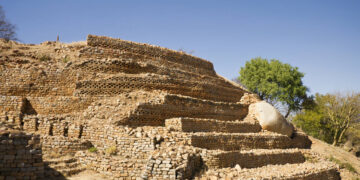
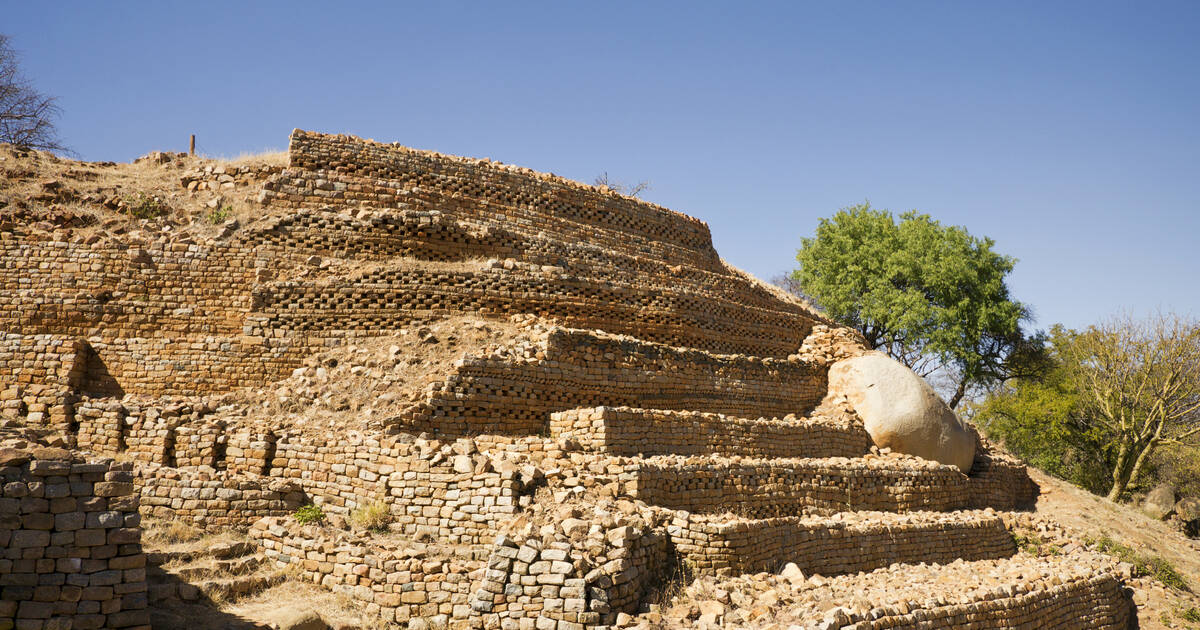
Khami’s architectural style differs significantly from that of Greater Zimbabwe. While the latter relied on high, freestanding stone walls, Khami’s architects employed a system of “retaining walls” or “stepped platforms”.
The city was built on artificial platforms raised using dry stone (without mortar). These platforms served as foundations for mud-brick and thatched houses (dhaka), giving the ruling elite a strategic and visual advantage; their homes overlooked the surrounding plains, reinforcing class and symbolic separation within the community.
The exterior walls of the platforms display exceptional artistry, employing decorative patterns such as herringbone, checkered, and wavy lines. These decorations were aesthetic and expressed the identity and political status of the ruling clan. Builders utilised the natural rock formations by incorporating them into the construction, thus reducing the amount of stone required and providing natural protection for the site.

The layout of Khami reflects a rigid social structure. The site consists of a series of residential and administrative complexes spread over a wide area, the largest and most important of which is the Hill Complex. This was the official residence of the chief (mambo). Located at the highest point of the site, this Hill Complex features the tallest and most ornate retaining walls. The complex contains narrow passageways and spaces that served as granaries or storehouses for valuable goods.
The Cross Platform, a controversial landmark in Khami, is a stone platform featuring a carved cross. Some neutral interpretations suggest that the local rulers may have been influenced by Portuguese missionaries, or perhaps that it was an attempt to incorporate foreign symbols into the local spiritual system to bolster legitimacy. Smaller platforms were spread around the centre, which were reserved for senior officials and the king’s family, while the common people lived in simple houses away from the stone centre, and their houses were often built directly on the ground without stone platforms, highlighting the economic and social gap.
Khami was not merely a military fortress or religious centre, but a vital trading hub connecting the heart of Africa to global trade networks across the Indian Ocean. Archaeological excavations have revealed compelling physical evidence of this connection.
The Torwa State exploited nearby gold mines and controlled the ivory trade, a commodity bartered with Swahili and Arab traders and later the Portuguese. Excavators in Khami have unearthed fragments of Chinese porcelain dating back to the Ming Dynasty, pieces of painted Spanish pottery, and glass beads from India. These artefacts demonstrate that the Torwa elite possessed cosmopolitan consumer tastes and considerable purchasing power.
Cattle formed the backbone of the local economy and a measure of personal and political wealth. The plains surrounding Khami provided vast grazing lands that sustained the population for extended periods.
The capital city of Khami was considered a sacred centre; the king was seen as a political leader and intermediary between the people and the ancestral spirits. Religious rituals were performed in designated areas on platforms, often aimed at invoking rain or ensuring the fertility of the land.
The Torwa State of government was characterised by its ability to unite local tribes under a single central authority through a combination of military power and spiritual legitimacy. This balance persisted for decades until external and internal pressures began to undermine the foundations of the state.
The golden age of Khami and the Torwa State ended in the 1680s. The city was invaded by Rozvi groups led by the Changamire dynasty. Archaeological evidence, such as layers of charred ash, suggests that large parts of the city were burnt during this invasion.
After the fall of Khami, the Rozvi rulers moved their capital to the site of Danamombe. With the departure of the ruling elite, Khami lost its administrative function, and the ruins were left to the elements. However, the sanctity of the site remained in the memory of local communities, who continued to visit it to offer sacrifices.
Khami represents a treasure trove for historians and archaeologists because, unlike Greater Zimbabwe, it did not suffer widespread looting or misguided “restoration” in the early 20th century. This means that the archaeological layers were better preserved, allowing researchers to gain a more nuanced understanding of daily life, diet, and metal smelting techniques.
Studies at Khami have shown that African societies of that period possessed sophisticated engineering knowledge for dealing with gravity and soil pressure, as evidenced by the stone platforms that have withstood centuries without the use of any adhesives. The study of animal remains at the site has also provided insights into the ancient environment and how herds were managed and meat was distributed.