
























The Kru, or Kroo, are a prominent ethnic group in West Africa, primarily concentrated in the coastal regions of Liberia and Ivory Coast. Their historical and anthropological significance stems from their close connection to the Atlantic Ocean, where they were historically known as skilled seafarers and navigators.
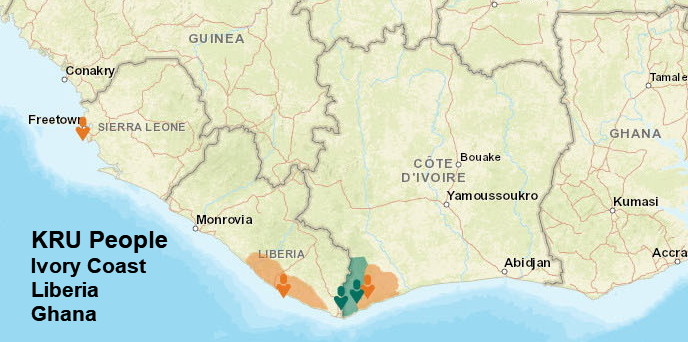
Linguistically, the Kru people belong to the Kru language family, a branch of the Niger-Congo language family. Geographically, their ancestral homeland extends along the “Grain Coast”, the historical name for the region stretching from the St John River in Liberia to the Bandama River in the Ivory Coast.
This ethnic group comprises several subgroups sharing cultural and linguistic ties, most notably the Bassa, Grebo, Krahn, and the actual Kroomen (also known as Krumen). Despite their geographical dispersion, a maritime identity remained their strongest common bond, particularly for those groups who settled directly on the coast.
The history of West Africa cannot be understood without considering the role played by the Kroomen in international navigation during the 18th and 19th centuries. Their exceptional skill in navigating canoes in rough seas made them highly sought-after labourers on British Royal Navy and European merchant ships.
Kroomen seafarers undertook arduous tasks, such as loading and unloading ships in African ports that lacked deep docks, in addition to serving as navigators and trade brokers. This occupation led to the emergence of Kru population centres in ports far from their original homeland, such as Freetown (Sierra Leone), Lagos (Nigeria), and Accra (Ghana), and some even settled in Liverpool, Britain, making them one of the first African groups to form an organised labour diaspora.
The Kru people were distinguished by their strong and persistent rejection of slavery. It was extremely difficult for slave traders to capture members of this group, due to their fighting prowess and the distinctive “mark” they wore on their faces. This was a dark blue vertical line running from the centre of the forehead to the tip of the nose. It served as a kind of “passport” and a symbol of freedom. European slave traders understood that a person bearing this mark would rather commit suicide or violent rebellion than be sold into slavery. British ships that hunted slave vessels also considered the mark proof that the person was a “free man” and not enslaved merchandise.
The Kru social structure was historically decentralised, with villages and tribes enjoying considerable autonomy. However, there was a strict internal organisational system based on the Panton System, as society was divided into clans bound by blood ties, each responsible for managing its members’ affairs and resolving internal disputes.
There is a collective leadership, as decisions were typically made by councils of elders and local leaders, with a prominent role played by experienced military commanders and navigators. Also, despite their maritime identity, land was considered communal property of the clan and could not be sold to outsiders, which later led to legal and political conflicts with American-Liberian settlers.
The Kru people have played a complex role in shaping the modern Liberian state. Since the arrival of “Black” settlers from America in the 19th century and the founding of Liberia, the Kru have been embroiled in a series of tensions with the central government in Monrovia. These conflicts have centred on sovereignty, taxation, and control of coastal trade.
The Kru have led several armed uprisings, most notably in 1915 and 1930, in protest against attempts to marginalise them politically and economically. However, over time, they have integrated into the political fabric of the state, and prominent national leaders and thinkers have emerged from among them, influencing the country’s history.
In contemporary history, former Liberian President George Weah is one of the most prominent figures of Kru ethnicity, reflecting a remarkable transformation from conflict with the state to reaching the pinnacle of its political hierarchy.
Kru culture is characterised by a rich diversity that blends inherited traditions with global influences resulting from their interaction with seafarers of various nationalities. Kru languages are characterised by a complex tonal system and are widely spoken in local radio and primary education in Liberia and the Ivory Coast.
Kru seafarers played a pioneering role in the development of West African music. They are credited with popularising early guitar-playing styles that paved the way for “highlife” music. They drew inspiration from sea shanties and blended them with Western instruments.
The civil wars in Liberia and Ivory Coast in the late 20th century led to the displacement of large numbers of Kru people. This displacement weakened some traditional cultural centres in coastal villages but, conversely, strengthened their presence in major cities such as Abidjan and Monrovia.
Despite economic challenges, the Kru diaspora has maintained “mutual benefit associations”, social organisations that aim to support individuals in exile, preserve linguistic ties, and pass on maritime heritage to new generations who no longer practise seafaring as their primary occupation.
The Kru people today face several challenges. The role of traditional seafarers has declined with the advent of giant ships and modern, automated ports, depriving many of their historical source of income. Kru coastal villages are suffering from coastal erosion and rising sea levels, threatening their historic homes and small farms.
Linguists fear that some small Kru dialects may be absorbed by national languages or trade languages (such as English and French) as a result of rapid urbanisation.