




Qiraat Africa
عربي  |  Fr
Advertisement
  • News
    • All
    • Climate Change
    • Economy
    • Education
    • Energy
    • Health
    • Migration
    • Mining
    • Politics
    • Security
    • Society
    • Sport
    SA President Ramaphosa launches Nelson Mandela Rules Academy at prison

    SA President Ramaphosa launches Nelson Mandela Rules Academy at prison

    Students turn on Senegalese government over Dakar university violence

    Students turn on Senegalese government over Dakar university violence

    Zimbabwe’s President Mnangagwa sworn in after a contested election

    Uproar in Zimbabwe over cabinet plan to extend president’s rule to 2030

    Ethiopia says Ghebreyesus, WHO chief has links to rebellious Tigrayan forces

    WHO urges US to share Covid origins findings

    Madagascan President Randrianirina visits city devastated by Cyclone Gezani

    Madagascan President Randrianirina visits city devastated by Cyclone Gezani

    India pulls out of Russian-backed Mali lithium project over security risks, sources say

    India pulls out of Russian-backed Mali lithium project over security risks, sources say

    Nigeria’s state-owned NNPC records $4.2 billion after-tax profit in 2025

    Nigeria’s state-owned NNPC records $4.2 billion after-tax profit in 2025

    DR Congo president calls for swift withdrawal of UN peacekeepers

    UN to launch reconnaissance flights to support eastern Congo ceasefire

    Cameroon President Paul Biya marks 41 years in power

    Cameroon President Biya delays elections once again

  • Analysis
    • All
    • Climate Change
    • Digital & Tech
    • Economy
    • Energy & Power
    • Health
    • Politics
    • Security
    • Society
    Security expert explains why the US can destroy terrorist bases in Nigeria but not terrorism

    Security expert explains why the US can destroy terrorist bases in Nigeria but not terrorism

    Africa’s informal economy taxation: the potential and drawbacks of technology

    Africa’s informal economy taxation: the potential and drawbacks of technology

    Ethiopia expects preliminary deal on IMF review within days, finance minister says

    Key events in Ethiopia’s journey towards debt restructuring

    BRICS Plus and the Shifting Global Power Balance: Implications of South Africa’s Role

    BRICS Plus and the Shifting Global Power Balance: Implications of South Africa’s Role

    African Union suspends Niger over coup, prepares sanctions; France denies report it asked Algeria to use airspace for a Niger operation

    Leaders in Africa’s human rights institutions are being elected. Why it matters

    Sahel Alliance leaders meet in Bamako to deepen break with ECOWAS

    The AES and the Reconfiguration of Regional Security Architecture: A Look at the 2025 Bamako Summit

    Somaliland rejects visas issued by Somalia and tightens control over its airpsace

    Why is Somaliland strategically important?

    US airstrikes in northern Nigeria: potential windfalls and dangers

    US airstrikes in northern Nigeria: potential windfalls and dangers

    Why France’s Focus is Shifting to Anglophone Africa

    Why France’s Focus is Shifting to Anglophone Africa

  • Studies
    Benin government says armed forces foil coup attempt

    Coup contagion? A rash of African power grabs suggests copycats are taking note of others’ success

    One in three South Africans have never heard of AI: what this means for policy

    One in three South Africans have never heard of AI: what this means for policy

    Social Media as a Catalyst for the Spread of Dangerous Wealth Ritual Myths

    Social Media as a Catalyst for the Spread of Dangerous Wealth Ritual Myths

    Overcoming Education Barriers for Young Mothers in Sub-Saharan Africa

    Overcoming Education Barriers for Young Mothers in Sub-Saharan Africa

    Youth Empowerment Through Vocational Training in Rural Sub-Saharan Africa

    Youth Empowerment Through Vocational Training in Rural Sub-Saharan Africa

    Manufacturers in Ghana and Nigeria claim that although corruption damages businesses, digital technologies provide a chance to combat it

    Manufacturers in Ghana and Nigeria claim that although corruption damages businesses, digital technologies provide a chance to combat it

    Environmental Threats and Conservation Efforts in Namibia

    Environmental Threats and Conservation Efforts in Namibia

    Your teachers’ level of knowledge affects how well you perform in class: perspectives from 14 French-speaking African nations

    Your teachers’ level of knowledge affects how well you perform in class: perspectives from 14 French-speaking African nations

    Islamic Finance in Nigeria: Between Islamization and Shariah Non-Compliance Polemics

    Islamic Finance in Nigeria: Between Islamization and Shariah Non-Compliance Polemics

  • Infographics
  • Figures
    Abubakar Gumi (1924–1992): Nigerian Islamic scholar and Grand Khadi of the Northern Region of Nigeria

    Abubakar Gumi (1924–1992): Nigerian Islamic scholar and Grand Khadi of the Northern Region of Nigeria

    Haile Selassie (1892-1975): Former Emperor of Ethiopia

    Haile Selassie (1892-1975): Former Emperor of Ethiopia

    Bennet Omalu: Nigerian-American physician and forensic pathologist

    Bennet Omalu: Nigerian-American physician and forensic pathologist

    Samori Touré (1830-1900): Military leader and founder of Wassoulou Empire

    Samori Touré (1830-1900): Military leader and founder of Wassoulou Empire

    Mohammed Abdulle Hassan (1856-1920): Somali religious and nationalist leader

    Mohammed Abdulle Hassan (1856-1920): Somali religious and nationalist leader

    Imam Abdullah Haron (1924-1969): South African Muslim cleric and anti-apartheid activist

    Imam Abdullah Haron (1924-1969): South African Muslim cleric and anti-apartheid activist

    Joyce Banda, educator and former president of Malawi

    Joyce Banda, educator and former president of Malawi

    Jomo Kenyatta (1894-1978): First prime minister and first president of Kenya

    Jomo Kenyatta (1894-1978): First prime minister and first president of Kenya

    What does a diary entry reveal about the West African origins of Apongo, a rebel leader in Jamaica?

    What does a diary entry reveal about the West African origins of Apongo, a rebel leader in Jamaica?

  • History
    Royal Palace, Porto-Novo, Republic of Benin

    Royal Palace, Porto-Novo, Republic of Benin

    W-Arly-Pendjari Complex, the West African wildlife sanctuary

    W-Arly-Pendjari Complex, the West African wildlife sanctuary

    Royal Court of Tiébélé, Burkina Faso

    Royal Court of Tiébélé, Burkina Faso

    Lake Tanganyika, the world’s longest freshwater lake

    Lake Tanganyika, the world’s longest freshwater lake

    The Bafut Chiefdom, Cameroon

    The Bafut Chiefdom, Cameroon

    The battles of Isandlwana and Rorke’s Drift

    The battles of Isandlwana and Rorke’s Drift

    Kimberley’s Big Hole, Northern Cape, South Africa

    Kimberley’s Big Hole, Northern Cape, South Africa

    Ogbunike Caves, Southeastern Nigeria

    Ogbunike Caves, Southeastern Nigeria

    Historic Town of Grand-Bassam

    Historic Town of Grand-Bassam

  • Others
    • Culture / Literature
    • Interview
    • Opinion
  • Countries
    • Country profiles
    • Regions
      • Central Africa
      • East Africa
      • Southern Africa
      • West Africa
No Result
View All Result
  • News
    • All
    • Climate Change
    • Economy
    • Education
    • Energy
    • Health
    • Migration
    • Mining
    • Politics
    • Security
    • Society
    • Sport
    SA President Ramaphosa launches Nelson Mandela Rules Academy at prison

    SA President Ramaphosa launches Nelson Mandela Rules Academy at prison

    Students turn on Senegalese government over Dakar university violence

    Students turn on Senegalese government over Dakar university violence

    Zimbabwe’s President Mnangagwa sworn in after a contested election

    Uproar in Zimbabwe over cabinet plan to extend president’s rule to 2030

    Ethiopia says Ghebreyesus, WHO chief has links to rebellious Tigrayan forces

    WHO urges US to share Covid origins findings

    Madagascan President Randrianirina visits city devastated by Cyclone Gezani

    Madagascan President Randrianirina visits city devastated by Cyclone Gezani

    India pulls out of Russian-backed Mali lithium project over security risks, sources say

    India pulls out of Russian-backed Mali lithium project over security risks, sources say

    Nigeria’s state-owned NNPC records $4.2 billion after-tax profit in 2025

    Nigeria’s state-owned NNPC records $4.2 billion after-tax profit in 2025

    DR Congo president calls for swift withdrawal of UN peacekeepers

    UN to launch reconnaissance flights to support eastern Congo ceasefire

    Cameroon President Paul Biya marks 41 years in power

    Cameroon President Biya delays elections once again

  • Analysis
    • All
    • Climate Change
    • Digital & Tech
    • Economy
    • Energy & Power
    • Health
    • Politics
    • Security
    • Society
    Security expert explains why the US can destroy terrorist bases in Nigeria but not terrorism

    Security expert explains why the US can destroy terrorist bases in Nigeria but not terrorism

    Africa’s informal economy taxation: the potential and drawbacks of technology

    Africa’s informal economy taxation: the potential and drawbacks of technology

    Ethiopia expects preliminary deal on IMF review within days, finance minister says

    Key events in Ethiopia’s journey towards debt restructuring

    BRICS Plus and the Shifting Global Power Balance: Implications of South Africa’s Role

    BRICS Plus and the Shifting Global Power Balance: Implications of South Africa’s Role

    African Union suspends Niger over coup, prepares sanctions; France denies report it asked Algeria to use airspace for a Niger operation

    Leaders in Africa’s human rights institutions are being elected. Why it matters

    Sahel Alliance leaders meet in Bamako to deepen break with ECOWAS

    The AES and the Reconfiguration of Regional Security Architecture: A Look at the 2025 Bamako Summit

    Somaliland rejects visas issued by Somalia and tightens control over its airpsace

    Why is Somaliland strategically important?

    US airstrikes in northern Nigeria: potential windfalls and dangers

    US airstrikes in northern Nigeria: potential windfalls and dangers

    Why France’s Focus is Shifting to Anglophone Africa

    Why France’s Focus is Shifting to Anglophone Africa

  • Studies
    Benin government says armed forces foil coup attempt

    Coup contagion? A rash of African power grabs suggests copycats are taking note of others’ success

    One in three South Africans have never heard of AI: what this means for policy

    One in three South Africans have never heard of AI: what this means for policy

    Social Media as a Catalyst for the Spread of Dangerous Wealth Ritual Myths

    Social Media as a Catalyst for the Spread of Dangerous Wealth Ritual Myths

    Overcoming Education Barriers for Young Mothers in Sub-Saharan Africa

    Overcoming Education Barriers for Young Mothers in Sub-Saharan Africa

    Youth Empowerment Through Vocational Training in Rural Sub-Saharan Africa

    Youth Empowerment Through Vocational Training in Rural Sub-Saharan Africa

    Manufacturers in Ghana and Nigeria claim that although corruption damages businesses, digital technologies provide a chance to combat it

    Manufacturers in Ghana and Nigeria claim that although corruption damages businesses, digital technologies provide a chance to combat it

    Environmental Threats and Conservation Efforts in Namibia

    Environmental Threats and Conservation Efforts in Namibia

    Your teachers’ level of knowledge affects how well you perform in class: perspectives from 14 French-speaking African nations

    Your teachers’ level of knowledge affects how well you perform in class: perspectives from 14 French-speaking African nations

    Islamic Finance in Nigeria: Between Islamization and Shariah Non-Compliance Polemics

    Islamic Finance in Nigeria: Between Islamization and Shariah Non-Compliance Polemics

  • Infographics
  • Figures
    Abubakar Gumi (1924–1992): Nigerian Islamic scholar and Grand Khadi of the Northern Region of Nigeria

    Abubakar Gumi (1924–1992): Nigerian Islamic scholar and Grand Khadi of the Northern Region of Nigeria

    Haile Selassie (1892-1975): Former Emperor of Ethiopia

    Haile Selassie (1892-1975): Former Emperor of Ethiopia

    Bennet Omalu: Nigerian-American physician and forensic pathologist

    Bennet Omalu: Nigerian-American physician and forensic pathologist

    Samori Touré (1830-1900): Military leader and founder of Wassoulou Empire

    Samori Touré (1830-1900): Military leader and founder of Wassoulou Empire

    Mohammed Abdulle Hassan (1856-1920): Somali religious and nationalist leader

    Mohammed Abdulle Hassan (1856-1920): Somali religious and nationalist leader

    Imam Abdullah Haron (1924-1969): South African Muslim cleric and anti-apartheid activist

    Imam Abdullah Haron (1924-1969): South African Muslim cleric and anti-apartheid activist

    Joyce Banda, educator and former president of Malawi

    Joyce Banda, educator and former president of Malawi

    Jomo Kenyatta (1894-1978): First prime minister and first president of Kenya

    Jomo Kenyatta (1894-1978): First prime minister and first president of Kenya

    What does a diary entry reveal about the West African origins of Apongo, a rebel leader in Jamaica?

    What does a diary entry reveal about the West African origins of Apongo, a rebel leader in Jamaica?

  • History
    Royal Palace, Porto-Novo, Republic of Benin

    Royal Palace, Porto-Novo, Republic of Benin

    W-Arly-Pendjari Complex, the West African wildlife sanctuary

    W-Arly-Pendjari Complex, the West African wildlife sanctuary

    Royal Court of Tiébélé, Burkina Faso

    Royal Court of Tiébélé, Burkina Faso

    Lake Tanganyika, the world’s longest freshwater lake

    Lake Tanganyika, the world’s longest freshwater lake

    The Bafut Chiefdom, Cameroon

    The Bafut Chiefdom, Cameroon

    The battles of Isandlwana and Rorke’s Drift

    The battles of Isandlwana and Rorke’s Drift

    Kimberley’s Big Hole, Northern Cape, South Africa

    Kimberley’s Big Hole, Northern Cape, South Africa

    Ogbunike Caves, Southeastern Nigeria

    Ogbunike Caves, Southeastern Nigeria

    Historic Town of Grand-Bassam

    Historic Town of Grand-Bassam

  • Others
    • Culture / Literature
    • Interview
    • Opinion
  • Countries
    • Country profiles
    • Regions
      • Central Africa
      • East Africa
      • Southern Africa
      • West Africa
No Result
View All Result
Qiraat Africa
عربي  |  Fr
No Result
View All Result
Home Regions Central Africa

Cameroon and Tanzania’s rulers clung to power in 2025—but look more vulnerable than ever

December 22, 2025
UN believes hundreds were killed in Tanzania election protests

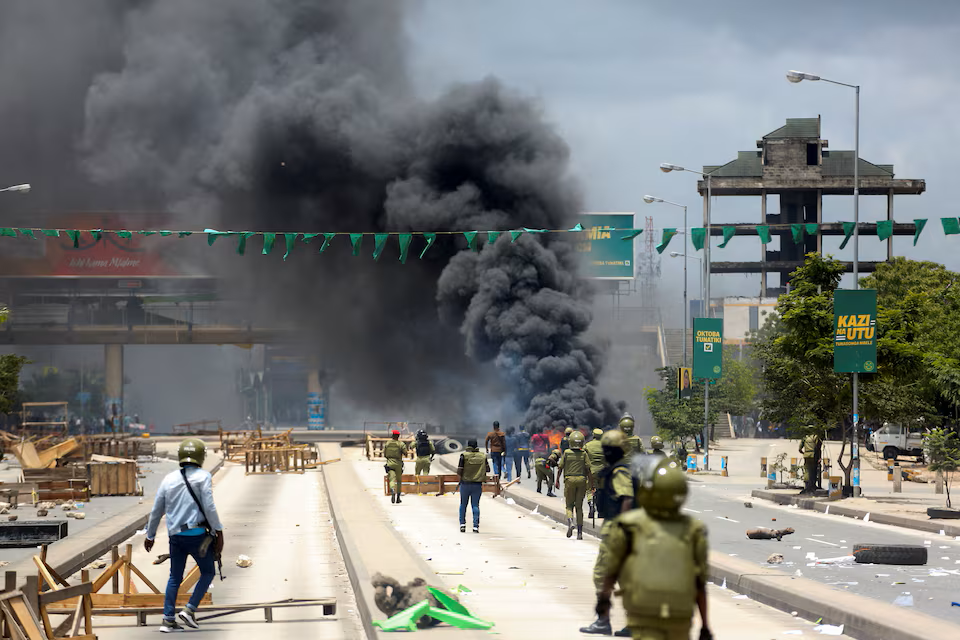
Tanzanian riot police disperse demonstrators during violent protests that marred the election following the disqualification of the two leading opposition candidates in Dar es Salaam, Tanzania, October 29, 2025. REUTERS/Onsase Ochando

Share on FacebookShare on Twitter

By Yonatan Morse*


Autocratic leaders in Africa like their numbers to be in the high 90s, it appears.

In October, Tanzanian President Samia Suluhu Hassan won a highly dubious 98% of the presidential vote, perpetuating the ruling party’s grip on power to 60 years. During the same month, Cameroonian President Paul Biya, who has ruled the country since 1982, secured an unprecedented eighth term in office. It will allow him to serve until he turns 99.

In neither case were elections deemed free or fair, and in both cases protests and severe government crackdowns followed.

Yet, while the outcome was ultimately the survival of incumbent governments, these elections are quite telling about the changing fortunes of autocracy in Africa.

In 2019, I wrote a book titled “How Autocrats Compete” that used Tanzania and Cameroon as contrasting examples. The divergent origins of their respective autocracies sowed the seeds for the kinds of challenges that each country would eventually face. Both country’s governments, which observers widely see as repressive and antidemocratic, have lost key sources of underlying strength, making them more vulnerable than they have been in decades.

The roots of 2 autocracies

“How Autocrats Compete” showed how Tanzania and Cameroon used to reflect two different strains of autocracy: party-based and a personalist.

For decades, Julius Nyerere was the driving force in Tanzanian politics. An immensely popular anti-colonial leader, Nyerere in 1965 created a single-party state governed by a robust and effective political party apparatus – first under the Tanganyika African National Union and later recast as Chama Cha Mapinduzi, or CCM.

The party attracted a wide swath of rural voters, had national functioning institutions and a widespread grassroots presence. Importantly, when Nyerere stepped down from power in 1985 – then a precedent in African politics – he established an internal primary system to select CCM’s future presidential candidates.

Cameroon’s autocracy emerged from much different terrain. After independence, political power was heavily centralized in the presidency. The main source of power was the president’s ability to use carrots and sticks to bring together a multiethnic coalition of elites into a transactional relationship.

By 1972, all political parties had been absorbed by the ruling Cameroonian National Union, later known as the Cameroon People’s Democratic Movement.

The ruling party played a secondary role compared to the presidency, withering away and not even meeting for years. Under Cameroon’s first president, Ahamdou Ahidjo, power was oriented to the north of the country, while under Paul Biya it has been oriented to the south.

These different foundations for autocracy translated into unique adaptations to multiparty elections. In Tanzania, the ruling CCM could rely on widespread turnout, and the candidate selection processes appeared to minimize elite discontent within the party.

Between 1995 and 2010, CCM and its presidential candidates could win determinative vote shares while minimizing costly repression and fraud.

Elections were still not free and fair, but there were not systematically high rates of violence or coercion. In fact, at the time many considered Tanzania somewhat of a democracy.

The same could not be said of Cameroon, where elections were initially much more challenging for the ruling party and President Biya.

In the 1990s, the ruling CPDM suffered a barrage of defections and Biya won only 40% of the 1992 election.

But, largely shielded from international scrutiny, he could deploy highly repressive tools that allowed him to build an image of invulnerability. Former opponents rejoined the CPDM, and the opposition wilted away to an enclave in majority Francophone Cameroon’s English-speaking regions. At the core remained Biya, with virtual control over all political and economic life.

The erosion of hegemony in Tanzania

When I wrote “How Autocrats Compete,” I argued that CCM’s core strengths in Tanzania would ultimately erode. As younger generations became removed from the mythology of Nyerere, CCM’s voting constituency would diminish.

And indeed, according to Afrobarometer, the percentage of Tanzanians who felt close to CCM declined from 91% in 2001 to 69% in 2012.

CCM’s advantages as a ruling party also incentivized opposition parties to emulate it. There is extensive research on how the main Tanzanian opposition party Chadema mimicked CCM’s grassroots approach to party building.

These changes were accompanied by increased factionalism within CCM. The key moment was the 2015 election when front-runner presidential candidate Edward Lowassa was disqualified and John Magufuli nominated instead. Magufuli, seen as an institutional choice, had no strong ties to any specific faction, and thus a tenuous grasp over the party elite.

The answer to all of these challenges has been for the ruling party to crack down on opposition and impose discipline. Since 2015, Tanzania has become a demonstrably less open place, ratcheting up the brutality against opposition elites and civil society writ large.

Meanwhile, to control its own elite, CCM has had to restrict its ability to maneuver. Despite promises of reform and conciliatory gestures, Hassan appears driven by the same political logic – the party cannot lose and can no longer rely on the tools of the past. The only way to secure victory is through much more overt repression.

The limits of personal rule in Cameroon

The personalized nature of the Cameroonian government has made the question of succession a perennial puzzle.

Absent any credible mechanism for choosing a successor, Biya’s solution has been to kick the can down the road. In 2008, despite public discontent, he controversially removed term limits, seemingly signaling his willingness to stay in office indefinitely.

But Biya’s ability to hold together the historic multiethnic coalition has appeared severely weakened in recent years.

Cameroon’s English-speaking regions, representing nearly a quarter of the population, grew more vocal in their demands for equality in Cameroon’s heavily centralized political system. The government’s response has been violent, and since 2017 these regions have been mired in a civil conflict.

Biya has also faced growing opposition from the the wing of his coalition representing the Bamileké, an important ethnic group that has largely remained within the ruling fold. Since 2012, when one of its leaders, Maurice Kamto, defected to challenge Biya, the government has routinely responded by arresting the opposition figure and many of his supporters.

These factors, along with growing impatience over the question of succession, likely influenced the decision of the northern-based leader Issa Tchiroma to leave government and challenge Biya in the 2025 election. The north-south coalition had been the most important axis of Biya’s coalition.

Given the size and importance of the northern bloc, overt repression of Tchiroma was much riskier for Biya. He could not simply disallow Tchiroma’s candidacy as he had done for Maurice Kamto.

So Biya’s government rigged the results.

To raise the costs of fraud, Tchiroma declared himself the winner immediately after the election. Cameroon’s election management body took a painstaking 15 days to declare Biya the victor with just 54% of the vote, his lowest showing since 1992. Given the obvious factionalism and Biya’s weakness, it would have been inconceivable to claim any larger of a victory.

Read also

Security expert explains why the US can destroy terrorist bases in Nigeria but not terrorism

Africa’s informal economy taxation: the potential and drawbacks of technology

SA President Ramaphosa launches Nelson Mandela Rules Academy at prison

The shifting tides of authoritarianism

While each election might have been a victory for autocracy, these are different autocracies from what they were 20 years ago. Importantly, the electoral contests tell us that authoritarian governments are dynamic – and even potentially at risk.

In the case of Tanzania, there has been a gradual unwinding of key sources of longevity in favor of more blatant and brutal tools of authoritarian rule. Hassan vote share is a reminder of sham results seen in places like Equatorial Guinea or Rwanda.

On the other hand, in Cameroon we are witnessing the logical unfolding of a highly personalized autocracy that has been unwilling to deal with its own internal contradictions. In both 2025 and 1992, Biya faced a frayed political coalition that sensed his vulnerability. The difference this time is that Biya does not have another 30 years ahead of him to rebuild a political coalition.

At the end of the day, these are autocracies in transition and entering into a new status quo that seems much more fragile. It is unclear what new equilibriums will emerge.

ـــــــــــــــــــــــــ

* Associate Professor, University of Connecticut.
Source: The Conversation
Tags: CameroonPaul BiyaSamia Suluhu HassanTanzania

Related Posts

Zimbabwe’s President Mnangagwa sworn in after a contested election
Featured

Uproar in Zimbabwe over cabinet plan to extend president’s rule to 2030

February 12, 2026
Ethiopia says Ghebreyesus, WHO chief has links to rebellious Tigrayan forces
East Africa

WHO urges US to share Covid origins findings

February 12, 2026
Madagascan President Randrianirina visits city devastated by Cyclone Gezani
East Africa

Madagascan President Randrianirina visits city devastated by Cyclone Gezani

February 12, 2026
India pulls out of Russian-backed Mali lithium project over security risks, sources say
Featured

India pulls out of Russian-backed Mali lithium project over security risks, sources say

February 12, 2026
Nigeria’s state-owned NNPC records $4.2 billion after-tax profit in 2025
Energy

Nigeria’s state-owned NNPC records $4.2 billion after-tax profit in 2025

February 12, 2026
DR Congo president calls for swift withdrawal of UN peacekeepers
East Africa

UN to launch reconnaissance flights to support eastern Congo ceasefire

February 12, 2026

Search Qiraat Africa

No Result
View All Result

Follow on Twitter

Follow @africanqiraat

Trending

Tunka Manin (c. 1010–1078), the last ruler of the Ghana Empire

Tunka Manin (c. 1010–1078), the last ruler of the Ghana Empire

December 12, 2025
Kumbi Saleh, the capital of the ancient Ghana Empire

Kumbi Saleh, the capital of the ancient Ghana Empire

October 13, 2025
Brief History and Culture of the City of Lagos, Nigeria

Brief History and Culture of the City of Lagos, Nigeria

July 24, 2024
The Bamiléké of western Cameroon

The Bamiléké of western Cameroon

September 18, 2024
Cyclone Gezani tears through Madagascar, killing at least 20

Cyclone Gezani tears through Madagascar, killing at least 20

February 11, 2026
Trump ally and Blackwater founder sent men, drones to help Congo’s army secure strategic town

Trump ally and Blackwater founder sent men, drones to help Congo’s army secure strategic town

February 10, 2026

Facebook

Sections

  • About Us
  • Privacy Policy
  • Opinion
  • Infographics
  • News
  • Analysis
  • Figures
  • Culture & Literature
  • Follow Ups
  • Historical Readings
  • Interview
  • Studies


© Copyright Qiraat Africa. Developed by Bunnaj Media .

No Result
View All Result
  • News
  • Analysis & Report
  • Studies
  • Opinion
  • Interview
  • Culture & Literature
  • Figures
  • Historical Readings
  • Regions

© 2021 Copyright Qiraat Africa.