



























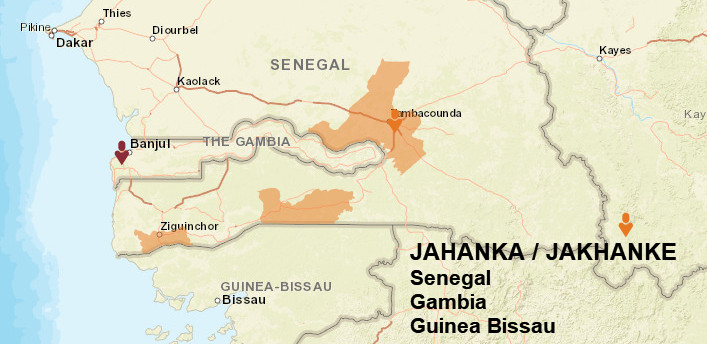
The Jakhanke are a distinctive ethnic and cultural group in Senegambia and the upper Niger River basin. They belong to the Mandinka language group and are closely related to the Soninke (also known as Serakhulle) and Malinke peoples. Historically, the Jakhanke are distinguished by their profound role as a religious elite—a class of scholars and jurists who adopted a unique, peaceful approach to spreading Islam and governing communities.
The Jakhanke trace their ethnic origins to a mixture of Soninke elements who migrated from the ancient Ghana Empire (Wagadougou) after its collapse and Malinke groups. This interaction produced a linguistic identity known as “Jakhanke”, a dialect very close to Soninke but influenced by the surrounding Mandinka culture.
The origins of this group are linked to the city of Jakhaba, located in the Bambouk region on the border between present-day Mali and Guinea. This city served as the first spiritual and intellectual centre from which Jakhanke migrations moved westward toward Senegal, Gambia, and Guinea-Bissau. These migrations were driven by a search for fertile agricultural lands and peaceful environments that would allow for the establishment of educational centres (kuttabs and scholarly councils) far from the turmoil of warring kingdoms.
The most significant contribution of the Jakhanke to the history of West Africa is their adoption of what is known as the “Suwarian tradition”, named after the scholar and jurist Al-Hajj Salim Suwari, who lived in the 13th or 15th century CE. Suwari laid the theoretical foundations that guided the Jakhankes’ conduct for centuries, encapsulated in the principle of “peaceful jihad” or “jihad of the self”.
This philosophy rests on the premise that Islam should spread through example, education, and trade, not by the sword. Accordingly, the Jakhankes adopted a neutral stance toward political conflicts, believing that involvement in power corrupted the religious world and distracted it from its educational mission. This position earned them the respect of both pagan and Muslim rulers in the kingdoms where they settled, as they were seen as stabilising forces with no ambition for power. This afforded them a degree of self-preservation, allowing them to move freely across complex political boundaries.
Education is the backbone of Jakhanke identity. In this community, an individual is valued by their academic achievement. Their educational system is based on the “Majlis”, a comprehensive educational and scholarly institution that begins with the teaching of the Quran (the initial stage) and progresses to the study of advanced texts in Maliki jurisprudence, Arabic language, exegesis, and Sufism.
The Jakhanke curriculum is characterised by its focus on specific texts such as “Mukhtasar Khalil” in jurisprudence and “Risalah Ibn Abi Zayd al-Qayrawani”. Students undergo a long period of study with a sheikh, culminating in the awarding of an “Ijazah”, which allows them to return to their village or migrate to establish a new scholarly council. This system has fostered a transboundary network of interconnected scholars, helping to maintain cultural, linguistic, and religious harmony in the Senegambia region and beyond.
Despite its religious character, the Jakhanke communities maintained a traditional class system similar to other Mandinka peoples, though with some degree of flexibility. The scholarly class Karamokho (or Karamoko) are educated elites who held positions in the judiciary, teaching, and leading prayers. The farming and trading class is the economic force that supported the centres of learning. The professional classes included blacksmiths and panegyrists (Griots), although their presence among the Jakhanke was less prominent than among the Malinke due to the religious focus, which may have limited some traditional arts.
It is noteworthy that the Jakhanke historically had a system of domestic slavery, where the enslaved performed arduous agricultural work on the sheikhs’ farms, freeing up the scholars for teaching and worship. With the abolition of slavery, this system transformed into social dependency or wage labour.
The Jakhanke were also prominent economic players. They adopted an economic model based on agricultural self-sufficiency. Each scholarly centre (educational village) was surrounded by a vast agricultural area for growing grains and cotton. Students participated in agricultural work as part of their education, which ensured the funding of the educational institution without the need to solicit alms or rely on the rulers’ gifts.
On another front, the Jakhanke excelled in long-distance trade, particularly in gold, salt, and textiles. Thanks to their widespread scholarly network, they were able to establish rest stops and safe havens for trade caravans.
The Jakhanke are distributed today across several major countries, maintaining strong kinship ties. In Senegal, they are concentrated in the regions of Tambacounda (notably Missirah), Kédougou, Kolda, and Ziguinchor (Casamance). In the Gambia, they form an important part of the social and religious fabric and have a strong presence in the eastern regions. In Guinea, they are concentrated in the Boké region and in historical centres such as Touba, founded by al-Hajj Salimu Kasama, commonly known as Karamokho Ba, and considered one of their most important centres of learning. Also, in Guinea-Bissau, they are found in the northern and eastern regions bordering Senegal and Guinea.
This geographical distribution has made them a quintessential “border people”, capable of adapting to different political systems while preserving their cultural independence.
As European colonialism (French and British) began to penetrate Senegambia, the Jakhanke faced a new challenge. Because their faith was based on pacifism, they avoided the direct armed conflict waged by leaders like Omar Saidou Tall or Samori Touré. Instead, they adopted a policy of cautious cooperation to preserve their schools.
However, the Jakhanke suffered administrative pressures, particularly regarding the abolition of slavery, which impacted their agricultural production system, and the imposition of French education, which began to compete with their traditional schools. This led to new waves of migration by some groups to more isolated areas to preserve the purity of their educational system.
In the modern era, and due to significant intermingling with the Mandinka, Wolof, and Fulani peoples, many Jakhanke have begun to speak the languages of the majority in their countries, while still retaining their ethnic name. The entry of new generations into government schools and universities has led to a decline in the role of traditional councils, creating a gap between the generation of traditional scholars and young people influenced by modern culture or contemporary Islamic movements. Also, many Jakhanke have moved from their historical villages to capital cities like Dakar, Banjul, and Conakry to work in modern commerce and technical professions, weakening their connection to the land and agriculture that were once a cornerstone of their identity.