




























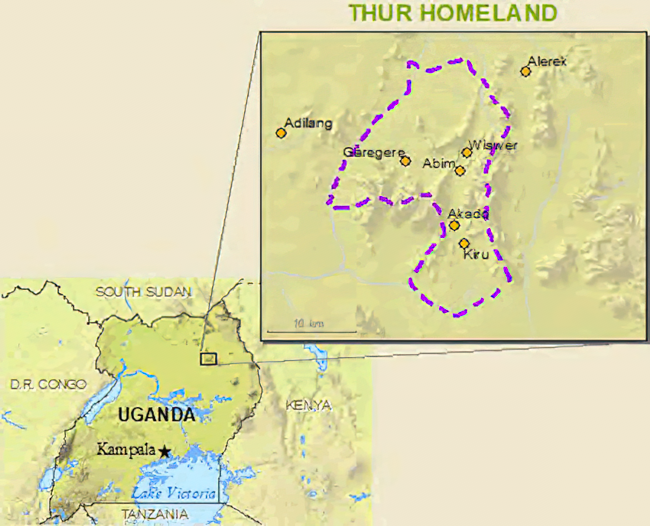
The Thur people, also known as the Ethur / Jo’ Abwor, are an ethnic group inhabiting northeastern Uganda, specifically the Abim District, formerly part of Kotido county. They represent a unique example of cultural and linguistic fusion in the Karamoja region, forming a human and cultural bridge between the western Nilotic peoples (such as the Acholi and Lango) and the eastern Nilotic peoples (such as the Karamojong).
Historically, the Thur people are part of the great Nilotic migrations that moved from southern Sudan into Ugandan territory. Anthropological studies indicate that they are part of the Luo confederation, the same origin from which the Acholi of Uganda and the Luo of Kenya descend. However, their separation from the main migration wave and their settlement in the Labwor Hills region led to the development of a distinct identity.
The Thur settled in these rugged hills, which provided them with natural protection from the frequent raids of neighbouring pastoral tribes. Over time, due to relative isolation and ongoing interaction with the Jie and Karamojong tribes, their customs and traditions were influenced, but they retained their linguistic roots, which are linked to the Luo group. This settlement in the Labwor Hills led to them being known in historical literature as the “Labwor people”, a geographical name for the region they inhabit.
The Thur speak a language known as Leb Thur, or the Ethur language. Classified as a West Nilotic language, it is closely related to Acholi and Lango, with a high degree of mutual understanding between these languages. However, Leb Thur has borrowed extensively from East Nilotic languages, particularly regarding terms related to the arid environment, livestock herding, and natural phenomena.
For the Thur, language is the primary tool for maintaining ethnic distinctiveness. Surrounded by structurally different languages, their language remains the link connecting them to their distant Luo heritage. In modern times, with the spread of formal education, English and Acholi have begun to exert influence in official and commercial transactions, but Leb Thur remains the dominant language for family communication and traditional rituals.
The Thur society is based on a strict clan system, which serves as the basic unit of political and social organisation. The tribe is divided into several clans, each with its own chief and oral history that traces its origins and ancestry. Kinship is patrilineal, with lineage traced through the father’s side, and property and titles passed down from fathers to sons.
The Thur people do not have a large, centralised political system like the kingdoms of central and southern Uganda. Instead, they rely on councils of elders. The elders of each clan are responsible for resolving disputes, distributing agricultural land, and organising seasonal rituals. A person’s social standing is crucial, with prestige based on wisdom, number of children, agricultural productivity, and expertise in traditional crafts.
Unlike their Karamojong neighbours, who are almost entirely nomadic pastoralists, the Thur people are primarily a settled agricultural society. The topography of the Labwor Hills has necessitated a production model based on utilising the surrounding slopes and plains.
The main crops grown by the Thur include sorghum, millet, groundnuts, and beans. Sorghum is a strategic crop, essential for their daily diet and for making traditional beverages. They have developed farming techniques adapted to the irregular rainfall patterns of northeastern Uganda, relying on communal labour during ploughing and harvesting, a system known as “mutual aid” among families.
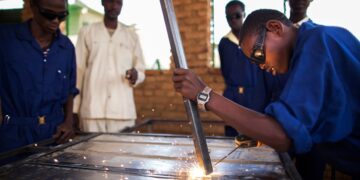
Besides, Thur people were renowned as some of the most skilled blacksmiths in northeastern Uganda. They utilised the iron deposits in their hills to smelt metal and craft tools. This craft gave them a significant strategic and economic advantage, as they supplied neighbouring pastoral tribes with spears for hunting and warfare and axes and hoes for farming. Despite the introduction of imported tools in the modern era, some families still preserve the secrets of traditional blacksmithing as part of their cultural heritage, even though its economic importance has declined compared to the past.
The Thur people played a pivotal role as a buffer zone between the pastoral peoples to the east and the agricultural peoples to the west and north. Due to their geographical location, they were often intermediaries in trade between these sometimes warring groups. However, this location also made them vulnerable to cattle raids and border conflicts.
Thur’s relationship with their neighbours was characterised by a kind of chronic tension intertwined with interdependence. While the Karamojong viewed them as farmers and a source of metal tools, the Thur saw the Karamojong as a source of meat and dairy products through barter but also as a security threat. This situation led the Thur to develop defensive skills and a social organisation focused on protecting their highland villages.
The mountainous and agricultural environment is reflected in their art; their dances feature drum-based rhythms and movements that mimic agricultural work or blacksmithing. Traditional songs are used to document historical events, preserve genealogies, and criticise undesirable social behaviours. With the dawn of the 20th century and the spread of missionary activity in northern Uganda, the vast majority of the Thur people converted to Christianity (Catholic and Protestant). However, a blend of Christian practices and some traditional customs persists, particularly in funerals and naming ceremonies, where a child is given a Christian name and a traditional name that reflects the circumstances of their birth or commemorates an ancestor.
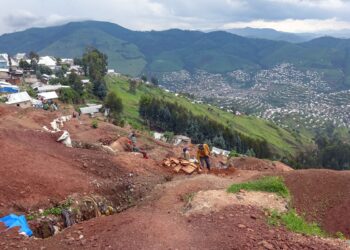
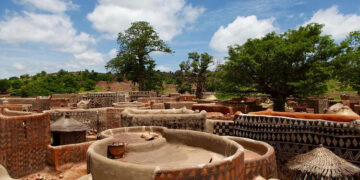
Thur villages are characterised by a spatial organisation that reflects the need for security and cooperation. Houses are typically built from local materials; walls are made of mud and reeds, and the roofs are conical and covered with dry grass. Villages are often surrounded by hedges or stone enclosures to protect crops and stores from wild animals or raids.
Given the hilly nature of the Labwor region, the inhabitants prefer to build their houses in close clusters on the slopes, which facilitates monitoring the surrounding plains. The “granaries” are considered the most important part of every residential unit, as the amount of stored crops reflects the stability of the family and its ability to cope with the years of drought that periodically hit the region.