



Qiraat Africa
عربي  |  Fr
Advertisement
  • News
    • All
    • Climate Change
    • Economy
    • Education
    • Energy
    • Health
    • Migration
    • Mining
    • Politics
    • Security
    • Society
    • Sport
    Gabon opposition leader and former PM Alain-Claude Bilie-By-Nze arrested

    Gabon opposition leader and former PM Alain-Claude Bilie-By-Nze arrested

    Pope Leo, in Cameroon, decries ‘handful of tyrants’ ravaging the world

    Pope Leo, in Cameroon, decries ‘handful of tyrants’ ravaging the world

    Nigerian airlines threaten to halt flights over soaring jet fuel prices

    Nigerian airlines threaten to halt flights over soaring jet fuel prices

    South Africa’s Malema faces political crisis after jail sentence in firearm case

    South Africa’s Malema faces political crisis after jail sentence in firearm case

    South Africa arrests activist Kemi Seba, wanted by Benin for ‘inciting rebellion’

    South Africa arrests activist Kemi Seba, wanted by Benin for ‘inciting rebellion’

    Nigeria orders probe and defends deadly airstrike in insurgent-held Jilli

    Nigeria orders probe and defends deadly airstrike in insurgent-held Jilli

    Kenyan court fines and jails Chinese man in ant-smuggling case

    Kenyan court fines and jails Chinese man in ant-smuggling case

    Why Julius Malema from South Africa touched a nerve in Kenya

    South African politician Malema back in court as prosecutors seek 15-year prison sentence

    DR Congo says it will receive third-country deportees under new deal with US

    DR Congo to receive first group of deportees from US this week, sources say

  • Analysis
    • All
    • Climate Change
    • Digital & Tech
    • Economy
    • Energy & Power
    • Health
    • Politics
    • Security
    • Society
    Impact of Kenya’s long-overdue new infrastructure fund may be limited by design problems

    Impact of Kenya’s long-overdue new infrastructure fund may be limited by design problems

    Why Africans Are Targeted by Recruitment Networks in the Ukraine-Russia War?

    Why Africans Are Targeted by Recruitment Networks in the Ukraine-Russia War?

    From Water Security to Geopolitical Realignment: Key Takeaways and Outcomes of the 39th African Union Summit 2026

    From Water Security to Geopolitical Realignment: Key Takeaways and Outcomes of the 39th African Union Summit 2026

    Rohingya Genocide: Why The Gambia Demands Justice at the International Court

    Rohingya Genocide: Why The Gambia Demands Justice at the International Court

    Security expert explains why the US can destroy terrorist bases in Nigeria but not terrorism

    Security expert explains why the US can destroy terrorist bases in Nigeria but not terrorism

    Africa’s informal economy taxation: the potential and drawbacks of technology

    Africa’s informal economy taxation: the potential and drawbacks of technology

    Ethiopia expects preliminary deal on IMF review within days, finance minister says

    Key events in Ethiopia’s journey towards debt restructuring

    BRICS Plus and the Shifting Global Power Balance: Implications of South Africa’s Role

    BRICS Plus and the Shifting Global Power Balance: Implications of South Africa’s Role

    African Union suspends Niger over coup, prepares sanctions; France denies report it asked Algeria to use airspace for a Niger operation

    Leaders in Africa’s human rights institutions are being elected. Why it matters

  • Studies
    60 new cosmic structures have been discovered by South Africa’s MeerKAT telescope, which is mapping previously unseen gaps between galaxies

    60 new cosmic structures have been discovered by South Africa’s MeerKAT telescope, which is mapping previously unseen gaps between galaxies

    Benin government says armed forces foil coup attempt

    Coup contagion? A rash of African power grabs suggests copycats are taking note of others’ success

    One in three South Africans have never heard of AI: what this means for policy

    One in three South Africans have never heard of AI: what this means for policy

    Social Media as a Catalyst for the Spread of Dangerous Wealth Ritual Myths

    Social Media as a Catalyst for the Spread of Dangerous Wealth Ritual Myths

    Overcoming Education Barriers for Young Mothers in Sub-Saharan Africa

    Overcoming Education Barriers for Young Mothers in Sub-Saharan Africa

    Youth Empowerment Through Vocational Training in Rural Sub-Saharan Africa

    Youth Empowerment Through Vocational Training in Rural Sub-Saharan Africa

    Manufacturers in Ghana and Nigeria claim that although corruption damages businesses, digital technologies provide a chance to combat it

    Manufacturers in Ghana and Nigeria claim that although corruption damages businesses, digital technologies provide a chance to combat it

    Environmental Threats and Conservation Efforts in Namibia

    Environmental Threats and Conservation Efforts in Namibia

    Your teachers’ level of knowledge affects how well you perform in class: perspectives from 14 French-speaking African nations

    Your teachers’ level of knowledge affects how well you perform in class: perspectives from 14 French-speaking African nations

  • Infographics
  • Figures
    Samora Machel (1933–1986): Mozambican politician and revolutionary

    Samora Machel (1933–1986): Mozambican politician and revolutionary

    Murtala Ramat Mohammed (1938–1976): Military officer and former President of Nigeria

    Murtala Ramat Mohammed (1938–1976): Military officer and former President of Nigeria

    Miriam Makeba (1932-2008): South African civil rights activist, singer and actress

    Miriam Makeba (1932-2008): South African civil rights activist, singer and actress

    Ahmed Sékou Touré (1922–1984): Revolutionary and First President of Guinea

    Ahmed Sékou Touré (1922–1984): Revolutionary and First President of Guinea

    Changamire Dombo I (1684–1695): Leader who expelled Portuguese invaders

    Changamire Dombo I (1684–1695): Leader who expelled Portuguese invaders

    Sobhuza II (1899-1982): Former Ngwenyama of Eswatini who led independence transition

    Sobhuza II (1899-1982): Former Ngwenyama of Eswatini who led independence transition

    Alpha Oumar Konare: historian, archaeologist, and former President of Mali

    Alpha Oumar Konare: historian, archaeologist, and former President of Mali

    Felix Konotey-Ahulu (1930-2025): Ghanaian physician and scientist

    Felix Konotey-Ahulu (1930-2025): Ghanaian physician and scientist

    Joaquim Chissano, Former President of Mozambique

    Joaquim Chissano, Former President of Mozambique

  • History
    The Land of Punt (modern Somalia, Eritrea, Ethiopia, or eastern Sudan)

    The Land of Punt (modern Somalia, Eritrea, Ethiopia, or eastern Sudan)

    Avenue of the Baobabs, Madagascar

    Avenue of the Baobabs, Madagascar

    Lopé-Okanda (Gabon)

    Lopé-Okanda (Gabon)

    The Sudd wetland

    The Sudd wetland

    Khami Ruins (Zimbabwe), the capital of the Torwa state

    Khami Ruins (Zimbabwe), the capital of the Torwa state

    Royal Palace, Porto-Novo, Republic of Benin

    Royal Palace, Porto-Novo, Republic of Benin

    W-Arly-Pendjari Complex, the West African wildlife sanctuary

    W-Arly-Pendjari Complex, the West African wildlife sanctuary

    Royal Court of Tiébélé, Burkina Faso

    Royal Court of Tiébélé, Burkina Faso

    Lake Tanganyika, the world’s longest freshwater lake

    Lake Tanganyika, the world’s longest freshwater lake

  • Others
    • Culture / Literature
    • Interview
    • Opinion
  • Countries
    • Country profiles
    • Regions
      • Central Africa
      • East Africa
      • Southern Africa
      • West Africa
No Result
View All Result
  • News
    • All
    • Climate Change
    • Economy
    • Education
    • Energy
    • Health
    • Migration
    • Mining
    • Politics
    • Security
    • Society
    • Sport
    Gabon opposition leader and former PM Alain-Claude Bilie-By-Nze arrested

    Gabon opposition leader and former PM Alain-Claude Bilie-By-Nze arrested

    Pope Leo, in Cameroon, decries ‘handful of tyrants’ ravaging the world

    Pope Leo, in Cameroon, decries ‘handful of tyrants’ ravaging the world

    Nigerian airlines threaten to halt flights over soaring jet fuel prices

    Nigerian airlines threaten to halt flights over soaring jet fuel prices

    South Africa’s Malema faces political crisis after jail sentence in firearm case

    South Africa’s Malema faces political crisis after jail sentence in firearm case

    South Africa arrests activist Kemi Seba, wanted by Benin for ‘inciting rebellion’

    South Africa arrests activist Kemi Seba, wanted by Benin for ‘inciting rebellion’

    Nigeria orders probe and defends deadly airstrike in insurgent-held Jilli

    Nigeria orders probe and defends deadly airstrike in insurgent-held Jilli

    Kenyan court fines and jails Chinese man in ant-smuggling case

    Kenyan court fines and jails Chinese man in ant-smuggling case

    Why Julius Malema from South Africa touched a nerve in Kenya

    South African politician Malema back in court as prosecutors seek 15-year prison sentence

    DR Congo says it will receive third-country deportees under new deal with US

    DR Congo to receive first group of deportees from US this week, sources say

  • Analysis
    • All
    • Climate Change
    • Digital & Tech
    • Economy
    • Energy & Power
    • Health
    • Politics
    • Security
    • Society
    Impact of Kenya’s long-overdue new infrastructure fund may be limited by design problems

    Impact of Kenya’s long-overdue new infrastructure fund may be limited by design problems

    Why Africans Are Targeted by Recruitment Networks in the Ukraine-Russia War?

    Why Africans Are Targeted by Recruitment Networks in the Ukraine-Russia War?

    From Water Security to Geopolitical Realignment: Key Takeaways and Outcomes of the 39th African Union Summit 2026

    From Water Security to Geopolitical Realignment: Key Takeaways and Outcomes of the 39th African Union Summit 2026

    Rohingya Genocide: Why The Gambia Demands Justice at the International Court

    Rohingya Genocide: Why The Gambia Demands Justice at the International Court

    Security expert explains why the US can destroy terrorist bases in Nigeria but not terrorism

    Security expert explains why the US can destroy terrorist bases in Nigeria but not terrorism

    Africa’s informal economy taxation: the potential and drawbacks of technology

    Africa’s informal economy taxation: the potential and drawbacks of technology

    Ethiopia expects preliminary deal on IMF review within days, finance minister says

    Key events in Ethiopia’s journey towards debt restructuring

    BRICS Plus and the Shifting Global Power Balance: Implications of South Africa’s Role

    BRICS Plus and the Shifting Global Power Balance: Implications of South Africa’s Role

    African Union suspends Niger over coup, prepares sanctions; France denies report it asked Algeria to use airspace for a Niger operation

    Leaders in Africa’s human rights institutions are being elected. Why it matters

  • Studies
    60 new cosmic structures have been discovered by South Africa’s MeerKAT telescope, which is mapping previously unseen gaps between galaxies

    60 new cosmic structures have been discovered by South Africa’s MeerKAT telescope, which is mapping previously unseen gaps between galaxies

    Benin government says armed forces foil coup attempt

    Coup contagion? A rash of African power grabs suggests copycats are taking note of others’ success

    One in three South Africans have never heard of AI: what this means for policy

    One in three South Africans have never heard of AI: what this means for policy

    Social Media as a Catalyst for the Spread of Dangerous Wealth Ritual Myths

    Social Media as a Catalyst for the Spread of Dangerous Wealth Ritual Myths

    Overcoming Education Barriers for Young Mothers in Sub-Saharan Africa

    Overcoming Education Barriers for Young Mothers in Sub-Saharan Africa

    Youth Empowerment Through Vocational Training in Rural Sub-Saharan Africa

    Youth Empowerment Through Vocational Training in Rural Sub-Saharan Africa

    Manufacturers in Ghana and Nigeria claim that although corruption damages businesses, digital technologies provide a chance to combat it

    Manufacturers in Ghana and Nigeria claim that although corruption damages businesses, digital technologies provide a chance to combat it

    Environmental Threats and Conservation Efforts in Namibia

    Environmental Threats and Conservation Efforts in Namibia

    Your teachers’ level of knowledge affects how well you perform in class: perspectives from 14 French-speaking African nations

    Your teachers’ level of knowledge affects how well you perform in class: perspectives from 14 French-speaking African nations

  • Infographics
  • Figures
    Samora Machel (1933–1986): Mozambican politician and revolutionary

    Samora Machel (1933–1986): Mozambican politician and revolutionary

    Murtala Ramat Mohammed (1938–1976): Military officer and former President of Nigeria

    Murtala Ramat Mohammed (1938–1976): Military officer and former President of Nigeria

    Miriam Makeba (1932-2008): South African civil rights activist, singer and actress

    Miriam Makeba (1932-2008): South African civil rights activist, singer and actress

    Ahmed Sékou Touré (1922–1984): Revolutionary and First President of Guinea

    Ahmed Sékou Touré (1922–1984): Revolutionary and First President of Guinea

    Changamire Dombo I (1684–1695): Leader who expelled Portuguese invaders

    Changamire Dombo I (1684–1695): Leader who expelled Portuguese invaders

    Sobhuza II (1899-1982): Former Ngwenyama of Eswatini who led independence transition

    Sobhuza II (1899-1982): Former Ngwenyama of Eswatini who led independence transition

    Alpha Oumar Konare: historian, archaeologist, and former President of Mali

    Alpha Oumar Konare: historian, archaeologist, and former President of Mali

    Felix Konotey-Ahulu (1930-2025): Ghanaian physician and scientist

    Felix Konotey-Ahulu (1930-2025): Ghanaian physician and scientist

    Joaquim Chissano, Former President of Mozambique

    Joaquim Chissano, Former President of Mozambique

  • History
    The Land of Punt (modern Somalia, Eritrea, Ethiopia, or eastern Sudan)

    The Land of Punt (modern Somalia, Eritrea, Ethiopia, or eastern Sudan)

    Avenue of the Baobabs, Madagascar

    Avenue of the Baobabs, Madagascar

    Lopé-Okanda (Gabon)

    Lopé-Okanda (Gabon)

    The Sudd wetland

    The Sudd wetland

    Khami Ruins (Zimbabwe), the capital of the Torwa state

    Khami Ruins (Zimbabwe), the capital of the Torwa state

    Royal Palace, Porto-Novo, Republic of Benin

    Royal Palace, Porto-Novo, Republic of Benin

    W-Arly-Pendjari Complex, the West African wildlife sanctuary

    W-Arly-Pendjari Complex, the West African wildlife sanctuary

    Royal Court of Tiébélé, Burkina Faso

    Royal Court of Tiébélé, Burkina Faso

    Lake Tanganyika, the world’s longest freshwater lake

    Lake Tanganyika, the world’s longest freshwater lake

  • Others
    • Culture / Literature
    • Interview
    • Opinion
  • Countries
    • Country profiles
    • Regions
      • Central Africa
      • East Africa
      • Southern Africa
      • West Africa
No Result
View All Result
Qiraat Africa
عربي  |  Fr
No Result
View All Result
Home Regions Southern Africa

Why is Zambia’s president issuing a warning to non-existent coup plotters?

September 17, 2023
Why is Zambia’s president issuing a warning to non-existent coup plotters?

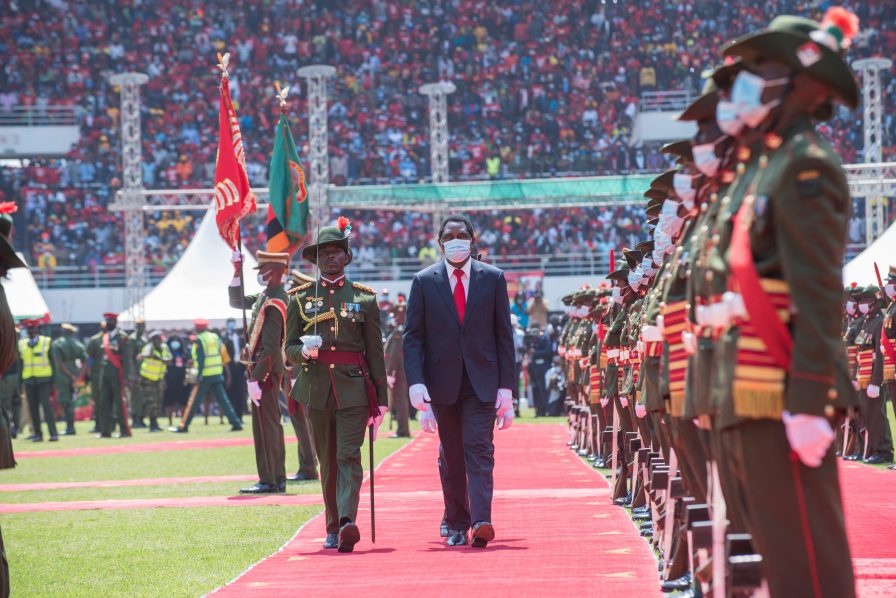
[FILES] Newly elected Zambian President Hakainde Hichilema (C-R) inspects the guard of honour during his inauguration at the Heroes Stadium in Lusaka on August 24, 2021. (Photo by Salim DAWOOD / AFP)

Share on FacebookShare on Twitter

By Sishuwa Sishuwa*


On 4 September 2023, Zambia’s President Hakainde Hichilema denounced alleged coup plotters who he claimed were planning to undermine the country’s democratic rule and stability by illegally seizing power. Coming after a string of military coups in West and Central African countries, his comments have attracted widespread attention across the continent and beyond.

Hichilema’s warning against those considering a coup was first issued at a rally in Kanyama, a densely populated settlement in the capital Lusaka. Any suggestion it was an off-the-cuff remark was eliminated when he restated the remarks in a carefully written Facebook post later that evening.

He wrote: “To colleagues that think we are timid by being kind and that they can break the laws and entertain thoughts of illegal takeover of government including undemocratic coup d’état, our only word is that ‘We are coming for you, and we will not allow you to make Zambians start running around as is the case in some places’.”

Hichilema’s talk of a coup plot caught many by surprise. Zambia has no history of military rule or interference in political processes, and the last (failed) coup attempt occurred 26 years ago. Furthermore, the country’s political elite has a well-established commitment to democratic politics, informed in part by a track record of elections that result in peaceful transfers of power.

Given this background, it is easy to understand why some individuals and organisations have since condemned Hichilema’s remarks as irresponsible. This condemnation is necessary, but not sufficient. Zambians also need to understand why Hichilema is making such comments.

Contrary to what some of his political opponents have argued, the president’s threats were neither random nor a result of careless talk. They are deliberate and demonstrate how Hichilema is slowly becoming adept at undermining democratic institutions in a committed, strategic, and well-defined manner. If Zambians wish to avert the increasing restrictions on political and civil rights, they will do well not to underestimate the lengths to which he is prepared to go in his bid for re-election.

Outside Hichilema’s head, there is no coup plot in Zambia. The talk about people scheming to overthrow him and his vow to punish those responsible should be seen as part of his wider political strategy to undermine opposition forces and stay in power beyond 2026.

Warning soldiers

Hichilema’s coup remarks were directed at different audiences for different objectives.

The first was the military whom he was warning not to depose him. Here, understanding of the wider context is useful: the recent coups elsewhere on the continent have occurred against presidents labelled by their opponents as puppets of France. In Zambia, Hichilema has faced growing criticism that he is a puppet Western powers too, but in his case of the US, UK, and EU. His administration’s policies in mining, energy, security, and foreign affairs have pushed the perception that he favours Western interests – a reversal of the position of his predecessor Edgar Lungu, who pivoted towards China and Russia.

The characterisation of Hichilema as a Western puppet was amplified by the toxic fallout from the August election in neighbouring Zimbabwe, which saw the re-election of President Emmerson Mnangagwa of the ruling ZANU-PF.

Read also

South Africa’s Malema faces political crisis after jail sentence in firearm case

South African politician Malema back in court as prosecutors seek 15-year prison sentence

South Africa’s new DA leader committed to coalition, will meet Ramaphosa

In the aftermath of that disputed poll, election observers from the southern bloc SADC criticised the process as having been deeply flawed, a verdict shared by most other international observers. Lashing out, senior figures in ZANU-PF dismissed the report by the SADC mission, whose head was controversially appointed by Hichilema as the current chair of the bloc. Zimbabwean leaders also went further in accusing the Zambian president of trying to influence the election by providing financial support to the opposition Citizens Coalition for Change (CCC).

Hichilema, said ZANU-PF spokesperson Christopher Mutsvangwa, “wants to become part of the charade of Western countries that always see Zimbabwean elections as a transition from ZANU-PF rule to some puppetry”. Mutsvangwa continued by saying that the West wants to see the back of national liberation movements in South Africa and Namibia too. “I do not know if Hichilema wants to become the new champion of Western neo-colonial interests in southern Africa,” he added. This message even found support from some within South Africa’s governing African National Congress (ANC), whose Secretary-General declared the outcome of Zimbabwe’s election “a victory over imperialist puppets.”

In warning that he would crush unspecified coup plotters, the Zambian president was attempting to make it look like there are elements in the military who may seek to emulate their colleagues in West and Central Africa. Behind this paranoia is also the knowledge that the government has failed to tackle the rising cost of living. The removal of most subsidies – at the instigation of the IMF – and falling value of the unstable kwacha have increased import costs and pushed up the price of fuel and corn meal, the country’s staple, by over 100% since August 2021.

The worst-affected are the urban poor on the Copperbelt and in Lusaka, where the president was booed and accosted with chants of “hunger” a day or two before he issued the coup speech. Although State House tried to play down these incidents as part of democratic expression, they demonstrate the changing public tide against Hichilema in urban areas.

Previous coup attempts – both in the era of one-party rule and multiparty democracy – have all taken place during periods of steep increases in the cost of living. Though unsuccessful, most were celebrated by urbanites on the Copperbelt and in Lusaka. While Zambia’s military has usually intervened in support of democracy, Hichilema is concerned by the precedent. It is probably one that fed his fears that overzealous soldiers may seek to seize power, as their colleagues attempted to do against founding president Kenneth Kaunda in June 1990, and Frederick Chiluba in October 1997.

Preparing Western allies

The second audience Hichilema was speaking to are Western governments, who he was effectively preparing for a further crackdown on opposition leaders ahead of the 2026 election. His comments implicate his opponents in an imaginary coup threat, opening the door for them being arrested on bogus but non-bailable charges like treason.

There is a well-established history of trumped-up charges being used against the political opposition in Zambia. For instance, in March 1993, President Chiluba accused the then main opposition of planning to illegally overthrow the government with foreign support. While no real evidence of the so-called “Zero Option Plan” was provided, officials detained 26 people on charges of treason and the president declared a state of emergency. More recently, in April 2017, Hichilema was himself detained on treason charges for four months after his convoy failed to give way to President Lungu’s motorcade, an act that was characterised as “likely to cause death or grievous harm to the President of the Republic of Zambia, in order to usurp the executive power of the state”.

In these two cases, the then incumbents’ motivations were the same: a sense of political insecurity and a desire to demonstrate control of national security forces.

One reason why Hichilema is currently feeling vulnerable is the growing perception in Zambia that he appears to be serving two interests – his own (mainly business) and those of external powers – rather than those of the population. Were opposition parties to field a common and credible candidate against him in 2026, they would be likely to win. Worried about this prospect, Hichilema, elected only two years ago, has launched a pilot clampdown on his opponents.

Over the last 30 days alone, three opposition leaders – Edith Nawakwi of the Forum for Democracy and Development, Sean Tembo of the Patriots for Economic Progress, and Fred M’membe of the Socialist Party (SP) – have all separately been arrested.

For M’membe, this was his third arrest this year alone. Following charges of “unlawful discharge of a firearm”, “libel”, and “acts intended to cause grievous bodily harm”, the government appears keen to bring a more serious charge against him such as treason. On 8 August 2023, Inspector General of Police Graphel Musamba held a press conference in which he declared that socialism will not succeed in Zambia and vowed to crush the Socialist Party, accusing it of “panting for violence because they want to cut corners to reach their destiny”. Musamba further claimed that M’membe, who has seemingly cultivated close political ties with Moscow and Beijing, had used social media to comment on “the emerging juntas in West Africa… thinking that the same [can] be extended to this country”. He added: “We are carefully studying the ingredients of the offence, and we will let you know in due course what his fate is going to be”.

In response, the Socialist Party leader attempted to sue the police chief for criminal defamation. Pursuing such charges, however, requires the consent of the Director of Public Prosecutions (DPP), who declined M’membe’s request. This is not the first time Gilbert Phiri, Hichilema’s former lawyer, has made partisan calls that have benefited the government. The DPP has previously sanctioned the prosecution of three opposition figures, including M’membe, on charges of criminal defamation brought by government officials.

Within the last month, the police have also arrested the former first lady, Esther Lungu, for theft of motor vehicle and twice refused to allow the opposition Patriotic Front (PF) to hold public rallies due to unspecified “security concerns”. Despite condemnation of this continued suppression of rights to peaceful assembly, association, and free speech by the Law Association of Zambia, the government has intensified the violations.

On 9 September, a battalion of police officers in full riot gear dispersed an interdenominational church service on the Copperbelt to which Lungu was invited. The pastor who organised the church meeting was arrested and charged with “conduct likely to cause breach of public peace”. Police had earlier attempted to block Lungu from traveling for the religious event. Earlier, on 7 September, the government had also declined Lungu’s request to travel abroad for medical review, a clear violation of his legal entitlements as a retired former president.

At the heart of the government’s manoeuvres against Lungu are Hichilema’s fears that his predecessor harbours plans of a political comeback. Recently, the president ordered PF leaders to stop reorganising or face arrest. Overlooking its members’ right of association, he declared: “I want to send a message to the PF thugs. I can see they are regrouping now. The fact that we did not lock you up, that we did not arrest you is not that we are not capable. We are just kind people.  If you start regrouping now, we will come after you in a heavy way.”

The highly-regarded retired archbishop of Lusaka, Telesphore Mpundu, condemned these threats as “primitive politics”, motivated by the desire “to completely get rid of the opposition”.

Many people see these undemocratic actions as resembling the crackdown that Hichilema and the now governing United Party for National Development (UPND) endured while in opposition in the 2010s. The major difference is that the different interest groups that previously condemned similar attacks on democracy and human rights under Lungu are now mute for a variety of reasons. Appointments to government bodies have secured the silence of erstwhile civic actors, while intellectuals, mainly from Hichilema’s ethnic Tonga group, who led the onslaught against the PF, have developed a new career: attacking those who criticise Hichilema, making excuses for and justifying his nascent authoritarian behaviour, while ignoring his transgressions.

Hichilema also feels that he has the personal support of key figures in the diplomatic community whose grovelling attitude towards him lends credibility to the charge that Western countries are prepared to ignore a leader’s attacks on democracy if that leader serves their interests. These include the UK High Commissioner Nicholas Woolley and the US ambassador Michael Gonzales, the latter of whom has – unlike his recent predecessors David Young, Daniel Foote, Eric Shultz, Mark Storella and Donald Booth – hardly shown any interest in questions of human rights and considers Hichilema “a personal friend”. Other diplomats, such as the recently arrived Swedish ambassador Johan Hallenborg, are not simply ignoring the violations but even attempting to construct an alternative reality by claiming that Hichilema, who has strategically weakened civil society, has “enhanced human rights and improved the civic space”.

Like their governments, Western diplomats have so far conveniently avoided publicly criticising their malleable partner for the abuses of his administration partly because of the fear that doing so may inadvertently strengthen his main political opponents, who ideologically lean towards Russia and China. Regional rights bodies such as Amnesty International and Human Rights Watch that previously highlighted violations with impressive commitment and efficiency now speak through absolute silence.

Democracy on a knife-edge 

Emboldened by the lack of vocal outrage against his emerging authoritarian tendencies, Hichilema’s claims of an impending coup serve as a convenient pretext for consolidating what he is already doing – eroding civil liberties – and stopping Western allies and rights bodies from calling him out. Knowing that he has their support may make him feel comfortable in expanding the crackdown on opposition leaders and using the threat of what has happened to Western-backed presidents in West and Central Africa as a sufficient reason for Western governments to continue supporting him even if his actions erode democracy.

As mass hunger bites and poverty worsens due to the rising cost of living and doing business for most Zambians, will Hichilema, a man elected precisely to resolve these challenges and to advance democracy, resort to full-blown repression or authoritarian rule to sustain his hold on power? Only time will tell.

ـــــــــــــ

* Zambian writer, historian, and Senior Lecturer at Stellenbosch University in South Africa.
Source: African Arguments
Tags: coup plottersHakainde HichilemaZambia

Related Posts

Taiwan president to visit Eswatini, last diplomatic ally in Africa
Featured

Taiwan president to visit Eswatini, last diplomatic ally in Africa

April 13, 2026
Cape Town mayor considers running for leader of key South African coalition partner
Featured

South Africa coalition party elects Cape Town mayor as leader

April 12, 2026
South Africa unveils draft AI policy, proposes new institutions and incentives
Featured

South Africa unveils draft AI policy, proposes new institutions and incentives

April 12, 2026
Trump’s new ambassador Bozell arrives in South Africa amid strained ties
Featured

South Africa accepts US envoy’s credentials amid strained relations

April 8, 2026
Zimbabwe to introduce lithium export quotas, sets conditions for resumption of shipments
Featured

Zimbabwe to introduce lithium export quotas, sets conditions for resumption of shipments

April 8, 2026
Malawi’s Chakwera warns: Fighting corruption can turn against you – Interview
Featured

Malawi’s Chakwera warns: Fighting corruption can turn against you – Interview

April 2, 2026

Search Qiraat Africa

No Result
View All Result

Follow on Twitter

Follow @africanqiraat

Trending

The Great Mosque of Djenne, Mali

The Great Mosque of Djenne, Mali

March 25, 2025
Brief History and Culture of the City of Lagos, Nigeria

Brief History and Culture of the City of Lagos, Nigeria

July 24, 2024
Tunka Manin (c. 1010–1078), the last ruler of the Ghana Empire

Tunka Manin (c. 1010–1078), the last ruler of the Ghana Empire

December 12, 2025
Kumbi Saleh, the capital of the ancient Ghana Empire

Kumbi Saleh, the capital of the ancient Ghana Empire

October 13, 2025
Steve Biko (1946-1977): South Africa’s anti-apartheid activist and voice of Black liberation

Steve Biko (1946-1977): South Africa’s anti-apartheid activist and voice of Black liberation

August 15, 2025
Mansa Musa of Mali Empire

Mansa Musa of Mali Empire

April 14, 2025

Facebook

Sections

  • About Us
  • Privacy Policy
  • Opinion
  • Infographics
  • News
  • Analysis
  • Figures
  • Culture & Literature
  • Follow Ups
  • Historical Readings
  • Interview
  • Studies


© Copyright Qiraat Africa. Developed by Bunnaj Media .

No Result
View All Result
  • News
  • Analysis & Report
  • Studies
  • Opinion
  • Interview
  • Culture & Literature
  • Figures
  • Historical Readings
  • Regions

© 2021 Copyright Qiraat Africa.