

Qiraat Africa
عربي  |  Fr
Advertisement
  • News
    • All
    • Climate Change
    • Economy
    • Education
    • Energy
    • Health
    • Migration
    • Mining
    • Politics
    • Security
    • Society
    • Sport
    Uganda’s president appoints son as military chief

    DRC–Uganda tensions escalate as Kinshasa summons Ugandan diplomat

    Guinea orders massive clean-up operation of dumped rubbish in Conakry

    Guinea orders massive clean-up operation of dumped rubbish in Conakry

    US equipment, experts arrive at Kenya Ebola facility despite court order, protests

    Kenya breached constitution by allowing US-backed Ebola quarantine site, court says

    Senegal’s President Faye says ruling party, led by PM Sonko, risks ‘collapse’

    Senegal parliament adopts resolution opposing president’s decision to implement budget

    Nigeria seizes more than $200 million of meth, arrests five Mexicans

    Nigeria seizes more than $200 million of meth, arrests five Mexicans

    Senegal vows action on smugglers after latest migrant boat tragedy

    Around 175 migrants unaccounted for after contact lost with boat from Senegal

    Ethiopian shelling of Tigray town should be investigated as possible war crimes, Amnesty says

    Ethiopian shelling of Tigray town should be investigated as possible war crimes, Amnesty says

    DR Congo rebels say they seized a key mining town

    Congo halts cobalt exports again to tackle oversupply, support prices, industry regulator says

    Namib Minerals revives Zimbabwe’s Redwing mine with first gold pour

    Namib Minerals revives Zimbabwe’s Redwing mine with first gold pour

  • Analysis
    • All
    • Climate Change
    • Digital & Tech
    • Economy
    • Energy & Power
    • Health
    • Politics
    • Security
    • Society
    The Future of Regional Integration in West Africa: Coexistence, Rivalry, or Re-engagement?

    The Future of Regional Integration in West Africa: Coexistence, Rivalry, or Re-engagement?

    Niger, Mali military leaders meet in Bamako, pledge stronger Sahel confederation

    Niger’s 2026 Diplomacy: A Selective Shift in Regional Engagement with Neighbouring States

    Free trade across Africa? Why policy must catch up with small-scale cross-border traders

    Free trade across Africa? Why policy must catch up with small-scale cross-border traders

    Hormuz block affected Africa in four places: what the continent must do to avoid future shocks

    Hormuz block affected Africa in four places: what the continent must do to avoid future shocks

    What is standing in the way of science’s ability to eradicate malaria? 3 areas where action can have an influence

    What is standing in the way of science’s ability to eradicate malaria? 3 areas where action can have an influence

    African Union summit clouded by Saudi-UAE rivalry in Horn of Africa

    Opportunities and Challenges of the AU’s Education in Emergencies Initiative

    Abiy Ahmed Tested: How the Tigray Alliance Is Reshaping Ethiopia’s Security—And What Comes Next

    Abiy Ahmed Tested: How the Tigray Alliance Is Reshaping Ethiopia’s Security—And What Comes Next

    UN report says Africa’s share of global trade stands at 3 percent

    AfCFTA: The Trade Rules Poised to Weave Africa’s Fragmented Textile Markets into One

    The global panel on inequality needs African evidence: here’s how it could work

    The global panel on inequality needs African evidence: here’s how it could work

  • Studies
    China could drive Africa’s renewable energy revolution, report says

    A study shows wind and solar projects in Kenya and South Africa don’t always benefit the communities that host them

    Angola’s lengthy war shaped the way farmers utilised fire—why it matters

    Angola’s lengthy war shaped the way farmers utilised fire—why it matters

    Schooling is the most severely affected by conflict when children are the target – Study

    Schooling is the most severely affected by conflict when children are the target – Study

    Pensions for Botswana’s elderly are expanding, but care services are lacking—study follows 20 years

    Pensions for Botswana’s elderly are expanding, but care services are lacking—study follows 20 years

    60 new cosmic structures have been discovered by South Africa’s MeerKAT telescope, which is mapping previously unseen gaps between galaxies

    60 new cosmic structures have been discovered by South Africa’s MeerKAT telescope, which is mapping previously unseen gaps between galaxies

    Benin government says armed forces foil coup attempt

    Coup contagion? A rash of African power grabs suggests copycats are taking note of others’ success

    One in three South Africans have never heard of AI: what this means for policy

    One in three South Africans have never heard of AI: what this means for policy

    Social Media as a Catalyst for the Spread of Dangerous Wealth Ritual Myths

    Social Media as a Catalyst for the Spread of Dangerous Wealth Ritual Myths

    Overcoming Education Barriers for Young Mothers in Sub-Saharan Africa

    Overcoming Education Barriers for Young Mothers in Sub-Saharan Africa

  • Infographics
  • Figures
    Sedick Isaacs (1940-2012): From a Robben Island prison cell to pioneering medical informatics

    Sedick Isaacs (1940-2012): From a Robben Island prison cell to pioneering medical informatics

    Prince Louis Rwagasore (1932-1961) and the Dream of Independence in Burundi

    Prince Louis Rwagasore (1932-1961) and the Dream of Independence in Burundi

    Josina Muthemba Machel (1945–1971): Reshaping of Women’s Role in the Mozambican Revolution

    Josina Muthemba Machel (1945–1971): Reshaping of Women’s Role in the Mozambican Revolution

    Yaa Asantewaa (1840-1921): Defending the Golden Stool and Asante Sovereignty in the Face of Colonialism

    Yaa Asantewaa (1840-1921): Defending the Golden Stool and Asante Sovereignty in the Face of Colonialism

    Usman Dan Fodio (1754-1817): Teacher, philosopher, and revolutionary reformer

    Usman Dan Fodio (1754-1817): Teacher, philosopher, and revolutionary reformer

    Sokhna Magat Diop (1917–2003): Senegalese cleric

    Sokhna Magat Diop (1917–2003): Senegalese cleric

    Ahmad Baba al-Timbukti (1556-1627): Writer and scholar

    Ahmad Baba al-Timbukti (1556-1627): Writer and scholar

    Namibia: Anger over Dubai COP28 trip by president Geingob’s children

    Hage Geingob (1941–2024): Former President of Namibia

    Cape Verde president says governments must discuss colonial reparations

    José Maria Neves: President of Cape Verde

  • History
    Mozambican Civil War (1977-1992): Societal Shock and the Path to Peace

    Mozambican Civil War (1977-1992): Societal Shock and the Path to Peace

    Second Ivorian Civil War (2010-2011): How struggle over legitimacy and identity lead to brink of abyss

    Second Ivorian Civil War (2010-2011): How struggle over legitimacy and identity lead to brink of abyss

    Malê Rebellion in Brazil (1835): Memory of Resistance and Identity

    Malê Rebellion in Brazil (1835): Memory of Resistance and Identity

    The Anglo-Zanzibar War (1896): A story of the shortest war in history

    The Anglo-Zanzibar War (1896): A story of the shortest war in history

    Kwanza Corridor-Cultural Landscape, Angola

    Kwanza Corridor-Cultural Landscape, Angola

    Gasumo, the southernmost source of the Nile, Burundi

    Gasumo, the southernmost source of the Nile, Burundi

    Loango ancient slavery harbour, the Republic of the Congo

    Loango ancient slavery harbour, the Republic of the Congo

    Archaeological site of Tchitundu-Hulu, Angola

    Archaeological site of Tchitundu-Hulu, Angola

    Manovo-Gounda St. Floris National Park, Central African Republic

    Manovo-Gounda St. Floris National Park, Central African Republic

  • Others
    • Culture / Literature
    • Interview
    • Opinion
  • Countries
    • Country profiles
    • Regions
      • Central Africa
      • East Africa
      • Southern Africa
      • West Africa
No Result
View All Result
Qiraat Africa
عربي  |  Fr
No Result
View All Result
Home Featured

Five Years After the Coup in Mali: Are Stability and Growth Within Reach?

Oyebamiji Usman Adesoji by Oyebamiji Usman Adesoji
October 9, 2025
Five Years After the Coup in Mali: Are Stability and Growth Within Reach?

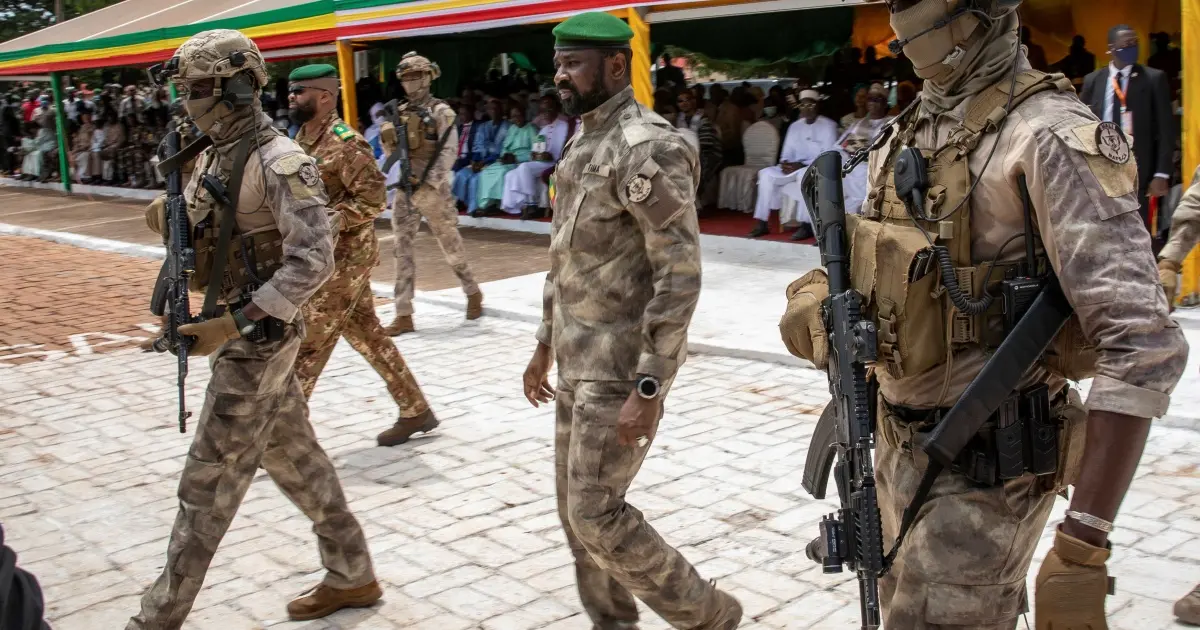
The leader of Mali’s junta, Lt. Col. Assimi Goita, center, attends an independence day military parade on September 22, 2022, in Bamako, Mali. © 2022 AP Photo

Share on FacebookShare on Twitter

Historically, coups have been a common method of political change, especially in nations where democratic institutions are weak or absent. The history of Africa, more than any other continent, has been marked by military coups. This phenomenon is often attributed to widespread poverty, corruption, mismanagement of government, and poor economic performance, which the military uses as a justification for seizing power to save the country from collapse and to reform its institutions and economy. However, despite these challenges, African nations have shown resilience and a strong will to uphold democratic values.

Between August 2020 and August 2024, West and Central Africa experienced at least 10 coup attempts. In 2020 and 2021, General Assimi Goita seized power of Mali, bringing the country under military rule. Since then, Mali has experienced significant democratic retrenchment. The current regime has delayed elections, which were slated to be held in February 2024. Since 2020, civil society and opposition actors have been jailed for their critiques of the government.

So far, the economic impact of these political upheavals remains a complex and evolving story. Media reports have depicted a grim security landscape. Over the past decade, Mali and the Sahel region have seen a surge in clashes and attacks by armed groups and terrorist affiliates, with 303 peacekeepers killed, according to the UN Multidimensional Integrated Stabilization Mission in Mali (MINUSMA). Conditions have also worsened due to climate shocks and rising intercommunal tensions over scarce resources that have become the main drivers of continued violence, mass displacement, instability, and cross-border trafficking.

Goita promised to free Mali from insurgents and the French soldiers sent to help fight them. And while the French troops have gone, they’ve been replaced by Russian paramilitary fighters. A major victory in the northeastern city of Kidal came at a cost, with human rights organizations denouncing abuses against civilians. Meanwhile, many other towns remain under insurgent control, with dozens of civilians held hostage.

Since Kidal fell, ethnic Tuareg have also been met with increasing levels of violence from the military, although it initially promised that civilians would be safe. Hundreds of people have fled into neighboring Mauritania, dreading Wagner fighters or the “white men with masks” who burn homes and execute those they suspect of being rebel fighters, according to reporting by The Washington Post.

But in June 2025, Goïta was granted a five-year presidential term by the transitional parliament. According to the report, the bill granting his new mandate said it could be renewed “as many times as necessary” and until Mali was “pacified.” It clears Gen. Goïta to lead the West African country until at least 2030, with many fearing the move could lead to the repression of the opposition or dissenting opinions. The bill also allows the transitional president, government, and legislative members to stand in presidential and general elections.

Goita has also cut ties with the political and economic union of West African states, the Economic Community of West African States (ECOWAS). Instead, he helped establish the Alliance of Sahel States, alongside Niger and Burkina Faso, who are also ruled by juntas. To boot, their aim is to create a federation and diminish the influence of the former colonial power, France, in their countries. In its place, they’ve increased cooperation with Russia, Turkey, China, North Korea, and Iran.

Similarly, some residents say they remain hopeful and view the current hardship as the price for greater independence from France. “Political independence without economic independence is meaningless,” said Alkady Haidara, a resident in the capital, Bamako. “I just want Malians to be patient, because it’s part of life. You have to go through a difficult time to have a brighter moment.”

Withal, it is hard to remain hopeful and patient when constant power cuts affect people’s daily lives. “If the head of the family goes out in the morning and comes back at night without being able to work to bring something to his family, it will affect the children, the women, and everyday life,” affirms Allasana Ag Agaly, a silversmith.

Rising Tensions in Mali: The Human Cost of Political Instability

Democracy, constitutionalism, and the rule of law. As is commonly the case in the event of a coup, the military has disavowed every semblance of democratic tenets by suspending the constitution. This disregard for the provisions of the constitution abrogates the rule of law, which, in turn, breeds anarchy.

With the military still in power, the situation for civilians is getting worse, according to Alioune Tine, a former UN expert on human rights in Mali and the founder of the Senegalese think tank Afrikajom Center. “They came for security, but today security is deteriorating,” he told RFI. “Now, the most serious thing from my point of view is that the promises of an 18-month transition have not been kept,” he explains.

Read also

DRC–Uganda tensions escalate as Kinshasa summons Ugandan diplomat

Guinea orders massive clean-up operation of dumped rubbish in Conakry

Kenya breached constitution by allowing US-backed Ebola quarantine site, court says

Moreover, the junta announced in May the dissolution of all political parties and organizations, as well as a ban on meetings. “We are witnessing a kind of authoritarian rule, with increasingly restricted civic space, making it virtually impossible for the press, civil society, or the opposition to express themselves,” Tine says.

Goita’s coup in August 2020 came during a wave of mass antigovernment protests in Bamako because of advancing swarms of armed groups from the north. The groups—which are still active and aim to build caliphates—rendered huge swaths of the country ungovernable, sacking villages, killing civilians, and displacing hundreds. ISIL affiliate in the Greater Sahara (ISGS) and al-Qaeda-linked Jama’at Nusrat al-Islam wal-Muslimin (JNIM) are two of the most active ones.

In June 2025, the Russia-backed Wagner Group said it was leaving Mali after more than three and a half years of fighting Islamic extremists and insurgents in the country. Despite Wagner’s announcement, Russia will continue to have a mercenary presence in the West African country. The Africa Corps, Russia’s state-controlled paramilitary force, said on its Telegram channel Friday that Wagner’s departure would not introduce any changes and the Russian contingent will remain in Mali. According to ACLED, Malian security forces and allied forces carried out 239 operations against civilians, resulting in 1,021 people killed between January 1 and October 11, compared to 184 operations resulting in 632 people killed over the same period in 2023.

“Mission accomplished. Private Military Company Wagner returns home,” the group announced via its channel on the messaging app Telegram. It said it had brought all regional capitals under control of the Malian army, pushed out armed militants, and killed their commanders. Nevertheless, rights groups, including New York-based Human Rights Watch, have repeatedly opened a new tab and accused Wagner, fighting alongside Mali’s army, of committing atrocities against civilians.

“We’ve been sinking deeper and deeper and continue to do so,” Moussa Kondo, executive director at the Bamako-based think tank Sahel Institute, told Al Jazeera. Kondo, a former journalist, was appointed a presidential adviser on governance, democracy, and rule of law in October 2021. He resigned from his post a year later, citing personal reasons, and resumed his work in civil society.

“We’ve rejected everything that we consider to be aligned with Western interests. But that doesn’t mean we should put all our eggs in one basket with Russia. It’s not about saying no to one foreign power only to say yes to everything another foreign power proposes … Our leaders have to remain transparent and keep away from manipulating the people with rhetoric,” Kondo said.

The Struggle for Mali’s Economic Revival: Challenges and Opportunities

By some measures, Mali’s economy has performed well over the last decade. It has respected most of the West African Economic and Monetary Union’s macroeconomic convergence criteria, was made eligible for the debt relief initiative for heavily indebted countries, and assessments by regional and international organizations highlight its fiscal prudence, appropriate economic policy choices, and macroeconomic stability.

Prior to the current and elusive crisis, Mali had made significant progress since 1994 in a broad range of social and economic indicators, including in road infrastructures, schools, health, agriculture, and the mine sector, for instance. These achievements are branded by high growth rates, improved living conditions, and the gradual establishment of social safety nets. Yet, despite major political orientations and several development strategies, the Mali development pathways have been marked by their erratic trend and have had difficulty in promoting social, economic, and political stability and a sustainable development process.

After a significant drop from 55.6% in 2001 to 45.6% in 2011, the monetary poverty rate decreased by only three (03) percentage points between 2011 and 2020, reaching 41.9%. From 2021 onward, poverty has increased again, reaching 44.6% in 2021 and 45.5% in 2022, before declining slightly to 43.9% in 2023. As for inequality, as measured by the Gini index, it has shown a fluctuating trend, increasing from 0.38 in 2018 to 0.4 in 2019, then from 0.38 in 2020 to 0.42 in 2021. It then declined to 0.33 in 2022 and 0.32 in 2023. In 2025, 6.4 million people in Mali, or over 27 percent of the population, need humanitarian assistance, with 4.7 million targeted for humanitarian support under the inter-agency Humanitarian Needs and Response Plan.

After back-to-back coups in Mali within a year led to Colonel Assimi Goita becoming head of state in May 2021, the bloc slapped economic sanctions on the landlocked nation to push the transitional government to hold elections within a reasonable timeframe. But that hit an economy grappling with blows from the COVID-19 pandemic and shocks from Russia’s war in Ukraine hard. Inflation rose, with the cost of basic items like oil and sugar more than doubling. Although ECOWAS ended up lifting some of those sanctions in July 2022, many continue to harbor resentment for the embargo that inflicted hardship upon them.

Mali’s economy is largely based on agriculture, with gold and cotton being the main exports. Mining, livestock, and fishing also contribute to the economy. The Gross Domestic Product (GDP) in Mali was worth 26.59 billion US dollars in 2024, according to official data from the World Bank. The GDP value of Mali represents 0.03 percent of the world economy. However, insufficient skilled labor poses a barrier to growth for industries such as industrial mining, which require more advanced skills.  Access to credit remains a first-order problem as well, as interest rates are high and local banks prefer to provide short-term loans even as many infrastructure projects require more long-term financial instruments.

In 2023, Goita’s government introduced a new mining code allowing the state to acquire up to a 30% stake in new mining projects. According to the report, this move aims to increase revenues from Mali’s mining sector, especially given its position as Africa’s second-largest gold producer, with over 101 tonnes of gold extracted in 2022, according to the World Gold Council. Authorities expect the new mining policies to boost annual mining revenues by around $822 million.

The Jama’at Nusrat al-Islam wal-Muslimin, or JNIM, militant group recently announced a ban on fuel imports from neighboring countries, in what analysts say poses huge risks for the fragile local economy and is a significant setback for Mali’s military junta. “Around 100 tanker trucks have been set on fire over the past two weekends,” an official with the National Council of Employers of Mali told The Associated Press, quoting a report they received from the Malian fuel association. The report said further that the fuel trucks were attacked close to the city of Kayes near the border with Senegal.

The recurrence of military coups in Mali has profoundly undermined the country’s governance structures, leading to persistent instability and weakened institutions. Each coup interrupts the democratic process, creating a power vacuum that breeds fragmentation and competing claims to legitimacy.  When it comes to corruption, some observers are cautiously optimistic. “In the population survey we conduct annually, respondents say they see an improvement,” says Svenja Bode, resident representative of the Friedrich Ebert Foundation’s Mali office in Bamako.

In 2021, about 90% of respondents said they believed corruption in Mali was very high. This figure has fallen to 58%, according to this year’s survey, which was released in May. Yet regardless of whether or not such perceptions are accurate, it is clear that the government has taken some steps towards reducing corruption—and made sure they were covered by the media, said Bode.

Yet fighting corruption is one thing; improving everyday life is another. “I don’t yet see the major economic progress that will ultimately translate into better living conditions,” said Claus‑Dieter König of the Rosa Luxemburg Foundation. In the meantime, Mali recently introduced an unpopular new tax on mobile communications and mobile money transfers.

What is the way forward?

Although experts attribute the expansion of violent extremism in the Sahel to persistently weak governance, characterized by corruption, democratic backsliding, legitimacy deficits, and human rights violations. Many countries in the region share similar internal dynamics of inequality—state power tends to be concentrated in southern, urban regions, while rural, northern areas remain underdeveloped and ripe for exploitation by extremist groups.

However, signs of change have been identified. These include, among others, a widely shared awareness of the inefficiency of current democratic practices, recognition that the country must take primary responsibility for its own security, and the need for a new kind of state leadership—one that restores authority and takes control of the strategic levers of development.

The functional gap between the political elite and the populations continues in administration, which is a mechanism intended to meet the real needs of the populations. Despite recent efforts to simplify property registration, the administration and safeguarding of land ownership remain a matter of concern for investors and ordinary citizens alike.  Recent reforms introduced in mining, customs, and land administration cannot guarantee the proper enforcement of business contracts, which depend on an unpredictable judicial system.  The tax authority adopted significant measures to facilitate the payment of taxes, but their impact remains unclear.

The social contract that exists between the Malian state and the Malian society has come under severe pressure. This has resulted in distrust and dissatisfaction between society and the state, eroding the state’s authority and legitimacy. This is worsened by the military’s continued hold on political power. The transitional government needs to be held accountable for its actions and keep its promise of holding elections soon. In moments like this, establishing a stable government becomes crucial to managing the economic crisis and ensuring peace for its citizens.

The authorities should also rebalance public spending in favor of essential social sectors. To do so, they will need to reduce excessive expenditures on defense. It is not a question of stopping investment in counterinsurgency, with the security situation still worsening, but of making adjustments. Bamako should adopt a more balanced approach in its relations with external partners, drawing inspiration from the non-alignment of the 1960s.

Other possible solutions may include reorganizing military institutions, strategies, and services; establishing more equitable and well-distributed justice; engaging in dialogue with various communities, including armed and jihadist groups; implementing integrative, conflict-sensitive, and climate-sensitive development projects and programs; strengthening the economy based on the policy of developing regional competitiveness clusters; and finding a better balance between various and conflicting geopolitical interests.
Source: Qiraat Africa
Tags: Coup in MaliMali
Oyebamiji Usman Adesoji

Oyebamiji Usman Adesoji

Writer and researcher on business, entrepreneurship and geopolitical affairs.

Related Posts

Senegal’s President Faye says ruling party, led by PM Sonko, risks ‘collapse’
Economy

Senegal parliament adopts resolution opposing president’s decision to implement budget

November 26, 2026
Nigeria seizes more than $200 million of meth, arrests five Mexicans
Featured

Nigeria seizes more than $200 million of meth, arrests five Mexicans

November 25, 2026
Senegal vows action on smugglers after latest migrant boat tragedy
Featured

Around 175 migrants unaccounted for after contact lost with boat from Senegal

November 25, 2026
Ethiopian shelling of Tigray town should be investigated as possible war crimes, Amnesty says
East Africa

Ethiopian shelling of Tigray town should be investigated as possible war crimes, Amnesty says

November 25, 2026
DR Congo rebels say they seized a key mining town
Central Africa

Congo halts cobalt exports again to tackle oversupply, support prices, industry regulator says

November 24, 2026
Namib Minerals revives Zimbabwe’s Redwing mine with first gold pour
Economy

Namib Minerals revives Zimbabwe’s Redwing mine with first gold pour

November 24, 2026

Search Qiraat Africa

No Result
View All Result

Follow on Twitter

Follow @africanqiraat

Trending

Nigeria’s SEC approves Dangote refinery’s IPO share distribution plan, sources say

Nigeria’s SEC approves Dangote refinery’s IPO share distribution plan, sources say

November 24, 2026
Africa’s 10 Strongest Currencies in June 2026

Africa’s 10 Strongest Currencies in June 2026

July 8, 2026
Tunka Manin (c. 1010–1078), the last ruler of the Ghana Empire

Tunka Manin (c. 1010–1078), the last ruler of the Ghana Empire

December 12, 2025
Kumbi Saleh, the capital of the ancient Ghana Empire

Kumbi Saleh, the capital of the ancient Ghana Empire

October 13, 2025
DR Congo’s President Tshisekedi calls for sanctions against Rwanda

DR Congo president orders probe into copper and cobalt export revenues, document shows

April 28, 2026
Zaghawa people of northeastern Chad and western Sudan

Zaghawa people of northeastern Chad and western Sudan

March 3, 2026

Facebook

Sections

  • About Us
  • Privacy Policy
  • Opinion
  • Infographics
  • News
  • Analysis
  • Figures
  • Culture & Literature
  • Follow Ups
  • Historical Readings
  • Interview
  • Studies


© Copyright Qiraat Africa. Developed by Bunnaj Media .

No Result
View All Result
  • News
  • Analysis & Report
  • Studies
  • Opinion
  • Interview
  • Culture & Literature
  • Figures
  • Historical Readings
  • Regions

© 2021 Copyright Qiraat Africa.