









































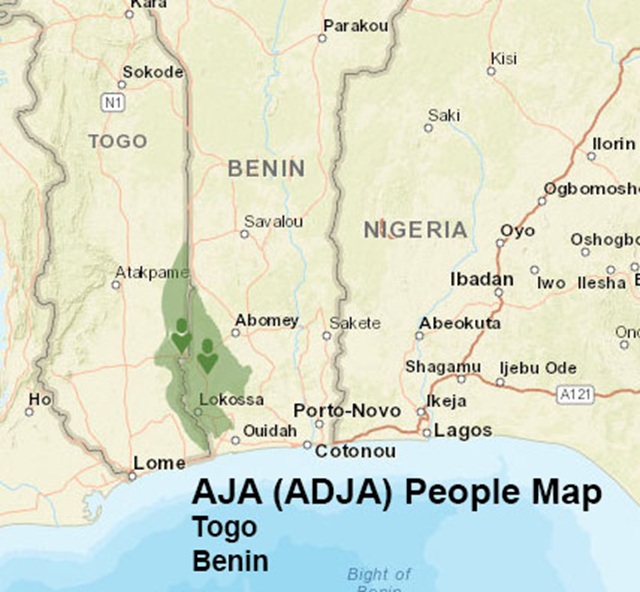
The Adja (or Aja) people are one of the most well-known ethnic groups in the Gulf of Guinea area. They mostly live in southwestern Benin and southeastern Togo. The Adja represent the ethnic core from which other major groups in the region, such as the Fon and Ewe, branched out, making an understanding of their history and culture key to understanding the political and social demographics of the historical Dahomey region.
According to oral tradition and historical research, the Adja people originated in the city of Tado, located in present-day Togo near the border with Benin. Tado is considered the “mother city,” or cradle of civilisation, from which waves of migration began in the 12th century CE and later.
The Kingdom of Tado was a powerful and stable political and religious centre. During the 16th century, internal power struggles and overpopulation led to a division within the ruling elite, prompting various groups to migrate eastward and southward. One of these migrations resulted in the formation of the Allada (Ardra) Kingdom in present-day southern Benin. From Allada, groups later branched out to establish the Dahomey (Abomey) and Ajase (or Àjàṣẹ́/Porto-Novo) kingdoms.
According to 101 last tribes:
“The real name of Aja is Gbaya and their old home was at Gbotu, north-west of the Naka near the Buma . During Zubeir’s period they were ruled by Nur al Anqara representative of Suleiman but their tribal leader Mereke, spent most of his time with this overlord.
After Suleiman’s fall and during the subsequent Mahdiya, the Aja shifted gradually northwards to Mbere, Angbaya, Mukpa together with the Banda and other tribes as a result of being pressured from the south by Rafai’s raids. They settled on Kumu and Mbangana rivers but were badly beaten by Sanusi forcing them to flee into Bahr el Ghazal.
Those Aja living in Abomey mingled with the local tribe, thus creating a new people known as the Fon, or “Dahomey” ethnic group. This group is now the largest in Benin. Another source claims the Aja were the rulers of Dahomey (Benin) until 1893, when the French conquered them. Currently, there are approximately 500,000 Ajas in an area straddling the border between Benin and Togo, 50 kilometres (30 miles) long and 30 km (20 mi) wide.”
Linguistic studies indicate that the Adja and the Ewe share a common origin, with the Ewe separating from the Tado Center and migrating westward toward present-day Ghana and Togo.
Today, specific geographical areas, characterised by agriculture and a tropical climate, distribute the Adja people. In Benin, they are concentrated in the provinces of Mono and Couffo, with cities like Aplahoué and Dogbo serving as their main urban and commercial centres. In Togo, they are found in the central and southern regions, and the city of Tado remains a spiritual and historical center visited by members of ethnic groups from both countries.
The number of Adja speakers is estimated to be in the hundreds of thousands, and they represent a significant voting bloc and social force in the political landscape of Benin and Togo, although they have not formed a unified, centralised state in modern times, like their Fon neighbours.
The Adja language (Aja-gbe) belongs to the Niger-Congo language family, specifically the Gbe branch. There is a high degree of mutual understanding between the Adja language and the Fon, Ewe, and Gen languages. It is a tonal language, which means that the meaning of a word changes depending on the pitch of the sound (high, low, or medium). It also relies heavily on proverbs, folktales, and historical songs passed down from generation to generation as a means of preserving historical identity.
The Adja society is characterised by a traditional hierarchy that combines spiritual and political authority. The society is based on a clan system, where individuals are related to a common ancestor. Each clan has its totem and social rules.
The position of “king” or “traditional chief” still exists in regions such as Tado. Although these positions do not have legal authority in the modern state, they wield significant moral influence in resolving local disputes and regulating seasonal rituals. Women also play a pivotal role in the domestic economy and local trade (markets), but the traditional political structure often remains in the hands of men.
The Adja people have a wide range of spiritual beliefs, including both traditional ones and monotheistic ones. They are considered the founders and original practitioners of Voodoo (often spelt Vodou or Vodun). For them, Voodoo is a philosophical system that explains the relationship between humanity, nature, and supernatural forces.
French colonisation and missionary activity led to a significant number of Adja converts to Christianity (especially Catholicism). There are also Muslim minorities as a result of trade with northern populations.
The economy of the Adja regions is based primarily on subsistence and commercial agriculture. They grow maize, yams, cassava, and beans for local consumption. Oil palm cultivation is a historical activity, producing palm oil for both food and industrial use.
Due to their location on the border between Benin and Togo, many Adja people are active in cross-border trade, transporting goods, and participating in the weekly markets that are the lifeblood of their economy.
Their Adja traditional arts reflect their military and agricultural histories. Their cultural and other rhythmic dances based on hand-carved drums are well-known. Their music is closely linked to funerals, agricultural festivals, and the investiture of leaders. They excel in pottery and traditional weaving, crafts passed down through families.
Like other groups in West Africa, the Adja people face modernisation challenges. The migration of young people from villages (such as Tadou and Ablahou) to capital cities (Lomé and Cotonou) in search of employment opportunities is leading to a decline in interest in their language and traditions.
The division of the Adja people between two countries (Benin and Togo) has sometimes led to administrative complications, although ethnic ties still transcend official borders. Primary school curricula are currently undergoing efforts to integrate the Adja language, safeguarding it from the dominance of official languages (French).