









Qiraat Africa
عربي  |  Fr
Advertisement
  • News
    • All
    • Climate Change
    • Economy
    • Education
    • Energy
    • Health
    • Migration
    • Mining
    • Politics
    • Security
    • Society
    • Sport
    Tanzania’s president dismisses foreign, information ministers

    US to give Tanzania $1.3 billion under five-year health pact

    Kenyan activists launch new court case against luxury lodges in Maasai Mara reserve

    Kenyan activists launch new court case against luxury lodges in Maasai Mara reserve

    Ethiopia says Ghebreyesus, WHO chief has links to rebellious Tigrayan forces

    Trial for Bundibugyo Ebola treatment starts in DRC, WHO says

    Ukraine says Niger’s move to cut relations is ‘regrettable’

    Niger arrests at least 16 for same-sex sexual acts, judicial source says

    South African labour unions urge workers to shun anti-migrant protests

    Over 900 arrested during South African anti-migrant protests

    Burkina Faso assembly votes to send troops to Niger

    Burkina Faso: what will change after the diplomatic rupture with France?

    Zimbabwe: Mnangagwa faces internal revolt over his legitimacy

    Zimbabwean parliament approves extending presidential term by two years

    AU grants $10.4m for Mpox emergency response

    Africa CDC: Uganda health ministry confirms isolated Marburg case

    South Africa says over 900 arrested during nationwide anti-migrant protests

    South Africa says over 900 arrested during nationwide anti-migrant protests

  • Analysis
    • All
    • Climate Change
    • Digital & Tech
    • Economy
    • Energy & Power
    • Health
    • Politics
    • Security
    • Society
    Ulysses in isiZulu: Why an African translation of the classic Irish novel is important in today’s world

    Ulysses in isiZulu: Why an African translation of the classic Irish novel is important in today’s world

    The promise and risks of Kenya’s ambitious new strategy to close refugee camps

    The promise and risks of Kenya’s ambitious new strategy to close refugee camps

    Al Qaeda-linked militants curb their brutality in seized Malian territory

    Al Qaeda-linked militants curb their brutality in seized Malian territory

    Five Years After the Coup in Mali: Are Stability and Growth Within Reach?

    The Political Economy of Insecurity in Mali: Armed Groups, Resources, and State Fragility

    Ghana to evacuate 300 citizens from South Africa after xenophobic attacks

    Xenophobic Violence and Human Security in South Africa: Causes and Consequences

    Inside an African lab that helped crack the hantavirus outbreak

    Inside an African lab that helped crack the hantavirus outbreak

    Nigeria’s Agricultural sector: Problems and challenges

    Agriculture in Africa: science and research cannot have an impact without investments and good policies

    Mali’s junta creates a new ministerial-level post to oversee the mining sector

    African Mineral Resources: The Controversial Link to US Health Deals

    Ghana curbs offshore investments to protect cedi, boost stability

    Ghana’s mining law attempts to eradicate speculation, but leaves communities in limbo: insights from a lithium case study

  • Studies
    Angola’s lengthy war shaped the way farmers utilised fire—why it matters

    Angola’s lengthy war shaped the way farmers utilised fire—why it matters

    Schooling is the most severely affected by conflict when children are the target – Study

    Schooling is the most severely affected by conflict when children are the target – Study

    Pensions for Botswana’s elderly are expanding, but care services are lacking—study follows 20 years

    Pensions for Botswana’s elderly are expanding, but care services are lacking—study follows 20 years

    60 new cosmic structures have been discovered by South Africa’s MeerKAT telescope, which is mapping previously unseen gaps between galaxies

    60 new cosmic structures have been discovered by South Africa’s MeerKAT telescope, which is mapping previously unseen gaps between galaxies

    Benin government says armed forces foil coup attempt

    Coup contagion? A rash of African power grabs suggests copycats are taking note of others’ success

    One in three South Africans have never heard of AI: what this means for policy

    One in three South Africans have never heard of AI: what this means for policy

    Social Media as a Catalyst for the Spread of Dangerous Wealth Ritual Myths

    Social Media as a Catalyst for the Spread of Dangerous Wealth Ritual Myths

    Overcoming Education Barriers for Young Mothers in Sub-Saharan Africa

    Overcoming Education Barriers for Young Mothers in Sub-Saharan Africa

    Youth Empowerment Through Vocational Training in Rural Sub-Saharan Africa

    Youth Empowerment Through Vocational Training in Rural Sub-Saharan Africa

  • Infographics
  • Figures
    Eduardo Mondlane (1920-1969): Mozambican Revolutionary and Anthropologist

    Eduardo Mondlane (1920-1969): Mozambican Revolutionary and Anthropologist

    William Tubman (1895-1971): Liberian politician and longest-serving president in the country’s history

    William Tubman (1895-1971): Liberian politician and longest-serving president in the country’s history

    Abebe Bikila (1932-1973): Ethiopian marathoner and first black African to win an Olympic medal

    Abebe Bikila (1932-1973): Ethiopian marathoner and first black African to win an Olympic medal

    W. E. B. Du Bois (1868-1963): Sociologist, historian, and Pan-Africanist civil rights activist

    W. E. B. Du Bois (1868-1963): Sociologist, historian, and Pan-Africanist civil rights activist

    Frantz Fanon (1925-1961): Psychiatrist and political philosopher

    Frantz Fanon (1925-1961): Psychiatrist and political philosopher

    Percy Lavon Julian (1899-1975): African American researcher and chemist

    Percy Lavon Julian (1899-1975): African American researcher and chemist

    Harriet Tubman (Araminta Ross, 1822-1913): American abolitionist and social activist

    Harriet Tubman (Araminta Ross, 1822-1913): American abolitionist and social activist

    Dorothy Vaughan (1910-2008): African American mathematician and human computer

    Dorothy Vaughan (1910-2008): African American mathematician and human computer

    George Washington Carver (1864-1943): African American agricultural scientist and inventor

    George Washington Carver (1864-1943): African American agricultural scientist and inventor

  • History
    Laas Geel, Somalia

    Laas Geel, Somalia

    Lakes Of Ounianga, Chad

    Lakes Of Ounianga, Chad

    Nok Caves, Togo

    Nok Caves, Togo

    The Land of Punt (modern Somalia, Eritrea, Ethiopia, or eastern Sudan)

    The Land of Punt (modern Somalia, Eritrea, Ethiopia, or eastern Sudan)

    Avenue of the Baobabs, Madagascar

    Avenue of the Baobabs, Madagascar

    Lopé-Okanda (Gabon)

    Lopé-Okanda (Gabon)

    The Sudd wetland

    The Sudd wetland

    Khami Ruins (Zimbabwe), the capital of the Torwa state

    Khami Ruins (Zimbabwe), the capital of the Torwa state

    Royal Palace, Porto-Novo, Republic of Benin

    Royal Palace, Porto-Novo, Republic of Benin

  • Others
    • Culture / Literature
    • Interview
    • Opinion
  • Countries
    • Country profiles
    • Regions
      • Central Africa
      • East Africa
      • Southern Africa
      • West Africa
No Result
View All Result
  • News
    • All
    • Climate Change
    • Economy
    • Education
    • Energy
    • Health
    • Migration
    • Mining
    • Politics
    • Security
    • Society
    • Sport
    Tanzania’s president dismisses foreign, information ministers

    US to give Tanzania $1.3 billion under five-year health pact

    Kenyan activists launch new court case against luxury lodges in Maasai Mara reserve

    Kenyan activists launch new court case against luxury lodges in Maasai Mara reserve

    Ethiopia says Ghebreyesus, WHO chief has links to rebellious Tigrayan forces

    Trial for Bundibugyo Ebola treatment starts in DRC, WHO says

    Ukraine says Niger’s move to cut relations is ‘regrettable’

    Niger arrests at least 16 for same-sex sexual acts, judicial source says

    South African labour unions urge workers to shun anti-migrant protests

    Over 900 arrested during South African anti-migrant protests

    Burkina Faso assembly votes to send troops to Niger

    Burkina Faso: what will change after the diplomatic rupture with France?

    Zimbabwe: Mnangagwa faces internal revolt over his legitimacy

    Zimbabwean parliament approves extending presidential term by two years

    AU grants $10.4m for Mpox emergency response

    Africa CDC: Uganda health ministry confirms isolated Marburg case

    South Africa says over 900 arrested during nationwide anti-migrant protests

    South Africa says over 900 arrested during nationwide anti-migrant protests

  • Analysis
    • All
    • Climate Change
    • Digital & Tech
    • Economy
    • Energy & Power
    • Health
    • Politics
    • Security
    • Society
    Ulysses in isiZulu: Why an African translation of the classic Irish novel is important in today’s world

    Ulysses in isiZulu: Why an African translation of the classic Irish novel is important in today’s world

    The promise and risks of Kenya’s ambitious new strategy to close refugee camps

    The promise and risks of Kenya’s ambitious new strategy to close refugee camps

    Al Qaeda-linked militants curb their brutality in seized Malian territory

    Al Qaeda-linked militants curb their brutality in seized Malian territory

    Five Years After the Coup in Mali: Are Stability and Growth Within Reach?

    The Political Economy of Insecurity in Mali: Armed Groups, Resources, and State Fragility

    Ghana to evacuate 300 citizens from South Africa after xenophobic attacks

    Xenophobic Violence and Human Security in South Africa: Causes and Consequences

    Inside an African lab that helped crack the hantavirus outbreak

    Inside an African lab that helped crack the hantavirus outbreak

    Nigeria’s Agricultural sector: Problems and challenges

    Agriculture in Africa: science and research cannot have an impact without investments and good policies

    Mali’s junta creates a new ministerial-level post to oversee the mining sector

    African Mineral Resources: The Controversial Link to US Health Deals

    Ghana curbs offshore investments to protect cedi, boost stability

    Ghana’s mining law attempts to eradicate speculation, but leaves communities in limbo: insights from a lithium case study

  • Studies
    Angola’s lengthy war shaped the way farmers utilised fire—why it matters

    Angola’s lengthy war shaped the way farmers utilised fire—why it matters

    Schooling is the most severely affected by conflict when children are the target – Study

    Schooling is the most severely affected by conflict when children are the target – Study

    Pensions for Botswana’s elderly are expanding, but care services are lacking—study follows 20 years

    Pensions for Botswana’s elderly are expanding, but care services are lacking—study follows 20 years

    60 new cosmic structures have been discovered by South Africa’s MeerKAT telescope, which is mapping previously unseen gaps between galaxies

    60 new cosmic structures have been discovered by South Africa’s MeerKAT telescope, which is mapping previously unseen gaps between galaxies

    Benin government says armed forces foil coup attempt

    Coup contagion? A rash of African power grabs suggests copycats are taking note of others’ success

    One in three South Africans have never heard of AI: what this means for policy

    One in three South Africans have never heard of AI: what this means for policy

    Social Media as a Catalyst for the Spread of Dangerous Wealth Ritual Myths

    Social Media as a Catalyst for the Spread of Dangerous Wealth Ritual Myths

    Overcoming Education Barriers for Young Mothers in Sub-Saharan Africa

    Overcoming Education Barriers for Young Mothers in Sub-Saharan Africa

    Youth Empowerment Through Vocational Training in Rural Sub-Saharan Africa

    Youth Empowerment Through Vocational Training in Rural Sub-Saharan Africa

  • Infographics
  • Figures
    Eduardo Mondlane (1920-1969): Mozambican Revolutionary and Anthropologist

    Eduardo Mondlane (1920-1969): Mozambican Revolutionary and Anthropologist

    William Tubman (1895-1971): Liberian politician and longest-serving president in the country’s history

    William Tubman (1895-1971): Liberian politician and longest-serving president in the country’s history

    Abebe Bikila (1932-1973): Ethiopian marathoner and first black African to win an Olympic medal

    Abebe Bikila (1932-1973): Ethiopian marathoner and first black African to win an Olympic medal

    W. E. B. Du Bois (1868-1963): Sociologist, historian, and Pan-Africanist civil rights activist

    W. E. B. Du Bois (1868-1963): Sociologist, historian, and Pan-Africanist civil rights activist

    Frantz Fanon (1925-1961): Psychiatrist and political philosopher

    Frantz Fanon (1925-1961): Psychiatrist and political philosopher

    Percy Lavon Julian (1899-1975): African American researcher and chemist

    Percy Lavon Julian (1899-1975): African American researcher and chemist

    Harriet Tubman (Araminta Ross, 1822-1913): American abolitionist and social activist

    Harriet Tubman (Araminta Ross, 1822-1913): American abolitionist and social activist

    Dorothy Vaughan (1910-2008): African American mathematician and human computer

    Dorothy Vaughan (1910-2008): African American mathematician and human computer

    George Washington Carver (1864-1943): African American agricultural scientist and inventor

    George Washington Carver (1864-1943): African American agricultural scientist and inventor

  • History
    Laas Geel, Somalia

    Laas Geel, Somalia

    Lakes Of Ounianga, Chad

    Lakes Of Ounianga, Chad

    Nok Caves, Togo

    Nok Caves, Togo

    The Land of Punt (modern Somalia, Eritrea, Ethiopia, or eastern Sudan)

    The Land of Punt (modern Somalia, Eritrea, Ethiopia, or eastern Sudan)

    Avenue of the Baobabs, Madagascar

    Avenue of the Baobabs, Madagascar

    Lopé-Okanda (Gabon)

    Lopé-Okanda (Gabon)

    The Sudd wetland

    The Sudd wetland

    Khami Ruins (Zimbabwe), the capital of the Torwa state

    Khami Ruins (Zimbabwe), the capital of the Torwa state

    Royal Palace, Porto-Novo, Republic of Benin

    Royal Palace, Porto-Novo, Republic of Benin

  • Others
    • Culture / Literature
    • Interview
    • Opinion
  • Countries
    • Country profiles
    • Regions
      • Central Africa
      • East Africa
      • Southern Africa
      • West Africa
No Result
View All Result
Qiraat Africa
عربي  |  Fr
No Result
View All Result
Home Historical Readings

Abomey, southern Benin

October 16, 2025
Abomey, southern Benin
Share on FacebookShare on Twitter

The city of Abomey is located in the southern part of the Republic of Benin, on a plateau that forms the heart of the Zagnan region. Today, Abomey’s history carries an extraordinary weight. For more than two and a half centuries (from about 1625 to 1900), it was the political and spiritual capital of one of the most powerful and organized kingdoms in pre-colonial West Africa: the Kingdom of Dahomey.

Abomey’s history represents a complex blend of centralized state building, unique military organization, distinctive architecture, and a deep and pivotal involvement in the transatlantic slave trade, before its story ended with its violent downfall at the hands of French colonial expansion.

The Kingdom of Dahomey and the Fon people trace their roots to migrations from the Tado region (in present-day Togo). According to the most established oral history, the kingdom arose as a result of a power struggle between three brothers. One of them, Houegbadja, settled on the Abomey plateau around 1625. Houegbadja is credited with establishing the first nucleus of the kingdom and building the first royal palace, laying the foundations for a strong, centralized state.

The name “Dahomey” itself carries a symbolic meaning of its founding. Legend has it that Houegbadja (or his ancestor) asked a local chief named Dan for land to build his palace. When Dan contemptuously refused, Houegbadja waged war against him, killed him, and then built his palace over his corpse. The kingdom was named Dan-ho-mé, which roughly translates as “in the belly of Dan,” as a symbol of the kingdom’s founder’s victory and consolidation of power.

From its founding, Abomey began as an inland state, isolated from the coast, and its initial economy was based on agriculture. This situation quickly changed with the rise of ambitious rulers.

The Kingdom of Dahomey was a highly centralized monarchy. The king, who held the title of Ahosu, wielded almost complete religious, political, and military authority. Power was not merely hereditary; it was administered through a complex bureaucracy that included ministers, such as the Megan (prime minister and supreme judge) and the person in charge of finance and the palaces, as well as a vast network of regional officials and spies who ensured the loyalty of the provinces to the capital, Abomey.

The most distinctive element of Dahomey’s military structure was undoubtedly the Agojie, known to Europeans as the “Amazons of Dahomey.” These units, composed entirely of women, began as a royal guard or a band of elephant hunters but evolved into an elite standing army, estimated to number in the thousands at the kingdom’s peak. Agojie women underwent rigorous training and were considered “king’s wives” (meaning they were forbidden from marrying or having children). They dedicated their lives to military service. These troops played a crucial role in the kingdom’s annual military campaigns and in the final defense of Abomey against the French.

The kingdom operated a centralized economy, with the state controlling all forms of trade, especially the most profitable commodities. Warfare was an integral part of this economy, with annual military campaigns aimed at expanding territory and capturing captives.

Read also

Niger arrests at least 16 for same-sex sexual acts, judicial source says

Burkina Faso: what will change after the diplomatic rupture with France?

Senegal to hold national referendum after controversial constitutional change

In the early 18th century, the Kingdom of Dahomey took a strategic turn that changed its fate. Under King Agaja (r. 1718–1740), the kingdom waged successful wars to control coastal kingdoms such as Allada and Ouidah. This expansion gave Abomey direct access to the Atlantic Ocean and direct access to European traders.

Dahomey rapidly transformed from an inland, agricultural kingdom into a powerful military state whose primary purpose became enslaving human beings. Abomey became an inland center for the collection of enslaved people captured from neighboring kingdoms (such as the Yoruba and Mahi peoples) before they were sent to the port of Ouidah to be sold as slaves in the transatlantic slave trade.

This trade was the kingdom’s primary economic driver for nearly two centuries. European firearms (guns and cannons), gunpowder, alcohol, and textiles were the primary commodities Dahomey received in exchange for captives. This “exchange” created a continuous cycle: more weapons allowed for more wars, which provided more captives, who were exchanged for more weapons. Abomey’s military strength became directly dependent on the continuation of this trade.

“Grand Customs” and Royal Art
Abomey was not just a military fortress; it was a complex cultural and spiritual center. The Vodun religion was an integral part of state authority, with the king considered the representative of the gods on earth.

The “annual customs” (Xwetanu) were the most prominent events in the kingdom. These weeks-long ceremonies served multiple functions: they honored royal ancestors, redistributed wealth among the people, demonstrated military might, and affirmed the loyalty of their subjects. These customs also included human sacrifice, often of captives, as part of the funerary and spiritual rites honoring the royal ancestors.

The most enduring manifestation of Abomey culture is the royal palaces themselves. The capital was a large complex comprising a series of palaces surrounded by mud walls. Each new king (with the exception of King Akaba) built his own palace next to his predecessor’s, rather than reusing the old one.

The palaces served as historical records. Their walls were decorated with bas-reliefs made of colored clay. These reliefs depicted the glories of the kings, major military events, royal symbols, popular proverbs, and deities. They served as a system for documenting history and conveying political messages in a society where writing was not widespread. The kingdom was also famous for its appliqués, colorful banners depicting similar scenes in intricate detail.

By the late 19th century and the start of the “Scramble for Africa,” the ambitions of the Kingdom of Dahomey directly conflicted with French colonial interests. France sought to control the coast and secure inland trade routes.

This clash led to the Franco-Dahomean Wars (1890–1894). King Béhanzin, considered the last independent king of Dahomey, led a fierce resistance against the technologically superior French forces. Dahomey’s troops, including Agouji units, fought valiantly.

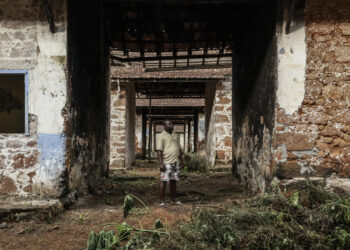
In November 1892, French forces under General Alfred-Amédée Dodds entered the capital, Abomey. Before its fall, Béhanzin ordered (or set fire to) the royal palaces to prevent their desecration by the invaders. Large parts of the royal complex were destroyed in the fire. Béhanzin fled and waged a guerrilla war for two years before being captured and exiled (first to Martinique and then to Algeria), thus ending the Kingdom of Dahomey as an independent political entity and becoming a French colony.

After the fire and occupation, Abomey lost its status as a capital. It became merely a regional administrative center within the French colony of Dahomey (later to become Benin).

In 1985, UNESCO inscribed the Royal Palaces of Abomey on the World Heritage List. This site does not include the entire complex but rather focuses on the preserved palaces of King Ghézo and King Glèlè, parts of which have been restored. These surviving palaces represent a rare testament to the traditional mud architecture and royal art of a powerful African kingdom.

Today, these palaces house the Historical Museum of Abomey, which displays numerous royal artifacts, including thrones (one of which is mounted on human skulls), weapons, decorated fabrics, and salvaged reliefs.
Tags: AbomeyBeninKingdom of Dahomey

Related Posts

Ghana agrees to accept West Africans deported from US, president says
Featured

Rights groups sue Ghana over US third-country deportations

June 30, 2026
Somalia launches Centennial Vision 2060 roadmap for ‘peace, prospertity and progress’
Featured

EU imposes visa restrictions on Somalis after readmission row with Mogadishu

June 29, 2026
Guinea plans regional gold refining hub as West African race intensifies
Featured

Guinea plans regional gold refining hub as West African race intensifies

June 29, 2026
International financial crime watchdog removes Senegal from ‘grey list,’ adds some others
Featured

Senegal police fire tear gas at constitutional reform protesters

June 29, 2026
Ghana president taps retired army officer as envoy to junta-led Sahel states
Energy

Ghana’s President Mahama announces $3.5bn investment to boost country’s oil production

June 28, 2026
Burkina Faso junta extends its transition term by 5 years
Economy

France considers measures after Burkina Faso breaks off relations

June 28, 2026

Search Qiraat Africa

No Result
View All Result

Follow on Twitter

Follow @africanqiraat

Trending

Kumbi Saleh, the capital of the ancient Ghana Empire

Kumbi Saleh, the capital of the ancient Ghana Empire

October 13, 2025
Abdon Atangana: Cameroonian scientist and professor of applied mathematics

Abdon Atangana: Cameroonian scientist and professor of applied mathematics

July 28, 2025
Ex-Credit Suisse chief executive Tidjane Thiam eyeing Ivory Coast 2025 presidential contest

Tidjane Thiam, Ivorian businessman and politician

October 10, 2025
Meja Mwangi: The Literary Genius with a Mighty pen

Meja Mwangi: The Literary Genius with a Mighty pen

May 24, 2025
Tuareg: The Blue People of the Sahara

Tuareg: The Blue People of the Sahara

May 23, 2025
New date set for return of Patrice Lumumba’s tooth

Patrice Lumumba (1925-1961), Congolese politician and independence leader

March 4, 2025

Facebook

Sections

  • About Us
  • Privacy Policy
  • Opinion
  • Infographics
  • News
  • Analysis
  • Figures
  • Culture & Literature
  • Follow Ups
  • Historical Readings
  • Interview
  • Studies


© Copyright Qiraat Africa. Developed by Bunnaj Media .

No Result
View All Result
  • News
  • Analysis & Report
  • Studies
  • Opinion
  • Interview
  • Culture & Literature
  • Figures
  • Historical Readings
  • Regions

© 2021 Copyright Qiraat Africa.