






Qiraat Africa
عربي  |  Fr
Advertisement
  • News
    • All
    • Climate Change
    • Economy
    • Education
    • Energy
    • Health
    • Migration
    • Mining
    • Politics
    • Security
    • Society
    • Sport
    DRC: armed forces find secret weapons stash in Ituri province

    DRC: armed forces find secret weapons stash in Ituri province

    Guinea’s draft constitution made public, limiting leaders to two terms

    Guinea’s junta dissolves 40 political parties with late-night decree

    South African minister and MPs cleared of corruption

    South Africa central bank to redraft risk scenarios as US-Israel war on Iran boosts oil price

    Ghana peacekeeping battalion hit by missile attacks in Lebanon, Ghana army says

    Ghana peacekeeping battalion hit by missile attacks in Lebanon, Ghana army says

    Flash floods in Nairobi kill 23, disrupt flights at major airport

    Flash floods in Nairobi kill 23, disrupt flights at major airport

    South Africa pushes for local production of HIV prevention drug lenacapavir

    South Africa pushes for local production of HIV prevention drug lenacapavir

    Ghana offers levy cut as sweetener for higher gold royalty regime, lobby says

    China, US pressure Ghana to halt gold royalty hike, document, sources say

    Somalia launches Centennial Vision 2060 roadmap for ‘peace, prospertity and progress’

    Somali parliament approves constitution change to extend president’s term, delay election

    Central African Republic seeks Russian support on energy

    Central African Republic seeks Russian support on energy

  • Analysis
    • All
    • Climate Change
    • Digital & Tech
    • Economy
    • Energy & Power
    • Health
    • Politics
    • Security
    • Society
    Rohingya Genocide: Why The Gambia Demands Justice at the International Court

    Rohingya Genocide: Why The Gambia Demands Justice at the International Court

    Security expert explains why the US can destroy terrorist bases in Nigeria but not terrorism

    Security expert explains why the US can destroy terrorist bases in Nigeria but not terrorism

    Africa’s informal economy taxation: the potential and drawbacks of technology

    Africa’s informal economy taxation: the potential and drawbacks of technology

    Ethiopia expects preliminary deal on IMF review within days, finance minister says

    Key events in Ethiopia’s journey towards debt restructuring

    BRICS Plus and the Shifting Global Power Balance: Implications of South Africa’s Role

    BRICS Plus and the Shifting Global Power Balance: Implications of South Africa’s Role

    African Union suspends Niger over coup, prepares sanctions; France denies report it asked Algeria to use airspace for a Niger operation

    Leaders in Africa’s human rights institutions are being elected. Why it matters

    Sahel Alliance leaders meet in Bamako to deepen break with ECOWAS

    The AES and the Reconfiguration of Regional Security Architecture: A Look at the 2025 Bamako Summit

    Somaliland rejects visas issued by Somalia and tightens control over its airpsace

    Why is Somaliland strategically important?

    US airstrikes in northern Nigeria: potential windfalls and dangers

    US airstrikes in northern Nigeria: potential windfalls and dangers

  • Studies
    Benin government says armed forces foil coup attempt

    Coup contagion? A rash of African power grabs suggests copycats are taking note of others’ success

    One in three South Africans have never heard of AI: what this means for policy

    One in three South Africans have never heard of AI: what this means for policy

    Social Media as a Catalyst for the Spread of Dangerous Wealth Ritual Myths

    Social Media as a Catalyst for the Spread of Dangerous Wealth Ritual Myths

    Overcoming Education Barriers for Young Mothers in Sub-Saharan Africa

    Overcoming Education Barriers for Young Mothers in Sub-Saharan Africa

    Youth Empowerment Through Vocational Training in Rural Sub-Saharan Africa

    Youth Empowerment Through Vocational Training in Rural Sub-Saharan Africa

    Manufacturers in Ghana and Nigeria claim that although corruption damages businesses, digital technologies provide a chance to combat it

    Manufacturers in Ghana and Nigeria claim that although corruption damages businesses, digital technologies provide a chance to combat it

    Environmental Threats and Conservation Efforts in Namibia

    Environmental Threats and Conservation Efforts in Namibia

    Your teachers’ level of knowledge affects how well you perform in class: perspectives from 14 French-speaking African nations

    Your teachers’ level of knowledge affects how well you perform in class: perspectives from 14 French-speaking African nations

    Islamic Finance in Nigeria: Between Islamization and Shariah Non-Compliance Polemics

    Islamic Finance in Nigeria: Between Islamization and Shariah Non-Compliance Polemics

  • Infographics
  • Figures
    Alpha Oumar Konare: historian, archaeologist, and former President of Mali

    Alpha Oumar Konare: historian, archaeologist, and former President of Mali

    Felix Konotey-Ahulu (1930-2025): Ghanaian physician and scientist

    Felix Konotey-Ahulu (1930-2025): Ghanaian physician and scientist

    Joaquim Chissano, Former President of Mozambique

    Joaquim Chissano, Former President of Mozambique

    Abubakar Gumi (1924–1992): Nigerian Islamic scholar and Grand Khadi of the Northern Region of Nigeria

    Abubakar Gumi (1924–1992): Nigerian Islamic scholar and Grand Khadi of the Northern Region of Nigeria

    Haile Selassie (1892-1975): Former Emperor of Ethiopia

    Haile Selassie (1892-1975): Former Emperor of Ethiopia

    Bennet Omalu: Nigerian-American physician and forensic pathologist

    Bennet Omalu: Nigerian-American physician and forensic pathologist

    Samori Touré (1830-1900): Military leader and founder of Wassoulou Empire

    Samori Touré (1830-1900): Military leader and founder of Wassoulou Empire

    Mohammed Abdulle Hassan (1856-1920): Somali religious and nationalist leader

    Mohammed Abdulle Hassan (1856-1920): Somali religious and nationalist leader

    Imam Abdullah Haron (1924-1969): South African Muslim cleric and anti-apartheid activist

    Imam Abdullah Haron (1924-1969): South African Muslim cleric and anti-apartheid activist

  • History
    Lopé-Okanda (Gabon)

    Lopé-Okanda (Gabon)

    The Sudd wetland

    The Sudd wetland

    Khami Ruins (Zimbabwe), the capital of the Torwa state

    Khami Ruins (Zimbabwe), the capital of the Torwa state

    Royal Palace, Porto-Novo, Republic of Benin

    Royal Palace, Porto-Novo, Republic of Benin

    W-Arly-Pendjari Complex, the West African wildlife sanctuary

    W-Arly-Pendjari Complex, the West African wildlife sanctuary

    Royal Court of Tiébélé, Burkina Faso

    Royal Court of Tiébélé, Burkina Faso

    Lake Tanganyika, the world’s longest freshwater lake

    Lake Tanganyika, the world’s longest freshwater lake

    The Bafut Chiefdom, Cameroon

    The Bafut Chiefdom, Cameroon

    The battles of Isandlwana and Rorke’s Drift

    The battles of Isandlwana and Rorke’s Drift

  • Others
    • Culture / Literature
    • Interview
    • Opinion
  • Countries
    • Country profiles
    • Regions
      • Central Africa
      • East Africa
      • Southern Africa
      • West Africa
No Result
View All Result
  • News
    • All
    • Climate Change
    • Economy
    • Education
    • Energy
    • Health
    • Migration
    • Mining
    • Politics
    • Security
    • Society
    • Sport
    DRC: armed forces find secret weapons stash in Ituri province

    DRC: armed forces find secret weapons stash in Ituri province

    Guinea’s draft constitution made public, limiting leaders to two terms

    Guinea’s junta dissolves 40 political parties with late-night decree

    South African minister and MPs cleared of corruption

    South Africa central bank to redraft risk scenarios as US-Israel war on Iran boosts oil price

    Ghana peacekeeping battalion hit by missile attacks in Lebanon, Ghana army says

    Ghana peacekeeping battalion hit by missile attacks in Lebanon, Ghana army says

    Flash floods in Nairobi kill 23, disrupt flights at major airport

    Flash floods in Nairobi kill 23, disrupt flights at major airport

    South Africa pushes for local production of HIV prevention drug lenacapavir

    South Africa pushes for local production of HIV prevention drug lenacapavir

    Ghana offers levy cut as sweetener for higher gold royalty regime, lobby says

    China, US pressure Ghana to halt gold royalty hike, document, sources say

    Somalia launches Centennial Vision 2060 roadmap for ‘peace, prospertity and progress’

    Somali parliament approves constitution change to extend president’s term, delay election

    Central African Republic seeks Russian support on energy

    Central African Republic seeks Russian support on energy

  • Analysis
    • All
    • Climate Change
    • Digital & Tech
    • Economy
    • Energy & Power
    • Health
    • Politics
    • Security
    • Society
    Rohingya Genocide: Why The Gambia Demands Justice at the International Court

    Rohingya Genocide: Why The Gambia Demands Justice at the International Court

    Security expert explains why the US can destroy terrorist bases in Nigeria but not terrorism

    Security expert explains why the US can destroy terrorist bases in Nigeria but not terrorism

    Africa’s informal economy taxation: the potential and drawbacks of technology

    Africa’s informal economy taxation: the potential and drawbacks of technology

    Ethiopia expects preliminary deal on IMF review within days, finance minister says

    Key events in Ethiopia’s journey towards debt restructuring

    BRICS Plus and the Shifting Global Power Balance: Implications of South Africa’s Role

    BRICS Plus and the Shifting Global Power Balance: Implications of South Africa’s Role

    African Union suspends Niger over coup, prepares sanctions; France denies report it asked Algeria to use airspace for a Niger operation

    Leaders in Africa’s human rights institutions are being elected. Why it matters

    Sahel Alliance leaders meet in Bamako to deepen break with ECOWAS

    The AES and the Reconfiguration of Regional Security Architecture: A Look at the 2025 Bamako Summit

    Somaliland rejects visas issued by Somalia and tightens control over its airpsace

    Why is Somaliland strategically important?

    US airstrikes in northern Nigeria: potential windfalls and dangers

    US airstrikes in northern Nigeria: potential windfalls and dangers

  • Studies
    Benin government says armed forces foil coup attempt

    Coup contagion? A rash of African power grabs suggests copycats are taking note of others’ success

    One in three South Africans have never heard of AI: what this means for policy

    One in three South Africans have never heard of AI: what this means for policy

    Social Media as a Catalyst for the Spread of Dangerous Wealth Ritual Myths

    Social Media as a Catalyst for the Spread of Dangerous Wealth Ritual Myths

    Overcoming Education Barriers for Young Mothers in Sub-Saharan Africa

    Overcoming Education Barriers for Young Mothers in Sub-Saharan Africa

    Youth Empowerment Through Vocational Training in Rural Sub-Saharan Africa

    Youth Empowerment Through Vocational Training in Rural Sub-Saharan Africa

    Manufacturers in Ghana and Nigeria claim that although corruption damages businesses, digital technologies provide a chance to combat it

    Manufacturers in Ghana and Nigeria claim that although corruption damages businesses, digital technologies provide a chance to combat it

    Environmental Threats and Conservation Efforts in Namibia

    Environmental Threats and Conservation Efforts in Namibia

    Your teachers’ level of knowledge affects how well you perform in class: perspectives from 14 French-speaking African nations

    Your teachers’ level of knowledge affects how well you perform in class: perspectives from 14 French-speaking African nations

    Islamic Finance in Nigeria: Between Islamization and Shariah Non-Compliance Polemics

    Islamic Finance in Nigeria: Between Islamization and Shariah Non-Compliance Polemics

  • Infographics
  • Figures
    Alpha Oumar Konare: historian, archaeologist, and former President of Mali

    Alpha Oumar Konare: historian, archaeologist, and former President of Mali

    Felix Konotey-Ahulu (1930-2025): Ghanaian physician and scientist

    Felix Konotey-Ahulu (1930-2025): Ghanaian physician and scientist

    Joaquim Chissano, Former President of Mozambique

    Joaquim Chissano, Former President of Mozambique

    Abubakar Gumi (1924–1992): Nigerian Islamic scholar and Grand Khadi of the Northern Region of Nigeria

    Abubakar Gumi (1924–1992): Nigerian Islamic scholar and Grand Khadi of the Northern Region of Nigeria

    Haile Selassie (1892-1975): Former Emperor of Ethiopia

    Haile Selassie (1892-1975): Former Emperor of Ethiopia

    Bennet Omalu: Nigerian-American physician and forensic pathologist

    Bennet Omalu: Nigerian-American physician and forensic pathologist

    Samori Touré (1830-1900): Military leader and founder of Wassoulou Empire

    Samori Touré (1830-1900): Military leader and founder of Wassoulou Empire

    Mohammed Abdulle Hassan (1856-1920): Somali religious and nationalist leader

    Mohammed Abdulle Hassan (1856-1920): Somali religious and nationalist leader

    Imam Abdullah Haron (1924-1969): South African Muslim cleric and anti-apartheid activist

    Imam Abdullah Haron (1924-1969): South African Muslim cleric and anti-apartheid activist

  • History
    Lopé-Okanda (Gabon)

    Lopé-Okanda (Gabon)

    The Sudd wetland

    The Sudd wetland

    Khami Ruins (Zimbabwe), the capital of the Torwa state

    Khami Ruins (Zimbabwe), the capital of the Torwa state

    Royal Palace, Porto-Novo, Republic of Benin

    Royal Palace, Porto-Novo, Republic of Benin

    W-Arly-Pendjari Complex, the West African wildlife sanctuary

    W-Arly-Pendjari Complex, the West African wildlife sanctuary

    Royal Court of Tiébélé, Burkina Faso

    Royal Court of Tiébélé, Burkina Faso

    Lake Tanganyika, the world’s longest freshwater lake

    Lake Tanganyika, the world’s longest freshwater lake

    The Bafut Chiefdom, Cameroon

    The Bafut Chiefdom, Cameroon

    The battles of Isandlwana and Rorke’s Drift

    The battles of Isandlwana and Rorke’s Drift

  • Others
    • Culture / Literature
    • Interview
    • Opinion
  • Countries
    • Country profiles
    • Regions
      • Central Africa
      • East Africa
      • Southern Africa
      • West Africa
No Result
View All Result
Qiraat Africa
عربي  |  Fr
No Result
View All Result
Home Regions East Africa

Ngugi wa Thiong’o (1938-2025): A Literary Revolutionary and Voice of African Identity

June 6, 2025
Ngugi wa Thiong’o: Five things you should know about one of Africa’s greatest living writers

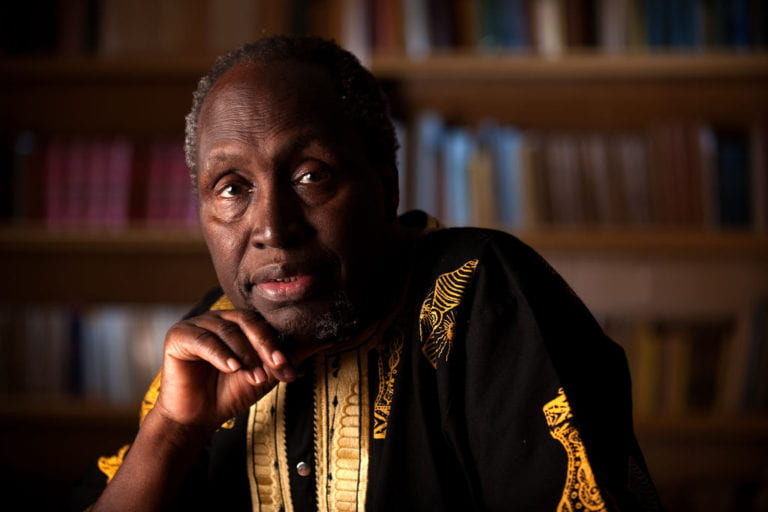
Ngugi wa Thiong’o, Distinguished Professor of comparative literature and English, has been awarded the 15th biennial Erich Maria Remarque Peace Prize for “Decolonising the Mind: The Politics of Language in African Literature.” Daniel Anderson / UCI

Share on FacebookShare on Twitter

Ngũgĩ wa Thiong’o is one of Africa’s most prominent literary and intellectual voices and a pivotal figure in the anti-colonial and post-colonial struggles. Through his prolific body of work spanning novels, plays, criticism, and essays, Ngugi has shaped an intellectual and literary movement that advocates for the reclaiming of African identity, the rejection of cultural subordination, and the defence of indigenous languages. His literary and intellectual career is a true reflection of the modern history of Kenya and Africa, and his influence continues to resonate in academic, political, and literary circles today.

According to Professor Emnet Tadesse Woldegiorgis, Ngũgĩ wa Thiong’o “redefined the purpose of African literature, insisting that it must speak to its people in their own languages, reflect their histories, and resist the epistemic violence of colonial modernity.”

Ngugi wa Thiong’o was born in 1938 in Kamirithu, Kenya, under British colonial rule. His early years were marked by violence and immense challenges, as the Mau Mau Uprising profoundly impacted his life and that of his family. This early experience planted within him the seeds of resistance and political awareness that would inform his later works. He was educated at Makerere College, University of East Africa, Uganda, where he studied English literature. He then pursued postgraduate studies at the University of Leeds in the United Kingdom. It was at this stage that his critical view of the English language as a colonial tool and its impact on African culture began to take shape.

Ngugi began his literary career by writing his first novels in English, such as Weep Not, Child (1964) and The River Between (1965), which dealt with themes of cultural conflict and the impact of colonialism on Kenyan society. However, his 1967 novel A Grain of Wheat was a turning point in his career. This novel, which depicts Kenya on the eve of independence, addresses the complexities of the struggle for freedom, betrayal, and hope. In these early works, Ngugi’s narrative style began to emerge, combining realism with deep historical narrative, focusing on characters who embody the conflict between tradition and modernity, nationalism and conflicting loyalties.

But the most significant point in Ngugi’s intellectual and literary career was his decision to switch to writing in his mother tongue, Gikuyu, in the late 1970s. This decision was not merely a personal choice; it was a profound political and cultural statement. Ngugi believed that English, as a colonial legacy, contributed to the “colonization of the mind”, alienating African intellectuals and writers from their original audiences. He called for “Decolonizing the Mind,” the title of one of his most important critical works, published in 1986. In this book, Ngugi powerfully argues that African languages ​​are the authentic vehicles for expressing African experience, heritage, and history, and that adherence to European languages ​​fosters cultural and intellectual subordination.

These bold stances led to a direct clash with the Kenyan authorities. In 1977, Ngugi wrote the play “Ngaahika Ndeenda” (I Marry Whenever I Want) in the Gikuyu language, which was performed at a community centre in Kamirithu, his hometown. The play criticised corruption and exploitation in post-independence Kenya and addressed sensitive issues of class and social class. The play was a popular success, but it angered the Kenyan government. As a result, Ngugi was arrested and imprisoned without trial for a year in a maximum-security prison. During his detention, Ngugi wrote the novel “Caitaani Mũtharaba-inĩ” (The Devil on the Cross) on toilet paper. This novel, one of his most famous works, is a powerful political and social satire that uses fictional narrative to criticise conditions in Kenya.

“Resistance is the best way of keeping alive,” he told The Guardian in 2018. “It can take even the smallest form of saying no to injustice. If you really think you’re right, you stick to your beliefs, and they help you to survive.”

After his release from prison, Ngugi was banned from teaching at the University of Nairobi and faced severe restrictions. In 1982, while visiting abroad, he learnt that he could not safely return to Kenya due to government threats. This marked the beginning of a long period of exile, most of which he spent in the United States. Despite this, he never stopped writing and campaigning. He continued to produce important literary and intellectual works in both Kikuyu and English and dedicated himself to promoting African languages ​​and cultures.

His later works include Mũrogi wa Kagogo (The Wizard of the Crow), a complex fantasy epic that is the longest novel written in the Kikuyu language and addresses issues of corruption, power, and myth.

Read also

DRC: armed forces find secret weapons stash in Ituri province

Guinea’s junta dissolves 40 political parties with late-night decree

South Africa central bank to redraft risk scenarios as US-Israel war on Iran boosts oil price

“Rumor has it that the Ruler talked nonstop for seven nights and days, seven hours, seven minutes, and seven seconds. By then the ministers had clapped so hard, they felt numb and drowsy,” he wrote. “When they became too tired to stand, they started kneeling down before the ruler, until the whole scene looked like an assembly in prayer before the eyes of the Lord. But soon they found that even holding their bodies erect while on their knees was equally tiring, and some assumed the cross-legged posture of the Buddhist.”

Ngugi also continued to write critical essays, such as “Globalectics: Theory and the Politics of Knowing” (2012), in which he expanded the concept of “decolonising the mind” to include a global context and advocated for a multipolar view of knowledge.

Ngugi wa Thiong’o is not just a writer; he is a philosopher, thinker, and activist. His contributions extend beyond literature to encompass the fields of education, politics, and anthropology. He challenged prevailing notions of “world literature” and emphasised the need to recognise the diversity of voices and languages ​​from around the globe. He also inspired generations of African writers and thinkers to embrace their native languages ​​and express their unique experiences.

Ngugi has received numerous international awards and honours in recognition of his contributions and is often mentioned as a potential candidate for the Nobel Prize in Literature. Awards aside, his true legacy lies in his lasting impact on African and global thought and his ability to spark debates about identity, language, and power.

In recent years, Ngugi wa Thiong’o has returned to Kenya for intermittent visits, but he continues to write and engage in intellectual activism. His voice remains powerful and influential in defending African heritage, rejecting cultural appropriation, and advocating for a more just and equitable world where all languages ​​and cultures are valued. In a time of accelerating globalisation, Ngugi’s calls for a “decolonisation of the mind” become even more relevant and urgent, as he invites us to critically reflect on the sources of knowledge, the languages ​​we use to express ourselves, and how these languages ​​shape our view of the world.

Ngugi wa Thiong’o faced significant health challenges late in life. In 1995, he was diagnosed with aggressive prostate cancer, but he made a remarkable recovery. More recently, in 2019, he underwent triple bypass open-heart surgery, during which time he also began to suffer from kidney failure. He died on May 28, 2025, in Buford, Georgia, USA, at the age of 87.
Tags: Ngũgĩ wa Thiong'o

Related Posts

Ghana peacekeeping battalion hit by missile attacks in Lebanon, Ghana army says
Featured

Ghana peacekeeping battalion hit by missile attacks in Lebanon, Ghana army says

March 8, 2026
Flash floods in Nairobi kill 23, disrupt flights at major airport
East Africa

Flash floods in Nairobi kill 23, disrupt flights at major airport

March 8, 2026
South Africa pushes for local production of HIV prevention drug lenacapavir
Featured

South Africa pushes for local production of HIV prevention drug lenacapavir

March 5, 2026
Ghana offers levy cut as sweetener for higher gold royalty regime, lobby says
Featured

China, US pressure Ghana to halt gold royalty hike, document, sources say

March 5, 2026
Somalia launches Centennial Vision 2060 roadmap for ‘peace, prospertity and progress’
East Africa

Somali parliament approves constitution change to extend president’s term, delay election

March 5, 2026
Central African Republic seeks Russian support on energy
Central Africa

Central African Republic seeks Russian support on energy

March 5, 2026

Search Qiraat Africa

No Result
View All Result

Follow on Twitter

Follow @africanqiraat

Trending

Tunka Manin (c. 1010–1078), the last ruler of the Ghana Empire

Tunka Manin (c. 1010–1078), the last ruler of the Ghana Empire

December 12, 2025
Samori Touré (1830-1900): Military leader and founder of Wassoulou Empire

Samori Touré (1830-1900): Military leader and founder of Wassoulou Empire

January 11, 2026
Burkina Faso assembly votes to send troops to Niger

Burkina Faso Parliament limits French as working language

December 31, 2023
Mansa Musa of Mali Empire

Mansa Musa of Mali Empire

April 14, 2025
Kumbi Saleh, the capital of the ancient Ghana Empire

Kumbi Saleh, the capital of the ancient Ghana Empire

October 13, 2025
Iran-Israel conflict: What are the implications for Africa?

Iran-Israel conflict: What are the implications for Africa?

October 9, 2024

Facebook

Sections

  • About Us
  • Privacy Policy
  • Opinion
  • Infographics
  • News
  • Analysis
  • Figures
  • Culture & Literature
  • Follow Ups
  • Historical Readings
  • Interview
  • Studies


© Copyright Qiraat Africa. Developed by Bunnaj Media .

No Result
View All Result
  • News
  • Analysis & Report
  • Studies
  • Opinion
  • Interview
  • Culture & Literature
  • Figures
  • Historical Readings
  • Regions

© 2021 Copyright Qiraat Africa.