

Qiraat Africa
عربي  |  Fr
Advertisement
  • News
    • All
    • Climate Change
    • Economy
    • Education
    • Energy
    • Health
    • Migration
    • Mining
    • Politics
    • Security
    • Society
    • Sport
    South Africa pushes for local production of HIV prevention drug lenacapavir

    South Africa pushes for local production of HIV prevention drug lenacapavir

    Ghana offers levy cut as sweetener for higher gold royalty regime, lobby says

    China, US pressure Ghana to halt gold royalty hike, document, sources say

    Somalia launches Centennial Vision 2060 roadmap for ‘peace, prospertity and progress’

    Somali parliament approves constitution change to extend president’s term, delay election

    Central African Republic seeks Russian support on energy

    Central African Republic seeks Russian support on energy

    West Africa bloc announces formal exit of three junta-led states

    West African states to create new force to fight terrorists in region

    US and EU warn Sudan military against naming own PM

    Sudan accuses Ethiopia for the first time of involvement in its civil war

    Ghana tops African countries with highest debt with IMF

    IMF Kenya visit not expected to yield lending deal, finance minister says

    South Africa President Ramaphosa says money spent on war is ‘indictment’ of world

    South Africa offers to mediate in Middle East conflict if asked

    Belgian museum, US mining company at odds over colonial-era Congo archive

    Belgian museum, US mining company at odds over colonial-era Congo archive

  • Analysis
    • All
    • Climate Change
    • Digital & Tech
    • Economy
    • Energy & Power
    • Health
    • Politics
    • Security
    • Society
    Rohingya Genocide: Why The Gambia Demands Justice at the International Court

    Rohingya Genocide: Why The Gambia Demands Justice at the International Court

    Security expert explains why the US can destroy terrorist bases in Nigeria but not terrorism

    Security expert explains why the US can destroy terrorist bases in Nigeria but not terrorism

    Africa’s informal economy taxation: the potential and drawbacks of technology

    Africa’s informal economy taxation: the potential and drawbacks of technology

    Ethiopia expects preliminary deal on IMF review within days, finance minister says

    Key events in Ethiopia’s journey towards debt restructuring

    BRICS Plus and the Shifting Global Power Balance: Implications of South Africa’s Role

    BRICS Plus and the Shifting Global Power Balance: Implications of South Africa’s Role

    African Union suspends Niger over coup, prepares sanctions; France denies report it asked Algeria to use airspace for a Niger operation

    Leaders in Africa’s human rights institutions are being elected. Why it matters

    Sahel Alliance leaders meet in Bamako to deepen break with ECOWAS

    The AES and the Reconfiguration of Regional Security Architecture: A Look at the 2025 Bamako Summit

    Somaliland rejects visas issued by Somalia and tightens control over its airpsace

    Why is Somaliland strategically important?

    US airstrikes in northern Nigeria: potential windfalls and dangers

    US airstrikes in northern Nigeria: potential windfalls and dangers

  • Studies
    Benin government says armed forces foil coup attempt

    Coup contagion? A rash of African power grabs suggests copycats are taking note of others’ success

    One in three South Africans have never heard of AI: what this means for policy

    One in three South Africans have never heard of AI: what this means for policy

    Social Media as a Catalyst for the Spread of Dangerous Wealth Ritual Myths

    Social Media as a Catalyst for the Spread of Dangerous Wealth Ritual Myths

    Overcoming Education Barriers for Young Mothers in Sub-Saharan Africa

    Overcoming Education Barriers for Young Mothers in Sub-Saharan Africa

    Youth Empowerment Through Vocational Training in Rural Sub-Saharan Africa

    Youth Empowerment Through Vocational Training in Rural Sub-Saharan Africa

    Manufacturers in Ghana and Nigeria claim that although corruption damages businesses, digital technologies provide a chance to combat it

    Manufacturers in Ghana and Nigeria claim that although corruption damages businesses, digital technologies provide a chance to combat it

    Environmental Threats and Conservation Efforts in Namibia

    Environmental Threats and Conservation Efforts in Namibia

    Your teachers’ level of knowledge affects how well you perform in class: perspectives from 14 French-speaking African nations

    Your teachers’ level of knowledge affects how well you perform in class: perspectives from 14 French-speaking African nations

    Islamic Finance in Nigeria: Between Islamization and Shariah Non-Compliance Polemics

    Islamic Finance in Nigeria: Between Islamization and Shariah Non-Compliance Polemics

  • Infographics
  • Figures
    Alpha Oumar Konare: historian, archaeologist, and former President of Mali

    Alpha Oumar Konare: historian, archaeologist, and former President of Mali

    Felix Konotey-Ahulu (1930-2025): Ghanaian physician and scientist

    Felix Konotey-Ahulu (1930-2025): Ghanaian physician and scientist

    Joaquim Chissano, Former President of Mozambique

    Joaquim Chissano, Former President of Mozambique

    Abubakar Gumi (1924–1992): Nigerian Islamic scholar and Grand Khadi of the Northern Region of Nigeria

    Abubakar Gumi (1924–1992): Nigerian Islamic scholar and Grand Khadi of the Northern Region of Nigeria

    Haile Selassie (1892-1975): Former Emperor of Ethiopia

    Haile Selassie (1892-1975): Former Emperor of Ethiopia

    Bennet Omalu: Nigerian-American physician and forensic pathologist

    Bennet Omalu: Nigerian-American physician and forensic pathologist

    Samori Touré (1830-1900): Military leader and founder of Wassoulou Empire

    Samori Touré (1830-1900): Military leader and founder of Wassoulou Empire

    Mohammed Abdulle Hassan (1856-1920): Somali religious and nationalist leader

    Mohammed Abdulle Hassan (1856-1920): Somali religious and nationalist leader

    Imam Abdullah Haron (1924-1969): South African Muslim cleric and anti-apartheid activist

    Imam Abdullah Haron (1924-1969): South African Muslim cleric and anti-apartheid activist

  • History
    Lopé-Okanda (Gabon)

    Lopé-Okanda (Gabon)

    The Sudd wetland

    The Sudd wetland

    Khami Ruins (Zimbabwe), the capital of the Torwa state

    Khami Ruins (Zimbabwe), the capital of the Torwa state

    Royal Palace, Porto-Novo, Republic of Benin

    Royal Palace, Porto-Novo, Republic of Benin

    W-Arly-Pendjari Complex, the West African wildlife sanctuary

    W-Arly-Pendjari Complex, the West African wildlife sanctuary

    Royal Court of Tiébélé, Burkina Faso

    Royal Court of Tiébélé, Burkina Faso

    Lake Tanganyika, the world’s longest freshwater lake

    Lake Tanganyika, the world’s longest freshwater lake

    The Bafut Chiefdom, Cameroon

    The Bafut Chiefdom, Cameroon

    The battles of Isandlwana and Rorke’s Drift

    The battles of Isandlwana and Rorke’s Drift

  • Others
    • Culture / Literature
    • Interview
    • Opinion
  • Countries
    • Country profiles
    • Regions
      • Central Africa
      • East Africa
      • Southern Africa
      • West Africa
No Result
View All Result
  • News
    • All
    • Climate Change
    • Economy
    • Education
    • Energy
    • Health
    • Migration
    • Mining
    • Politics
    • Security
    • Society
    • Sport
    South Africa pushes for local production of HIV prevention drug lenacapavir

    South Africa pushes for local production of HIV prevention drug lenacapavir

    Ghana offers levy cut as sweetener for higher gold royalty regime, lobby says

    China, US pressure Ghana to halt gold royalty hike, document, sources say

    Somalia launches Centennial Vision 2060 roadmap for ‘peace, prospertity and progress’

    Somali parliament approves constitution change to extend president’s term, delay election

    Central African Republic seeks Russian support on energy

    Central African Republic seeks Russian support on energy

    West Africa bloc announces formal exit of three junta-led states

    West African states to create new force to fight terrorists in region

    US and EU warn Sudan military against naming own PM

    Sudan accuses Ethiopia for the first time of involvement in its civil war

    Ghana tops African countries with highest debt with IMF

    IMF Kenya visit not expected to yield lending deal, finance minister says

    South Africa President Ramaphosa says money spent on war is ‘indictment’ of world

    South Africa offers to mediate in Middle East conflict if asked

    Belgian museum, US mining company at odds over colonial-era Congo archive

    Belgian museum, US mining company at odds over colonial-era Congo archive

  • Analysis
    • All
    • Climate Change
    • Digital & Tech
    • Economy
    • Energy & Power
    • Health
    • Politics
    • Security
    • Society
    Rohingya Genocide: Why The Gambia Demands Justice at the International Court

    Rohingya Genocide: Why The Gambia Demands Justice at the International Court

    Security expert explains why the US can destroy terrorist bases in Nigeria but not terrorism

    Security expert explains why the US can destroy terrorist bases in Nigeria but not terrorism

    Africa’s informal economy taxation: the potential and drawbacks of technology

    Africa’s informal economy taxation: the potential and drawbacks of technology

    Ethiopia expects preliminary deal on IMF review within days, finance minister says

    Key events in Ethiopia’s journey towards debt restructuring

    BRICS Plus and the Shifting Global Power Balance: Implications of South Africa’s Role

    BRICS Plus and the Shifting Global Power Balance: Implications of South Africa’s Role

    African Union suspends Niger over coup, prepares sanctions; France denies report it asked Algeria to use airspace for a Niger operation

    Leaders in Africa’s human rights institutions are being elected. Why it matters

    Sahel Alliance leaders meet in Bamako to deepen break with ECOWAS

    The AES and the Reconfiguration of Regional Security Architecture: A Look at the 2025 Bamako Summit

    Somaliland rejects visas issued by Somalia and tightens control over its airpsace

    Why is Somaliland strategically important?

    US airstrikes in northern Nigeria: potential windfalls and dangers

    US airstrikes in northern Nigeria: potential windfalls and dangers

  • Studies
    Benin government says armed forces foil coup attempt

    Coup contagion? A rash of African power grabs suggests copycats are taking note of others’ success

    One in three South Africans have never heard of AI: what this means for policy

    One in three South Africans have never heard of AI: what this means for policy

    Social Media as a Catalyst for the Spread of Dangerous Wealth Ritual Myths

    Social Media as a Catalyst for the Spread of Dangerous Wealth Ritual Myths

    Overcoming Education Barriers for Young Mothers in Sub-Saharan Africa

    Overcoming Education Barriers for Young Mothers in Sub-Saharan Africa

    Youth Empowerment Through Vocational Training in Rural Sub-Saharan Africa

    Youth Empowerment Through Vocational Training in Rural Sub-Saharan Africa

    Manufacturers in Ghana and Nigeria claim that although corruption damages businesses, digital technologies provide a chance to combat it

    Manufacturers in Ghana and Nigeria claim that although corruption damages businesses, digital technologies provide a chance to combat it

    Environmental Threats and Conservation Efforts in Namibia

    Environmental Threats and Conservation Efforts in Namibia

    Your teachers’ level of knowledge affects how well you perform in class: perspectives from 14 French-speaking African nations

    Your teachers’ level of knowledge affects how well you perform in class: perspectives from 14 French-speaking African nations

    Islamic Finance in Nigeria: Between Islamization and Shariah Non-Compliance Polemics

    Islamic Finance in Nigeria: Between Islamization and Shariah Non-Compliance Polemics

  • Infographics
  • Figures
    Alpha Oumar Konare: historian, archaeologist, and former President of Mali

    Alpha Oumar Konare: historian, archaeologist, and former President of Mali

    Felix Konotey-Ahulu (1930-2025): Ghanaian physician and scientist

    Felix Konotey-Ahulu (1930-2025): Ghanaian physician and scientist

    Joaquim Chissano, Former President of Mozambique

    Joaquim Chissano, Former President of Mozambique

    Abubakar Gumi (1924–1992): Nigerian Islamic scholar and Grand Khadi of the Northern Region of Nigeria

    Abubakar Gumi (1924–1992): Nigerian Islamic scholar and Grand Khadi of the Northern Region of Nigeria

    Haile Selassie (1892-1975): Former Emperor of Ethiopia

    Haile Selassie (1892-1975): Former Emperor of Ethiopia

    Bennet Omalu: Nigerian-American physician and forensic pathologist

    Bennet Omalu: Nigerian-American physician and forensic pathologist

    Samori Touré (1830-1900): Military leader and founder of Wassoulou Empire

    Samori Touré (1830-1900): Military leader and founder of Wassoulou Empire

    Mohammed Abdulle Hassan (1856-1920): Somali religious and nationalist leader

    Mohammed Abdulle Hassan (1856-1920): Somali religious and nationalist leader

    Imam Abdullah Haron (1924-1969): South African Muslim cleric and anti-apartheid activist

    Imam Abdullah Haron (1924-1969): South African Muslim cleric and anti-apartheid activist

  • History
    Lopé-Okanda (Gabon)

    Lopé-Okanda (Gabon)

    The Sudd wetland

    The Sudd wetland

    Khami Ruins (Zimbabwe), the capital of the Torwa state

    Khami Ruins (Zimbabwe), the capital of the Torwa state

    Royal Palace, Porto-Novo, Republic of Benin

    Royal Palace, Porto-Novo, Republic of Benin

    W-Arly-Pendjari Complex, the West African wildlife sanctuary

    W-Arly-Pendjari Complex, the West African wildlife sanctuary

    Royal Court of Tiébélé, Burkina Faso

    Royal Court of Tiébélé, Burkina Faso

    Lake Tanganyika, the world’s longest freshwater lake

    Lake Tanganyika, the world’s longest freshwater lake

    The Bafut Chiefdom, Cameroon

    The Bafut Chiefdom, Cameroon

    The battles of Isandlwana and Rorke’s Drift

    The battles of Isandlwana and Rorke’s Drift

  • Others
    • Culture / Literature
    • Interview
    • Opinion
  • Countries
    • Country profiles
    • Regions
      • Central Africa
      • East Africa
      • Southern Africa
      • West Africa
No Result
View All Result
Qiraat Africa
عربي  |  Fr
No Result
View All Result
Home Analysis & Report

Tshisekedi secures a second term as DR Congo president: lessons and challenges

Oyebamiji Usman Adesoji by Oyebamiji Usman Adesoji
January 7, 2024
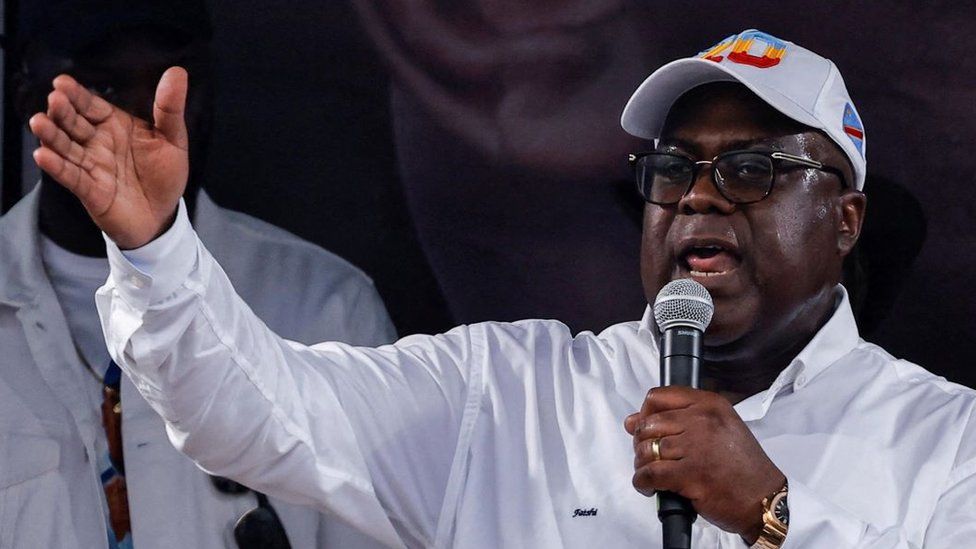
DR Congo: Protests erupt in Goma as opposition challenges election results; Tshisekedi supporters celebrate his re-election

President Félix Tshisekedi will be sworn in for a second term on 20 January. Copyright: Reuters

Share on FacebookShare on Twitter

The Democratic Republic of the Congo (DRC) has a lengthy history of violent, irregular, and chaotic elections. In July 2006, the DRC held democratic, multiparty elections for the first time in more than forty years. In a runoff held on October 29, President Kabila won 58 percent of the vote, defeating former rebel leader Jean-Pierre Bemba. The elections are regarded as generally free and fair by international observers, despite Bemba’s accusations of widespread fraud. According to observers, organizing elections in the DRC is a monumental task given its vast geography (about the size of Western Europe), poor or non-existent infrastructure, and endemic violence, with over 100 rebel groups marauding parts of the country. However, successive governments have used these constraints as a smokescreen to manipulate democratic institutions.

Experts indicate that elections in the DRC have a long history of electoral misconduct, following decades of autocratic rule under Mobutu Sese Seko and conflicts since late 1996. Allegations of electoral fraud and irregularities also marred subsequent democratic elections between 1997 and 2018. Independent electoral watchers, including the National Episcopal Conference of Congo (CENCO), which deployed 40,000 observers to the majority of the country’s 70,000 polling stations and produced an independent tally, indicated that the winner of the presidential election by a commanding margin was the leading opposition candidate, Martin Fayulu. However, after an apparent deal with Kabila, Félix Tshisekedi, the son of the venerated democracy champion Étienne Tshisekedi, was declared the winner of those polls. The Independent National Electoral Commission (CENI) conducted another election on December 20, 2023, and declared President Tshisekedi the winner.

Meanwhile, Congolese reacted with a mixture of joy and trepidation to the announcement of Tshisekedi’s second term in government; yet, a closer look revealed a country struggling with a strong desire for change.

Tshisekedi’s win: “A Big Electoral Stew”

The Democratic Republic of Congo’s (DRC) President Felix Tshisekedi won re-election with more than 70 percent of the vote, in what opposition leaders have dismissed as a “sham.” The incumbent, Tshisekedi, was followed by businessman Moise Katumbi, who received 18% of the vote, and Martin Fayulu, who received 5%. Nobel Peace Prize winner Denis Mukwege, a physician renowned for treating women brutalized by sexual violence in eastern Congo, got less than 1%. Nearly 44 million voters, out of a total population of around 100 million, were called to the polls. The cost of the elections exceeded the nations’ budgets for health and education by around $1.2 billion (£945 million).

The elections were rather ill-organized in the end. Cardinal Fridolin Ambongo of the Roman Catholic Church told the BBC that the situation was “a gigantic, organized disorder.” Others called it “une grande bouillabaisse,” or “a big electoral stew.” A few days later, after the announcement, confrontations broke out between supporters of Fayulu and police officers. According to reports, tear gas was deployed as the protesters, who were throwing rocks and barricading themselves inside the opposition headquarters, clashed with law enforcement. Also, Théodore Ngoy, who came last in the presidential election, filed the petition just before the expiration of its deadline. He is credited by the Céni with 0.02% of the vote and 4,139 votes.

Read also

Somali parliament approves constitution change to extend president’s term, delay election

Central African Republic seeks Russian support on energy

Sudan accuses Ethiopia for the first time of involvement in its civil war

Before the election, international monitoring groups raised alarms about the corrupt practices of the Congo’s electoral commission and the potential for political violence in and beyond Kinshasa, which would compound the conflict in the eastern provinces and further increase displacement just as foreign troops withdraw from the DRC.

The Economic Skepticism

At the international level, Congo’s strategic minerals are of major interest to the West and China. Washington and Beijing are the two major competitors in this domain. Of particular interest is cobalt. China’s advancement in the region is the result of mining deals, which the minority opposition in the parliament and the IMF have described as predatory. The DRC, with the largest reserve of cobalt in the world, is no exception. As of October 2023, 6.9 million Congolese people have been displaced due to violence and rebel attacks. Some of that displacement (about 400 households in October 2023) has been directly linked to forced evictions driven by cobalt mining. Mining in the DRC has particularly gained attention, albeit insufficient, due to its association with grave human rights abuses and exploitation, along with the fierce international competition that leeches off it.

Consequently, Tshisekedi has led the DRC through the COVID pandemic and the ongoing M23 rebellion in the mineral-rich east. The success of his first term in office is often viewed as mixed: the economy has grown, but inflation is soaring and high unemployment remains the norm. In fact, in 2023, the DRC was one of the ten fastest-growing global economies in the world, with a GDP growth rate of 6.7 percent. ‘Fatshi,’ as the incumbent’s supporters call him, oversaw significant tax reforms, won approval for significantly larger budget outlays for social welfare programs, and took responsibility for enforcing serious anti-corruption efforts.

His administration is in the midst of a laudable review of ‘badly’ negotiated mining contracts and minerals-for-infrastructure deals. In September 2023, the country’s Ministry of Health introduced a US$200 million program, entitling pregnant Congolese to free pre- and post-natal services (babies receive free healthcare for the first month). He introduced free tuition for many levels of education. Tshisekedi garnered US$800 million from the World Bank for free primary school education for some 4.5 million children, which enabled employment for at least 36,000 teachers. He also secured over US$1.5 billion as a post-COVID support package from the International Monetary Fund (IMF).

The influence of M23 and Kigali

Apparently, Rwanda and the DRC have not always been friendly. Their armies clashed at the border during Joseph Kabila’s reign. Yet Kabila rarely accused Kigali in public, as Tshisekedi has been doing lately. With an M23 offensive threatening North Kivu’s capital, Goma, the DRC increasingly blames Rwanda for intervening to support the rebels. Kinshasa has signaled unwillingness to extend the EACRF mandate for the second time, amid feelings that it has failed to rout the M23 rebels, who have been a thorn in Kinshasa’s flesh and who have been blamed for massacres of unarmed civilians.

Similarly, observers have noted that the conflict between the M23 and militias loyal to the Democratic Republic of the Congo’s government has recently intensified around Goma, North Kivu’s capital and home to over a million people. In 2023, the United Nations humanitarian agency OCHA says almost 200,000 people have had to flee their homes since October 1 in Rutshuru and Masisi territory, north of Goma. Independent UN experts, the Kinshasa government, and several Western nations, including the United States and France, accuse Rwanda of backing the Tutsi-led M23, which Kigali denies. The authority says the situation remains complex, with multidimensional issues that need to be handled at different levels.

A special South African Community Development Mission (SAMIDRC) against extremists in the unrest-plagued Democratic Republic of the Congo will be led by joint South African, Malawian, and Tanzanian forces. According to the analyst, the SADC force is expected to attempt, in cooperation with the local security forces, to neutralize the main rebel groups operating in the eastern DRC. This is something that MONUSCO and the East African Community Regional Force have not been able to do for the last 20 years. However, as U.N. missions cannot operate without the authorization of host countries, the DRC forced the Security Council’s hand, though its messaging has been less forceful than Mali’s.

Throughout the campaign, President Tshisekedi poured scorn on what he termed “foreign candidates,” suggesting that his opponents have dual loyalties and lack the will to stand up to Rwanda, which the DRC accuses of funding rebel groups on its soil. Also, during his final campaign stop in Kinshasa, he said, “I’ve had enough of invasions and M23 rebels backed by Kigali.” “If you re-elect me and Rwanda persists, I will request parliament and Congress to authorize a declaration of war. We will march on Kigali. Tell Kagame those days of playing games with Congolese leaders are over.” Observers say it was evidence of a further breakdown in the fractious relationship between the DRC and its tiny neighbor, Rwanda.

Congolese are harmed by politics

Tshisekedi released hundreds of political prisoners when he first took office, but initial optimism began to fade after intimidation of critics started again in 2020. However, under Tshisekedi, political rights and civil liberties in his country have sharply declined, as its collapsing ratings on the Ibrahim Index of African Governance, Freedom House’s Freedom in the World report, and Transparency International’s Anti-Corruption Perceptions Index demonstrate. Even the Catholic Church has expressed public concern, much as it has in the past. As the security situation continues to deteriorate, movements become more frequent and humanitarian needs soar.

Experts indicate that progress on consolidating the DRC’s fragile democracy is stalling. Authorities have jailed opposition politicians as well as a prominent journalist. Across the DRC, the right to freedom of peaceful assembly remained the exception rather than the rule. Administrative authorities in Kinshasa, as well as the cities of Lubumbashi, Matadi, Kisangani, Kolwezi, Kananga, Tshikapa, Mbujimayi, Bukavu, Kalemie, Kindu, Lisala, and Gbadolite, unlawfully and systematically banned all demonstrations deemed critical of President Tshisekedi or his government. However, Tshisekedi’s administration has yet to demonstrate that it can bring about systemic reforms and human rights improvements before the election.

Church and democracy

The Congolese participation in politics, particularly in the Christian faith, where the majority are Catholics, is a clear indication of the significance of religion in their lives. While the Protestants and the Anglicans are organized in the Church of Christ in Congo, which is composed of 62 churches called “communities,” the DRC is the home of the Kimbanguist Church, one of the largest African Instituted Churches. There are many other independent churches and a small indigenous Orthodox Church under the Patriarchate of Alexandria. The Catholic Church and the Church of Christ in Congo played a key role in the inter-Congolese dialogue, and several of their clergy were given high positions in the coalition government.

In the meantime, various reports have shown that the Catholic Church has a long history of promoting democracy in the vast African country where organizing elections has been complicated by financial and logistical problems, and disputes over vote tampering have frequently caused widespread unrest. According to the Vatican, there are more than 52 million Catholics in the DRC, almost half of the country’s total population of over 105 million people. The country, which covers 905,600 square miles, is divided into 48 Catholic dioceses. Amid the chaos, the Catholic Church deployed thousands of observers across the country before and during the voting. Sometimes, as was the case in the 2018 polls, its tallies—trusted by millions—have clashed with official results, raising concerns of fraud.

Analysts say since the creation of the Belgian Congo, the Church has been the main partner of the colonial state, especially in the fields of education and health. This legacy is visible: even today, the state will subcontract part of education and health services to the Catholic Church. The church remains one of the main landowners in the DRC and provides many services to the population. “While it advocates for the well-being of the population, the church has interests to protect too. When Tshisekedi decided to introduce free elementary schooling in the DRC, he clashed with the Catholic Church because it created financial problems for the institution.”

Meanwhile, the powerful Catholic bishops conference and Protestant churches in the Democratic Republic of the Congo (DRC) have demanded an independent inquiry be opened into irregularities and alleged legal violations observed during the December general elections. They noted that the results of the presidential and legislative votes would only be acceptable if an inquiry was set up. More than five thousand incidents were reported to observers representing the Catholic and Protestant churches while the polls were open. Its data showed that over 27 percent of the polling stations did not open at all and catalogued numerous malpractices, like 11 percent of all voting machines being placed in military schools and 45 percent of voting machines malfunctioning. This suggests that the church’s influence is still present in the Democratic Republic of the Congo after the elections.

Moving Forward

With so many pressing issues facing the nation, how can it progress when so many people still doubt the legitimacy of its political leadership? This is yet another chance for President Tshisekedi’s administration to stop the exploitation of the natural resources of the Democratic Republic of the Congo and to restore peace to the war-torn eastern regions of the nation.

In addition, the government of the Congo ought to encourage fresh investment, establish democratic change, remove favoritism, and help forge a national consensus. Specialists advise that in order to ensure that the term is successful, global attention should now be directed at collaborating with the Tshisekedi Administration.

 _______________

This article expresses the views and opinions of the author, and does not necessarily reflect the views of Qiraat Africa and its editors.
Source: Qiraat Africa
Tags: Democratic Republic of CongoFelix TshisekediMobutu Sese Seko
Oyebamiji Usman Adesoji

Oyebamiji Usman Adesoji

Writer and researcher on business, entrepreneurship and geopolitical affairs.

Related Posts

Ghana tops African countries with highest debt with IMF
East Africa

IMF Kenya visit not expected to yield lending deal, finance minister says

March 4, 2026
Belgian museum, US mining company at odds over colonial-era Congo archive
Central Africa

Belgian museum, US mining company at odds over colonial-era Congo archive

March 4, 2026
Ethiopia prime minister says Africa is becoming economic, political and social powerhouse
East Africa

Abiy Ahmed insists Ethiopia will not go to war over sea access

March 4, 2026
US imposes sanctions on Rwanda military over east Congo fighting
Central Africa

US imposes sanctions on Rwanda military over east Congo fighting

March 3, 2026
US open to minerals partnerships with Democratic Republic of Congo
East Africa

US struggling to de-risk Congo’s ‘war zone minerals’ even after pact, sources say

March 3, 2026
Congo-Zambia copper corridor to reopen Tuesday after road damage, minister
Central Africa

Congo-Zambia copper corridor to reopen Tuesday after road damage, minister

March 3, 2026

Search Qiraat Africa

No Result
View All Result

Follow on Twitter

Follow @africanqiraat

Trending

Tunka Manin (c. 1010–1078), the last ruler of the Ghana Empire

Tunka Manin (c. 1010–1078), the last ruler of the Ghana Empire

December 12, 2025
Samori Touré (1830-1900): Military leader and founder of Wassoulou Empire

Samori Touré (1830-1900): Military leader and founder of Wassoulou Empire

January 11, 2026
Kumbi Saleh, the capital of the ancient Ghana Empire

Kumbi Saleh, the capital of the ancient Ghana Empire

October 13, 2025
Burkina Faso assembly votes to send troops to Niger

Burkina Faso Parliament limits French as working language

December 31, 2023
Iran-Israel conflict: What are the implications for Africa?

Iran-Israel conflict: What are the implications for Africa?

October 9, 2024
Mansa Musa of Mali Empire

Mansa Musa of Mali Empire

April 14, 2025

Facebook

Sections

  • About Us
  • Privacy Policy
  • Opinion
  • Infographics
  • News
  • Analysis
  • Figures
  • Culture & Literature
  • Follow Ups
  • Historical Readings
  • Interview
  • Studies


© Copyright Qiraat Africa. Developed by Bunnaj Media .

No Result
View All Result
  • News
  • Analysis & Report
  • Studies
  • Opinion
  • Interview
  • Culture & Literature
  • Figures
  • Historical Readings
  • Regions

© 2021 Copyright Qiraat Africa.