


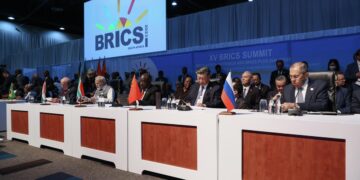





















Initially composed of four members—Brazil, Russia, India, and China in 2006—with South Africa joining in 2011, BRICS, from 2024 to 2025, admitted six new members—Ethiopia, Egypt, Iran, Indonesia, Saudi Arabia, and the United Arab Emirates—becoming BRICS+. Furthermore, it also introduced a new “partner countries” category at its 2024 summit. Belarus, Bolivia, Cuba, Kazakhstan, Malaysia, Nigeria, Thailand, Uganda, and Uzbekistan were the first countries to get the designation. While falling short of full member status, the “partner countries” classification allows them to participate in BRICS summits.
“As more big emerging markets join the BRICS+ nations, the grouping could give the Global South a greater voice in world affairs and challenge the domination of existing institutions,” BCG noted, adding that “the bloc is starting to build institutions with important implications for energy trade, international finance, supply chains, and technological research.” For instance, one such institution, launched to provide finance to member states as an alternative to the traditional multilateral banks, is the New Development Bank (NDB), popularly known as the BRICS Bank.
Recent crises have added momentum to BRICS expansion. Several big developing nations that are aligned with neither NATO nor Russia resisted pressure to adhere to Western-imposed sanctions on Moscow in response to the invasion of Ukraine. Others have complained that G7 nations’ initiatives to combat climate change and the COVID-19 pandemic did not take their needs into account. BRICS+ institutions have been slowly evolving through regular meetings, joint initiatives, and formal bodies.
The debate surrounding BRICS’ expansion and its potential impact on global affairs is multifaceted and influenced by differing perspectives. On one hand, proponents argue that the inclusion of additional countries in BRICS+ could provide a platform for the Global South to assert its interests and challenge traditional Western dominance in global affairs. They point to the combined economic strength of BRICS countries, which surpasses that of the G7, and some argue that this collective economic weight could serve as a counterbalance to what they perceive as Western hegemony.
Today, South Africa occupies a uniquely strategic position among the BRICS+ countries, and as Africa’s most developed economy, it serves as both a continental gateway and a normative broker within the bloc.
South Africa’s Strategic Value within BRICS Plus
The coalition government has six foreign policy priorities: revisit and redefine the national interest; implement the African agenda; promote the interests of the Global South; recover the institutions of global governance; reform the international financial architecture; and professionalize the foreign ministry. However, developing a cohesive worldview proves difficult due to the diffuse ideological orientations of the coalition partners. They hold different positions on delicate foreign policy issues, such as the Russia-Ukraine and Israel-Hamas wars.
BRICS has become an important part of South Africa’s relations with the global community, not only in terms of economies, trade, and investment. South Africa’s chairing of the BRICS bloc is a unique opportunity for South Africa to impose some of its priorities within the BRICS and more broadly in geopolitics. The world is seeing changes that have not been seen in the past 100 years, and the BRICS is at the center of reshaping geopolitical and geo-economic architecture. This presents an opportunity to create a fairer and more just global community.
In particular, the creation of a circle of economic cooperation among the main regional integration blocks uniting the expanded BRICS economies could include MERCOSUR (Brazil), SCO (China, Iran), and the UAE and Saudi Arabia (members of the Gulf Cooperation Council (GCC)), the Eurasian Economic Union (Russia), and the African Union and the AfCFTA (Ethiopia, Egypt, and South Africa). The AfCFTA platform could play a key role in the South-South trade liberalization process, as among the main regional blocs of the Global South, the African Union/AfCFTA has the greatest representation in the expanded BRICS+ core (three core members of the African Union/AfCFTA are also core members of the expanded BRICS+).
In the past, observers noted that the process of turning raw materials into finished items is key if Africa is to benefit from opportunities offered by BRICS+. They indicated that BRICS expansion can work alongside the rollout of the African Continental Free Trade Area (AfCFTA) agreement, which aims to boost trade within the continent by removing tariffs and non-tariff barriers. The overall mandate of the AfCFTA is to create a single continental market with a population of about 1.3 billion people and a combined GDP of approximately US$ 3.4 trillion.
Another important aspect to consider in terms of the potential role that BRICS can play in Africa’s development is the New Development Bank. BRICS established the New Development Bank (NDB) in 2015 to counter the Bretton Woods financial institutions’ (World Bank, IMF, WTO, etc.) dominance and to provide alternative financing to promote trade and investment. It also serves to provide financial impetus for integrating BRICS economies. This has opened up large trade markets for South Africa, as the NDB has financed more than 80 investment projects worth $180 billion. In SA alone, projects worth $30 billion have been approved for implementation.
The NDB is the most viable solution for the lack of private sector investment on the African continent, making it a perfect option to raise resources and funding for the continent’s immediate needs. A study says South Africa should spearhead a strategy for AfCFTA to partner and work with the NDB to unlock financing and infrastructure development funding and ensure that there is mutually beneficial trade between Africa, Asia, the Middle East, and South America.
Security and Geopolitical Shifts: Naval Exercises and Power Projection
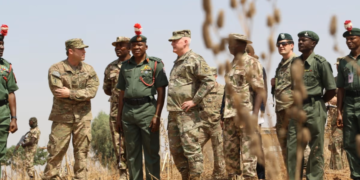
A very recent event showcasing the geopolitical dimension of BRICS Plus is the “Will for Peace 2026” naval exercise, a week of joint naval exercises in South Africa’s waters in what the host country described as a BRICS Plus operation to “ensure the safety of shipping and maritime economic activities.” The joint drills attract participants from countries such as China, Russia, and Iran in South African waters, under the BRICS Plus framework.
The South African Department of Defence said in a statement that this year’s exercise “reflects the collective commitment of all participating navies to safeguard maritime trade routes, enhance shared operational procedures, and deepen cooperation in support of peaceful maritime security initiatives.” The ongoing exercises come amid heightened geopolitical tensions. South Africa drew strong criticism from Washington after it held joint naval exercises with Russia and China in February 2023 on the first anniversary of Russia’s full-scale invasion of Ukraine. The exercises come shortly after the US captured Venezuela’s leader Nicolás Maduro—an important Chinese and Russian ally in South America—and seized a Russian oil tanker in the North Atlantic.
Lieutenant Colonel Mpho Mathebula, acting spokesperson for joint operations, told Reuters all members had been invited. However, Trump has accused the BRICS nations of pursuing “anti-American” policies and last January threatened all members with a 10% trade tariff on top of duties he was already imposing on countries across the world.
Similarly, the pro-Western Democratic Alliance, the second-largest party in South African President Cyril Ramaphosa’s coalition, said the exercises “contradict our stated neutrality” and that BRICS had “rendered South Africa a pawn in the power games being waged by rogue states on the international stage.” Mathebula rejected that criticism. “This is not a political arrangement … there is no hostility (towards the U.S.),” Mathebula told Reuters, pointing out that South Africa has also periodically carried out exercises with the U.S. Navy.
Analysts argue that the exercises in South African waters will likely further raise tensions with Washington. Since Trump took office again, South Africa-US ties have deteriorated over a range of issues, and Trump has imposed 30 percent tariffs on South African goods. However, a part of the fallout is also rooted in the South African government’s decision to bring a genocide case against Israel, a top US ally, before the International Court of Justice in The Hague. It accuses the Israeli government of committing genocide against Palestinians in Gaza. In a preliminary ruling, the world court found it plausible that Israeli actions amounted to genocide.
Meanwhile, these exercises highlight how BRICS Plus is growing outside economic alliance into areas in history dominated by Western military influence, challenging existing security norms around littoral Africa and the wider Indian Ocean region.
Strategic Implications for Global Power Balances
i. Multipolarity and Structural Shifts: The BRICS countries formed their alliance with the primary aim to increase the influence of emerging economies and developing countries in global financial institutions, particularly in light of their criticism towards the Bretton Woods institutions, such as the World Bank and the IMF, for their outdated rules and inadequate representation. Despite BRICS+ having a larger combined GDP than either the G7 or the EU, its capital share and subsequent voting influence within institutions such as the International Bank for Reconstruction and Development (IBRD) remain significantly smaller (as each member country’s voting power is weighted on the basis of its financial contribution to the World Bank). On the other hand, India and Brazil were the largest recipients of IBRD loans in 2023, yet contributed just 5% of the capital. To address these issues, BRICS established the New Development Bank (NDB) and the Contingent Reserve Arrangement (CRA) in 2014. The NDB provides loans for infrastructure and sustainable development, with an equal distribution of voting shares among BRICS members. The CRA ensures mutual support during currency crises.
BRICS+ countries back the idea of ‘de-dollarization,’ that is, reduced dependence on the US dollar in trade. Accordingly, some countries, such as Iran, Russia, and China, have already finalized agreements to trade with each other in their local currencies instead. While there have been discussions about a common BRICS+ currency, experts view this as a distant possibility, especially now that the alliance has been enlarged. On the other hand, the People’s Bank of China, the country’s central bank, has concluded bilateral swap agreements with all BRICS+ countries with the exception of Iran and Ethiopia; these arrangements are intended to facilitate local currency usage in trade and can also be used to address central bank foreign exchange reserve shortages during times of crisis.
ii. Coordination Challenges and Internal Divergence: According to experts, in addition to challenges to implementing their economic vision, the BRICS countries also face increasing internal tensions and rivalry among members. China and India have seen tensions rise over their decades-old border dispute as well as their growing competition for economic and geopolitical leadership of the Global South. The group has already had problems in making decisions; at a foreign ministers’ meeting in New York in September 2024, leaders sought to propose a model for streamlining new additions to the UN Security Council, but the group could not muster an agreement.
With the expansion to BRICS+, the group’s total GDP would rise to 35.6 % of global GDP. While this could increase the group’s influence, taking decisions by consensus in BRICS+ might prove challenging given the increased diversity of interests within the group. On Russia’s invasion of Ukraine, most BRICS members have sought a middle ground, while other members have largely ignored Western sanctions. Some analysts argue the Western sanctions on Russian oil and other necessities are in fact pushing BRICS countries closer together.
In this instance, it may benefit South Africa to strike a healthy balance between advocating for specific causes and broader promotion of recognized principles of peace and security, such as reconciliation through mediation, rule of law, and human rights. In doing so, South Africa may not be pushed into moral binaries but rather retain its diplomatic flexibility—a quality that must be preserved should the country want to rebuild relations with the US and its allies without sacrificing its principles. Consequently, the country seeks to avoid entanglement in great-power rivalries while leveraging the bloc to advance African development priorities.
Conclusion
The global system is moving from post-Cold War, Western unipolarity to a more complex multipolar arrangement. Emerging powers, especially from the global South, are increasingly influencing global norms and institutions. BRICS countries express varying degrees of dissatisfaction with aspects of this order, particularly economic governance and security.
South Africa’s role in BRICS Plus exemplifies the shift toward a more dispersed global power architecture, one that is not yet post-Western but clearly multi-centric and increasingly challenged. Thus, Pretoria’s calculated choices, whether on trade diversification, institutional modification, or security cooperation, will not only improve its own developmental trajectory but also broader patterns of influence within the Global South and beyond.
ــــــــــــــــــــ
* This article expresses the views and opinions of the author, and does not necessarily reflect the views of Qiraat Africa and its editors.