
























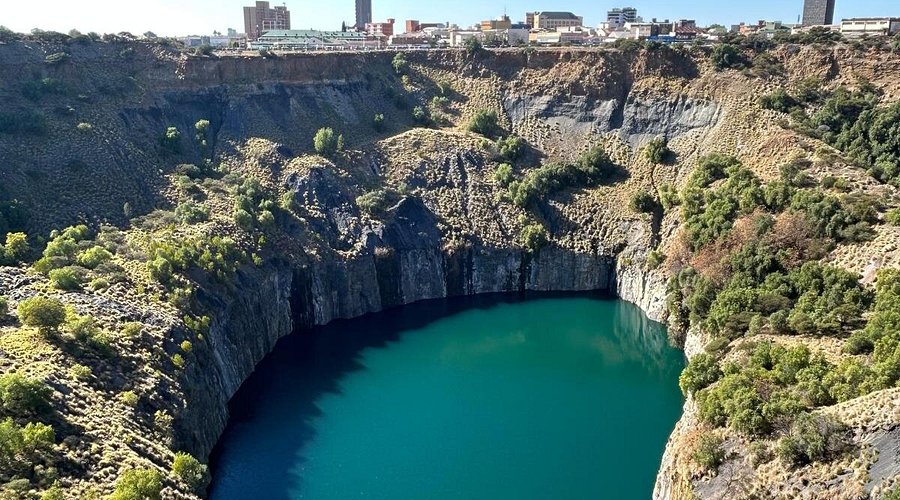
Kimberley’s Big Hole in Northern Cape Province, South Africa, is one of the most prominent geological and historical testaments to the era of diamond mining expansion in Africa during the 19th century. More than just a tourist attraction, it is a physical record of the immense human effort required to extract diamonds and the role of South Africa in it.
One of the stories related to the site was narrated by Michelle Freson:
In the 1860s, Erasmus Jacobs, aged 15, often collected stones on their farm near Hopetown (120km or 74 miles south of present-day Kimberley). In 1867, a neighbor, Schalk van Niekerk, asked if he could borrow one of the shiny stones which Jacobs had found the previous year.
Schalk took the stone to a friend, believing the stone to be a diamond. This man showed the stone to storekeepers in Hopetown who thought it might be a topaz and he was about to throw it away when someone suggested testing it on a pane of glass. He sent it to one of the few people in the Cape Colony who knew about minerals and gems and identified it as a 21.25-carat diamond. In turn it was passed to Mr. Southey, the Colonial Secretary, who stated: “This diamond is the rock upon which the future success of South Africa will be built.”
The discovery of diamonds in 1871 in a small hill known as Colesberg Kopje triggered what is known today as the “Diamond Rush,” drawing thousands of prospectors from around the world to the area.
As the number of prospectors increased, the hill was transformed within a few years into a giant hole due to continuous manual digging. By 1873, the town of Kimberley had sprung up from the mining camps, later becoming a global center for the diamond trade.
The Big Hole is an extinct volcanic crater of the kimberlite type, a type of igneous rock that forms deep within the Earth and erupts to the surface carrying diamonds. The hole boasts dimensions that place it among the largest man-made holes excavated by hand:
- The hole reached a depth of approximately 240 meters before open-pit mining ceased.
- The hole’s opening is approximately 463 meters wide.
- The hole’s circumference is approximately 1.6 kilometers.
- Approximately 2,722 kilograms (about 13.6 million carats) of diamonds were extracted from this site.
After open-pit mining ceased in 1914, underground mining continued to a depth of 1,097 meters, making it one of the deepest mining operations of its time.
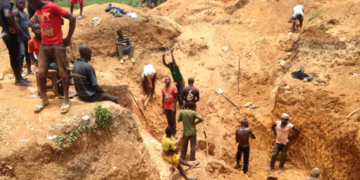
The Big Hole cannot be discussed without mentioning the immense human effort that shaped it. It is estimated that around 50,000 miners used picks and shovels to remove approximately 22 million tons of rock and earth.
Working conditions in the hole were extremely dangerous and crowded. The land was divided into thousands of small, privately owned “claims,” resulting in a chaotic jumble of ropes and ladders before large companies took control of the site and consolidated the excavation operations.
According to research by Marj Brown:
“In the early days, Kimberley diggers laid down a series of laws, “Diggers’ democracy”, which limited each digger to two claims. Black and White claim owners worked side by side. After the Black Flag Rebellion in 1873 however, this changed, and wealthier miners bought the claims of poorer diggers, who became labourers, working the deepening holes. Supply of labour to the mines was slow at first, but eventually was facilitated through the dispossession of Black people from their land through conquest, the introduction of taxes to force Blacks to earn wages and the lure of wages for cash to procure guns so that tribes could protect themselves from further attack and dispossession. By 1873, approximately 30 000 Basotho had been forced under the twin pressures of dispossession and taxation to seek work outside Basutholand and especially on the Kimberley mines (Innes, 1984). Shillington (1985) has covered extensively the wars for land, and control of this region, that ensued. In 1888, De Beers Consolidated Mines Ltd bought up the last remaining rivals or established a significant share in their operations and started a policy of tight labour control through compounds and contracts, supported by the state laws of passes and taxation. It also successfully manipulated the diamond market with its monopoly. Today, De Beers is still the biggest producer of diamonds in the world and continues to manage the supply of diamonds to world markets.”
The technical and financial challenges associated with deep drilling necessitated the consolidation of smaller miners. This site became the main arena for conflict and cooperation between mining magnates such as Cecil Rhodes and Barney Barnato.
In 1888, De Beers Consolidated Mines Limited was formed through the merger of several companies operating at the site. This company gained control of the large hole and most of the world’s diamond production, establishing a monopoly system that influenced diamond prices and availability in global markets for decades.
After the mine closed in August 1914, the hole was left to gradually transform into a heritage site. Over time, groundwater and rainwater began to collect at its bottom, forming a turquoise lake that now reaches a depth of approximately 40 meters below the visible bottom of the hole.
The site now houses a visitor center and an open-air museum that includes the Old Town, a reconstruction of Kimberley’s mining-era streets and buildings, including original shops, houses, and pubs that were relocated to preserve them. There is a viewing platform, a steel structure extending over the edge of the hole, allowing visitors to see the vast expanse and profound depth of the site. There is also a museum that features a collection of rough diamonds and tools used in early mining, providing a technical insight into the development of the industry.
Kimberley’s Big Hole is an early example of the radical impact of human activity on the natural landscape. An entire hill disappeared, replaced by a deep depression that altered the balance of the local earth’s crust. Groundwater contamination and tailings have been environmental challenges for the region for many years.