






Qiraat Africa
عربي  |  Fr
Advertisement
  • News
    • All
    • Climate Change
    • Economy
    • Education
    • Energy
    • Health
    • Migration
    • Mining
    • Politics
    • Security
    • Society
    • Sport
    Nigeria’s president signs amended Electoral Act into law despite push back

    Nigeria’s president signs amended Electoral Act into law despite push back

    Two IMF adjustments that may channel billions to Africa

    IMF approves $91 million in funding for Niger following programme review

    Russia has taken ‘over 1,000’ Kenyans to Ukraine – intelligence report

    Russia has taken ‘over 1,000’ Kenyans to Ukraine – intelligence report

    Nigeria at 65: President Tinubu says “worst is over” on independence day amid worsening hardship

    Nigeria’s Tinubu, Germany’s Merz talk security, power deal in phone call

    Gabon

    Gabonese opposition and businesses angry about social media ban

    Guinea-Bissau stops vaccine study funded by Trump administration

    Guinea-Bissau stops vaccine study funded by Trump administration

    Students turn on Senegalese government over Dakar university violence

    Senegal prosecutor rejects accusations police tortured and killed student

    Somalia announces deal with Turkey that includes support for the Horn of Africa nation’s sea assets

    Turkey’s Erdogan says Israel’s recognition of Somaliland benefits nobody

    Zimbabwe: Mnangagwa faces internal revolt over his legitimacy

    Zimbabwe war veterans challenge Mnangagwa term extension in court

  • Analysis
    • All
    • Climate Change
    • Digital & Tech
    • Economy
    • Energy & Power
    • Health
    • Politics
    • Security
    • Society
    Rohingya Genocide: Why The Gambia Demands Justice at the International Court

    Rohingya Genocide: Why The Gambia Demands Justice at the International Court

    Security expert explains why the US can destroy terrorist bases in Nigeria but not terrorism

    Security expert explains why the US can destroy terrorist bases in Nigeria but not terrorism

    Africa’s informal economy taxation: the potential and drawbacks of technology

    Africa’s informal economy taxation: the potential and drawbacks of technology

    Ethiopia expects preliminary deal on IMF review within days, finance minister says

    Key events in Ethiopia’s journey towards debt restructuring

    BRICS Plus and the Shifting Global Power Balance: Implications of South Africa’s Role

    BRICS Plus and the Shifting Global Power Balance: Implications of South Africa’s Role

    African Union suspends Niger over coup, prepares sanctions; France denies report it asked Algeria to use airspace for a Niger operation

    Leaders in Africa’s human rights institutions are being elected. Why it matters

    Sahel Alliance leaders meet in Bamako to deepen break with ECOWAS

    The AES and the Reconfiguration of Regional Security Architecture: A Look at the 2025 Bamako Summit

    Somaliland rejects visas issued by Somalia and tightens control over its airpsace

    Why is Somaliland strategically important?

    US airstrikes in northern Nigeria: potential windfalls and dangers

    US airstrikes in northern Nigeria: potential windfalls and dangers

  • Studies
    Benin government says armed forces foil coup attempt

    Coup contagion? A rash of African power grabs suggests copycats are taking note of others’ success

    One in three South Africans have never heard of AI: what this means for policy

    One in three South Africans have never heard of AI: what this means for policy

    Social Media as a Catalyst for the Spread of Dangerous Wealth Ritual Myths

    Social Media as a Catalyst for the Spread of Dangerous Wealth Ritual Myths

    Overcoming Education Barriers for Young Mothers in Sub-Saharan Africa

    Overcoming Education Barriers for Young Mothers in Sub-Saharan Africa

    Youth Empowerment Through Vocational Training in Rural Sub-Saharan Africa

    Youth Empowerment Through Vocational Training in Rural Sub-Saharan Africa

    Manufacturers in Ghana and Nigeria claim that although corruption damages businesses, digital technologies provide a chance to combat it

    Manufacturers in Ghana and Nigeria claim that although corruption damages businesses, digital technologies provide a chance to combat it

    Environmental Threats and Conservation Efforts in Namibia

    Environmental Threats and Conservation Efforts in Namibia

    Your teachers’ level of knowledge affects how well you perform in class: perspectives from 14 French-speaking African nations

    Your teachers’ level of knowledge affects how well you perform in class: perspectives from 14 French-speaking African nations

    Islamic Finance in Nigeria: Between Islamization and Shariah Non-Compliance Polemics

    Islamic Finance in Nigeria: Between Islamization and Shariah Non-Compliance Polemics

  • Infographics
  • Figures
    Abubakar Gumi (1924–1992): Nigerian Islamic scholar and Grand Khadi of the Northern Region of Nigeria

    Abubakar Gumi (1924–1992): Nigerian Islamic scholar and Grand Khadi of the Northern Region of Nigeria

    Haile Selassie (1892-1975): Former Emperor of Ethiopia

    Haile Selassie (1892-1975): Former Emperor of Ethiopia

    Bennet Omalu: Nigerian-American physician and forensic pathologist

    Bennet Omalu: Nigerian-American physician and forensic pathologist

    Samori Touré (1830-1900): Military leader and founder of Wassoulou Empire

    Samori Touré (1830-1900): Military leader and founder of Wassoulou Empire

    Mohammed Abdulle Hassan (1856-1920): Somali religious and nationalist leader

    Mohammed Abdulle Hassan (1856-1920): Somali religious and nationalist leader

    Imam Abdullah Haron (1924-1969): South African Muslim cleric and anti-apartheid activist

    Imam Abdullah Haron (1924-1969): South African Muslim cleric and anti-apartheid activist

    Joyce Banda, educator and former president of Malawi

    Joyce Banda, educator and former president of Malawi

    Jomo Kenyatta (1894-1978): First prime minister and first president of Kenya

    Jomo Kenyatta (1894-1978): First prime minister and first president of Kenya

    What does a diary entry reveal about the West African origins of Apongo, a rebel leader in Jamaica?

    What does a diary entry reveal about the West African origins of Apongo, a rebel leader in Jamaica?

  • History
    Royal Palace, Porto-Novo, Republic of Benin

    Royal Palace, Porto-Novo, Republic of Benin

    W-Arly-Pendjari Complex, the West African wildlife sanctuary

    W-Arly-Pendjari Complex, the West African wildlife sanctuary

    Royal Court of Tiébélé, Burkina Faso

    Royal Court of Tiébélé, Burkina Faso

    Lake Tanganyika, the world’s longest freshwater lake

    Lake Tanganyika, the world’s longest freshwater lake

    The Bafut Chiefdom, Cameroon

    The Bafut Chiefdom, Cameroon

    The battles of Isandlwana and Rorke’s Drift

    The battles of Isandlwana and Rorke’s Drift

    Kimberley’s Big Hole, Northern Cape, South Africa

    Kimberley’s Big Hole, Northern Cape, South Africa

    Ogbunike Caves, Southeastern Nigeria

    Ogbunike Caves, Southeastern Nigeria

    Historic Town of Grand-Bassam

    Historic Town of Grand-Bassam

  • Others
    • Culture / Literature
    • Interview
    • Opinion
  • Countries
    • Country profiles
    • Regions
      • Central Africa
      • East Africa
      • Southern Africa
      • West Africa
No Result
View All Result
  • News
    • All
    • Climate Change
    • Economy
    • Education
    • Energy
    • Health
    • Migration
    • Mining
    • Politics
    • Security
    • Society
    • Sport
    Nigeria’s president signs amended Electoral Act into law despite push back

    Nigeria’s president signs amended Electoral Act into law despite push back

    Two IMF adjustments that may channel billions to Africa

    IMF approves $91 million in funding for Niger following programme review

    Russia has taken ‘over 1,000’ Kenyans to Ukraine – intelligence report

    Russia has taken ‘over 1,000’ Kenyans to Ukraine – intelligence report

    Nigeria at 65: President Tinubu says “worst is over” on independence day amid worsening hardship

    Nigeria’s Tinubu, Germany’s Merz talk security, power deal in phone call

    Gabon

    Gabonese opposition and businesses angry about social media ban

    Guinea-Bissau stops vaccine study funded by Trump administration

    Guinea-Bissau stops vaccine study funded by Trump administration

    Students turn on Senegalese government over Dakar university violence

    Senegal prosecutor rejects accusations police tortured and killed student

    Somalia announces deal with Turkey that includes support for the Horn of Africa nation’s sea assets

    Turkey’s Erdogan says Israel’s recognition of Somaliland benefits nobody

    Zimbabwe: Mnangagwa faces internal revolt over his legitimacy

    Zimbabwe war veterans challenge Mnangagwa term extension in court

  • Analysis
    • All
    • Climate Change
    • Digital & Tech
    • Economy
    • Energy & Power
    • Health
    • Politics
    • Security
    • Society
    Rohingya Genocide: Why The Gambia Demands Justice at the International Court

    Rohingya Genocide: Why The Gambia Demands Justice at the International Court

    Security expert explains why the US can destroy terrorist bases in Nigeria but not terrorism

    Security expert explains why the US can destroy terrorist bases in Nigeria but not terrorism

    Africa’s informal economy taxation: the potential and drawbacks of technology

    Africa’s informal economy taxation: the potential and drawbacks of technology

    Ethiopia expects preliminary deal on IMF review within days, finance minister says

    Key events in Ethiopia’s journey towards debt restructuring

    BRICS Plus and the Shifting Global Power Balance: Implications of South Africa’s Role

    BRICS Plus and the Shifting Global Power Balance: Implications of South Africa’s Role

    African Union suspends Niger over coup, prepares sanctions; France denies report it asked Algeria to use airspace for a Niger operation

    Leaders in Africa’s human rights institutions are being elected. Why it matters

    Sahel Alliance leaders meet in Bamako to deepen break with ECOWAS

    The AES and the Reconfiguration of Regional Security Architecture: A Look at the 2025 Bamako Summit

    Somaliland rejects visas issued by Somalia and tightens control over its airpsace

    Why is Somaliland strategically important?

    US airstrikes in northern Nigeria: potential windfalls and dangers

    US airstrikes in northern Nigeria: potential windfalls and dangers

  • Studies
    Benin government says armed forces foil coup attempt

    Coup contagion? A rash of African power grabs suggests copycats are taking note of others’ success

    One in three South Africans have never heard of AI: what this means for policy

    One in three South Africans have never heard of AI: what this means for policy

    Social Media as a Catalyst for the Spread of Dangerous Wealth Ritual Myths

    Social Media as a Catalyst for the Spread of Dangerous Wealth Ritual Myths

    Overcoming Education Barriers for Young Mothers in Sub-Saharan Africa

    Overcoming Education Barriers for Young Mothers in Sub-Saharan Africa

    Youth Empowerment Through Vocational Training in Rural Sub-Saharan Africa

    Youth Empowerment Through Vocational Training in Rural Sub-Saharan Africa

    Manufacturers in Ghana and Nigeria claim that although corruption damages businesses, digital technologies provide a chance to combat it

    Manufacturers in Ghana and Nigeria claim that although corruption damages businesses, digital technologies provide a chance to combat it

    Environmental Threats and Conservation Efforts in Namibia

    Environmental Threats and Conservation Efforts in Namibia

    Your teachers’ level of knowledge affects how well you perform in class: perspectives from 14 French-speaking African nations

    Your teachers’ level of knowledge affects how well you perform in class: perspectives from 14 French-speaking African nations

    Islamic Finance in Nigeria: Between Islamization and Shariah Non-Compliance Polemics

    Islamic Finance in Nigeria: Between Islamization and Shariah Non-Compliance Polemics

  • Infographics
  • Figures
    Abubakar Gumi (1924–1992): Nigerian Islamic scholar and Grand Khadi of the Northern Region of Nigeria

    Abubakar Gumi (1924–1992): Nigerian Islamic scholar and Grand Khadi of the Northern Region of Nigeria

    Haile Selassie (1892-1975): Former Emperor of Ethiopia

    Haile Selassie (1892-1975): Former Emperor of Ethiopia

    Bennet Omalu: Nigerian-American physician and forensic pathologist

    Bennet Omalu: Nigerian-American physician and forensic pathologist

    Samori Touré (1830-1900): Military leader and founder of Wassoulou Empire

    Samori Touré (1830-1900): Military leader and founder of Wassoulou Empire

    Mohammed Abdulle Hassan (1856-1920): Somali religious and nationalist leader

    Mohammed Abdulle Hassan (1856-1920): Somali religious and nationalist leader

    Imam Abdullah Haron (1924-1969): South African Muslim cleric and anti-apartheid activist

    Imam Abdullah Haron (1924-1969): South African Muslim cleric and anti-apartheid activist

    Joyce Banda, educator and former president of Malawi

    Joyce Banda, educator and former president of Malawi

    Jomo Kenyatta (1894-1978): First prime minister and first president of Kenya

    Jomo Kenyatta (1894-1978): First prime minister and first president of Kenya

    What does a diary entry reveal about the West African origins of Apongo, a rebel leader in Jamaica?

    What does a diary entry reveal about the West African origins of Apongo, a rebel leader in Jamaica?

  • History
    Royal Palace, Porto-Novo, Republic of Benin

    Royal Palace, Porto-Novo, Republic of Benin

    W-Arly-Pendjari Complex, the West African wildlife sanctuary

    W-Arly-Pendjari Complex, the West African wildlife sanctuary

    Royal Court of Tiébélé, Burkina Faso

    Royal Court of Tiébélé, Burkina Faso

    Lake Tanganyika, the world’s longest freshwater lake

    Lake Tanganyika, the world’s longest freshwater lake

    The Bafut Chiefdom, Cameroon

    The Bafut Chiefdom, Cameroon

    The battles of Isandlwana and Rorke’s Drift

    The battles of Isandlwana and Rorke’s Drift

    Kimberley’s Big Hole, Northern Cape, South Africa

    Kimberley’s Big Hole, Northern Cape, South Africa

    Ogbunike Caves, Southeastern Nigeria

    Ogbunike Caves, Southeastern Nigeria

    Historic Town of Grand-Bassam

    Historic Town of Grand-Bassam

  • Others
    • Culture / Literature
    • Interview
    • Opinion
  • Countries
    • Country profiles
    • Regions
      • Central Africa
      • East Africa
      • Southern Africa
      • West Africa
No Result
View All Result
Qiraat Africa
عربي  |  Fr
No Result
View All Result
Home Featured

Rohingya Genocide: Why The Gambia Demands Justice at the International Court

Oyebamiji Usman Adesoji by Oyebamiji Usman Adesoji
February 19, 2026
Rohingya Genocide: Why The Gambia Demands Justice at the International Court

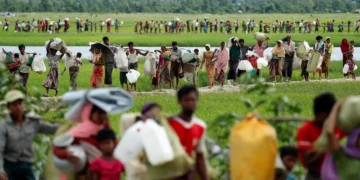
Rohingya refugees walk through rice fields after crossing the border from Myanmar into Palang Khali, Bangladesh, October 19, 2017. © 2017 Jorge Silva/Reuters

Share on FacebookShare on Twitter

Gambia, a predominantly Muslim West African country, filed the case at the ICJ—also known as the World Court—in 2019, accusing Myanmar of committing genocide against the Rohingya, a mainly Muslim minority in the remote western Rakhine state. Under the rules of the ICJ, the application argues, member states can bring actions against other member states over disputes alleging breaches of international law—in this case the 1948 Convention on the Prevention and Punishment of the Crime of Genocide.

The 1948 UN Genocide Convention, which The Gambia accuses Myanmar of breaching in its treatment of the Rohingya, was adopted following the mass murder of Jews by Nazi Germany during the Second World War. It defines genocide as crimes committed “with intent to destroy, in whole or in part, a national, ethnical, racial, or religious group.”

In response, the ICJ issued an order on 23 January 2020 directing Myanmar to “take all measures within its power” to prevent the commission of acts defined in the Genocide Convention, including ensuring that its military and any irregular armed units refrain from committing these acts. The Court also ordered Myanmar to “take effective measures to prevent the destruction and ensure the preservation of evidence” related to the ICJ proceedings and to submit regular reports concerning the measures it has taken to comply with the order.

On 15 November 2023, Canada, Denmark, France, Germany, the Netherlands, and the United Kingdom filed a joint declaration of intervention, given their “common interest in the accomplishment of the high purposes” of the Genocide Convention. The Maldives also filed a declaration to intervene, citing its deep concern “over the continued… human rights violations and barbarous assaults against the Rohingya Muslims” and recognising the need for “international cooperation in the quest to prevent and punish genocide.”

International law experts say it’s typical for such cases to take several years to reach the hearings stage. “There are all kinds of stalling tactics that are used, and we’ve seen the military do that in this case—challenging jurisdiction, asking for extensions of time, and so forth. And the court is reasonably tolerant of those kinds of manoeuvres,” said Chris Sidoti, an international human rights lawyer and consultant.

Myanmar asked for and received multiple extensions from the court. It also challenged both the court’s jurisdiction over the alleged crimes and The Gambia’s right to bring the case against Myanmar. A final ruling is expected towards the end of 2026, the Reuters news agency reported.

The Rohingya Crisis in Context

The Gambia vs. Myanmar marks the first time a purportedly non-injured state—in this instance a state that did not assert an injury or interest beyond being a party to the Genocide Convention—has been brought to the ICJ. The circumstances that led to this case are complex and grounded in both the events in Myanmar itself and the wider geopolitics of international human rights law.

The persecution of Rohingya groups—and wider violence within Rakhine State—has multiple roots, but historians have identified the incorporation of Arakan, the ancient kingdom whose territory loosely correlates with Rakhine State, into British colonial India in 1926 as a key moment in inter-communal tension. Extractive colonial enterprises brought migrants into Rakhine State, particularly from Bengal, who provided a range of jobs, from labourers through to civil servants and moneylenders; the latter began to play an authoritative role in the provision of finance to locals.

These migrations have been used since independence in 1948 by the Myanmar state to argue that the Rohingya are a non-indigenous population and consequently reject the concept of a distinct identity and instead label them as ‘Bengali’ or, in more offensive terms, ‘kala’. But evidence suggests that a Rohingya identity precedes these colonial encounters: the writings of physician and polymath Francis Buchanan, who travelled extensively in India and South Asia in the late eighteenth and early nineteenth centuries, point to the existence of a defined Rohingya community in Arakan prior to the arrival of the British East India Company.

One of the challenges, outlined in the analysis of Ronan Lee, is that the British colonial record-keeping, made in English rather than Burmese, Rakhine, or Rohingya, failed to use the prominent indigenous label of ‘Rohingya’, translating instead into “Arakanese Muslim”, “Musalman”, or “Mohammadan”. This assertion of non-indigenous status has cast a long historic shadow, notably enshrined within Myanmar’s 1982 Citizenship Law, which failed to grant citizenship to Rohingya groups, citing their imagined non-indigenous status, while also preventing a possible pathway for future generations through processes of naturalisation.

This denial of citizenship rights is the backdrop to episodes of violence between the Tatmadaw (Myanmar military), Burmese communities, and the Rohingya, including by the Arakan Rohingya Salvation Army (ARSA), an armed insurgency movement formed in 2012. ARSA attacks on Myanmar government guard posts in 2016 and 2017 were the precursor to a dramatic increase in violence in Rakhine State by the Tatmadaw and other armed groups within Rakhine State, leading to over 700 000 Rohingya refugees fleeing their homes.

A damning report issued by the UN the following year said top military figures in Myanmar must be investigated for genocide in Rakhine State and crimes against humanity in other areas. Myanmar authorities rejected that report, saying its military offensive was a legitimate counter-terrorism campaign in response to attacks by Muslim militants. Today, more than a million Rohingya refugees now live across the border in Bangladesh’s Cox’s Bazar region alone—some of the largest and most densely populated camps in the world, according to the UN’s refugee agency.

Why The Gambia? Understanding Its Standing and Motivation

The Gambia may have been inspired to take up the case due to its own long history of repression under former dictator Yahya Jammeh, who ruled the country with an iron fist for 22 years until 2017, Imran Darboe, a barrister formerly with the Gambian justice ministry, told Al Jazeera. The report says Jammeh was forced out of office in 2017 by a regional military mission when he failed to leave office after losing the presidential elections.

In 2018, the new government began investigating Jammeh-era atrocities perpetrated by his “killer squad” security forces, including widespread abductions and killings. Gambians were collectively reckoning with the painful testimonies of scores of victims as the Rohingya crisis unfolded, prompting the government to take action, despite a lack of precedent at the ICJ at the time. “At that point, we were also going through our truth-and-reconciliation commission and realising the value of protecting human rights,” Darboe said.

“Most people [in The Gambia] were shocked by what was being revealed, so there was the thinking that if the concept of human rights is universal, we cannot just focus on our own issues. We feel what the Rohingya people were feeling … we were all on the same page about that.” The Gambia’s active role in the OIC also likely played a large role, Darboe added. While bringing an ICJ case would be expensive for the small nation, the OIC’s backing likely alleviates financial pressures, he said.

In September 2019, the United Nations-backed Independent International Fact-Finding Mission on Myanmar concluded that “Myanmar is failing in its obligation to prevent genocide, to investigate genocide and to enact effective legislation criminalising and punishing genocide.” The fact-finding mission highlighted “the enormity and nature of the sexual violence perpetrated against women and girls” during Myanmar’s military campaign as one of seven indicators of the state’s intent to destroy the Rohingya people.

Gambia’s application identifies two elements of Myanmar’s persecution of the Rohingya as “particularly indicative of genocidal intent”: its systematic denial of legal rights to Rohingya, notably restrictions on their ability to marry and bear children and severe restrictions on freedom of movement, including detention camps, and its support for, and participation in, pervasive hate campaigns aimed at demonising and dehumanising the group.

As for the genocidal acts, the application points to incidents from the October 2016 and August 2017 “clearance operations”, including mass executions of Rohingya men, women, and children; the systematic burning of Rohingya villages “with the intent to destroy the group in whole or in part”; the targeting of children; and the commission of rape and sexual violence on a massive scale.

As for ongoing acts of genocide, the application highlights continuing attacks on the Rohingya, notably the destruction of more than 30 villages between November 2018 and May 2019 and the denial to the Rohingya of access to food. It also notes the Fact-Finding Mission’s recent warning that the 600,000 Rohingya still in Myanmar live under the threat of further genocidal acts by Myanmar.

Read also

Nigeria’s president signs amended Electoral Act into law despite push back

IMF approves $91 million in funding for Niger following programme review

Russia has taken ‘over 1,000’ Kenyans to Ukraine – intelligence report

Besides issuing the directives, the government of Myanmar has not taken any meaningful and practical steps to dismantle existing discriminatory structures, including the process of repealing or amending laws and policies that target the Rohingya, bringing the military under civilian control, and ending military impunity for international crimes, including sexual violence.

Experts argue that to comply with the provisional measures, civilian authorities should declare such reforms a government priority and begin the process of amending the 1982 Citizenship Law, take steps to ease movement restrictions for the Rohingya, and grant the Rohingya equal access to healthcare, education, employment and legal representation, among the rights enjoyed by other communities in Myanmar.

The Myanmar Arguments at the ICJ

Nevertheless, during the three-week hearings, the junta has argued its “clearance operations” were merely counterterrorism activities, despite the 700,000 refugees it created. In December 2019, Nobel Peace laureate Aung San Suu Kyi, Myanmar’s de facto civilian leader at the time, personally defended the country at the ICJ, calling the allegations “incomplete and incorrect”.

Although human rights advocates criticised her for appearing to defend the very military that had persecuted her for most of her life. The military nonetheless seized power from her democratically elected government in 2021, once again placing her under arrest, where she remains. The ICJ rejected Myanmar’s objections to the case the following year.

Myanmar’s first objection was that The Gambia was not the real, interested party seeking to establish its own legal rights; rather, it was a mere purveyor of the Organisation of Islamic Cooperation (OIC), which, as an international organisation, lacked standing to invoke the ICJ’s contentious jurisdiction. To support this contention, Myanmar referred to the recommendation of the OIC’s Ad Hoc Ministerial Committee on Accountability for Human Rights Violations Against the Rohingyas, which had been approved by the OIC’s Council of Ministers to bring legal proceedings, as well as The Gambia’s press release, which indicated that it was not filing the case in its own right. The Gambia did not deny the OIC’s support but argued that such support did not render it any less a genuine party.

Referring to its judgement in Nicaragua v. Honduras, the Court stressed that its judgement is of a legal character; as such, the motivation of the party to sue is immaterial. In that case, the Court held that there may be political aspects in any dispute brought before it. The underlying political motivation of the state party invoking the ICJ’s jurisdiction is not a relevant consideration for the Court and cannot be a ground to mount a jurisdictional challenge. The ICJ also held in the current case that the political or economic support of an organisation cannot deprive a state of its legal right to file a case before it.

Finally, Myanmar sought to argue that even if The Gambia had a right to invoke its right to legal responsibility, it did not possess the right to bring a claim before the Court, as it was not itself an injured state party. If any state could have the right to bring proceedings, it would have been Bangladesh as the host state of many Rohingyas who are victims of the alleged genocide.

In response, the Court pointed out that in the Genocide Convention Case, it had observed that the Convention is not about any individual advantage or disadvantage of a state, but rather for the achievement of common purposes. It concluded that the breach of erga omnes obligations, such as those contained in the Genocide Convention, even without establishing any special interest in the matter, is plausible.

Additionally, the Court noted that Bangladesh had been affected by the influx of a huge number of the Rohingya but held that its reservation to Article IX of the Genocide Convention could not in any way affect the locus standi of The Gambia to file the case in its own right as a party to the Convention. In making this observation, the ICJ referred to its advisory opinion in Reservations to the Genocide Convention, in which it noted that the Convention had been adopted with a pure humanitarian and civilising objective.

Why this Case Matters Beyond Myanmar

While speaking in The Hague before the hearings, Rohingya victims said they wanted the long-awaited case to deliver justice. Yousuf Ali, a 52-year-old Rohingya refugee who says he was tortured by the Myanmar military. He said, “We are hoping for a positive result that will tell the world that Myanmar committed genocide, and we are the victims of that, and we deserve justice.”

Legal experts say The Gambia’s case against Myanmar could also set a precedent for other cases before the ICJ, including one filed by South Africa against Israel in 2023 over its military operations in Gaza. Like the Gambia, South Africa bore no direct impact on the crimes it is alleging.

“Israel is also before the International Court of Justice in relation to the genocide convention, and some of the legal interpretation issues that the court will decide in this case may have implications for the next case,” said Sidoti, referring to the Gaza case, which is likely to be heard in the next few years. The ICJ’s decision may also affect whether Min Aung Hlaing, the Myanmar military’s top general and leader of the 2021 coup, faces possible arrest.

According to Dr Azeem Ibrahim, the director of special initiatives at the Newlines Institute for Strategy and Policy in Washington, this matters well beyond Myanmar. Around the world, regimes accused of atrocity crimes are learning from one another. Legal tactics are shared, adapted and refined. From invoking sovereignty to contest jurisdiction to flooding courts with technical objections and exploiting diplomatic paralysis, the playbook is increasingly familiar. If the International Court of Justice allows a junta accused of genocide to use it as a shield, it sends a signal that the legal process itself can be weaponised against accountability.

Similarly, Dr Azeem stated that the Rohingya case also raises broader questions about enforcement. Even a favourable judgement for Gambia will not, on its own, bring justice to survivors. He also argues that there is also a regional dimension. The Association of Southeast Asian Nations has struggled to respond meaningfully to Myanmar’s crisis, constrained by norms of noninterference. Yet instability in Myanmar now spills across borders, fuelling refugee flows, transnational crime and insecurity.

Sidoti explained that the UN Security Council is ultimately responsible for enforcing the orders of the ICJ, as it is the UN’s top court. But with China and Russia both shielding Myanmar from Security Council resolutions that would comprehensively sanction Myanmar, he sees little chance of it enforcing any ICJ orders against the regime. “So, the Security Council should act; it has a legal obligation to act. But I don’t expect it to. What I do expect is that other states acting individually and collectively will take stronger action against the Myanmar military in response to an adverse finding by the ICJ,” he said.

The Gambia’s quest for justice for the Rohingya shows an ever-changing architecture of international relations where law, norms, and institutions increasingly challenge raw power. The case redefines genocide prevention as a communal legal obligation rather than a voluntary political choice. As international justice grows, this hearing stands as a precedent for how small states can shape global rules by converting moral responsibility into juridical action.
Source: Qiraat Africa
Tags: GambiaInternational Court of Justice (ICJ)Rohingya Genocide
Oyebamiji Usman Adesoji

Oyebamiji Usman Adesoji

Writer and researcher on business, entrepreneurship and geopolitical affairs.

Related Posts

Nigeria at 65: President Tinubu says “worst is over” on independence day amid worsening hardship
Featured

Nigeria’s Tinubu, Germany’s Merz talk security, power deal in phone call

February 19, 2026
Gabon
Central Africa

Gabonese opposition and businesses angry about social media ban

February 19, 2026
Guinea-Bissau stops vaccine study funded by Trump administration
Health

Guinea-Bissau stops vaccine study funded by Trump administration

February 19, 2026
Students turn on Senegalese government over Dakar university violence
Education

Senegal prosecutor rejects accusations police tortured and killed student

February 18, 2026
Zimbabwe: Mnangagwa faces internal revolt over his legitimacy
Featured

Zimbabwe war veterans challenge Mnangagwa term extension in court

February 18, 2026
Kenya appoints Citi, Standard Bank to study possibility of borrowing in international markets
East Africa

Kenya returns to global markets to fund $500 million buyback

February 18, 2026

Search Qiraat Africa

No Result
View All Result

Follow on Twitter

Follow @africanqiraat

Trending

Tunka Manin (c. 1010–1078), the last ruler of the Ghana Empire

Tunka Manin (c. 1010–1078), the last ruler of the Ghana Empire

December 12, 2025
Equatorial Guinea

Equatorial Guinea orders crackdown on sex in government offices after videos leaked

November 6, 2024
The Great Mosque of Djenne, Mali

The Great Mosque of Djenne, Mali

March 25, 2025
Kumbi Saleh, the capital of the ancient Ghana Empire

Kumbi Saleh, the capital of the ancient Ghana Empire

October 13, 2025
Brief History and Culture of the City of Lagos, Nigeria

Brief History and Culture of the City of Lagos, Nigeria

July 24, 2024
The NYSC SCHEME in Nigeria: Impacts, Challenges, and the Path Forward

The NYSC SCHEME in Nigeria: Impacts, Challenges, and the Path Forward

June 19, 2025

Facebook

Sections

  • About Us
  • Privacy Policy
  • Opinion
  • Infographics
  • News
  • Analysis
  • Figures
  • Culture & Literature
  • Follow Ups
  • Historical Readings
  • Interview
  • Studies


© Copyright Qiraat Africa. Developed by Bunnaj Media .

No Result
View All Result
  • News
  • Analysis & Report
  • Studies
  • Opinion
  • Interview
  • Culture & Literature
  • Figures
  • Historical Readings
  • Regions

© 2021 Copyright Qiraat Africa.