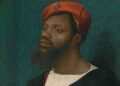


















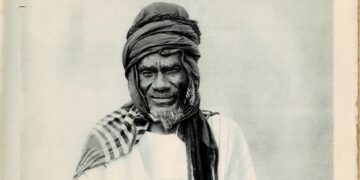
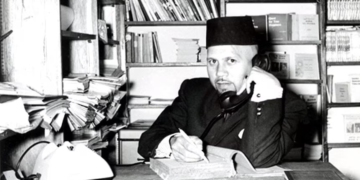




Mohammed Abdulle Hassan (Sayyid Maxamed Cabdulle Xasan, also called the “Mad Mullah” by the British) is considered one of the most influential figures in the history of modern Somalia. He led an armed resistance movement against colonial powers (Britain, Italy, and Ethiopia) that lasted for more than two decades, a movement known as the Dervish movement (or Dervish state). Besides being a military leader and religious figure, he was one of the greatest poets in the Somali language, using words as powerful a political tool as the sword.
Mohammed Abdulle Hassan was born in 1856 in Buuhoodle, British Somaliland (which exists today as Somaliland). He grew up in a traditional pastoral environment; his father belonged to the Ogaden clan and his mother to the Dhulbahante clan. From a young age, he displayed exceptional talent in memorizing the Quran and studying Islamic jurisprudence. He traveled extensively in pursuit of knowledge among the religious centers of Somalia, which later earned him the title of “Sayyid” in recognition of his scholarly standing.
In 1894, Sayyid Mohammed traveled to Mecca to perform the Hajj pilgrimage. It was there that he met Sheikh Muhammad Salih, the founder of the Salihiyya Sufi order (a branch of the Ahmadiyya Idrisiyya order). Sayyid Mohammed was deeply influenced by the reformist approach of the Salihiyya order, which advocated a return to the fundamentals of Islam, a rejection of innovations, and an emphasis on the importance of jihad against foreign influence. He returned to Somalia in 1895 imbued with a religious and political vision aimed at purifying Somali society from within and resisting foreign intervention.
Upon his return to the British-protected city of Berbera, Sayyid Mohammed began spreading his message. His strict vision clashed with the prevailing Sufi traditions (the Qadiriyya order), and he also resented the growing Christian missionary activity under British protection. Somali sources recount a famous incident that served as the spark: Sayyid Mohammed met a Somali child and asked him his name. The child gave a Christian name, and when asked about his clan, he said he belonged to the “clan of the fathers” (the missionaries). This incident angered Sayyid Mohammed, who saw it as proof that colonialism targeted not only the land but also identity and religion.
Sayyid Mohammed moved into the Somali interior and began rallying supporters from various tribes, transcending narrow affiliations and focusing on the bonds of faith and homeland. He called his followers “Dervishes,” a Sufi term meaning ascetics, but in the Somali context, it became the name for a disciplined army committed to the cause of liberation.
Actual military operations began in 1899. The Dervish movement was confronting Britain and was engaged in a three-pronged struggle: Britain in the north (British Somaliland), Italy in the east and south, and Ethiopia under Emperor Menelik II, who sought to expand into the Ogaden region.
Sayyid Mohammed proved highly effective in guerrilla warfare. His forces moved with exceptional speed across rugged terrain, relying on camels and an intimate knowledge of the desert.
In 1913, the Dervish movement defeated a British force and killed its renowned commander, Richard Corfield. This battle sent shockwaves through London and boosted the morale of the resistance.
Sayyid Mohammed realized the importance of military stability, so he built a series of huge stone fortresses, the most famous of which was the “Taleh” fortress, which became the capital of the Dervish movement and a sophisticated administrative and military center.
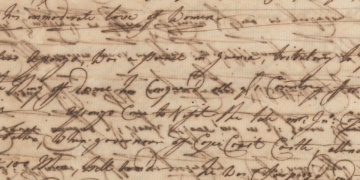
The personality of Sayyid Mohammed Abdulle Hassan cannot be understood without examining his poetry. He is considered one of the greatest Somali poets in history. In a society reliant on oral culture, poetry was the most influential “media.” He used his poems to rouse the morals of his fighters and remind them of their religious and national duty. He attacked his Somali rivals who collaborated with colonialism, accusing them of treason. He also sent poetic messages to foreign kings and leaders, presenting his positions in eloquent and powerful language. His famous poem “Death of Corfield” is a prime example of how literature was used to record military victories and immortalize historical moments.
Sayyid Mohammed’s reign was not without criticism and internal conflicts. His style of governance was characterized by severity and rigidity, and he frequently clashed with Somali clans that refused to join him or submitted to foreign protection.
Some historians believe the fierce raids launched by Dervish movement against Somali tribes, which resulted in heavy civilian casualties, contributed to the fragmentation of the Somali home front and provided a pretext for colonial powers to intervene under the guise of “protecting the tribes.”
Besides, his religious opponents accused him of using religion to justify violence against Muslims who disagreed with his political ideology. This led to fatwas being issued against him by some scholars in Mecca and the Qadiriyya Sufi order at the time.
After the end of World War I, Britain decided to resolve what it deemed the “Somali problem.” In 1920, Britain used the Royal Air Force (RAF) for the first time in Africa to bomb Dervish strongholds. Taleh Fort was subjected to intense aerial bombardment, leading to its destruction and the dispersal of Dervish forces. Sayyid Muhammed was forced to retreat to the Ogaden region, attempting to regroup.
He died in December 1920 from influenza (or malaria, according to other accounts) and remains a pivotal figure in the Somali consciousness.
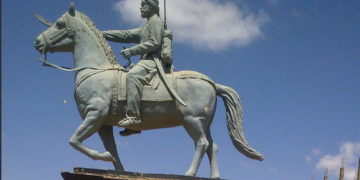
Today, he is regarded by many as the first leader who attempted to unite Somalis under a single banner transcending tribalism. This led the modern Somali state (after its independence in 1960) to erect a statue of him in the heart of Mogadishu and recognize him as the “Father of Independence.”
His poems are still studied and memorized and are considered a fundamental linguistic and historical reference for Somali language and culture. His movement represented one of the longest and fiercest resistance movements against colonialism in Africa, demonstrating the ability of local peoples to confront regular armies with limited resources.