










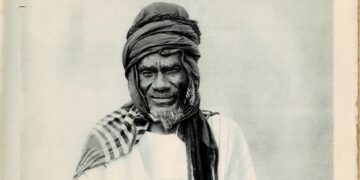
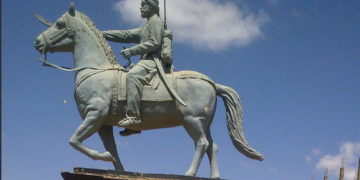
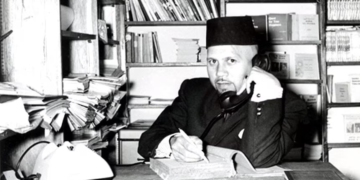
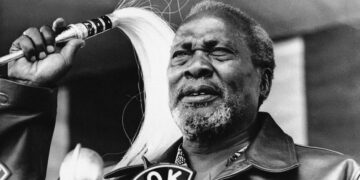


Samori Touré, who lived from 1830 to 1900, is considered one of the greatest military and political leaders in 19th-century West African history. He was the architect of the Wassoulou Empire and a brilliant administrator who unified vast territories under a single banner. He is renowned for his long and fierce resistance against French colonial expansion, a struggle that lasted nearly two decades, earning him the nickname “Black Napoleon” for his tactical genius and ability to challenge a superpower with relatively limited local resources.
Samori Touré was born in the village of Manyambaladugu (in what is now southeastern Guinea) to a Malinke family. His family was involved in trade, a vital sector in West Africa that connected the tropical forests with the savannah regions. Samori grew up as a roving trader (“dula”), which gave him a deep understanding of geography, supply routes, and the ability to negotiate with various ethnic groups.
In 1853, his mother, Masara Touré, was kidnapped during a raid by the Cissé clan. To save her, Samori offered himself to serve in the Cissé army in exchange for her release. During this time, he demonstrated exceptional military skills, learning martial arts, military organization, and horsemanship. After fulfilling his promise and freeing his mother, Samori decided to break away and form his own armed group, taking advantage of the political fragmentation in the region.
By 1878, Samori Touré had declared himself a “fama” (sword bearer or military leader) and began uniting the scattered tribal chiefs of the Milo River Valley. Samori also relied on the use of trade ties and Islam as tools for unification. In 1884, he adopted the title “Almamy” (meaning imam or religious and political leader), lending his state legitimacy and uniting his followers under a shared religious and political identity.
The Wassoulou Empire reached its zenith in the 1880s, encompassing parts of present-day Guinea, Mali, Sierra Leone, and Ivory Coast. Administratively, the empire was divided into provinces governed by military and civilian officials, with a legal system based on Islamic law and a sophisticated tax system that supported the army and administration.
Samori Touré realized early on that courage alone was insufficient to counter modern European weaponry, so he implemented a series of reforms. He established a standing army known as the Sofa, divided into infantry and cavalry. These warriors were professional soldiers who received continuous training and were subject to a merit-based promotion system.
Samori was one of the few during his time who possessed sophisticated workshops for manufacturing and repairing weapons. He employed hundreds of skilled blacksmiths who could replicate and manufacture spare parts for French Chassepot rifles and British rifles. He also established a trading network with the British colonies in Sierra Leone to acquire the latest rifles and ammunition in exchange for gold and cattle.
When the conflict with the French began, Samori employed the scorched earth tactic with remarkable skill. He would evacuate villages of their inhabitants and burn crops and wells in front of advancing French forces, depriving them of local supplies and forcing them to lengthen their supply lines, which made French operations costly and slow.
Direct clashes between Samori Touré and the French began in 1882. France sought to link its colonies in Senegal with French Sudan (present-day Mali), and Samori represented the greatest obstacle to this goal.
The relationship fluctuated between war and diplomacy. In 1886 and 1887, he signed treaties with the French (such as the Treaty of Bissandougou) to demarcate the border, buying time to reorganize his forces and acquire more weapons. However, both sides understood that a final confrontation was inevitable.
In 1891, France launched a full-scale offensive aimed at the heart of the empire. Despite the French superiority in artillery, Samori fought remarkable defensive battles. Realizing that the capital, Bissandougou, was about to fall, he relocated his entire empire (army, administration, and population) hundreds of kilometers eastward toward northern Ivory Coast and western Ghana, where he established his “Second Empire.”
Samori Touré’s empire was not without internal challenges, as his imposition of Islam and use of force to unify the tribes sometimes provoked internal rebellions. However, he is credited with successfully eliminating the slave trade within his borders in favor of promoting agriculture and legitimate trade. He also focused on developing roads and infrastructure to facilitate the movement of caravans.
Samori used religion as a tool for social and political integration, encouraging the construction of Quranic schools and mosques, which helped create a class of educated people and administrative officials.
Despite his legendary resilience, Samori Touré’s power began to wane in the late 1890s. His scorched-earth policy caused famines that affected his soldiers and the inhabitants of the regions he traversed, and ammunition began to run out as French and British blockades of trade routes intensified.
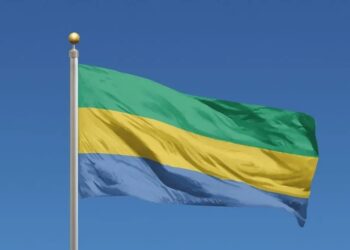
On September 29, 1898, a French force led by Captain Henri Gouraud surprised Samori Touré’s camp at Guélémou (in present-day Ivory Coast) and captured him. He was exiled to Ndjole Island in Gabon, where he died on June 2, 1900, from pneumonia.
Samori Touré remains a pivotal figure in the collective memory of West Africa. He is considered the great-grandfather of Ahmed Sékou Touré (the first president of independent Guinea), and he is regarded as a symbol of national resistance against colonialism. He demonstrated that the African continent possessed centralized states with sophisticated administrative and military organizations prior to full-scale colonial intervention. Similarly, his tactics of strategic movement and withdrawal are studied as a model for organized guerrilla warfare.