































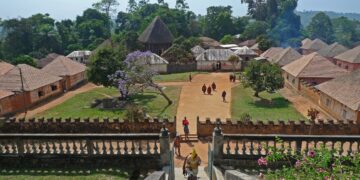

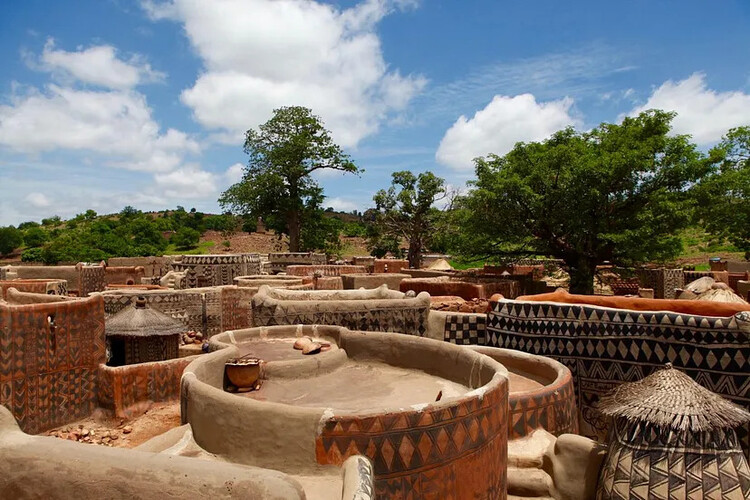
The Royal Court of Tiébélé, located in southern Burkina Faso near the border with Ghana, is one of the most distinctive cultural and architectural sites in West Africa. This residential and historical complex represents the heart of the Kassena culture, one of the oldest ethnic groups to have settled in this region since the 15th century.
The village of Tiébélé was founded as the seat of “Pè,” the title given to the chief or king of the Kassena people. The authority of this court extends over a vast area encompassing dozens of neighboring villages. Within this royal complex resides the king and his extended family, along with his courtiers and advisors, making it a village within a village.
The social organization in Tiébélé is governed by a precise system, with roles distributed according to gender and age. While men were responsible for construction and fortification, women took on the most famous and prominent task, which was decorating the exterior facades of buildings with traditional engravings and drawings, which gave Tiébélé its international fame.
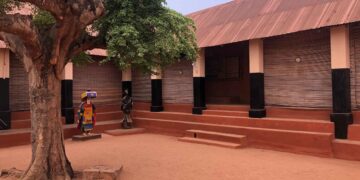
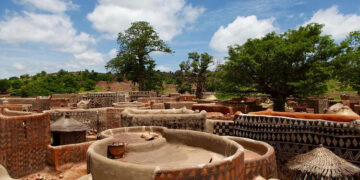
Tiébélé architecture is characterized by the complete use of local, natural materials, known as “mud architecture” or “earth architecture.” Houses are built using a mixture of mud, straw, and animal dung, creating thick walls that provide excellent thermal insulation against the scorching savanna heat.
Within the royal court, there are three main building types, each reflecting the social and functional status of its inhabitants. The round houses (Dra), which are typically reserved for young men or single men. While the figure-eight houses (Sukhala) are houses for small families or the elderly, where two circular rooms are connected by a narrow passageway. The rectangular houses are a relatively newer style, often used for large families or as storage.
Tiébélé houses were designed defensively to repel historical attacks and protect against predators. The walls are very thick, the windows are almost nonexistent (there are only small openings for ventilation), while the doors are very short, not exceeding one meter, forcing the occupier to stoop, a position that makes him vulnerable to surveillance and control by the residents of the house.
What distinguishes the royal court of Tiébélé is the art of mural decoration, created by women. This art is a visual language that tells stories of identity, religion, and nature. The decoration process is carried out collectively after the rainy season. The women use entirely natural materials: Black: extracted from graphite or by boiling certain leaves; White: made from kaolin (white clay) or chalk; and Red: extracted from laterite soil rich in iron oxide.
After the geometric shapes are drawn, the walls are smoothed with stones and then coated with a layer of natural lacquer made from boiling the fruit of the nero tree, making the drawings rainproof for several seasons.
The royal court covers an area of approximately 1.2 hectares and is surrounded by a low earthen wall that separates the sacred and royal area from the rest of the village.
- The Royal Cemetery: Located near the main entrance, this is a sacred place where funerary rites are performed and ancestors are honored.
- The Royal Platform (Le Pourou): This is a small hill or raised platform from which the king sits to receive visitors and manage the affairs of the community.
- Common Spaces: The narrow, interconnected alleyways between the houses foster a sense of community and facilitate the defense of the site.
In July 2024, the royal court in The Royal Court achieved a historic milestone with its official inscription on the UNESCO World Heritage List. This recognition was based on the criteria of outstanding cultural value and the site’s status as “a unique testimony to a living cultural tradition” and “an outstanding example of a type of building and architectural ensembles.”
According to UNESCO:
“The Royal Court of Tiébélé is an outstanding example of an earthen architectural complex, which is distinctive in terms of its construction techniques, its spatial, social and functional distribution, the role of men and women in its construction, the plurality of its architectural forms, its decorative style and its specificity as a living site. It is an outstanding illustration of Kasena culture, of which the Royal Court architecture and mural decorations are representative, and of the associated social, anthropological and political aspects. These characteristics bear outstanding and living testimony to the culture and traditions of the Kasena people, which have evolved over time while preserving the identity and values of the Kasena people.
The integrity of the Royal Court of Tiébélé is based on the set of concession huts and on the sacred symbolic elements that continue to be used today. The Royal Court has retained its original site and has been preserved from urban development up to the present day by its immediate surroundings, which are still predominantly natural. The property embodies all the attributes of Outstanding Universal Value. However, integrity continues to be threatened by a lack of maintenance, or even the ruin of certain concessions, and the use of new materials and chemicals. Furthermore, the maintenance of the concessions and their alterations lead sometimes to construction malpractices that cause problems of rising damp, erosion and water drainage. Lastly, hut construction techniques are changing, particularly with the use of the adobe technique, the making of cement brick foundations and the use of tar-based paint coatings; if these practices become widespread, they could adversely affect the integrity of the property.”
This inscription places Tiébélé on the global map of cultural tourism, while simultaneously placing a significant responsibility on the government of Burkina Faso and the local community to preserve the site’s integrity and authenticity in the face of urban sprawl and modern building materials such as cement and iron.
Tiébélé faces contemporary challenges that threaten its survival. Since the houses are built of mud brick, they require annual maintenance, which is both stressful and financially burdensome for the local community. The migration of younger generations to larger cities is reducing the number of artisans and women skilled in traditional decorative arts. Also, increased intensity of flash floods is causing the mud walls to erode more rapidly than usual.
However, there are local and international initiatives aimed at transforming Tebli into a model of sustainable tourism, where the proceeds from tourist visits go directly towards restoring the houses and supporting the families who maintain this heritage.