




































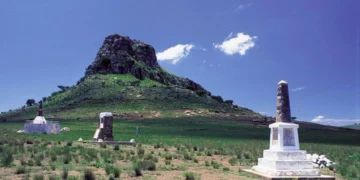




The battles of Isandlwana and Rorke’s Drift, fought in January 1879, are considered among the most significant military engagements of the 19th century. They were part of the Anglo-Zulu War, with a stark contrast in their military and strategic outcomes. The two battles took place within 24 hours of each other, in areas only a few kilometers apart in what is now KwaZulu-Natal, South Africa.
The war erupted as a result of the British colonial administration’s desire, under Henry Bartle Frere, to unify the southern African colonies under the British Crown, a project that required dismantling the power of the independent Zulu kingdom. King Cetshwayo kaMpande was given an ultimatum containing impossible demands, including the disbanding of his powerful army and a complete overhaul of his social system. The king refused, prompting British forces under Lord Chelmsford to invade Zulu territory in January 1879.
The Battle of Isandlwana (January 22, 1879)
Isandlwana was the most crushing defeat suffered by the British army during the Victorian era at the hands of a local force ill-equipped with modern firearms.
The British force, encamped in an exposed position at the foot of Mount Isandlwana, consisted of approximately 1,800 soldiers (British and local volunteers) equipped with advanced Martini-Henry rifles and artillery. In contrast, the Zulu kingdom mustered an army of around 20,000 warriors, primarily armed with short spears (assegai ) and leather javelins.
The Zulu army employed the “Impi Horns” tactic (“Buffalo Horn” or “Impondo zankomo”), where the “head” faced the enemy directly, while the “horns” (wings) circled around the enemy to encircle them from the rear.
Due to overconfidence, the British commanders failed to adequately fortify their camp. The wide defensive lines also resulted in ammunition shortages and slow resupply. The Zulu warriors exploited these weaknesses, surging forward in massive human waves that breached the British defensive lines.
British casualties are to be over 1,300 soldiers killed, including senior officers. The result was a resounding shock in London, as the Zulu army demonstrated superior organizational and logistical capabilities despite the disparity in military technology.
The Battle of Rorke’s Drift (22-23 January 1879)
While the British camp at Isandlwana was falling, a Zulu force of approximately 4,000 warriors (led by Prince Dabulamanzi kaMpande, the king’s brother) attacked a British supply depot and field hospital at Rorke’s Drift.
The British force at the depot consisted of only about 150 soldiers, many of whom were sick and wounded. Upon hearing news of the defeat at Isandlwana, Lieutenants John Chard and Gonville Bromhead decided not to retreat and fortified the position using sandbags and biscuit crates intended for supplies.
The battle raged for 12 hours, including hand-to-hand combat over the barricades. The British used their rifles effectively from behind the fortifications, enabling them to repel repeated waves of attacks by the Zulu warriors, who attempted to set fire to the thatched roofs of the hospital.
The Zulu army withdrew at dawn the following day, their forces exhausted. The British government awarded 11 Victoria Crosses (the highest military decoration) to the defenders of Rorke’s Drift in a single day, a record number intended, in part, to divert British public attention from the tragic Isandlwana defeat.
The Battle of Isandlwana transformed European perceptions of African armies, forcing Britain to send unprecedentedly large reinforcements to South Africa. Conversely, the two battles depleted the Zulu kingdom’s manpower, ultimately leading to their final defeat at the Battle of Ulundi in July 1879 and the kingdom’s collapse.
Today, the sites remain national landmarks in South Africa; Isandlwana and Rorke’s Drift symbolize Zulu national resistance and military prowess.
The Battle of Isandlwana was also the first engagement in the Anglo-Zulu War, and it remains the greatest triumph in the Zulu nation’s military history—and an ignominious defeat for the British Empire.
According to EBSCO:
“January 22, 1879, is remembered as one of the worst days in British colonial history. However, despite the magnitude of the British defeat at Isandlwana and the brutal struggle at Rorke’s Drift, the British inflicted more than 5,000 casualties on the Zulu army. The loss represented about 15 percent of the available Zulu fighting force. Total military losses for the Zulu over six months of the Zulu War are estimated at between 10,000 and 20,000—approximately half of all Zulu warriors. Total British military losses during the war were fewer than 2,000 men.
“The war resulted in a total British victory under which they imposed upon the Zulu an unworkable peace that divided the Zulu Kingdom into thirteen states. These separate states were denied the prosperity of a united kingdom and began warring against one another. By design, this kept the Zulu militarily impotent and thus unable to attack in force any nearby European colonies. The British victory in the Zulu War, and the imposed dividing of the once independent Zulu state, virtually destroyed the traditional ways of Zulu life.”
Isandlwana is distinguished by a unique rock formation resembling a reclining lion or sphinx, lending the battle a majestic visual character. Rorke’s Drift is a river crossing on the Buffalo River (known as the Mzinyathi River in Zulu), a strategic location linking the colony of Natal with the Zulu kingdom, making its control vital for logistical operations.