


Publisher: Qira’at Afriqiyah Magazine
Issue: 67, January 2026
ISSN: 2634-131X
Year : 22
Pages: 72-89
Author: Dr.Gihan Abdel Salam – Egypt
DOI: 10.64665/qirat.2026.2206705
Download pdf
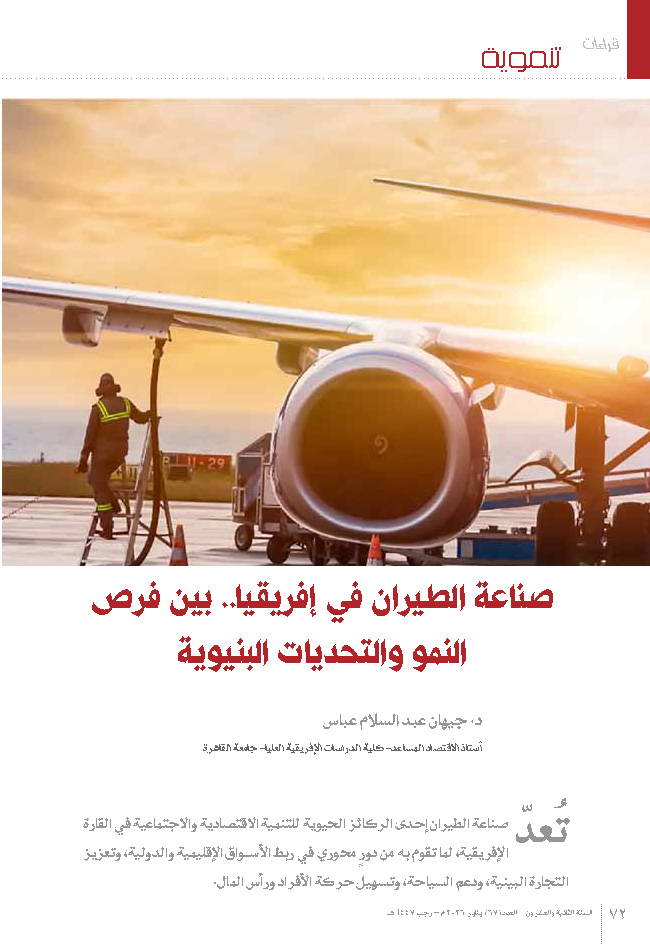
Abstract:
     The study provides a comprehensive analysis of the aviation industry in Africa, recognizing it as a vital sector that supports economic development and regional integration. Although the continent accounts for a limited share of global air traffic, the sector holds significant growth potential, driven by demographic shifts, the expansion of the middle class, increased demand for travel and cargo, and regional initiatives aimed at liberalizing airspace and enhancing connectivity.
The study highlights the economic contribution of the aviation sector, estimated at approximately USD 75 billion and 8.1 million jobs, and its role in supporting trade, tourism, and investment. It also identifies the factors that make the sector a developmental priority, including the projected high growth in passenger numbers, the expansion of e-commerce, the rise of low-cost carriers, and growing investments in airport infrastructure. On the other hand, the industry faces complex structural challenges, including weak infrastructure, high operating costs, poor governance and management, limited intra-African connectivity, regulatory disparities between countries, and pressures related to environmental sustainability. The study also emphasizes the shortage of skilled aviation personnel, which limits the sector’s capacity for expansion and development.
The study reviews the experiences of leading African countries—such as Ethiopia, South Africa, Kenya, Nigeria, and Rwanda—that have successfully built more competitive aviation systems through investment in modern fleets, airport development, enhanced maintenance capabilities, and improved institutional and regulatory frameworks. It also analyzes regional efforts to strengthen the sector, including the Single African Air Transport Market (SAATM) initiative and African Aviation Summits, which play a role in harmonizing policies, regulating air traffic, and promoting economic integration across the continent.
The study concludes that maximizing the benefits of Africa’s aviation sector requires adopting comprehensive reform policies, including improving governance, developing infrastructure, updating regulatory frameworks, supporting innovation and digitalization, enhancing environmental sustainability, and strengthening regional and international partnerships. It emphasizes that investment in aviation represents a strategic pillar for achieving the Sustainable Development Goals and Africa’s Agenda 2063, serving as a key driver for connectivity and economic growth across the continent.