


Publisher: Qira’at Afriqiyah Magazine
Issue: 67, January 2026
ISSN: 2634-131X
Year : 22
Pages: 60-71
Author: Rabie Abu Zamil – Egypt
DOI: 10.64665/qirat.2026.2206704
Download pdf
Abstract:
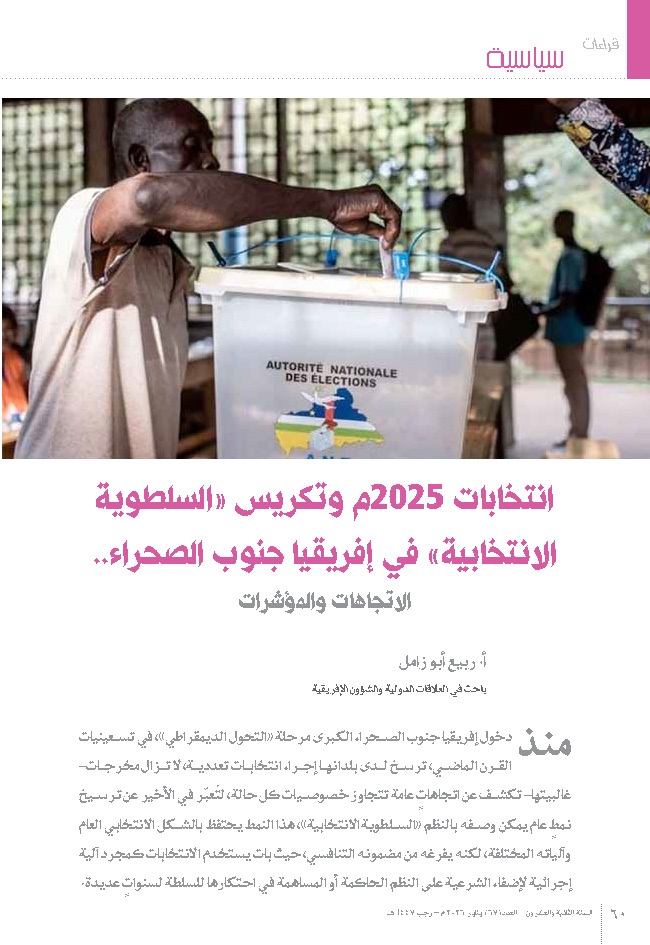
     Since the 1990s “democratic transition” in Sub-Saharan Africa, multiparty elections have become widespread; however, their outcomes reveal recurring patterns that transcend individual cases, pointing to the consolidation of “electoral authoritarianism,” whereby the formal structure of elections is maintained while their competitive substance is hollowed out and used mainly to legitimize or monopolize power.
This paper examines the impact of the 2025 presidential and legislative elections held in twelve Sub-Saharan African countries on the trajectory of democratic transition, asking whether these electoral experiences entrenched “electoral authoritarianism” in states still in transition. It adopts an electoral authoritarianism framework, employing comparative case studies and quantitative and qualitative analyses of key indicators, including party pluralism, electoral violence, and institutional manipulation.
The paper concludes that the 2025 elections largely reinforced electoral authoritarianism in Sub-Saharan Africa, as they were conducted in constrained political environments that systematically weakened opposition forces through electoral violence, restricted freedoms, and institutional manipulation to secure regime survival or loyal parliamentary majorities. These elections also deepened trends of dynastic succession, power entrenchment, and the legitimization of military coups, alongside cases of limited democratic transition, which nonetheless represent a modest but meaningful hope for advancing genuine democratic change and respecting popular will.