


Publisher: Qira’at Afriqiyah Magazine
Issue: 70, October 2026
ISSN: 2634-131X
Year : 22
Pages: 8-27
Author: Ahmed Mohammed Ahmed Ismail – Sudan
Download pdf
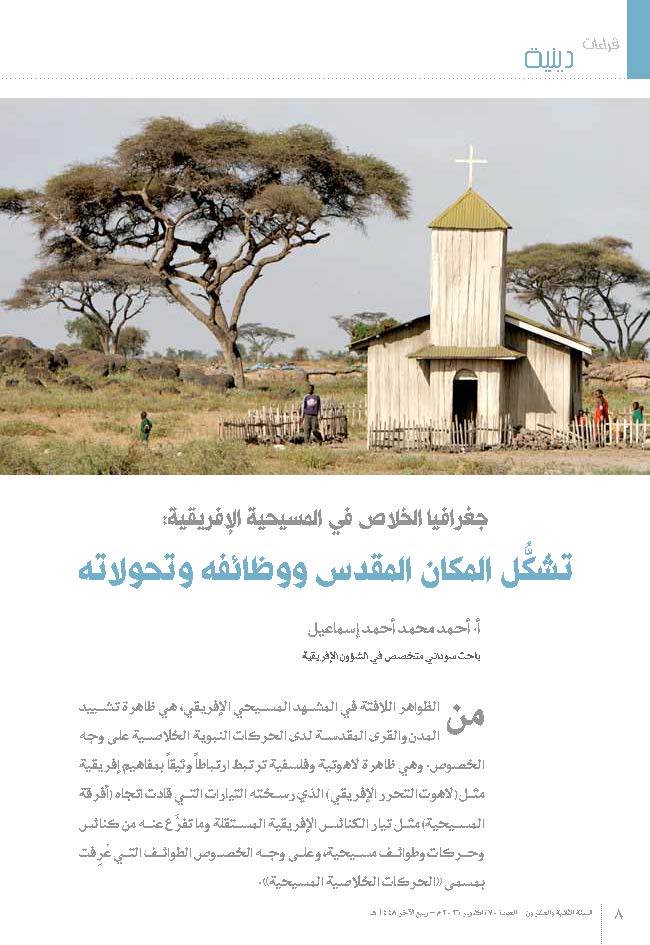
Abstract:

This study examines the phenomenon of sacred villages and cities established by Christian Salvationist movements in sub-Saharan Africa, viewing them as geographical and urban manifestations of a theology of “holistic salvation” that integrates the spiritual, material, and spatial dimensions of religious life. The study is guided by a central question: How do places founded by African Christian prophets become sacred spaces that perform religious, social, political, and economic functions, and how do these spaces negotiate with the modern state, globalization, and contemporary digital transformations?

Drawing on a comparative socio-anthropological and historical approach, and through an analysis of theological discourse, urban planning, and symbolic functions, the study examines four representative cases: Nkamba/Nkongo in the Democratic Republic of the Congo, Moria and eKuPhakameni in South Africa, and Redemption City in Nigeria. The findings indicate that these sacred settlements share several foundational characteristics: they are established by a “prophet” who claims to have received a revelation inaugurating a new covenant; they are conceived as “centers of the world” and pilgrimage destinations; and they are governed, to varying degrees, by internal religious norms that distinguish them from the surrounding social and legal order. These characteristics make them practical manifestations of Michel Foucault’s concept of “heterotopia,” while also representing a reconfiguration of the traditional African “theology of land” within the context of African Christian redemptive movements.

The study concludes that the sacred village is not merely an isolated spiritual refuge, but a complex institution that redefines the relationship between the sacred, land, and authority in postcolonial contexts. Its functions evolve from the “anti-colonial prophetic village” toward forms of the “neoliberal ecclesial city” integrated into globalization, without losing its fundamental character as an alternative sacred space to the profane world. The study further argues that these sacred settlements have not undergone functional decline; rather, they have experienced a continuous reconfiguration of sacredness, incorporating the institutional mechanisms of the state, market forces, and digital media, while retaining varying degrees of religious autonomy and sacred identity.