


Publisher: Qira’at Afriqiyah Magazine
Issue: 70, October 2026
ISSN: 2634-131X
Year : 22
Pages: 28-45
Author: Prof. Batal Shaban Mohammad Gheriany – Egypt
Download pdf
Abstract:

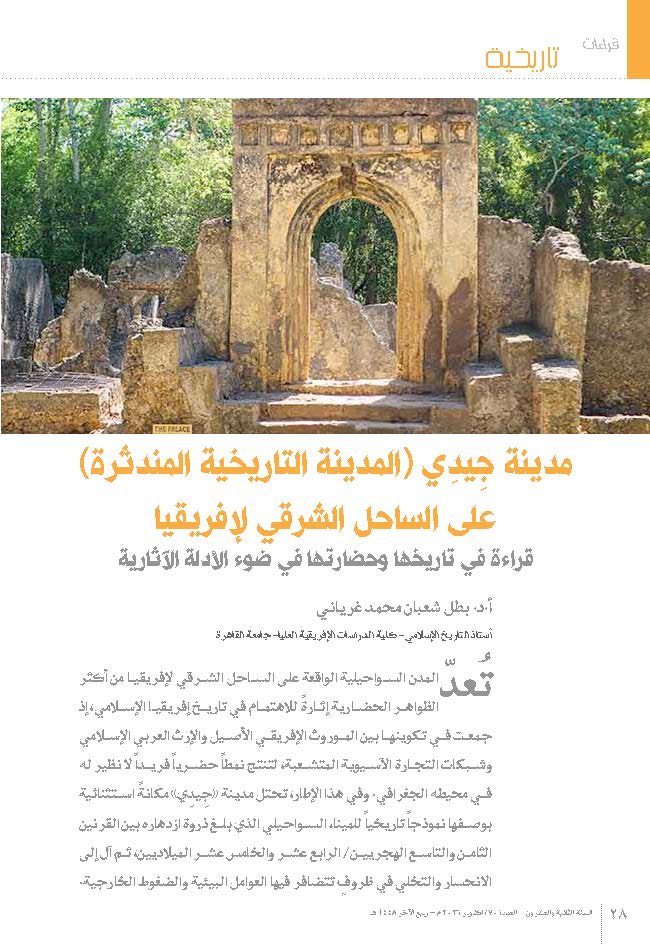
Gedi holds exceptional research value as a unique case among the ruined Swahili towns of the East African coast: it is entirely absent from every historical source contemporary with its period of flourishing—Arabic or Portuguese—despite these sources' meticulous documentation of neighboring towns such as Mogadishu, Kilwa, and Mombasa. This resounding historiographical silence renders Gedi a rare and seldom-discussed methodological case: a city whose history can be accessed solely through purely archaeological reading, independent of any supporting or comparative textual record. This lends the study added value in offering a model for how an integrated civilizational history can be reconstructed relying exclusively on material evidence. The study's significance is further enhanced by Gedi's recent inscription (in 2024) on UNESCO's World Heritage List, making its scholarly treatment timely amid renewed international interest in the site.

This study proceeds through six interconnected principal axes. The first addresses the broader civilizational context of the geographical and historical development of Swahili towns, serving as an introductory framework for understanding Gedi’s emergence. The second examines the city’s geographic location and the circumstances of its initial founding, drawing on the findings of James Kirkman’s excavations (1948–1958) and Stéphane Pradines’ excavations (1999–2003). The third traces the phases of construction and architectural development of Gedi, through a study of the succession of the three Great Mosques, the six neighborhood mosques, and the building materials and techniques employed.

The fourth surveys the city’s economic activities—agriculture, local craft production, and international trade with Yemen, Oman, Egypt, Persia, India, and China—relying particularly on the analysis of imported and locally produced ceramics. The fifth explores the structure of Gedi’s Swahili society through archaeological evidence relating to residential and social differentiation. The research concludes with a sixth axis discussing the converging factors that led to the city’s decline and eventual abandonment. Together, these axes rest upon the integration of three successive waves of excavation spanning seven decades, granting the study a methodological depth that goes beyond reliance on a single phase of fieldwork.