


Publisher: Qira’at Afriqiyah Magazine
Issue: 70, October 2026
ISSN: 2634-131X
Year : 22
Pages: 70-81
Author: Dr. Khaled Ramadn – Eritrea
Download pdf
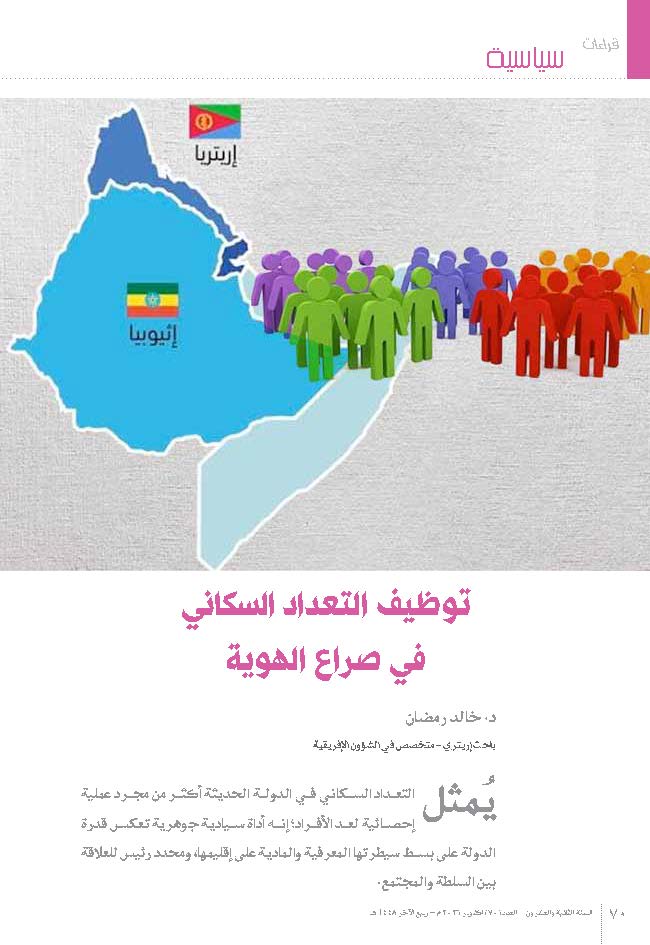
Abstract:

This study examines the population census in Eritrea and Ethiopia as a political phenomenon rather than a neutral technical exercise. It is organised around a central question: how does the census shift from a technical instrument of development planning into a political instrument of domination and exclusion, and how does this shift bear on the crisis of state-building in the Horn of Africa? The study seeks to identify the strategic functions of the census in multi-ethnic states, to explain the absence of an official census in Eritrea and its politicisation in Ethiopia, to dissect the causes and consequences of manipulation, and to propose alternatives and foundations for a fair and inclusive census. It adopts a descriptive-analytical method supported by comparative case study, contrasting the Eritrean and Ethiopian models with one another and with the experiences of Sudan, Nigeria, Myanmar, and South Africa. The analysis is framed by James Scott’s concept of "legibility" and by the contrast between conflict theory and state-building theory, and draws on conflicting estimates issued by the United Nations, COMESA, the World Bank, the CIA, and the Ethiopian Statistical Service, alongside official Ethiopian census results, federal budget figures, and alternative data sources.

The study concludes that the absence of any comprehensive official census in Eritrea since its independence in May 1993 is not a technical shortcoming, but a deliberate strategy for preserving "demographic ambiguity", in which instruments of security enumeration—from national service registers and ration cards to transnational surveillance of the diaspora—have replaced statistics, producing external estimates ranging from 3.6 to 6.7 million people. In Ethiopia, under ethnic-based federalism since 1991, the census has become an open arena of conflict over identity and resources, leading to the postponement of the fourth census at least three times since 2017 and to a statistical gap of 18 million people between the estimate of the Ethiopian Statistical Service and that of the United Nations, under which a federal budget of 971.2 billion birr is distributed on the basis of estimation and guesswork. The study finds that manipulation and the absence of a census result in the marginalisation of religious and ethnic groups, the loss of public trust and the erosion of legitimacy, and a "developmental blindness" in planning; and that the remedy requires "disarming" the population figure through independent statistical agencies, community participation, the use of technology and alternative sources, and investment in civil registration and vital statistics systems.