


Publisher: Qira’at Afriqiyah Magazine
Issue: 51, January 2022
ISSN: 2634-131X
Year : 18
Pages: 32-43
Author: Mutawakel Daqash
Download pdf
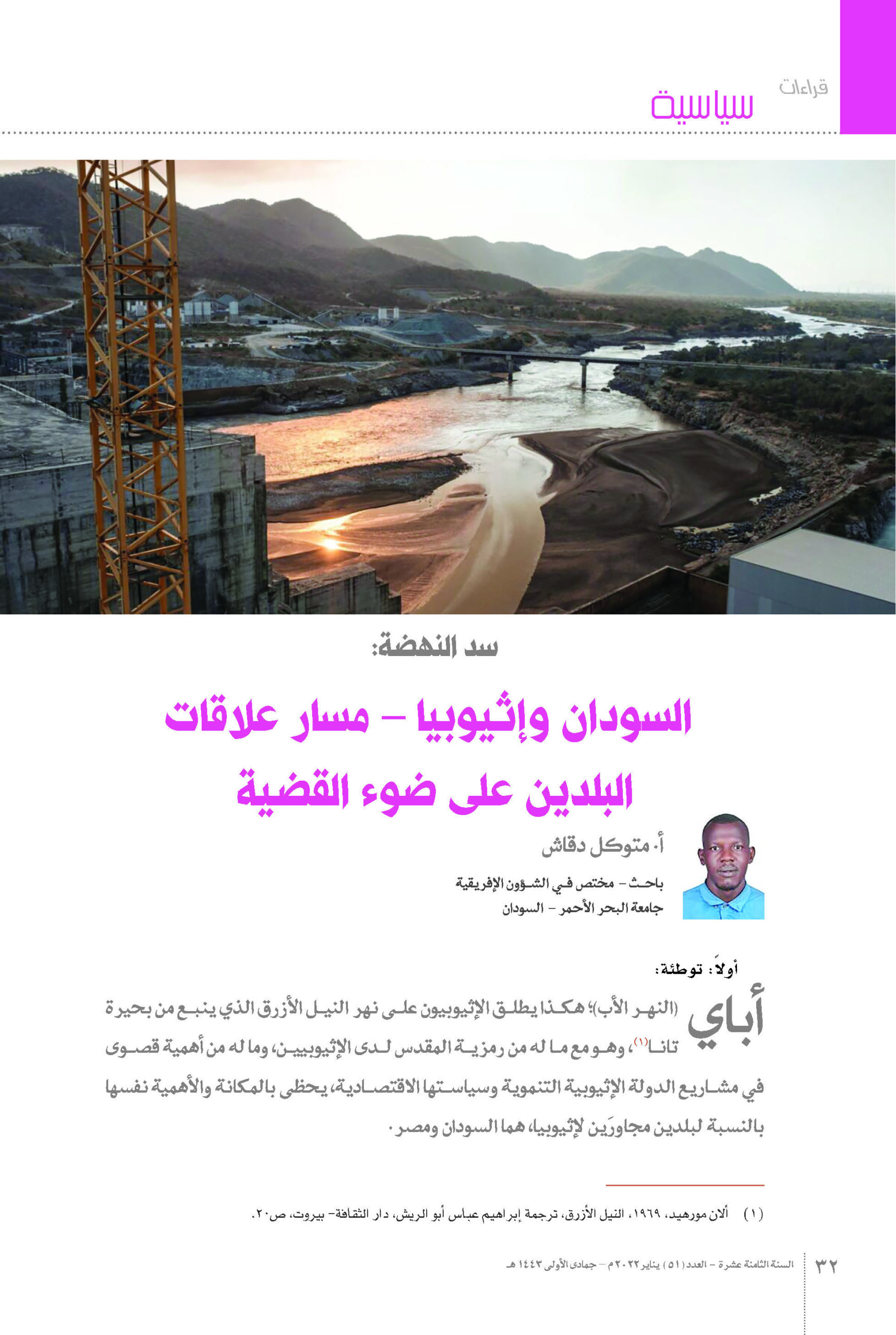
Abstract:

Sudan and Ethiopia have been neighboring countries throughout history, bound together by the River Nile, whose waters are vital to the lives and livelihoods of the Sudanese people. This geographical proximity inevitably necessitates continuous contact—and at times friction—across commercial, economic, political, and agricultural spheres, dictated by their respective interests, both positive and negative. It is also shaped by the orientations and ambitions of the governing political regimes in both countries, as well as the internal and external dynamics that drive the shifts in their bilateral ties. Due to geographical, political, historical, religious, and cultural factors, the relationship between Sudan and Ethiopia has historically fluctuated between intense conflicts and uneasy truces. Such turbulent relations are hardly unique to them, as history across the globe shows that neighboring nations have frequently experienced cycles of war and invasion.

In this context, contemporary Sudanese-Ethiopian relations face significant strains amid a widening rift between the two nations. Across numerous shared files and overlapping issues, the perspectives of the leadership in both countries continue to diverge, complicating efforts to reach viable solutions and delineate practical frameworks for cooperation.